The US airport that put sustainable aviation fuel to the test
Date of publication: September, 2026 (Produced by Bloomberg Media Studios for Shell)
Summary by Bloomberg AI
- To support growth while reducing carbon intensity, aviation needs sustainable aviation fuel (SAF) secure supply chains and reliable energy infrastructure.
- Portland International Airport integrated SAF into existing airport fuel systems to support passenger demand while reducing lifecycle greenhouse emissions.
- Scaling SAF relies on collaboration between producers, airlines, infrastructure owners and systems integrators like Shell, to deliver fuel through existing supply chains.
Portland International Airport (PDX) wasn’t trying to make a statement about sustainable aviation fuel (SAF). It was trying to keep planes on schedule.
Due in part to fuel refining capacity reductions over several years, the US West Coast regional fuel market has become increasingly complex, with greater exposure to supply disruption, import dependency and market volatility, according to Alaska Airlines, a major aircraft operator in the region. Complex supply chains and aging assets have led to situations where demand has outweighed supply of jet fuel. This has led the US aviation industry to think more holistically about fuel supply resilience, including integrating SAF, which Portland could deliver.
Once blended to meet approved specifications, SAF becomes a drop-in alternative fuel that can reduce well-to-wing greenhouse gas emissions by up to 80% compared with conventional jet fuel*, and it can be moved through existing airport fuel infrastructure.
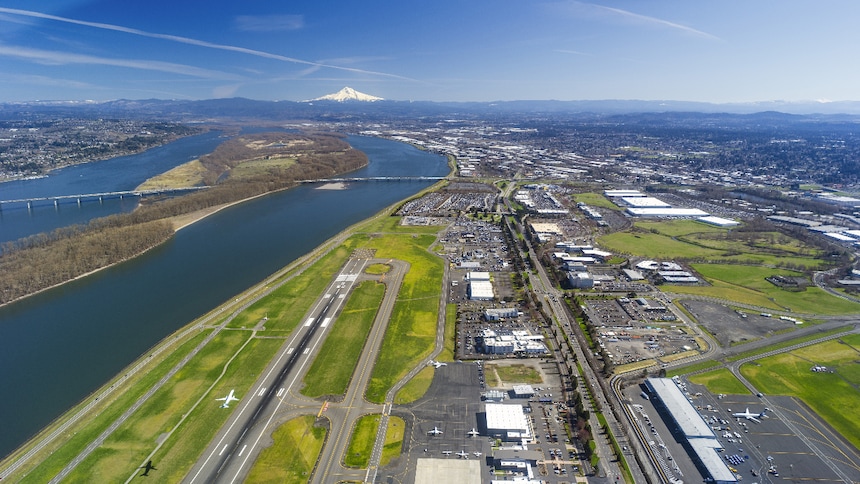
Each link in PDX’s SAF chain had an important role. Montana Renewables supplied the SAF. Shell, the systems integrator, blended it to specification and delivered it through existing infrastructure. And Alaska Airlines took flight with it.
“Portland is an important market for Alaska [Airlines] and a growing gateway for the Pacific Northwest,” says Justin Neff, Vice-President of Strategic Sourcing and Supply Chain Management at Alaska Airlines.
At a time when the aviation industry is working to scale up SAF, Portland has shown that rising fuel demand from airlines and efforts to integrate SAF don’t have to pull in opposite directions.
“Growth and decarbonization can appear to be in opposition, but they have to be pursued in parallel to support the growth of aviation,” says Reema Bari, Shell’s Head of Aviation Americas. “Bold leaders understand they must exist together.”
Portland brings to life one of the central questions in Shell’s Aviation Energy Security Scenarios: how aviation can keep growing while building a more resilient, affordable and lower-carbon fuel system.
Explained: How the Portland International Airport fuel ecosystem works
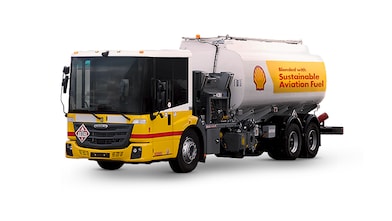

Production
Montana Renewables produces SAF at commercial scale using domestic, waste-based and agricultural feedstocks.
Distribution
Shell Aviation purchases the SAF, blends it to specification and delivers it through existing logistics and airport fuel infrastructure.
Implementation
Airlines including Alaska Airlines can then access SAF through the shared airport system without bespoke airport facilities or new aircraft.
How SAF can support energy resilience
For aviation, SAF is increasingly being judged not only by its emissions profile, but also by what it can add to the resilience of the fuel system.
“Over the last several years, energy security has become just as important as price and operational reliability in our fuel strategy," says Neff.
Shell views fuel security as a shared focus throughout the system, including "where fuel is produced, how the supply chains are interlinked and how reliable the delivery is going to be over time,” says Bari.
The supply landscape has grown more complex in recent years due to geopolitics, logistical pressures and, in some regions, aging infrastructure.
“Managing volatility is no longer just about affordability,” says Bari. “It’s also about availability and reliability.”
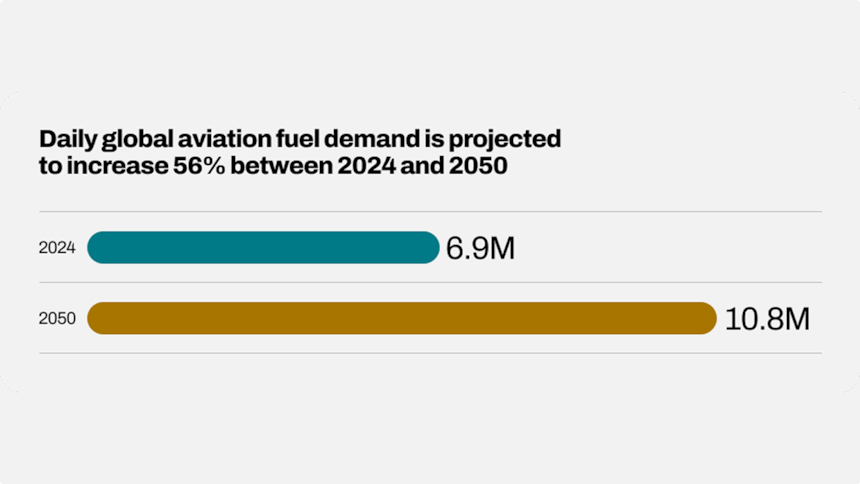
Daily global aviation fuel demand is projected to increase 56% between 2024 and 20501
Read chart description
Read chart description
Daily global aviation fuel demand is projected to increase 56% between 2024 and 2050, rising from 6.9M in 2024 to 10.8M in 2050.
Source
1 BNEF Aviation Fuel Outlook 2026
SAF can help reduce aviation’s lifecycle greenhouse gas emissions without waiting for new aircraft technology. It can support system flexibility, because SAF can be produced from diverse feedstock sources and widen the set of viable supply sources integrated into airport systems. In constrained markets, that can help absorb supply shocks.
Bruce Fleming, CEO of Montana Renewables, sees this dynamic from the production end. His plant in Great Falls, Mont. sits close to the West Coast markets it serves, and it produces SAF that can easily move into the aviation system using existing infrastructure.
“We did not have to go and replicate existing infrastructure that was already working just fine,” says Fleming.
Read the transcript
Read the transcript
Audio Explained: What can aviation teach other fuel-intensive industries? Bruce Fleming CEO, Montana Renewables
For any fuel consuming industry, it doesn’t matter what kind, any fuel consumer is paying attention to how much it costs.
The way to keep the cost down is to tap into existing distribution and fueling infrastructure;
The critical enabler for sustainable aviation fuel is fuel suppliers blending renewable into fossil fuels.
When you have to create a whole new fueling infrastructure, you have made it more expensive and you’ve made it take longer.
Once the renewable jet fuel is blended and allowed into the pipeline, we’ve removed a lot of this extra handling.
You’ve got to look for local solutions that make sense, and stop trying to leap to 2050 or 2075 with a one size fits all full replacement.
Coexistence is a systems challenge. Scaling SAF is not only about building plants and reducing prices; it also requires integrating this new aviation fuel into the system, from blending and certification to storage, pipelines and airport tanks. SAF is typically blended and certified before it enters the airport fuel system, so what arrives meets the required specifications.
Portland demonstrated how SAF can be effectively integrated into regional airport infrastructure, aircraft and operations. The shift from a constrained system to a more flexible supply model may influence how quickly aviation can expand use of lower-carbon fuels.
“Conventional jet fuel has powered aviation for more than a century, and it's going to be needed well into the mid-century as SAF scales." says Bari. The challenge is not ambition alone, she adds, but “it is making the whole system ready: building dependable supply, creating long-term demand certainty, and safely integrating SAF through blending, certification, logistics, storage and airport fuel infrastructure.”
Read chart description
Read chart description
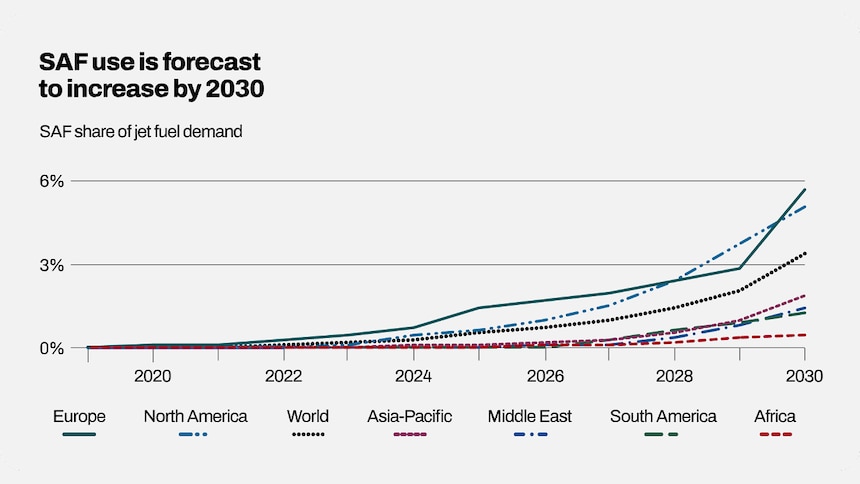
SAF use is forecast to increase by 2030
The chart shows sustainable aviation fuel (SAF) as a share of jet fuel demand from 2019 to 2030 for Europe, North America, Asia-Pacific, the Middle East, South America and Africa, as well as globally. The vertical scale ranges from 0% to 6%, with a midpoint at 3%.
SAF's share of jet fuel demand is forecast to increase across all regions shown. Europe and North America show the largest increases, with both rising above 3% by 2030 and Europe ending slightly higher than North America. The global share also increases and ends just above 3%. Asia-Pacific, the Middle East, South America and Africa all remain below 3% by 2030, with Africa having the lowest forecast share.
Source
2 BloombergNEF
An integrated approach to aviation fuel supply
Portland’s SAF story started with a challenge related to fuel supply. “And bringing in more conventional jet fuel didn’t seem to be viable from an affordability standpoint,” says Bari.
The solution emerged for partners committed to lower-carbon fuels. Blended with conventional jet fuel to certified specifications, SAF offers a practical route to lower lifecycle emissions while supporting state-level programs. Its inclusion in Portland’s fuel mix made commercial sense.
The fuel journey from Montana Renewables to PDX was a test of the system. SAF had to move from production into Shell’s supply chain, be blended to specification and then enter the airport fuel system without requiring bespoke facilities. The process involved multiple handoffs across companies and infrastructure.
"One of the most encouraging aspects of the Portland project is that it demonstrates that SAF can be integrated into existing airport fueling systems, without fundamentally changing day-to-day airline operations," says Neff. “Scalability in aviation depends on solutions that can work within today’s operational environment.”
Read the transcript
Read the transcript
Justin Neff, Vice President of strategic Sourcing and Supply Chain Management, Alaska Airlines
Demonstrating that SAF can work effectively, in a real commercial operating environment is incredible valuable.
What we’ve learned is success requires coordination across the entire ecosystem.
From producers to suppliers, pipeline operators, airports and airlines.
The Portland project shows when those stakeholders collaborate early and consistently, SAF deployment can be much more practical and repeatable.
Partners like Shell have played an important role in helping connect production, blending, logistics and airport delivery into a system that works operationally.
Once blended to approved specifications, it helps advance our long term decarbonisation goals using fuel that works within today’s fleet and infrastructure.
There is also value in demonstrating these projects are not theoretical anymore. They are operational they’re real and can be deployed in commercial aviation systems today.
The PDX example also points to a broader scaling challenge: SAF has to work not only at major aviation hubs, but also in the regional gateways where airlines are adding capacity and managing supply risk.
“The Portland project has shown that SAF deployment can become much more practical and repeatable,” says Neff.
What began as a one-time fix is now a standing option. Once blended to approved specifications, SAF moves into Portland through existing infrastructure, giving the region a second source of supply when the conventional system comes under strain.
“This only helps improve system flexibility,” says Bari.
Partnerships are essential to scaling solutions
Making Portland’s success repeatable means connecting production, supply and demand into an investable framework. The challenge involves both capital and coordination. SAF projects require multiyear financing, and also depend on stable, long-term regulations that give investors confidence in long-life assets. Investors are being asked to back capital-intensive projects whose returns depend on demand, infrastructure readiness and incentives that may evolve over time.
Long-term commitments across the aviation value chain can help, and Bari says policy has an important role in making collaborations easier to sustain. SAF depends on coordination among governments, producers, integrators, infrastructure owners and airline customers.
“Whenever you have collaboration at this scale, with long supply chains and a complex ecosystem, it’s very difficult to achieve end-to-end transparency,” says Bari. This is where long-term commercial commitments become catalytic. “By creating secure demand through offtake agreements, industry participants can help unlock financing, turning lower‑carbon fuel ambition into investable projects,” she says.
Portland did not begin as a sustainability exercise. It began with a constrained fuel system that found a way to keep aircraft supplied. It showed how SAF and conventional jet fuel can work in tandem, adding supply optionality while supporting lower-carbon flights.
The challenge for aviation’s transition to lower-carbon energy is not only about fuel choices. It is also about the ability to secure, integrate and scale that energy supply and make it operational.
“Fuel strategy should be viewed as a strategic lever, not a procurement activity,” says Bari.
The New Energy Economy – Aviation
Read the transcript
Read the transcript
Title: The New Energy Economy – Aviation
Duration: 1:00 minutes
Description: This film explores aviation growth, fuel supply and the role of collaboration in supporting the sector’s energy needs. Reema Bari, Head of Aviation Americas, Shell, discusses the need for multiple jet fuel supply pathways, integrated supply chains and collaboration across the aviation ecosystem.
The video combines interview footage with aircraft, airport, fuel supply and logistics visuals, on-screen statistics and stakeholder labels, concluding with Shell and Bloomberg Media Studios branding and a corporate disclaimer.
The New Energy Economy – Aviation Transcript
[Background music plays]
Instrumental background music plays beneath the aviation footage and interview.
[Visuals]
A passenger aircraft flies above a layer of clouds.
[Text displays]
The New Energy Economy
[Visuals]
View from an aircraft window showing the wing above the clouds.
[Text displays]
Aviation
[Visuals]
Reema Bari sits beside large windows overlooking an airport. She wears a blue suit with a white top.
[Text displays]
Reema Bari
Head of Aviation Americas, Shell
[Conversation]
Head of Aviation Americas, Shell
Reema Bari
Growth and decarbonization can be seen as opposing forces.
The reality is bold leaders understand they must coexist together.
[Visuals]
An airport ground worker in high-visibility clothing works beneath an aircraft wing. An animated percentage counter increases before settling at 56%.
[Text displays]
up 56%
Expected increase in aviation fuel demand from 2024 to 2050
Source: BloombergNEF, Jan 2026
[Visuals]
Close-up of aircraft fuelling equipment connected beneath a wing
An aircraft passes overhead.
An aerial view shows a large industrial facility with storage tanks and processing equipment.
[Conversation]
So, if you want to grow aviation and service existing demand, you need multiple jet fuel supply pathways.
[Visuals]
A Shell-branded fuel tanker drives through an industrial facility.
The film returns to a close-up of Reema speaking.
[Conversation]
Shell’s role to play is through our energy business. Through trading, we enable supply chains and complex global movements, with producers of feedstock and transportation.
[Visuals]
Dark granular material pours from a chute.
Airport ground workers in high-visibility clothing stand beside operational vehicles and equipment.
The film returns to Reema speaking beside the airport windows.
[Conversation]
We can create the right ecosystem that needs to exist to make this affordable and optimize for what the customer is looking for.
[Visuals]
A ground worker services an aircraft beside its wing and engine.
A pilot reaches up to operate controls inside an aircraft cockpit.
An overhead view shows people seated in a modern indoor space.
[Conversation]
Collaboration is essential to this.
[Visuals]
A traveller pulls a suitcase through an airport terminal. The film then shows passengers moving through the terminal, followed by Reema speaking.
[Text displays]
Airlines
Consumers
Passengers
Producers
Logistics
[Conversation
Airlines, consumers, passengers, producers, logistic providers all have to exist in this ecosystem together.
[Visuals]
Close-up interview footage of Reema alternates with shots of an aircraft moving along a runway.
[Conversation]
Working in a coalition enables us to progress society’s needs and to service the communities we operate in.
[Visuals]
Reema continues speaking in the interview setting.
A ground worker services an aircraft from an elevated platform.
An aerial view shows an airport terminal, aircraft and surrounding apron.
Two airport workers in high-visibility clothing review information together beside an aircraft.
Reema stands at the window looking across the airport.
An aircraft takes off from a runway.
[Conversation]
So, having a partner who is flexible, agile, has scale, global presence, helps ensure that we are best suited to support the airlines in navigating that volatility.
[Visuals]
The screen fades to black.
[Text displays]
Shell logo
Bloomberg Media Studios logo
[Text displays]
Disclaimer: In 2025, 80.85% of Shell’s global investments included oil & gas.
9.58% included low-carbon energy solutions and 9.58% non-energy products.
Shell’s target is to become a net-zero emissions (NZE) energy business by 2050.
Disclaimers, including NZE target: shell.com/disclaimer
[Background music fades out]
More from Bloomberg Media Studios for Shell
Freight decarbonization needs demand, not just molecules
In this Bloomberg feature, the article examines how book and claim is being put into practice across real‑world freight and logistics operations.
How shipping can cut emissions without losing efficiency
In this Bloomberg feature, the article examines how shipowners are making pragmatic progress on emissions while adapting as technology and regulations evolve.
Cautionary note
Cautionary note
The companies in which Shell plc directly and indirectly owns investments are separate legal entities. In this content “Shell”, “Shell Group” and “Group” are sometimes used for convenience to reference Shell plc and its subsidiaries in general. Likewise, the words “we”, “us” and “our” are also used to refer to Shell plc and its subsidiaries in general or to those who work for them. These terms are also used where no useful purpose is served by identifying the particular entity or entities. ‘‘Subsidiaries’’, “Shell subsidiaries” and “Shell companies” as used in this content refer to entities over which Shell plc either directly or indirectly has control. The terms “joint venture”, “joint operations”, “joint arrangements”, and “associates” may also be used to refer to a commercial arrangement in which Shell has a direct or indirect ownership interest with one or more parties. The term “Shell interest” is used for convenience to indicate the direct and/or indirect ownership interest held by Shell in an entity or unincorporated joint arrangement, after exclusion of all third-party interest.
Forward-Looking statements
This content contains forward-looking statements (within the meaning of the U.S. Private Securities Litigation Reform Act of 1995) concerning the financial condition, results of operations and businesses of Shell. All statements other than statements of historical fact are, or may be deemed to be, forward-looking statements. Forward-looking statements are statements of future expectations that are based on management’s current expectations and assumptions, including (without limitation) those concerning Shell’s strategy and operating plans, macroeconomic conditions, future energy demand, supply and product mix, commodity prices, demand for Shell’s products, production results and reserve estimates, development, execution and management of projects, energy transition and climate change, management of safety and environmental risks, costs, cash capital expenditures, technology advancements, legislative, judicial, fiscal and regulatory developments, regional conflicts and trading conditions, and involve known and unknown risks and uncertainties that could cause actual results, performance or events to differ materially from those expressed or implied in these statements. Forward-looking statements include, among other things, statements concerning the potential exposure of Shell to market risks and statements expressing management’s expectations, beliefs, estimates, forecasts, projections and assumptions. These forward-looking statements are identified by their use of terms and phrases such as “aim”; “ambition”; ‘‘anticipate’’; “aspire”, “aspiration”, ‘‘believe’’; “commit”; “commitment”; ‘‘could’’; “desire”; ‘‘estimate’’; ‘‘expect’’; ‘‘goals’’; ‘‘intend’’; ‘‘may’’; “milestones”; ‘‘objectives’’; ‘‘outlook’’; ‘‘plan’’; ‘‘probably’’; ‘‘project’’; ‘‘risks’’; “schedule”; ‘‘seek’’; ‘‘should’’; ‘‘target’’; “vision”; ‘‘will’’; “would” and similar terms and phrases. There are a number of factors that could affect the future operations of Shell and could cause those results to differ materially from those expressed in the forward-looking statements included in this content, including (without limitation): (a) price fluctuations in crude oil and natural gas; (b) changes in demand for Shell’s products; (c) currency fluctuations; (d) drilling and production results; (e) reserves estimates; (f) loss of market share and industry competition; (g) environmental and physical risks, including climate change; (h) risks associated with the identification of suitable potential acquisition properties and targets, and successful negotiation and completion of such transactions; (i) the risk of doing business in developing countries and countries subject to international sanctions; (j) legislative, judicial, fiscal and regulatory developments including tariffs and regulatory measures addressing climate change; (k) economic and financial market conditions in various countries and regions; (l) political risks, including the risks of expropriation and renegotiation of the terms of contracts with governmental entities, delays or advancements in the approval of projects and delays in the reimbursement for shared costs; (m) risks associated with the impact of pandemics, regional conflicts, such as the Russia-Ukraine war and the conflict in the Middle East, and a significant cyber security, data privacy or IT incident; (n) the pace of the energy transition; and (o) changes in trading conditions. No assurance is provided that future dividend payments will match or exceed previous dividend payments. All forward-looking statements contained in this content are expressly qualified in their entirety by the cautionary statements contained or referred to in this section. Readers should not place undue reliance on forward-looking statements. Additional risk factors that may affect future results are contained in Shell plc’s Form 20-F for the year ended December 31, 2025 (available at www.shell.com/investors/news-and-filings/sec-filings.html and www.sec.gov
). These risk factors also expressly qualify all forward-looking statements contained in this content and should be considered by the reader. Each forward-looking statement speaks only as of the date of the publication mentioned in this website. Neither Shell plc nor any of its subsidiaries undertake any obligation to publicly update or revise any forward-looking statement as a result of new information, future events or other information. In light of these risks, results could differ materially from those stated, implied or inferred from the forward-looking statements contained in this content.
Shell’s net carbon intensity and net-zero emissions target
In this content we may refer to Shell’s “net carbon intensity” (NCI), which includes Shell’s carbon emissions from the production of our energy products, our suppliers’ carbon emissions in supplying energy for that production and our customers’ carbon emissions associated with their use of the energy products we sell. Shell’s NCI also includes the emissions associated with the production and use of energy products produced by others which Shell purchases for resale. Shell only controls its own emissions. The use of the terms Shell’s “net carbon intensity” or NCI is for convenience only and not intended to suggest these emissions are those of Shell plc or its subsidiaries.
Shell’s operating plan and outlook are forecasted for a three-year period and ten-year period, respectively, and are updated every year. They reflect the current economic environment and what we can reasonably expect to see over the next three and ten years. Accordingly, the outlook reflects our combined Scope 1 and 2 target, NCI target and our oil products ambition over the next ten years. However, Shell’s operating plan and outlook cannot reflect our 2050 net-zero emissions target, as this target is outside our planning period. Such future operating plans and outlooks could include changes to our portfolio, efficiency improvements and the use of carbon capture and storage and carbon credits. In the future, as society moves towards net-zero emissions, we expect Shell’s operating plans and outlooks to reflect this movement. However, if society is not net zero in 2050, as of today, there would be significant risk that Shell may not meet this target.
The information provided above regarding Shell’s NCI and net zero emissions target are not intended, nor should they be construed as introducing, suggesting or making any claim, target or representation thereof other than what is included in the content.
Forward-Looking non-GAAP measures
This content may contain certain forward-looking non-GAAP measures such as free cash flow and underlying operating expenses. We are unable to provide a reconciliation of these forward-looking non-GAAP measures to the most comparable GAAP financial measures because certain information needed to reconcile those non-GAAP measures to the most comparable GAAP financial measures is dependent on future events some of which are outside the control of Shell, such as oil and gas prices, interest rates and exchange rates. Moreover, estimating such GAAP measures with the required precision necessary to provide a meaningful reconciliation is extremely difficult and could not be accomplished without unreasonable effort. Non-GAAP measures in respect of future periods which cannot be reconciled to the most comparable GAAP financial measure are calculated in a manner which is consistent with the accounting policies applied in Shell plc’s consolidated financial statements. These forward-looking non-GAAP measures are provided to assist readers in understanding management’s use and expectations of such measures and may not be appropriate for other purposes.
The contents of websites referred to in this content do not form part of this content.
We may have used certain terms, such as resources, in this content that the United States Securities and Exchange Commission (SEC) strictly prohibits us from including in our filings with the SEC. Investors are urged to consider closely the disclosure in our Form 20-F, File No 1-32575, available on the SEC website www.sec.gov.
* Reduction in lifecycle greenhouse gas emissions in its neat form, compared with conventional jet aviation fuel.
Disclaimers
When we refer to “low‑carbon fuels”, we mean fuels that demonstrate a lower lifecycle greenhouse gas (GHG) emissions intensity compared to their fossil‑fuel‑based equivalent.
In 2025, 80.85% of Shell’s global investments included oil & gas, 9.58% included low‑carbon energy solutions and 9.58% non‑energy products.