How shipping can cut emissions without losing efficiency
Date of publication: February, 2026 (Produced by Bloomberg Media Studios for Shell)
Summary by Bloomberg AI
Global trade depends on shipping. To remain competitive, shipowners must continue investing in efficiency and decarbonization, without waiting for ideal conditions or perfect solutions.
Pragmatic progress through flexible, lower-carbon pathways – especially the methane pathway (LNG, bio-LNG and, eventually, synthetic LNG) – enables shipowners to cut emissions1 now and adapt as technology and regulations evolve.
Success depends on industry-wide collaboration, practical action, clear policy signals and strong demand to achieve affordable, effective decarbonization.
The global economy charts its course at sea.
Every container ship crossing the Pacific, every tanker navigating the Suez Canal, every bulk carrier hauling iron ore operates on the same calculus: Every year, ships carry around 80% of world trade2 because no other mode of transport can move 10+ billion metric tons as efficiently, in terms of cost and carbon intensity per ton carried.
The efficiency of shipping has helped build the global economy, and it is the core performance metric by which operators compete and win business. This competitive edge is being sustained through investment in newer, more efficient vessels and technologies, which continues to drive growth in shipping volumes and fleets as trade expands.
However, without sustainable action, that same efficiency-led growth will continue to push shipping emissions beyond their current level of around 3% of global carbon emissions. Today’s challenge is not efficiency itself, but ensuring that this efficiency continues to underpin growth while emissions fall.
The majority of vessels still rely on conventional fuel³
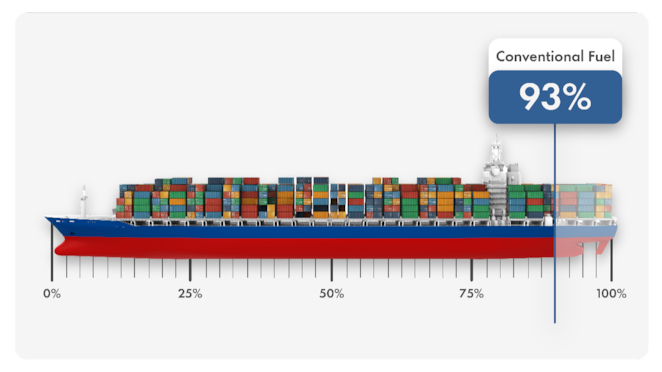
Side view of a container ship with a scale from 0 to 100 percent, highlighting that 93 percent of vessels use conventional fuel.
Ships built today are likely to sail into the 2050s, making fleet renewal one of the most consequential decisions shipowners face. Increasingly they are addressing emissions with ships that accommodate both fossil and bio-based fuels. Yet with the potential for broad regulatory clarity delayed by the International Maritime Organization (IMO) and global standards continuing to be fragmented, owners must nevertheless act amid diverging regional measures and uncertainty over which lower-carbon fuels will ultimately scale.
In a sector where efficiency and compliance underpin competitiveness, pausing is not an option. Delays in fleet renewal risk lost charter premiums, higher compliance costs, aging fleets and erosion of market position.
In this environment, decisions that enable progress today and provide options for the future become paramount to retain competitiveness. The cost of inaction is too great. In the IMO’s business-as-usual scenario4, emissions from shipping are projected to increase 50% between 2018 and 2050 – from 1 billion to 1.5 billion metric tons of CO2.
Uncertain seas, long-term bets
Today’s shipowners have the option to invest in low-carbon fuel solutions that allow progress now, while retaining fuel flexibility as the market’s regulatory framework evolves.
In October 2025, the IMO postponed a vote on its Net Zero Framework, delaying a decision on global emissions standards as delegates sought more economic assessment of policies with decades-long implications. The process continues to move toward alignment, but this delay extends the period of uncertainty for fleet investment, which would be easier to absorb if ships were short-lived assets. Instead, long asset lives mean that regulatory uncertainty today can invite incremental retrofit costs and risks later.

“The industry needs a clear and stable regulatory environment, one that incentivizes investment to scale up fuels that are lower carbon compared with conventional marine fuels.”
Houda Dabboussi, President, Shell Marine
As global consensus continues to take shape, regional regulators have been moving ahead. The European Union, for example, has established Europe’s FuelEU Maritime regulation, which requires progressive GHG emission cuts reaching 80% in 2050, from a 2020 baseline. Separately, the EU Emissions Trading Scheme, extended to include shipping in 2024, requires companies to surrender emissions allowances on a phased schedule, starting with 40% in 2024 and reaching 100% from 2026 onward.
The result is a regulatory patchwork where the cost of compliance depends not just on what fuel a ship burns, but on where it’s registered and where it sails – and where regulations will tighten next.
Read the transcript
Read the transcript
In the maritime sector, decarbonization is a very complex problem.
There are a lot of stakeholders who are involved in this process.
The fuels producers, the consumers, the shipping companies and then the regulatory bodies.
All the stakeholders in this supply chain needs to come together to solve this problem.
We need the support of regulatory bodies to establish the frameworks to make these low carbon fuels cost comparable with the fossil alternatives.
We also then need our customers support in the voluntary market space.
I think with the combination of these two things on the regulatory side and on the voluntary market side, we will be able to achieve our decarbonization goals and that requires huge efforts from all the stakeholders.
And then collaboration will be key to solve these big and complex problems.
Shipowners say regulatory stability is now the missing piece. “We need clear, long-term regulatory mechanisms that make lower carbon fuels cost-competitive with fossil fuels,” agrees Ilyas Muhammad, Head of Green Fuels at global shipping and logistics company Hapag-Lloyd.
In the absence of harmonized global regulations, shipowners face an uneasy choice: Act without regulatory clarity and risk making the wrong bet on alternative fuel, or default to conventional fuel to reduce capital expenditure today and risk difficult compliance options in the future. What's needed is a pathway that cuts emissions today while creating flexibility to adapt as rules tighten and renewable fuels scale, and a framework that offers commercial opportunities for countries producing lower-carbon fuels.
A bridge from today to the future
That pathway begins with liquified natural gas (LNG), a methane-based fuel. “It provides the shipping industry with a practical option that can support fleet transition planning while preserving flexibility for future fuel pathways.” says Houda Dabboussi, President of Shell Marine.
Available at commercial scale now, LNG delivers lifecycle greenhouse gas reductions versus conventional marine fuel using proven infrastructure that continues to expand globally. Dual-fuel vessels designed to run on methane (LNG) and liquid fuels maximize flexibility and optionality: They can operate using LNG as a primary fuel, can switch to conventional or bio-liquid fuels when required, blend in bio-LNG as the supply scales, and ultimately, transition to synthetic LNG produced from renewable energy.
“Liquified Bio-Methane (bio-LNG) is the easiest fuel to use for the decarbonization of the shipping sector, supply is relatively high and prices are competitive compared with other lower-carbon fuels,” says Muhammad. For dual-fuel vessels, “Bio-methane is a drop-in fuel, so one does not need to invest in retrofits or buy new dual-fuel engines.”
The industry is being proactive. Over one-third of new ship orders5 now specify LNG capability. LNG demand is projected to reach 70 million tons by 2050, according to BNEF. Charter premiums for vessels with lower-emissions operating profiles have emerged faster than expected – driven not by regulation, but by cargo owners under pressure from shareholders and customers to decarbonize their operations. Amazon, IKEA, Michelin, and Unilever, through Cargo Owners for Zero Emission Vessels (coZEV), have committed to zero-carbon shipping by 20406.
Read the transcript
Read the transcript
The goal here is to progressively reduce carbon intensity by adopting the methane pathway, which means having dual fuel LNG vessels that can take conventional LNG today, which gives you immediate reductions and then blend in bio-LNG and eventually synthetic-LNG.
The advantage of dual fuel LNG is that it’s available at scale today.
The infrastructure is there and so we see the network for bunkering developing, the experience progressing, and it really offers this path to decarbonization.
The commercial imperative is clear. Shipowners who opt for fuel flexibility today will likely control access to premium contracts as fuel standards tighten and late movers find themselves at a competitive disadvantage. New vessels with LNG capability run more efficiently and reliably, and are better positioned to secure charters.
Scaling the future
LNG use helps cut emissions today.1 Depending on the production pathway, bio-LNG – made from manure can deliver net-negative climate impact on a lifecycle basis7, avoiding methane emissions that would otherwise escape into the atmosphere. Current production is minimal, but the potential is staggering. When sourced from manure and other high-methane feedstocks, it can deliver net-negative climate impact on a lifecycle basis, avoiding methane emissions that would otherwise escape into the atmosphere.7
The International Energy Agency8 estimates at least 1 trillion cubic meters [716 million metric tons] of biomethane could be produced each year sustainably using organic waste streams. “That’s about a quarter of today's natural gas demand,” says Anna Onida, Policy Officer for Transport at the European Biogas Association (EBA). The association’s latest Guidehouse report9 on biogases towards 2040 and beyond estimates that the EU could produce up to 101 billion cubic meters of biomethane, enough to cover 80% of the EU’s gaseous fuel demand. “This highlights biomethane’s crucial role not only in advancing decarbonization, but also in strengthening Europe’s energy security,” adds Onida

“Chemically speaking, methane is methane – whether its fossil-based or produced from organic waste. We don’t need to change anything in our engines to use bio-methane, which makes it a powerful drop-in solution.”
Ilyas Muhammad, Head of Green Fuels, Hapag-Lloyd
Bio-LNG requires no new infrastructure, engines or bunkering systems and vessels running on conventional LNG can shift to this renewable fuel the moment supply arrives. “Biomethane is fully compatible with existing methane pathways, which means vessels can switch to bio-LNG the moment supply becomes available,” says Onida.
Synthetic LNG, produced from renewable electricity and captured carbon, could offer the maritime sector the potential for an eventual pathway to near-zero emissions using the same compatibility advantage. According to the EBA, when sourced from specific feedstocks and managed properly, bio-LNG doesn’t just lower emissions, it can actually reach a negative emissions potential.7 Other alternatives – methanol, ammonia, hydrogen – face infrastructure gaps, technical hurdles, or supply constraints that have delayed their commercial viability at scale.
Demand for LNG in the shipping sector is expected to reach more than 70 million tons by 2050¹⁰
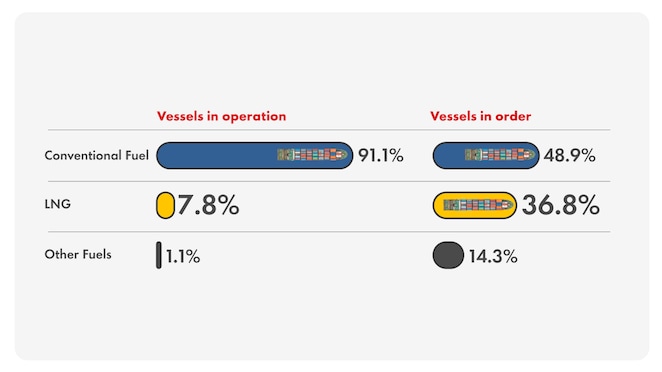
Comparison chart showing vessel fuel types. Of vessels in operation, 91.1% use conventional fuel, 7.8% use LNG, and 1.1% use other fuels. Of vessels in order, 48.9% use conventional fuel, 36.8% use LNG, and 14.3% use other fuels.
But technology alone won't deliver the transition. Scaling renewable supply demands a level of coordination the industry hasn’t yet achieved – requiring simultaneous investment across producers, carriers, and cargo owners, each betting billions on outcomes that depend on others following through.
Long-term partnerships are crucial, Muhammad emphasizes, because bio-LNG and other alternative marine fuels are not yet a globally available commodity like fossil fuels. “Fuel suppliers need to invest big money into scaling up these fuel production assets,” he says. “We, as a shipping company, need to provide long-term offtake support for those projects to materialize so that lower-carbon fuels are available when they’re needed.”
LNG provides a pragmatic route forward today. But shipping’s sustainable growth and long-term prosperity depend on collaboration as bio-LNG scales and regulatory frameworks stabilize.
“No single party can solve this alone,“ says Dabboussi. “Ship owners, cargo operators, ship and engine builders, fuel and energy providers, policy makers – everyone needs to pull together.“
The pragmatic path for shipping
The New Energy Economy – Shipping
Read the transcript
Read the transcript
The New Energy Economy – Shipping
Duration: Approximately 2 minutes
Description
This film explores the critical role of the global shipping industry in the world economy and its contribution to greenhouse gas emissions. Houda Dabboussi, President of Shell Marine, discusses industry uncertainty, the importance of regulation, and the role of collaboration and innovation in the energy transition.
The video combines interview footage, maritime and port visuals, on-screen statistics, and examples of research and technology in action, concluding with a corporate disclaimer and brand logos.
The New Energy Economy – Shipping Transcript
[Background music plays]
Calm, cinematic instrumental music plays beneath ocean and port visuals.
[Visuals]
A wide aerial shot rises slowly over a blue ocean dotted with freight ships.
[Text displays]
The New Energy Economy – Shipping
[Visuals]
Houda Dabboussi, President of Shell Marine, sits in a modern wooden room with large windows overlooking the River Thames. She wears a bright pink suit. Natural daylight fills the room.
Cut to a rapid montage:
- Cars parked at a busy shipping port
- Orange and red shipping containers stacked on a vessel
- A freight ship passing beneath a bridge as road traffic moves above
[Conversation]
President of Shell Marine
Houda Dabboussi
Shipping is the backbone and the engine of the global economy. Practically everything our society needs gets transported by sea.
But the mere size of it means that it’s responsible for 3 percent of global emissions. Global regulations are vital to progress society towards net zero.
[Text displays]
3% of global greenhouse gas emissions come from the shipping industry.
[Visuals]
A shipyard worker wearing a hard hat using a tablet.
Time-lapse footage of cranes and trucks moving in a shipyard.
Traffic slowing on a motorway.
A politician speaking at a podium.
[Conversation]
Today, the industry is seeing a delay in making decisions. This creates an environment where there is a level of uncertainty of what happens next and what that means to the world.
[Visuals]
Close-up of figures written on a clipboard beside a calculator.
A forklift moves boxes through a warehouse.
An aerial view shows trucks driving along a motorway bordered by forest at sunset.
Return to the interview setting. Houda smiles and gestures as she speaks.
[Conversation]
What we’ve learned being a hundred-year supplier for the marine sector is at times of uncertainty, the best thing to do is to up the collaboration.
When we work with our customers on research and development, catalyst technology for methane abatement, what dual fuel vessels to choose, we can really help them beyond just being their supplier and work with them to help the solutions of tomorrow be ready when they need them.
[Visuals]
A laboratory technician drops blue liquid from a pipette into a testing container.
[Text displays]
Research and Development
orker walks past a large industrial pipeline inside a warehouse.
[Text displays]
Catalyst Technologies
A container ship sits docked in a port.
[Text displays]
Dual Fuel
[Visuals]
Houda leaves the building and walks toward the Thames dock, silhouetted against a bright skyline. She pauses and looks out across the water.
Final shots show freight ships traveling at sea.
The screen fades to black.
[Text displays]
Shell logo
Bloomberg Media Studios logo
[Text displays]
Disclaimer: In 2024, 78.2% of Shell’s global investments included oil and gas, 11.37% included low-carbon energy solutions and 10.43% non-energy products. Shell’s target is to become a net-zero emissions energy business by 2050. Disclaimers, including NZE target: shell.com/disclaimer
[Background music fades out]
More from Shell Marine
From Compliance to Competitive Edge: The case for the methane pathway
Discover how the methane pathway can offer a compliant, scalable and commercially viable approach to reducing lifecycle greenhouse gas emissions.
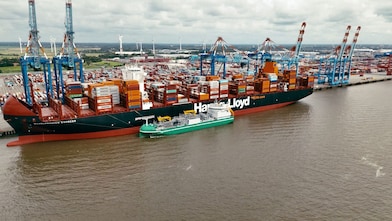
Powering ships with waste? | Discover bio-LNG with Hapag Lloyd
In the journey to decarbonize the shipping sector, every lever counts. And bio-LNG is a renewable fuel, supporting shipping companies like Hapag-Lloyd to lower emissions.
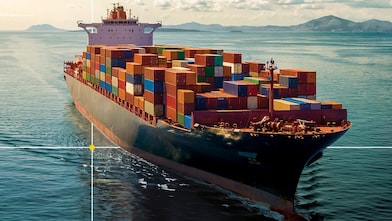
Shell Alexia 40 XC oil is designed to deliver value to you
Explore the findings in our latest paper: "Field experience with Shell Alexia 40 XC in dual-fuel two-stroke engines combusting alternative fuels", which offers valuable insights
Sources
1 Compared with very low sulphur fuel oil, LNG, bio-LNG and synthetic LNG can achieve different levels of greenhouse gas (GHG) reductions on a well-to-wake basis, depending on the feedstocks used, production methods, emissions accounting approaches, and vessel type.
2 UN Trade and Development. “Shipping data: UNCTAD releases new seaborne trade statistics.” April 23, 2025.
3 DNV. “DNV Maritime Forecast to 2050.” 2025.
4 International Maritime Organization (IMO). “Climate action.”
5 Clarksons. “Green Technology & Alternative Fuel Uptake.” July 17, 2024.
6 World Ports Org. “Leading cargo owners commit to ‘zero by 2040’ target.” May 3, 2025.
7 Bio-LNG can achieve one of the lowest or even negative CO₂e emissions intensity values on a life cycle basis when manure is used as a feedstock, when considering all emissions associated with the production and use of the fuel, including avoided emissions. These avoided emissions are recognised in EU REDII and US CARB LCFS methodologies as resulting from improved agricultural practices.
8 IEA. “Outlook for Biogas and Biomethane.” May 28, 2025.
9 European Biogas Association. “Biogases towards 2040 and beyond.” August 2024.
10 BloombergNEF. “DNV Maritime Forecast to 2050. Conventional means oil-derived fuels such as Very-Low-Sulfur-Fuel-Oil; include LNG carriers.” Data as of December 4, 2025, and presented on a gross-tonnage basis.
Disclaimer
Disclaimer
Cautionary Note
The companies in which Shell plc directly and indirectly owns investments are separate legal entities. In this content “Shell”, “Shell Group” and “Group” are sometimes used for convenience to reference Shell plc and its subsidiaries in general. Likewise, the words “we”, “us” and “our” are also used to refer to Shell plc and its subsidiaries in general or to those who work for them. These terms are also used where no useful purpose is served by identifying the particular entity or entities. ‘‘Subsidiaries’’, “Shell subsidiaries” and “Shell companies” as used in this content refer to entities over which Shell plc either directly or indirectly has control. The terms “joint venture”, “joint operations”, “joint arrangements”, and “associates” may also be used to refer to a commercial arrangement in which Shell has a direct or indirect ownership interest with one or more parties. The term “Shell interest” is used for convenience to indicate the direct and/or indirect ownership interest held by Shell in an entity or unincorporated joint arrangement, after exclusion of all third-party interest.
Forward-Looking statements
This content contains forward-looking statements (within the meaning of the U.S. Private Securities Litigation Reform Act of 1995) concerning the financial condition, results of operations and businesses of Shell. All statements other than statements of historical fact are, or may be deemed to be, forward-looking statements. Forward-looking statements are statements of future expectations that are based on management’s current expectations and assumptions, including (without limitation) those concerning Shell’s strategy and operating plans, macroeconomic conditions, future energy demand, supply and product mix, commodity prices, demand for Shell’s products, production results and reserve estimates, development, execution and management of projects, energy transition and climate change, management of safety and environmental risks, costs, cash capital expenditures, technology advancements, legislative, judicial, fiscal and regulatory developments, regional conflicts and trading conditions, and involve known and unknown risks and uncertainties that could cause actual results, performance or events to differ materially from those expressed or implied in these statements. Forward-looking statements include, among other things, statements concerning the potential exposure of Shell to market risks and statements expressing management’s expectations, beliefs, estimates, forecasts, projections and assumptions. These forward-looking statements are identified by their use of terms and phrases such as “aim”; “ambition”; ‘‘anticipate’’; “aspire”, “aspiration”, ‘‘believe’’; “commit”; “commitment”; ‘‘could’’; “desire”; ‘‘estimate’’; ‘‘expect’’; ‘‘goals’’; ‘‘intend’’; ‘‘may’’; “milestones”; ‘‘objectives’’; ‘‘outlook’’; ‘‘plan’’; ‘‘probably’’; ‘‘project’’; ‘‘risks’’; “schedule”; ‘‘seek’’; ‘‘should’’; ‘‘target’’; “vision”; ‘‘will’’; “would” and similar terms and phrases. There are a number of factors that could affect the future operations of Shell and could cause those results to differ materially from those expressed in the forward-looking statements included in this content, including (without limitation): (a) price fluctuations in crude oil and natural gas; (b) changes in demand for Shell’s products; (c) currency fluctuations; (d) drilling and production results; (e) reserves estimates; (f) loss of market share and industry competition; (g) environmental and physical risks, including climate change; (h) risks associated with the identification of suitable potential acquisition properties and targets, and successful negotiation and completion of such transactions; (i) the risk of doing business in developing countries and countries subject to international sanctions; (j) legislative, judicial, fiscal and regulatory developments including tariffs and regulatory measures addressing climate change; (k) economic and financial market conditions in various countries and regions; (l) political risks, including the risks of expropriation and renegotiation of the terms of contracts with governmental entities, delays or advancements in the approval of projects and delays in the reimbursement for shared costs; (m) risks associated with the impact of pandemics, regional conflicts, such as the Russia-Ukraine war and the conflict in the Middle East, and a significant cyber security, data privacy or IT incident; (n) the pace of the energy transition; and (o) changes in trading conditions. No assurance is provided that future dividend payments will match or exceed previous dividend payments. All forward-looking statements contained in this content are expressly qualified in their entirety by the cautionary statements contained or referred to in this section. Readers should not place undue reliance on forward-looking statements. Additional risk factors that may affect future results are contained in Shell plc’s Form 20-F for the year ended December 31, 2025 (available at www.shell.com/investors/news-and-filings/sec-filings.html and www.sec.gov). These risk factors also expressly qualify all forward-looking statements contained in this content and should be considered by the reader. Each forward-looking statement speaks only as of the date of the publication mentioned in this website. Neither Shell plc nor any of its subsidiaries undertake any obligation to publicly update or revise any forward-looking statement as a result of new information, future events or other information. In light of these risks, results could differ materially from those stated, implied or inferred from the forward-looking statements contained in this content.
Shell’s net carbon intensity and net-zero emissions target
In this content we may refer to Shell’s “net carbon intensity” (NCI), which includes Shell’s carbon emissions from the production of our energy products, our suppliers’ carbon emissions in supplying energy for that production and our customers’ carbon emissions associated with their use of the energy products we sell. Shell’s NCI also includes the emissions associated with the production and use of energy products produced by others which Shell purchases for resale. Shell only controls its own emissions. The use of the terms Shell’s “net carbon intensity” or NCI is for convenience only and not intended to suggest these emissions are those of Shell plc or its subsidiaries.
Shell’s operating plan and outlook are forecasted for a three-year period and ten-year period, respectively, and are updated every year. They reflect the current economic environment and what we can reasonably expect to see over the next three and ten years. Accordingly, the outlook reflects our combined Scope 1 and 2 target, NCI target and our oil products ambition over the next ten years. However, Shell’s operating plan and outlook cannot reflect our 2050 net-zero emissions target, as this target is outside our planning period. Such future operating plans and outlooks could include changes to our portfolio, efficiency improvements and the use of carbon capture and storage and carbon credits. In the future, as society moves towards net-zero emissions, we expect Shell’s operating plans and outlooks to reflect this movement. However, if society is not net zero in 2050, as of today, there would be significant risk that Shell may not meet this target.
The information provided above regarding Shell’s NCI and net zero emissions target are not intended, nor should they be construed as introducing, suggesting or making any claim, target or representation thereof other than what is included in the content.
Forward-Looking non-GAAP measures
This content may contain certain forward-looking non-GAAP measures such as free cash flow and underlying operating expenses. We are unable to provide a reconciliation of these forward-looking non-GAAP measures to the most comparable GAAP financial measures because certain information needed to reconcile those non-GAAP measures to the most comparable GAAP financial measures is dependent on future events some of which are outside the control of Shell, such as oil and gas prices, interest rates and exchange rates. Moreover, estimating such GAAP measures with the required precision necessary to provide a meaningful reconciliation is extremely difficult and could not be accomplished without unreasonable effort. Non-GAAP measures in respect of future periods which cannot be reconciled to the most comparable GAAP financial measure are calculated in a manner which is consistent with the accounting policies applied in Shell plc’s consolidated financial statements. These forward-looking non-GAAP measures are provided to assist readers in understanding management’s use and expectations of such measures and may not be appropriate for other purposes.
The contents of websites referred to in this content do not form part of this content.
We may have used certain terms, such as resources, in this content that the United States Securities and Exchange Commission (SEC) strictly prohibits us from including in our filings with the SEC. Investors are urged to consider closely the disclosure in our Form 20-F, File No 1-32575, available on the SEC website www.sec.gov.