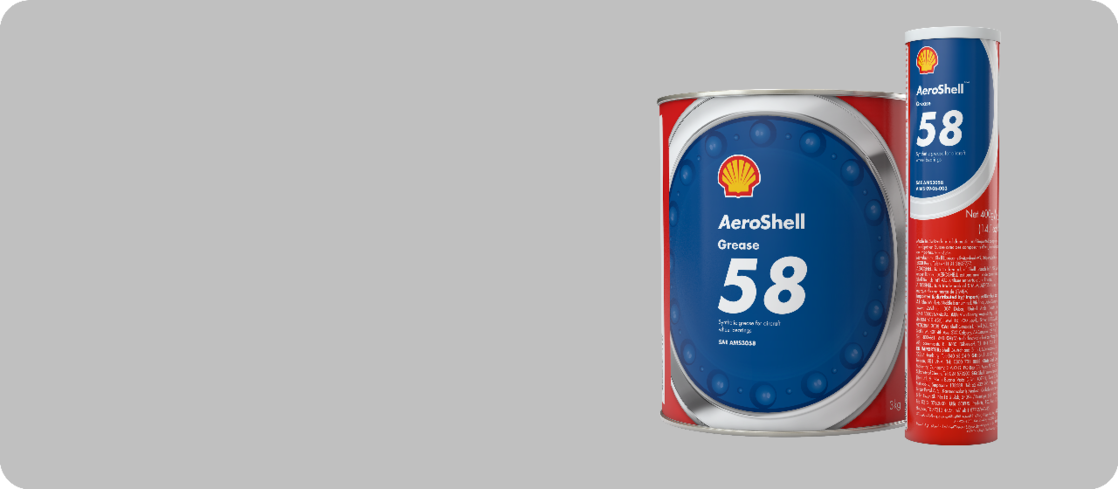
AeroShell Grease 58
Elevate wheel bearing performance with AeroShell Grease 58, helping to deliver exceptional durability and stability from -54°C to +175°C, suited for demanding conditions.
Features and benefits
Advanced wheel bearing protection
Specially designed for aircraft wheel bearings, offering superior protection and performance under high loads.
High mechanical stability
Retains its consistency and effectiveness even under severe operating conditions, reducing the need for frequent reapplication.
Enhanced corrosion resistance
Provides outstanding protection against rust and corrosion, even in harsh environmental conditions, extending component life.
Excellent water washout resistance
Remains effective in wet conditions, preventing lubricant loss and ensuring continued protection.
Superior load-carrying capability
Formulated to handle high-pressure environments, reducing wear on critical components.
Exceeds industry-leading standards
AeroShell Grease 58 is the first grease to exceed SAE AMS3058 standards, as the future for landing gear greases.
Specifications & approvals
| Country / OEM | Specification |
|---|---|
| SAE | AMS3058 |
| Airbus | AIMS 09-06-003 CML 03GCC1 |
The TDS and MSDS are in English, but you can find these documents for other countries in the Shell EPC area.
Video transcript
Video transcript
Title: AeroShell Grease 58 – A short introduction
Duration: 4:12 minutes
Description:
AeroShell Grease 58 is our innovative response to the need to enhance wheel-bearing protection in current and future aircraft fleets.
AeroShell Grease 58 | Shell Aviation Transcript
[Background music plays]
Music build up
Soft, mellow music
Aircraft wheels screeching and engine running sounds
[Animated sequence]
Plane landing on runway
[Title – Text on visuals]
Shell Aviation
AeroShell Grease 58
Enhanced corrosion protection1
Excellent anti-wear and load-carrying properties1
Exceeds the SAE AMS 3058 sepecification
1Compared with MIL-PRF-81322 specification greases
[Dialogue: Narrator]
Today’s aircraft placed increased demands on their wheel bearing and wheel bearding grease,
[Animated sequence]
Close up animation of aircraft wheels landing on runway, showing the internal components of the wheel and wheel hub
[Dialogue: Narrator]
when landing, taking off, and especially when a heavy landing or aborted takeoff.
Modern wheel bearings need a grease that can protect against
[Animated sequence]
Animated graphics of aircraft wheel hub with arrows pointing both inwards and outwards from the centre of the wheel hub
[Dialogue: Narrator]
extreme multidimensional loads,
[Animated sequence]
Animated graphics of aircraft wheel hub internal components heating up and dirt particles moving in wheel hub
[Dialogue: Narrator]
rapid heating, particulate contamination,
[Animated sequence]
Animated graphics of aircraft wheel rolling with fluids all around wheel
[Dialogue: Narrator]
intense runway and jet wash spray, and corrosive runway de-icing fluids.
[Animated sequence]
Animated bar chart showing that grease life and tyre life, and with extended tyre life, grease life needs to be longer before reaching maintenance interval.
[Dialogue: Narrator]
Extended tyre life means the grease must also protect the bearings for longer.
[Animated sequence]
Animated graphics showing zoomed out top view of an aircraft in the sky
[Dialogue: Narrator]
Shell has pioneered grease technology.
[Title – Text on visuals]
1960s
Microgel® thickener technology
[Animated sequence]
Images of AeroShell Grease 5, 6, 7 and 22 in both tin cans and cartridges below and right of text.
[Dialogue: Narrator]
It was the first to use Mircogel thickeners.
[Animated sequence]
Animated appearance of AeroShell Grease 33 tin can and cartridge
[Title – Text on visuals]
1995
Lithium-complex technology
1st to meet
Boeing BMS3-33 specifications
[Dialogue: Narrator]
AeroShell Grease 33, based on lithium-complex technology, was the first grease to meet the new Boeing BMSS3-33 specifications.
[Animated sequence]
Animated graphics of aircraft wheel rolling, with wheel hub internal components visible.
[Title – Text on visuals]
SAE AMS 3058
[Dialogue: Narrator]
Now, the new SAE AMS 3058 specifications for wheel bearings, requires the use of lithium complex technology, as it is better suited for today’s requirements.
[Animated sequence]
Animated appearance of three white grease pails representing lithium-complex thickened wheel bearing grease from competition brands with warning signs above each of them, followed by one red AeroShell Grease 58 pail with a yellow tick above it.
[Title – Text on visuals]
Exceeds
SAE AMS 3058
[Dialogue: Narrator]
There are already lithium-complex thickened wheel bearing greases available commercially, but some do not meet the new specification.
AeroShell Grease 58 exceeds the current requirements.
[Animated sequence]
Animated appearance of AeroShell Grease 58 in a drum and tin can packaging next to pail packaging.
Animated graph comparing Load Wear Index values of AeroShell Grease 58 with 4 competitor greases, including the minimum Load Wear Index requirement for both MIL-PRF-81322 and SAE AMS 3058 specifications.
[Dialogue: Narrator]
Compared with clay thickened greases, AeroShell Grease 58 has better load wear protection, thanks to its extreme pressure additives, this helps to extend bearing life.
[Animated sequence]
Animated graphics showing grease leaking out from bearing chambers and little grease covering the bearings when the grease used has poor mechanical stability; followed by bearing chamber with no leak bearings still well covered with grease when the grease used has good mechanical stability.
[Graphics – Text on visuals]
On the right of the animated sequence shows an image of grease testing apparatus with one dish of soft MIL-PRF-81322 grease and one dish of comparatively firmer AeroShell Grease 58.
[Dialogue: Narrator]
Its greater mechanical stability, even when wet, should provide a longer life under extreme conditions, compared with MIL-PRF-81322 specification wheel bearing greases.
[Animated sequence]
Animated graph showing longer grease life reducing costs.
[Footnote – Text on visuals]
Tests move grease-lubricated bearings partially immersed in water/sodium chloride solution for one week room temperature. The bearing rings are examined for corrosion. 0 = no corrosion; 5 = up to 10% of the inside surface corroded.
[Dialogue: Narrator]
And longer grease and bearing life can help to reduce costs.
[Animated sequence]
Animated graphics showing AeroShell Grease 33, 58 and 64 are all based on lithium complex technology
[Title – Text on visuals]
Enhanced safety
[Dialogue: Narrator]
Because AeroShell Grease 58 is based on same thickener technology proven in AeroShell Grease 33 and 64, safety can be enhanced safety by reducing the potential for thickener incompatibility.
[Title – Text on visuals]
EMCOR corrosion test
[Animated sequence]
Animated graphics showing the test results from a 3% salt solution EMCOR corrosion test, where AeroShell Grease 58 has a score of 0 which indicates no corrosion, Competitor grease A has the worst score of 5 indicating poor corrosion protection, and Competitor grease B having a score of 3.
[Dialogue: Narrator]
Corrosion protection is vital. SAE AMS 3058 requires a rating of 1 or less in EMCOR corrosion tests with a 3% salt solution.
[Text display]
AeroShell Grease 58
0 – Exceeds specification
Competitor grease A
5 – Fail
Competitor grease B
3 – Fail
[Dialogue: Narrator]
AeroShell Grease 58 passes while 2 competitor greases fail in Shell-run EMCOR tests.
[Animated sequence]
Competitor grease A highlighted in red box.
[Dialogue: Narrator]
One popular grease in service today, has a running track with more than 10% corrosion, giving the worst possible rating of 5.
[Animated sequence]
Animated graphics showing the test results of EMCOR corrosion tests using runway de-icer fluid 1 and runway de-icer fluid 2:
Runway De-icer Fluid 1:
AeroShell Grease 58 = 0
Competitor grease A = 2
Competitor grease B = 0
Competitor grease C = 0
Runway De-icer Fluid 2:
AeroShell Grease 58 = 0
Competitor grease A = 2
Competitor grease B = 3
Competitor grease C = 4
[Dialogue: Narrator]
AeroShell Grease 58 is better than or equals competitor’s product in Shell-run EMCOR tests, including with corrosive runway de-icer fluids, thereby offering the best overall corrosion protection.
[Animated sequence]
Animated graphics showing increasing number of flight cycles from 0 to 14,522.
[Footnote – Text on visuals]
Evaluation of AeroShell Grease 58 in Airbus A319 and A320 aircraft using Safran Landing Systems main landing gear and UTAS nose landing gear with Timken bearings.
[Dialogue: Narrator]
It’s so good that you could see the benefits.
Austrian Airlines evaluated AeroShell Grease 58 and the red-lithium complex grease it normally uses for 14,522 flight cycles.
[Text display]
A320 main landing gear bearing comparison at 547 cycles
Red lithium-complex grease does not meet SAE AMS 3058 specification
Signs of oil separation
Greater ingress of contaminants
AeroShell Grease 58 exceeds SAE AMS 3058 specification
Remains in contact with the bearing rollers and track
Better sealing against external contamination
[Graphics – Text on visuals]
Images of landing gear bearing assembly with used grease.
Left image shows bearing assembly using red lithium-complex grease.
Right image shows bearing assembly using AeroShell Grease 58.
[Background music plays]
Uplifting and inspirational music
[Dialogue: Narrator]
Which grease would you choose to protect your bearings?
[Graphics – Text on visuals]
Austrian Airlines logo
[Text display]
“AeroShell Grease 58 shows superior anti-wear performance against the red lithium-complex grease we normally use.
All the bearings look in better condition and with less wear.
AeroShell Grease 58 is better dispersed or distributed around the rollers and the bearing cages, looks stickier and offers better sealing against external contamination.”
Roman Valentin
Component Engineering Austrian Airlines
[Dialogue: Narrator]
This is what Austrian Airlines had to say:
AeroShell Grease 58 shows superior anti-wear performance against the red lithium-complex grease we normally use.
All the bearings look in better condition and with less wear.
AeroShell Grease 58 is better dispersed or distributed around the rollers and the bearing cages, looks stickier and offers better sealing against external contamination.
[Text display]
If you want to know more about this outstanding grease, get in touch with your Shell representative today!
[Dialogue: Narrator]
If you want to know more about this outstanding grease, get in touch with your Shell representative today.
[Graphics – Text on visuals]
Shell logo
[Text display]
aeroshell.com
[Text display]
Subscribe for more
© Shell International 2018
[Background music ends]
Applications
AeroShell Grease 58 has been developed to exceed the requirements of the SAE AMS 3058 Wide Temperature Range Lithium Complex Aircraft Wheel Bearing Grease specification. It is recommended for use wherever severe operating conditions are encountered as in high bearing loads, high speeds, wide operating temperature range, and particularly where long grease retention and high resistance to water washout and corrosive fluids are required. AeroShell Grease 58 is the latest member of the AeroShell Lithium Complex Grease portfolio which includes AeroShell Greases 33 and 64.
The wide range of applications include aircraft wheel bearings, engine accessories, control systems, actuators, screw-jacks, servo mechanisms and electric motors, helicopter rotor bearings, instruments, airframe lubrication, hinge pins, static joints, landing gears.
Health, Safety and Environment
Health and Safety
- Guidance on Health and Safety is available on the appropriate Safety Data Sheet, which can be obtained from https://www.epc.shell.com/
Protect the Environment
- Take used oil to an authorised collection point. Do not discharge into drains, soil or water.
Additional information
Advice
- Advice on applications not covered here may be obtained from your Shell representative.
Technical Talk
Greases
Get to grips with the basics of aircraft greases by reading this handy article, discussing how greases are created and their best applications for aviation engines.
Typical Physical Characteristics
| Properties | Method | SAE AMS3058 | Typical |
|---|---|---|---|
| Oil type | - | Synthetic Hydrocarbon or Ester | Synthetic Hydrocarbon |
| Thickener type | - | Lithium or Lithium Complex | Lithium Complex |
| Colour | Visual | - | Yellow |
| Base Oil Viscosity 40°C mm²/s | ASTM D445 | 165 max | 100 |
| Useful operating temperature range °C | - | -54 to +175 | -54 to +175 |
| Drop point °C | IP 396 | 250 min | Min 250 |
| Worked penetration @25°C | ASTM D217 | 265 to 305 | 280 |
| Penetration unworked @25°C | ASTM D217 | - | 270 |
| Oxidation Stability 100h @ 99°C, kPa | ASTM D942 | 35 max | 30 |
| Oil separation 30 hrs @175°C %m | ASTM D6184 | 8 max | 4 |
| Water Washout @79°C %m | ASTM D1264 | 15 max | 1.5 |
| Evaporation Loss 22h @ 175°C, %m | ASTM D2595 | 10 max | 4.9 |
| Extreme Pressure Weld Load @27°C kg | ASTM D2596 | 315 min | 400 |
| Low Temperature Torque - @-54°C Nm Start | ASTM D1478 | 2.0 max | 0.8 |
| Low Temperature Torque - @-54°C Nm Run | ASTM D1478 | 0.5 max | 0.15 |
| Copper Corrosion 24h @ 100°C | ASTM D4048 | Must pass | Passes |
| Dynamic Rust Prevention 3% @25°C NaCl 7 days | ASTM D6138 | 1/1 max | 0/0 |
| Roll Stability 10% Water 1/10 mm | ASTM D1831 | -20 to +50 | 20 |
These characteristics are typical of current production. Whilst future production will conform to Shell's specification, variations in these characteristics may occur.
Disclaimer
Disclaimer
Cautionary Note
The companies in which Shell plc directly and indirectly owns investments are separate legal entities. In this content “Shell”, “Shell Group” and “Group” are sometimes used for convenience to reference Shell plc and its subsidiaries in general. Likewise, the words “we”, “us” and “our” are also used to refer to Shell plc and its subsidiaries in general or to those who work for them. These terms are also used where no useful purpose is served by identifying the particular entity or entities. ‘‘Subsidiaries’’, “Shell subsidiaries” and “Shell companies” as used in this content refer to entities over which Shell plc either directly or indirectly has control. The terms “joint venture”, “joint operations”, “joint arrangements”, and “associates” may also be used to refer to a commercial arrangement in which Shell has a direct or indirect ownership interest with one or more parties. The term “Shell interest” is used for convenience to indicate the direct and/or indirect ownership interest held by Shell in an entity or unincorporated joint arrangement, after exclusion of all third-party interest.
Forward-Looking statements
This content contains forward-looking statements (within the meaning of the U.S. Private Securities Litigation Reform Act of 1995) concerning the financial condition, results of operations and businesses of Shell. All statements other than statements of historical fact are, or may be deemed to be, forward-looking statements. Forward-looking statements are statements of future expectations that are based on management’s current expectations and assumptions, including (without limitation) those concerning Shell’s strategy and operating plans, macroeconomic conditions, future energy demand, supply and product mix, commodity prices, demand for Shell’s products, production results and reserve estimates, development, execution and management of projects, energy transition and climate change, management of safety and environmental risks, costs, cash capital expenditures, technology advancements, legislative, judicial, fiscal and regulatory developments, regional conflicts and trading conditions, and involve known and unknown risks and uncertainties that could cause actual results, performance or events to differ materially from those expressed or implied in these statements. Forward-looking statements include, among other things, statements concerning the potential exposure of Shell to market risks and statements expressing management’s expectations, beliefs, estimates, forecasts, projections and assumptions. These forward-looking statements are identified by their use of terms and phrases such as “aim”; “ambition”; ‘‘anticipate’’; “aspire”, “aspiration”, ‘‘believe’’; “commit”; “commitment”; ‘‘could’’; “desire”; ‘‘estimate’’; ‘‘expect’’; ‘‘goals’’; ‘‘intend’’; ‘‘may’’; “milestones”; ‘‘objectives’’; ‘‘outlook’’; ‘‘plan’’; ‘‘probably’’; ‘‘project’’; ‘‘risks’’; “schedule”; ‘‘seek’’; ‘‘should’’; ‘‘target’’; “vision”; ‘‘will’’; “would” and similar terms and phrases. There are a number of factors that could affect the future operations of Shell and could cause those results to differ materially from those expressed in the forward-looking statements included in this content, including (without limitation): (a) price fluctuations in crude oil and natural gas; (b) changes in demand for Shell’s products; (c) currency fluctuations; (d) drilling and production results; (e) reserves estimates; (f) loss of market share and industry competition; (g) environmental and physical risks, including climate change; (h) risks associated with the identification of suitable potential acquisition properties and targets, and successful negotiation and completion of such transactions; (i) the risk of doing business in developing countries and countries subject to international sanctions; (j) legislative, judicial, fiscal and regulatory developments including tariffs and regulatory measures addressing climate change; (k) economic and financial market conditions in various countries and regions; (l) political risks, including the risks of expropriation and renegotiation of the terms of contracts with governmental entities, delays or advancements in the approval of projects and delays in the reimbursement for shared costs; (m) risks associated with the impact of pandemics, regional conflicts, such as the Russia-Ukraine war and the conflict in the Middle East, and a significant cyber security, data privacy or IT incident; (n) the pace of the energy transition; and (o) changes in trading conditions. No assurance is provided that future dividend payments will match or exceed previous dividend payments. All forward-looking statements contained in this content are expressly qualified in their entirety by the cautionary statements contained or referred to in this section. Readers should not place undue reliance on forward-looking statements. Additional risk factors that may affect future results are contained in Shell plc’s Form 20-F for the year ended December 31, 2025 (available at www.shell.com/investors/news-and-filings/sec-filings.html and www.sec.gov). These risk factors also expressly qualify all forward-looking statements contained in this content and should be considered by the reader. Each forward-looking statement speaks only as of the date of the publication mentioned in this website. Neither Shell plc nor any of its subsidiaries undertake any obligation to publicly update or revise any forward-looking statement as a result of new information, future events or other information. In light of these risks, results could differ materially from those stated, implied or inferred from the forward-looking statements contained in this content.
Shell’s net carbon intensity and net-zero emissions target
In this content we may refer to Shell’s “net carbon intensity” (NCI), which includes Shell’s carbon emissions from the production of our energy products, our suppliers’ carbon emissions in supplying energy for that production and our customers’ carbon emissions associated with their use of the energy products we sell. Shell’s NCI also includes the emissions associated with the production and use of energy products produced by others which Shell purchases for resale. Shell only controls its own emissions. The use of the terms Shell’s “net carbon intensity” or NCI is for convenience only and not intended to suggest these emissions are those of Shell plc or its subsidiaries.
Shell’s operating plan and outlook are forecasted for a three-year period and ten-year period, respectively, and are updated every year. They reflect the current economic environment and what we can reasonably expect to see over the next three and ten years. Accordingly, the outlook reflects our combined Scope 1 and 2 target, NCI target and our oil products ambition over the next ten years. However, Shell’s operating plan and outlook cannot reflect our 2050 net-zero emissions target, as this target is outside our planning period. Such future operating plans and outlooks could include changes to our portfolio, efficiency improvements and the use of carbon capture and storage and carbon credits. In the future, as society moves towards net-zero emissions, we expect Shell’s operating plans and outlooks to reflect this movement. However, if society is not net zero in 2050, as of today, there would be significant risk that Shell may not meet this target.
The information provided above regarding Shell’s NCI and net zero emissions target are not intended, nor should they be construed as introducing, suggesting or making any claim, target or representation thereof other than what is included in the content.
Forward-Looking non-GAAP measures
This content may contain certain forward-looking non-GAAP measures such as free cash flow and underlying operating expenses. We are unable to provide a reconciliation of these forward-looking non-GAAP measures to the most comparable GAAP financial measures because certain information needed to reconcile those non-GAAP measures to the most comparable GAAP financial measures is dependent on future events some of which are outside the control of Shell, such as oil and gas prices, interest rates and exchange rates. Moreover, estimating such GAAP measures with the required precision necessary to provide a meaningful reconciliation is extremely difficult and could not be accomplished without unreasonable effort. Non-GAAP measures in respect of future periods which cannot be reconciled to the most comparable GAAP financial measure are calculated in a manner which is consistent with the accounting policies applied in Shell plc’s consolidated financial statements. These forward-looking non-GAAP measures are provided to assist readers in understanding management’s use and expectations of such measures and may not be appropriate for other purposes.
The contents of websites referred to in this content do not form part of this content.
We may have used certain terms, such as resources, in this content that the United States Securities and Exchange Commission (SEC) strictly prohibits us from including in our filings with the SEC. Investors are urged to consider closely the disclosure in our Form 20-F, File No 1-32575, available on the SEC website www.sec.gov.


