Demand for LNG is growing. These projects will help meet it.
Global demand for liquefied natural gas (LNG) is expected to grow by around 65% by 2050. We take an early look at three Shell projects that will help unlock new supplies for customers around the world.
At a glance
- Global LNG demand continues to grow – meeting it will require new supply.
- Crux in Australia, Manatee in Trinidad and Tobago, and Train 7 in Nigeria are among Shell’s projects expected to come on stream in the coming years.
- Shell has built a world-leading LNG portfolio with supply from more than 10 countries and sales in more than 30 countries.

On October 5, 2026
Listen to this story
For many countries, liquefied natural gas (LNG) acts as a stabilising force because it is versatile, flexible and reliable. When cooled into LNG, natural gas can be shipped around the world, delivering energy to places that need it to help heat homes, generate electricity and power industry. LNG also offers a lower-carbon alternative to coal in power generation and industry, and to diesel and fuel oil in heavy-duty transport and shipping.
Demand for LNG is expected to grow by about 65% by 2050. Investment in new supplies is essential for meeting that demand. It is why Shell in September announced a final investment decision to double production capacity at LNG Canada. This facility on the country’s west coast exports resources to help meet Asia’s rising energy needs. Shell’s recent acquisition of Canadian energy company ARC Resources will also grow its Integrated Gas and LNG business.
But the company’s LNG portfolio - spanning more than 10 countries and serving customers in more than 30 markets – is expanding further. Over the coming years, new projects in Australia, Nigeria, and Trinidad and Tobago, will help to deliver more gas to homes, businesses and industries in Asia, Europe and North America.
Where Shell’s LNG comes from — and where it goes
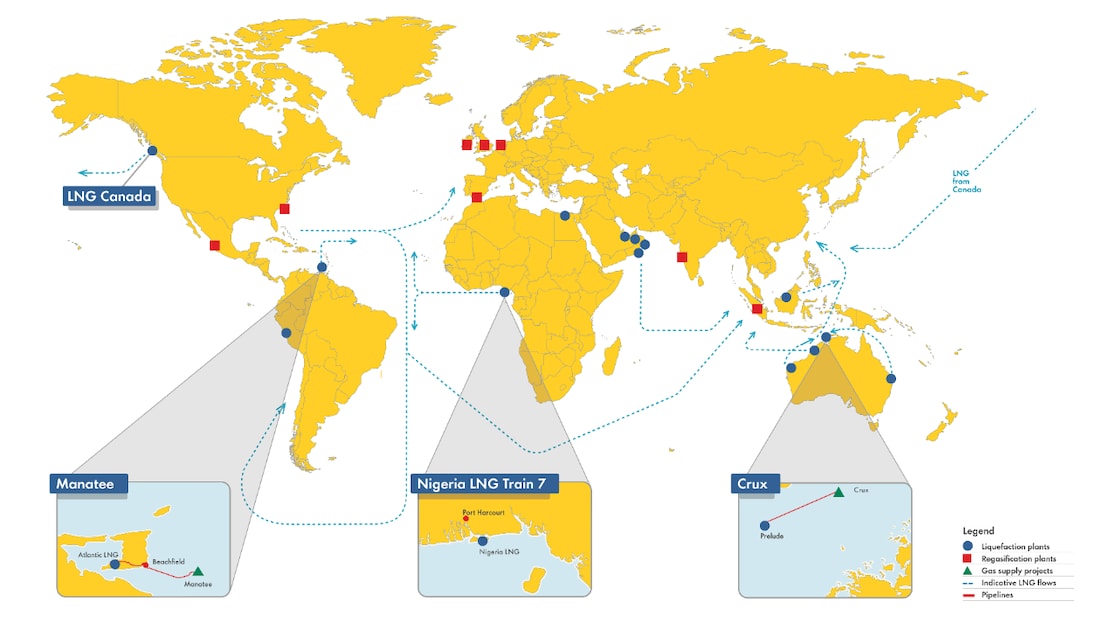
This map shows LNG production facilities and regasification terminals in which Shell has interests or rights, as well as indicative LNG flows worldwide.
Map description
Map description
The world map shows the locations of LNG liquefaction plants and regasification terminals, together with indicative LNG flows around the world.
Blue circles mark LNG liquefaction plants. These are shown in Canada, Trinidad and Tobago, Peru, Egypt, Nigeria, Qatar, Oman, Brunei and Australia.
Red squares mark regasification terminals. These are shown in the UK, the Netherlands, Gibraltar, India, Singapore, the USA and Mexico.
Dashed blue lines and arrows indicate broad LNG flows around the world, including from Canada towards Asia, from the Caribbean towards Europe, from Nigeria north towards Europe and southwards, from the Middle East towards Southeast Asia, and from Australia towards Asia.
Three enlarged inset maps highlight projects featured in the story:
Manatee, Trinidad and Tobago: shows the planned offshore location of the Manatee platform and the pipeline that will transport gas from Manatee to the Beachfield processing facility and from there to Atlantic LNG.
Nigeria LNG Train 7, Nigeria: shows the location of Nigeria LNG and nearby Port Harcourt.
Crux, Australia: shows the location of the Crux platform and the pipeline that will transport gas from Crux to Prelude.
Crux in Australia: new gas for the next decade
Hundreds of kilometres off Australia’s north-west coast, the new Crux platform will produce natural gas from reservoirs beneath the seabed. The gas will travel through a 160-kilometre (99-mile) pipeline to Prelude, Shell’s floating LNG facility, where it will be turned into LNG and shipped to customers in Asia.
Once producing, Crux will supply Prelude with up to 550 million standard cubic feet of gas a day – almost equivalent to Vietnam’s gas demand in 2024. The new gas will help Prelude produce LNG well into the 2030s.
By tying into existing infrastructure, Crux can be developed at a significantly lower cost than a standalone project. “With Crux, we do not have to start from scratch,” says Emma Purton, who leads the team preparing to operate and maintain the new platform. “We have the people, the experience and much of what we need already in place, which help us do things more efficiently.”
Crux will eventually operate with no one on board. Instead, the team will manage it from Prelude, making periodic visits to the platform. Crux will also generate its own electricity using gas turbines. “It will be self-sufficient power-wise, which is unique for an unmanned facility,” says Emma.
Four years after construction began, the platform is now in place offshore. The next major step is commissioning, including preparing the wells for production. “We are really excited to get through start-up and see Crux up and running,” says Emma.
Production is expected to start in 2027.
Train 7 in Nigeria: adding 8 million tonnes of LNG a year
On Bonny Island, off Nigeria’s southern coast, Nigeria LNG’s six production units, known as trains, turn natural gas into LNG for export. Now, 16 years after the plant’s last major expansion, a seventh production unit is taking shape.
Train 7 will increase the plant’s production capacity from 22 million to 30 million tonnes a year – roughly equivalent to Belgium and the Netherlands’ combined gas demand in 2024.
Construction is taking place while the plant continues to operate around the clock. Once complete, Train 7 will share its power systems, control rooms, storage tanks and export infrastructure with the rest of the plant. "I have never seen a project with this level of integration to the existing asset. That is what makes it exciting – and why bringing it all together safely is so important,” says Gerard Bowers, Governance Manager at Train 7, who helps keep one of the world's largest LNG expansion projects on track, connecting teams on Bonny Island with experts across Shell.
By using infrastructure already in place, Train 7 can add LNG capacity at a lower cost than building a standalone facility from scratch. The project is now more than 90% complete. Much of the work ahead involves testing equipment and control systems that will eventually need to operate together as one train.
“Nigeria LNG has been producing for over 25 years,” says Gerard. “With this latest expansion, we’ll help set the plant and the community up for success for years to come.”
Train 7 is expected to start up in 2027.
Photo gallery

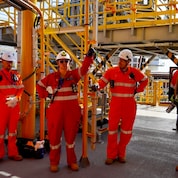
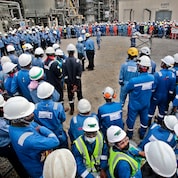
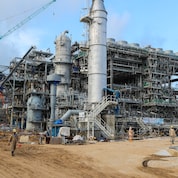
Manatee in Trinidad and Tobago: bringing a major gas field into production
Off Trinidad and Tobago’s southeast coast, Shell is developing one of the country’s largest gas fields ever discovered. At its peak, Manatee is expected to produce around 604 million standard cubic feet of gas a day – enough to heat London and Berlin combined for a year. The project will also help more than double Shell’s current gas production in Trinidad and Tobago.
Gas from Manatee will travel through a 115-kilometre (71-mile) pipeline to the existing Beachfield processing facility. From there, a portion of the gas will go to Atlantic LNG, a liquefaction plant on the south-west coast, where it will be turned into LNG and shipped to customers overseas, including in Europe and North America. The rest will stay in Trinidad and Tobago, helping generate electricity and supply the country’s petrochemical industry.
“Manatee is a great resource, and we can process it using infrastructure that is already in place,” says Jos van Peer, Project Director for Manatee, who leads the team responsible for delivering the project. “That helps reduce costs and delivery times compared with similar projects in the region.”
Manatee will be operated remotely as a normally unmanned offshore platform. Its topsides weigh several thousand tonnes and will house the production unit. They have now left Altamira, Mexico, bound for Trinidad and Tobago, where they will be mounted on the locally manufactured jacket – the steel structure that acts as the platform’s legs.
“There is still a huge amount of work ahead, but we have an incredible team integrating and bringing all these pieces together,” says Jos.
Manatee is expected to start production in 2027.
Frequently asked questions
Why is global demand for LNG expected to grow?
Why is global demand for LNG expected to grow?
Global demand for liquefied natural gas is expected to reach nearly 700 million tonnes a year by 2050, around 65% higher than 2025 levels¹, according to the Shell LNG Outlook 2026.
Growth is being driven by rising energy demand and the need for reliable and flexible energy supplies. Emerging economies in Asia are expected to account for around 40% of global LNG imports by 2050, as they seek to meet growing demand for energy with lower emissions than coal. New sources of electricity demand, including data centres, are also expected to contribute to LNG demand growth.
1. This is calculated using the median figure of the forecasts, 695 MT, we have used for LNG demand by 2050. The range is between 610 and 780 million tonnes a year. Based on 2025 total trade, this is forecast growth of around 65%. These are the same forecast figures that were used in Shell’s Strategic Spotlight on LNG (3 MB) (PDF) published in March this year.
What role does Shell play in LNG?
What role does Shell play in LNG?
Shell is a world-leading supplier of LNG, with around 44 million tonnes of equity liquefaction capacity. We are involved across the LNG value chain, from exploring for and producing natural gas, to liquefaction, trading, shipping, regasification and delivering LNG to customers around the world.
We are growing our Integrated Gas and LNG business and aim to increase LNG sales by 4-5% per year through to 2030 [A].
[A] On a compound annual growth rate (CAGR) basis
What is Shell doing to reduce methane emissions?
What is Shell doing to reduce methane emissions?
Shell uses a range of technologies and work practices to detect, monitor, measure, and reduce methane emissions across our operations. In 2025, Shell reduced total methane emissions from assets under our operational control by 78% compared with 2016, from 138,000 tonnes to 31,000 tonnes. Shell also works with suppliers, customers and industry partners to reduce methane emissions across the LNG value chain, from gas production and liquefaction to shipping and delivery.
Why is new oil and gas production still needed today?
Why is new oil and gas production still needed today?
The world still needs energy from hydrocarbons. Fossil fuels, including coal, oil and gas, represented about 80% of global energy consumption in 2024, with oil and gas accounting for 53%, according to the International Energy Agency (IEA). Shell believes continued investment in oil and gas will be needed to ensure a balanced energy transition. Our investments are needed to maintain oil and gas supplies as existing fields naturally decline at a rate of 4-5% a year, faster than reductions in demand.
Cautionary note
Cautionary note
The companies in which Shell plc directly and indirectly owns investments are separate legal entities. In this content “Shell”, “Shell Group” and “Group” are sometimes used for convenience to reference Shell plc and its subsidiaries in general. Likewise, the words “we”, “us” and “our” are also used to refer to Shell plc and its subsidiaries in general or to those who work for them. These terms are also used where no useful purpose is served by identifying the particular entity or entities. ‘‘Subsidiaries’’, “Shell subsidiaries” and “Shell companies” as used in this content refer to entities over which Shell plc either directly or indirectly has control. The terms “joint venture”, “joint operations”, “joint arrangements”, and “associates” may also be used to refer to a commercial arrangement in which Shell has a direct or indirect ownership interest with one or more parties. The term “Shell interest” is used for convenience to indicate the direct and/or indirect ownership interest held by Shell in an entity or unincorporated joint arrangement, after exclusion of all third-party interest.
Forward-Looking statements
This content contains forward-looking statements (within the meaning of the U.S. Private Securities Litigation Reform Act of 1995) concerning the financial condition, results of operations and businesses of Shell. All statements other than statements of historical fact are, or may be deemed to be, forward-looking statements. Forward-looking statements are statements of future expectations that are based on management’s current expectations and assumptions, including (without limitation) those concerning Shell’s strategy and operating plans, macroeconomic conditions, future energy demand, supply and product mix, commodity prices, demand for Shell’s products, production results and reserve estimates, development, execution and management of projects, energy transition and climate change, management of safety and environmental risks, costs, cash capital expenditures, technology advancements, legislative, judicial, fiscal and regulatory developments, regional conflicts and trading conditions, and involve known and unknown risks and uncertainties that could cause actual results, performance or events to differ materially from those expressed or implied in these statements. Forward-looking statements include, among other things, statements concerning the potential exposure of Shell to market risks and statements expressing management’s expectations, beliefs, estimates, forecasts, projections and assumptions. These forward-looking statements are identified by their use of terms and phrases such as “aim”; “ambition”; ‘‘anticipate’’; “aspire”, “aspiration”, ‘‘believe’’; “commit”; “commitment”; ‘‘could’’; “desire”; ‘‘estimate’’; ‘‘expect’’; ‘‘goals’’; ‘‘intend’’; ‘‘may’’; “milestones”; ‘‘objectives’’; ‘‘outlook’’; ‘‘plan’’; ‘‘probably’’; ‘‘project’’; ‘‘risks’’; “schedule”; ‘‘seek’’; ‘‘should’’; ‘‘target’’; “vision”; ‘‘will’’; “would” and similar terms and phrases. There are a number of factors that could affect the future operations of Shell and could cause those results to differ materially from those expressed in the forward-looking statements included in this content, including (without limitation): (a) price fluctuations in crude oil and natural gas; (b) changes in demand for Shell’s products; (c) currency fluctuations; (d) drilling and production results; (e) reserves estimates; (f) loss of market share and industry competition; (g) environmental and physical risks, including climate change; (h) risks associated with the identification of suitable potential acquisition properties and targets, and successful negotiation and completion of such transactions; (i) the risk of doing business in developing countries and countries subject to international sanctions; (j) legislative, judicial, fiscal and regulatory developments including tariffs and regulatory measures addressing climate change; (k) economic and financial market conditions in various countries and regions; (l) political risks, including the risks of expropriation and renegotiation of the terms of contracts with governmental entities, delays or advancements in the approval of projects and delays in the reimbursement for shared costs; (m) risks associated with the impact of pandemics, regional conflicts, such as the Russia-Ukraine war and the conflict in the Middle East, and a significant cyber security, data privacy or IT incident; (n) the pace of the energy transition; and (o) changes in trading conditions. No assurance is provided that future dividend payments will match or exceed previous dividend payments. All forward-looking statements contained in this content are expressly qualified in their entirety by the cautionary statements contained or referred to in this section. Readers should not place undue reliance on forward-looking statements. Additional risk factors that may affect future results are contained in Shell plc’s Form 20-F for the year ended December 31, 2025 (available at www.shell.com/investors/news-and-filings/sec-filings.html and www.sec.gov). These risk factors also expressly qualify all forward-looking statements contained in this content and should be considered by the reader. Each forward-looking statement speaks only as of the date of this content. Neither Shell plc nor any of its subsidiaries undertake any obligation to publicly update or revise any forward-looking statement as a result of new information, future events or other information. In light of these risks, results could differ materially from those stated, implied or inferred from the forward-looking statements contained in this content.
Shell’s net carbon intensity and net-zero emissions target
In this content we may refer to Shell’s “net carbon intensity” (NCI), which includes Shell’s carbon emissions from the production of our energy products, our suppliers’ carbon emissions in supplying energy for that production and our customers’ carbon emissions associated with their use of the energy products we sell. Shell’s NCI also includes the emissions associated with the production and use of energy products produced by others which Shell purchases for resale. Shell only controls its own emissions. The use of the terms Shell’s “net carbon intensity” or NCI is for convenience only and not intended to suggest these emissions are those of Shell plc or its subsidiaries.
Shell’s operating plan and outlook are forecasted for a three-year period and ten-year period, respectively, and are updated every year. They reflect the current economic environment and what we can reasonably expect to see over the next three and ten years. Accordingly, the outlook reflects our combined Scope 1 and 2 target, NCI target and our oil products ambition over the next ten years. However, Shell’s operating plan and outlook cannot reflect our 2050 net-zero emissions target, as this target is outside our planning period. Such future operating plans and outlooks could include changes to our portfolio, efficiency improvements and the use of carbon capture and storage and carbon credits. In the future, as society moves towards net-zero emissions, we expect Shell’s operating plans and outlooks to reflect this movement. However, if society is not net zero in 2050, as of today, there would be significant risk that Shell may not meet this target.
The information provided above regarding Shell’s NCI and net zero emissions target are not intended, nor should they be construed as introducing, suggesting or making any claim, target or representation thereof other than what is included in the content.
Forward-Looking non-GAAP measures
This content may contain certain forward-looking non-GAAP measures such as free cash flow and underlying operating expenses. We are unable to provide a reconciliation of these forward-looking non-GAAP measures to the most comparable GAAP financial measures because certain information needed to reconcile those non-GAAP measures to the most comparable GAAP financial measures is dependent on future events some of which are outside the control of Shell, such as oil and gas prices, interest rates and exchange rates. Moreover, estimating such GAAP measures with the required precision necessary to provide a meaningful reconciliation is extremely difficult and could not be accomplished without unreasonable effort. Non-GAAP measures in respect of future periods which cannot be reconciled to the most comparable GAAP financial measure are calculated in a manner which is consistent with the accounting policies applied in Shell plc’s consolidated financial statements. These forward-looking non-GAAP measures are provided to assist readers in understanding management’s use and expectations of such measures and may not be appropriate for other purposes.
The contents of websites referred to in this content do not form part of this content.
We may have used certain terms, such as resources, in this content that the United States Securities and Exchange Commission (SEC) strictly prohibits us from including in our filings with the SEC. Investors are urged to consider closely the disclosure in our Form 20-F, File No 1-32575, available on the SEC website www.sec.gov.