The Energy Podcast from Shell
With more than a century of experience connecting energy to people, we bring together our own experts and guests on the big topics in energy. The home of conversation about the energy that powers our world.
Listen, watch and subscribe:
The Energy Podcast is designed for anyone interested in the future of the global energy system, the energy transition and corporate sustainability. Whether you work in, invest in or are just curious about the energy sector, The Energy Podcast is for those who want to understand the technological, logistical, and environmental shifts happening in the industry. For more information, see our FAQs.
Latest from season 8
Read the transcript
Read the transcript
Title: Energy demand: what customers need now | The Energy Podcast
Duration: 18:24
Description:
What is driving the growth in energy demand? From transport to industry, how are customer needs changing?
From fuels and lubricants to chemicals, electric-vehicle charging and lower-carbon solutions, customer expectations are evolving and industries are adapting. In this episode of The Energy Podcast, Machteld de Haan, Shell's President of Downstream, Renewables and Energy Solutions, discusses why different sectors require different solutions, what customers need today, and how policy, technology and demand influence whether new energy solutions can scale.
About The Energy Podcast:
https://www.shell.com/news-and-insights/the-energy-podcast.html
Cautionary note:
https://www.shell.com/investors/disclaimer-and-cautionary-note.html
The Energy Podcast – Season Eight, Episode Four - Accessibility Transcript
[Background music]
Up-tempo music
[Text displays]
Coming up
[Visuals]
We open with a montage of soundbites delivered at various points throughout the upcoming episode, featuring the episode’s guest, Shell’s President of Downstream, Renewables and Energy Solutions, Machteld de Haan, seated in a yellow armchair that forms part of The Energy Podcast’s set.
Machteld:
When you read the news, you would think that actually most of the energy demand growth would be coming from data centres and AI. It's actually a story that's broader than that, and it's really grounded in human progress.
Customer need, technology readiness, and supportive policy. All three need to be in place to make sure that you can then really develop something at scale. It's not always about investing early.
[Visuals]
Cuts to ‘The Energy Podcast from Shell’ title sting
[Voiceover]
Over the title sting, the host of The Energy Podcast, Bryony, delivers the out-of-vision voiceover lines:
The Energy Podcast from Shell. The home of conversation about the energy that powers our world.
[Visuals]
Transitions to shot of Bryony sat in a yellow armchair in an interview/podcast setting.
Bryony:
The world needs more energy than ever before - to fly, to build, to use AI - but what customers expect from energy is changing, too. So what happens when growing demand meets changing demand? And how do you keep pace with what customers need? Joining me to explore this is Machteld de Haan, Shell's President of Downstream, Renewables and Energy Solutions.
I'm Bryony…
[Text displays]
Bryony (with a white arrow pointing to her)
Bryony (continues):
…. and this is The Energy Podcast from Shell.
[Visuals]
Transitions to The Energy Podcast title sting before returning to Bryony who we see is joined by her guest for this episode. The video will cut between host and guest multiple times during their conversation.
[Text displays]
A chapter heading for the episode appears on screen that reads:
Downstream
Bryony:
Machteld, thanks so much for coming to join us on The Energy Podcast today. Let's talk about your job title. Perhaps let's decode it a bit. What does downstream mean? And tell us what you do.
Machteld:
It's not very intuitive, so maybe good to decode it a bit. The downstream business literally means that, in my part of the business, we produce the products that meet the needs of our customers…
[Name strap]
Machteld de Haan
President, Downstream, Renewables and Energy Solutions
Shell
Machteld (continues):
…and those products you will find everywhere out there. So, our customers are on the road, in the air, on ships - even electricity to businesses. So, it really cuts across a wide range of sectors. So, if you think about it directly or indirectly, we supply energy to about a billion people every year. So, it's a very broad range of products that ranges, indeed, from fuel at the mobility stations, could be electricity, these are chemical products but also lubricants products and also lower-carbon products that we have in our portfolio. And that means that we will always be listening to our customers, in terms of what their needs are, and continue to make, buy, or blend those products as we go.
[Text displays]
A chapter heading for the episode appears on screen that reads:
Role of fuels and lubricants
Bryony:
And the customer, your, sort of, customer on your forecourt may know Shell through filling up their cars or charging their cars. But we also have some other products that people may be less familiar with, as well. Tell us what those are.
Machteld:
Absolutely. The gas stations are always the easy part to explain, but if you think about the products that we make from oil and gas in our chemicals factories, or even the broader range that we make in our refineries, and where they show up in the world, you will never look the same at the world because you will see it everywhere. The chemicals that we produce, they go into plastics, they go into your clothing, they go into the iPhone, they go into a wind turbine, a car. So, you will literally see that everywhere. Similar to our lubricants, any process that requires any rotation, whether it's a car, an industrial process or, again, a wind turbine, it's going to need lubricants or it will not work. So, literally, the products that we make are everywhere you look.
[Text displays]
A chapter heading for the episode appears on screen that reads:
Demand growth
Bryony:
When you add all of that up, you start to imagine just how much energy the world is consuming and demand is still growing. So, where do you see that growth coming from?
Machteld:
When you read the news, you would think that most of the growth would be coming from data centres and AI and the tech growth that we see everywhere. I would argue it's actually a story that's broader than that, and it's really grounded in human progress because, if you think about it, every year another 150 million people move up to the middle class.
[Text displays]
Share your questions and comments: @Shell
(LinkedIn, YouTube and Instagram logos also appear underneath this)
Machteld (continues):
And when they move up to the middle class, their desires change, right? Suddenly they may be able to afford a car and get more fuel. They may get air conditioning, they may start to travel by air. So, there's all this demand that grows on the back of human progress. It impacts the infrastructure, the housing space. And these are all the areas where we, as Shell, make products for, as we discussed earlier. So, that means there's a lot of growth across the board. But it's not just tech. It's also human progress.
[Text displays]
A chapter heading for the episode appears on screen that reads:
Customer needs
Bryony:
But growth is a part of the picture, right. So, for the customers that you work with, back to your businesses in particular, what do you think has changed most for them over the last, sort of, five to 10 years?
Machteld:
I think a lot has changed, to be honest. If you think about the level of uncertainty that our customers need to navigate and, obviously, our role is to help them navigate those pathways, but it's geopolitical tension, it is decarbonisation considerations, emissions. It is technology disruptions. It's also including AI, and then the conflicts that have happened recently. So it's all of that together. And, in the end, the customers want affordable, reliable, performance-driven and resilient supply of energy. And of course, in our businesses across the B2B and B2C customers, we try to help them navigate all of that uncertainty.
[Text displays]
A chapter heading for the episode appears on screen that reads:
Supply resilience
Bryony:
Yeah, I mean, this year is the year of uncertainty. The crisis in the Middle East, the effective closure of the Strait of Hormuz. Big impact on customers. When do you think they started to feel the impact of that disruption? And to what extent, perhaps a difficult question, but to what extent have you been able to mitigate the impact on your business customers?
Machteld:
I think it differs a little bit per sector. Maybe I'll start saying upfront that probably when it happened, all our scenario thinking turned out not to be correct because, basically, you find that the market is so resilient, in terms of finding ways - alternative ways - to get the products to the customers. And I have to say, our teams have been phenomenal. Whether it is from a shipping perspective which was, of course, very largely impacted and moving the products became difficult or not possible even. On the lubricants side, the team has done a great job to work with our customers, to find alternatives and to make sure that we continue to keep their operations running. And, from an airline perspective, I will say that particularly jet fuel was looking difficult. But, as I said, the market and the refineries have found ways to make sure that we can continue to supply the market. But it is always a very tight supply chain, and it remains a very tight supply chain. And the longer the conflict lasts, the more impact we will continue to feel.
[Text displays]
A chapter heading for the episode appears on screen that reads:
Road transport
Bryony:
I want to talk about many of the ways that energy’s consumed. Let's start with road transport. So, acknowledging the picture is different depending on which country you're in, when you look at road transport today, what do you think is the biggest change and the biggest challenge, I guess, in seeing how customers think about energy? And when I say customers, I mean people making decisions about their corporate fleets to the person on the forecourt.
Machteld:
Road transport is a name for a very wide variety that sits within the road transport, as you alluded to. It's one of the biggest sectors, in terms of emissions, but it's also a very differentiated sector within. You've got your commercial road transport, so long haul delivering products across coast to coast in the US or across Europe. You've got your, maybe, smaller delivery vans which have shorter distances. And then, of course, you've got your passenger cars, your consumers that drive to work or to holiday or wherever they go. And I think what I'm seeing is that every part of that, within that sector, really requires… and we'll look at different solutions going forward. Won't be the same solution for everything because the purpose of the transport is different. I do think electrification is a big part of it, particularly on the consumer side. If you look to 2025, I think we topped 20 million electric vehicles sold globally. So, one out of four - and it's now, I guess, around 5% of the total global fleet. So it's there, but it's not going as fast as it can everywhere, right? So, we need to find, also, alternatives that we can use today in the existing transport vehicles that we have. So, think about renewable diesel, biofuels - those are the type of fuels that you can use within the existing fleet that is out there today.
Bryony:
And renewable diesel for someone may think, I'm not sure what that is.
Machteld:
Renewable fuels are made out of organic waste, usually, or used cooking oil. So, they're different sources, but they're organic sources and not fossil-based. Today, we have renewable diesel on that side. But you also have ethanol on the gasoline side. So, again, more for the passenger cars. And ethanol is a product that gets made out of corn or out of sugar cane, and that you can blend into existing pools of fuel.
[Text displays]
A chapter heading for the episode appears on screen that reads:
Sustainable aviation
Bryony:
So, the road is a place where we see different solutions coexisting. But let's look at aviation because I think that is a trickier picture. Air travel continues to grow and so does demand to reduce emissions. So how do you think airlines are tackling that?
Machteld:
I think the airline is a very specific situation because it's really a growing sector. People will start to travel. People will continue to travel, but countries need the air connectivity to make sure that they can run their economies in the most efficient way. So, I think for the airline sector, it's not about one or the other. It's about, how do we facilitate the growth and decarbonise the industry? So they're going to need to find ways to reduce their carbon intensity, but allow people to travel more through air. If you think about the solutions there today, we use sustainable aviation fuel, or SAF, as we call it, and this is a product that can be used today. And, again, we do. And we blend it into the jet so that we can already support the airlines in reducing their carbon intensity. The team was able to sign a five-year agreement with Delta recently - where we then support them to get access to sustainable aviation fuel across their US hubs. But we support them with the logistics, with the blending and the infrastructure to be able to start using it. So, it's a really important part in that sector.
Bryony:
And you see that growing?
Machteld:
It does require good policy framework and regulation because, as it stands today, sustainable aviation fuel is much more expensive to produce, as you can imagine, than regular jet. So it does require stable policy and regulation to make sure that there's a mandate that then drives the customer demand to offtake it, so that we can reduce the intensity in the sector.
[Text displays]
A chapter heading for the episode appears on screen that reads:
Heavy industry
Bryony:
Industry is a very energy-intense sector, as well. So for the customers of yours that might be in the iron business, steel business, cement business, chemicals perhaps. What are they looking for from a provider like Shell?
[Name strap]
Machteld de Haan
President, Downstream, Renewables and Energy Solutions
Shell
Machteld:
The sectors that you mentioned are exactly the sectors that you need to, again, accommodate the growing middle class with houses, infrastructure, the steel, the cement, etc. These are also the hard-to-abate sectors, which means that it's really hard for these sectors to electrify or to find alternatives in way of reducing their emissions. So, one of the ways that we're looking at whether we can support them on that is with carbon capture and storage. So, we have a position offshore Norway we call Northern Lights, and we actually have a cement customer bringing their liquid CO2 to Northern Lights that we can then store safely and securely. So, there are different alternatives in that space for these sectors that have more difficulty finding other solutions.
[Text displays]
A chapter heading for the episode appears on screen that reads:
AI and data centres
Bryony:
I think we've spoken about Northern Lights quite a few times on the podcast, and actually spoken to one of the customers from Northern Lights, as well. It's a really interesting, ongoing project. Data centres and AI. I know you mentioned this briefly at the beginning. Generating headlines, probably more about their scale and where to put them at the moment, but the energy required for data centres is something that you're involved with.
Machteld:
It's an interesting, up-and-coming sector. And, as you said, it makes the headline on a daily basis. I think there are different ways that we're trying to work with data centres. On one hand, we have a very clear competitive capability with our trading team…
[Text displays]
Share your questions and comments: @Shell
(LinkedIn, YouTube and Instagram logos also appear underneath this)
Machteld (continues):
… where they actually arrange supply and demand for data centres, and many other customers, in terms of the electricity needs that we have there. But we're also looking from a different angle, particularly from our lubricants sector, where we're looking at direct cooling or immersion cooling for data centres so that they can produce more, be more effective, but also potentially reduce some of the more negative consequences of a data centre, in terms of water usage or land usage. So, it's a very interesting up-and-coming sector.
Bryony:
So, when you say immersion cooling, just for people who are perhaps uninitiated, just tell me what that is, in a nutshell.
Machteld:
So, basically what it does is when you run a data centre, there's a lot of heat coming from the data centre. You need to cool that heat. That's usually done in the past by air or by water. Now we're trying to reduce the heat through liquid. So, you immerse the cables in the liquid that then absorbs the heat and releases it in a different way, making the data centre or the computing power more effective.
[Text displays]
A chapter heading for the episode appears on screen that reads:
Integrated energy solutions
Bryony:
So, following on from that, Shell wants to be the leading integrated energy company. Perhaps give us a good example of how a customer might benefit from Shell being able to connect the different parts of that system together.
Machteld:
We should actually ask the question to the customers but, when I've done that in the past, the customer wants a whole range of different products or services. So, take an example like DHL. They have logistics, they've got a large truck fleet, they have airplanes, they fly, and they have a decarbonisation target. So, it's a really wide range of things that they require, and I’ve probably missed out on a few more as well. So, when I think about Shell being an integrated energy company, it's our ability to service the customer as one, to make sure that we can really make the connections across those different products and services. Because, in the end, the customer doesn't really care how we're organised. They want what they need to run their business. And I think, being integrated, we’re able to make that work in the best way possible.
[Text displays]
A chapter heading for the episode appears on screen that reads:
Technology at scale
Bryony:
We've talked about things that are evolving. Perhaps your immersion cooling fluids and things that, maybe, are going to come more into the, kind of, public consciousness. But I wonder how much of your job, which is obviously so involved with so many different parts of the energy system, how much of your job is about responding to evolving needs, and how much is about anticipating what comes next? How do you do that?
Machteld:
Of course, it's both that we need to do. But talking about maybe a new product or technology, when things really come together is where you have the customer need, where you have the technology readiness and where you have supportive policy. And, actually, all three of them need to be in place to make sure that you can then really develop something at scale. So, we get the customer demand, of course, from listening to our customers. We've got a fantastic technology group within Shell, where we develop the latest and newest insight for products of today, but also for products of tomorrow. But particularly that policy framework needs to be in place, so that our customers and then, of course, we as well, in meeting their demands, can make the long-term investments against the backdrop of a stable policy - particularly, I would say, in Europe. That is something that we've seen quite volatile, and I would like to see a much more stable policy to warrant some of those long-term investments that are needed for the next wave of technology and products. So it's not always about investing early sometimes it's better when all those things come together.
Bryony:
What would be an example?
Machteld:
One is carbon capture and storage. This is where you really see the three things coming together: the technology, the customer demand for, in particular, those hard-to-abate sectors, but also the policy framework coming together. And one of the great examples is Northern Lights, where the Norwegian government was very supportive, we have the customer demand and we have the technology to store the liquid carbon in a safe and secure way. So, this is a good example. We're probably at the start - more to be done.
[Text displays]
A chapter heading for the episode appears on screen that reads:
Future energy demand
Bryony:
Talking about the future. Ten, 20 years, 30 years’ time, what's the one way that you think that the world uses energy today that may be completely different in the next two decades? If you can point to one.
Machteld:
Probably I could point to many different aspects. I would probably say it's not so much how we consume the energy. I think it's who consumes the energy. And it's a little bit back to the point that I made earlier. There's such a large group coming up to middle class every year that I think it will be surprising who is consuming all the energy, and particularly across countries like India and China and across the globe. So, I would say that would probably be the biggest change - and, therefore, huge growth in the demand of energy going forward.
Bryony:
Machteld, thanks so much for joining us today.
Machteld:
Thank you.
[Visuals]
The Energy Podcast - Epilogue wipe. Then transitions back to Bryony sat in her armchair.
Bryony:
That's it for today. You can find Shell's cautionary note and references for this episode in the show notes.
[Text displays]
Subscribe now (with white arrow pointing to bottom right-hand corner of screen)
Bryony (continues):
And if you enjoyed our conversation, make sure to follow us wherever you get your podcasts. Or, of course, you can find us on YouTube. In our next episode, we'll be discussing hydrogen and what it takes to develop lower carbon solutions like this. We'll see you next time.
[Visuals]
Transitions to ‘The Energy Podcast from Shell’ closing sting.
[Visuals]
The closing sting transitions to:
[Shell endboard with logo]
© SHELL INTERNATIONAL LIMITED 2026
What is driving the growth in energy demand?
From transport to industry, how are customer needs changing?
From fuels and lubricants to chemicals, electric-vehicle charging and lower-carbon solutions, customer expectations are evolving and industries are adapting. In this episode of The Energy Podcast, Machteld de Haan, Shell's President of Downstream, Renewables and Energy Solutions, discusses why different sectors require different solutions, what customers need today, and how policy, technology and demand influence whether new energy solutions can scale.
Read the transcript
Read the transcript
Title: Strait of Hormuz: inside the response to a global energy crisis? | The Energy Podcast
Duration: 29:18
Description:
What happens when a global energy chokepoint closes?
In this episode of The Energy Podcast, we go inside Shell's response to the closure of the Strait of Hormuz, a disruption that put around a fifth of global oil and LNG supplies at risk.
Drawing on first-hand experience, Shell's Chief of Staff Tony Nunan and Executive Vice President Shipping and Maritime Karrie Trauth reflect on navigating uncertainty, supporting ships and crews affected by the crisis, and working with governments, partners and customers to help keep energy flowing safely.
From difficult decisions to the complexity of global shipping networks, this is a behind-the-scenes look at navigating a crisis when the world's energy system is under strain.
About The Energy Podcast:
https://www.shell.com/news-and-insights/the-energy-podcast.html
Cautionary note:
https://www.shell.com/investors/disclaimer-and-cautionary-note.html
The Energy Podcast – Season Eight, Episode Two - Accessibility Transcript
[Background music]
Up-tempo music
[Text displays]
Coming up
[Visuals]
We open with a montage of soundbites delivered at various points throughout the upcoming episode, featuring the episode’s two guests, both seated in yellow armchairs, as part of The Energy Podcast’s set.
We start by hearing a soundbite from Tony Nunan, Shell’s Chief of Staff, followed by a soundbite from Karrie Trauth, Executive Vice President Shipping and Maritime at Shell.
Tony:
You're doing those calls with colleagues in the affected areas, and a siren goes off and they have to evacuate. It makes it incredibly real that what we're dealing with is impacting people's lives then and there.
Karrie:
There are women and men on board these ships. There's human life. That decision never actually gets easier.
[Visuals]
Cuts to ‘The Energy Podcast from Shell’ title sting
[Voiceover]
Over the title sting, Bryony delivers the out-of-vision voiceover lines:
The Energy Podcast from Shell. The home of conversation about the energy that powers our world.
[Visuals]
Transitions to shot of Bryony and Nitin sat in yellow chairs in an interview/podcast setting. The camera switches often between them.
Bryony:
Hello and welcome to The Energy Podcast from Shell. I'm Bryony…
[Text displays]
Bryony (with a white arrow pointing to her)
Nitin:
… and I'm Nitin…
[Text displays]
Nitin (with a white arrow pointing to him)
Bryony:
At its narrowest point, the Strait of Hormuz is barely 50 kilometres wide, but most oil and gas exports from the Gulf have nowhere else to go other than travel through this narrow sea passage.
Nitin:
Around a fifth of the world's supply of oil and liquefied natural gas, LNG, typically flows through the Strait. So when it closed earlier this year, the ripple effects were felt worldwide.
Bryony:
Ships carrying vital energy supplies were stranded, oil and gas markets were rocked, huge production facilities ground to a halt. Access to energy became a real concern in some countries.
Nitin:
So, if it's your job to help keep energy supplies moving safely, where do you begin when a crisis like this one hits? And how do you deal with the uncertainty?
Bryony:
Well, this is exactly what our guests today have been grappling with since the crisis began. We'll be speaking to Shell's Chief of Staff, Tony Nunan, and Executive Vice President for Shipping and Maritime, Karrie Trauth.
Nitin:
With them, we'll build a picture of safely navigating the energy crisis from inside a global energy organisation. One which provides energy, directly or indirectly, to around a billion people each year.
Bryony:
Okay, let's get into it.
[Visuals]
Transitions to The Energy Podcast title sting before returning to Bryony and Nitin, joined by their two guests for this episode. The video will cut between hosts and guests multiple times during their conversation.
[Text displays]
A chapter heading for the episode appears on screen that reads:
Crisis response
Bryony:
Karrie, Tony, so good to have you both with us today. Thank you for being here. Let's just start, just briefly tell us what your roles involve.
Karrie:
It's great to be here. It's great to be back here. I'm the Global Head of Shipping for Shell…
[Name strap]
Karrie Trauth
Executive Vice President Shipping and Maritime, Shell
Karrie (continues):
So, my team does everything from design and construction of ships for Shell's fleet to operations to, as I think we'll talk about today, our emergency and security responses.
Tony:
Tony Nunan, I’m our Chief of Staff. I really have a couple parts of the job…
[Name strap]
Tony Nunan
Chief of Staff, Shell
Tony (continues):
One is I support our executive and the way that we think longer term as a company and the way we bring our strategy to life. I help manage our reputation as a company, and I'm also our Global Crisis Lead who manages our crisis capability.
Bryony:
We're obviously going to start there, Tony, but let's go back to the beginning. So, the Strait of Hormuz closes. Arguably a lot of people have to look up where the Strait of Hormuz is, if you're outside the energy industry. Do you just pull a big crisis plan out of a drawer, dust it off, you know, good to go? Talk us through the process from the outset and how you felt about it when this crisis started.
Tony:
You would always love to have this perfectly planned, you know, response to any situation, of course. Because they're so unpredictable, you don't have that. We've got a couple of things. So first of all, we've got a fantastic team, so we stand them up, who are trained and ready to respond. We follow a pretty simple process, particularly in the early stage. Because the first thing that we're trying to do is to understand what's happening. What does that mean for people? What does it mean for assets? What does it mean for governments and customers? So we look at the current situation. We understand what could escalate it, what could make it worse. And that helps us to get a frame of where we are, so that we can start making decisions. How do you feel, though? You know, when those calls come in, I generally feel initially unsettled because I know that something's happening that I don't yet have a grip on. And so I feel unsettled until we're able to start getting the information and putting some process around it to help us make decisions. I think the second reaction is, I know pretty quickly that this is going to dominate for the foreseeable future, because this is the single most important thing we need to be able to do.
Nitin:
So, as things develop then, could you give us an idea of where some of the crucial decisions, as well as some of the hardest decisions, lay for you?
Tony:
That's the thing, I think that with any crisis it will start in one place and it evolves. And I think with this one in particular, the first place you start is: Are our people safe? Do we know where they are? Are they being looked after? Can we support them? You then go to our assets. Are they producing? Can they safely produce? And are we able to get product to our customers? So that's where you start. And I think that always has to be the focus. Because, of course, looking after our people, making sure that they're safe and well, is critical. And then recognising the huge responsibility we have for our customers to give them the energy that they need in their lives. They have to be the first two places we go. As the crisis evolves and as we're getting more and more information, we want to be in a position to make decisions. You want to be capable of making a decision because it means that you've got insights that can help either keep our people safe, can support the supply of energy, can make sure we look after our customers. So what we're looking for is how do we bring those decisions forward so we can give guidance. And we're doing a couple of things. We're getting information from our colleagues in the region, and we've got fantastic teams on the ground in each of those affected countries. We're also talking to those around us. We're talking to governments, we're talking to security advisers, we're talking to customers. And that's giving us information that helps. What are the hardest decisions? They’re for me anyway, personally, it's always about people. It's knowing that you had in the region, you know, we had a couple of thousand staff and their dependents who were in a really challenging personal situation. It's making decisions that keep them safe and well, knowing that there is risk that sits around it.
Bryony:
How do you make decisions in a situation like this?
Tony:
I love listening to people, first and foremost. I know that I don't have all the information, and it will come from others. So listening and hearing the views of others is really, really important. I know that I'm not going to always get it right, but I know that the decision has to be made. And so recognising those things, I always think how do I make a decision which I believe is the best one at that moment in time, knowing that it may not be perfect? And I do it with a view to what will this look like in the weeks, months and years ahead, rather than just the decision in the moment? And it just helps me personally to recognise that these decisions will have longer effects. But, of course, we're not alone, and we're not the experts in everything. We rely heavily on those around us, whether it's governments, whether it's the advice of the emergency response services in the various countries, but also getting updates from media and other sources. All of those things come together in helping us to make decisions.
Nitin:
Karrie, for anyone that didn't hear you on the podcast last season, could you paint us a quick picture of how the global shipping network usually functions to deliver the energy that our customers need?
Karrie:
Yeah, happy to do that. So I think I described roughly 80% of the world's products and goods move by ship. And that's some 60,000 ships moving around the world, largely in a series of operational lanes. You can see images. There are ships that go around Africa to Europe, there are ships that are going from the Middle East to Asia, there's almost highlighted lanes around the globe if you watch the 60,000 ships moving around. And, on a good day, the system is in balance. Where the demand is and where the supply is are reasonably balanced.
[Text displays]
Share your questions and comments: @Shell
(LinkedIn, YouTube and Instagram logos also appear underneath this)
Karrie (continues):
So I think, when I was on the podcast last, there had been a disruption in the Red Sea. And that caused ships to reroute, reset their approach, and go around the southern tip of Africa to come to Europe or come to America from the Far East. That's a bit of a disruption in how the global flow goes, but it's actually how shipping works, and that's the beauty of it. With 60,000 ships on the sea, you can simply redirect from supply into demand.
[Text displays]
A chapter heading for the episode appears on screen that reads:
Shipping routes
Bryony:
So, you've outlined how it usually works. But I wonder, from your front row seat, do you think the crisis has changed the way you think about that system of moving energy around the world?
Karrie:
Yeah, I think what this crisis has shown, with some 1,000 ships trapped in the Gulf and unable to exit, is how important the navigational chokepoints in the globe are. So there's one here in the Strait of Hormuz, there's the Suez Canal, the Panama Canal. There are a handful of these chokepoints and what this crisis really made us see is that, when one chokepoint closes, it has the potential to significantly impact the entire rest of the system. And this is a chokepoint that doesn't have another outlet. Some chokepoints you can go much longer around, you can go around Africa instead of go through the Suez Canal. This chokepoint simply stopped the provision of this 20% or 30% of the world's oil and gas, and container shipping and bulk shipping from being able to exit the Straits and indeed from being able to go in and supply. So it was two ways.
Nitin:
What has this disruption felt like operationally? Could you give us some insights into how this disruption has maybe changed where yours and your team's immediate focus has been each day?
Karrie:
The focus really was on understanding what ships were where, and what conditions they were in. Many of them were doing cargo operations, they were loading the ship, they were discharging the ship. There were crews transferring because that's something that we do when we go to ports. Global shipping requires people to embark and disembark ships. But those first few days, we also expected this to be short-lived. We had every expectation that, once we gathered the information, we would get to a position where we would be able to start moving ships in and out of the Gulf. And a week in, when we realised that this wasn't going to be short-lived, then you start to think about things like food, water. If you think about the ships travelling the world, sometimes those voyages are a few days, but sometimes those voyages are up to 30, 60 days. So ships carry food. They're big refrigerated stores, big dry stores, just like in your own house. You're settled in, but in your own house you're not ready on any given day to go weeks without going to the grocery store. And so some of the ships, of course, had just loaded and were getting ready to depart and were set for a 30, 60, 90 day voyage. Some ships had just gotten to port, and they were due to have a vessel come alongside and transfer food, or have food transferred across the pier, but if the terminals were full as well... So the early days were finding where do supplies come from? Where can we procure those? How can we physically get those to the ship?
[Text displays]
A chapter heading for the episode appears on screen that reads:
Supporting crews
Bryony:
Tony's said his hardest decision was around people. I wonder where your hardest decisions lie.
Karrie:
Maybe there are two. One of the hardest decisions was trying to determine the safest place for a ship to be within the Gulf when ships within the Gulf were being either intentionally attacked or impacted by projectiles flying over. Ultimately, it's the decision of the captain. The captain, his or her accountabilities includes the safety of the ship and the people. My team provides advice. Many of the companies that we work with rely exactly on that advice, because Shell has a huge network. We have deep relationships into the countries, in this case, around the Gulf, but really around the globe. So, when Shell provides advice, often the companies take it. What probably was the hardest decision was when we started to consider whether to have the vessels under our operations transit the Strait of Hormuz and exit the Gulf.
Bryony:
I mean, I know that, you know, you've got such a long career in what you do. And like you said, people turn to Shell for this kind of expert advice. But does it become easier to make that call, such a crucial call?
Karrie:
I think the only thing that gets easier is the process. How do you think about the question? What information, what data sources are you looking at? How do you test your logic? The decision itself? There are women and men on board these ships. There's human life. That decision never actually gets easier.
Nitin:
So, Karrie, you touched on this earlier, of course. But could you give us a wider sense of what supporting colleagues on the front line actually looks like?
Karrie:
Of course, we have security teams, intelligence teams, but also resilience teams. And so we would have calls with the ships, some of them daily, some of them every other day, depending on what the ship needed. And we've been working on resilience and wellbeing in all of the ships in our fleet. We've been working with them on how to build their resilience just on a normal 30 day trip. And so we were able to pull some of that material out, walk with the ships, walk through the tools they know, remind them what they know, and helping particularly the senior team on the ship. So there's a captain, there's a chief engineer. These are the people who are really responsible for the ship. Helping support them in the decisions they had to make. And I think that's what was so crucial was the two way conversation. Hearing what the master, the captain on the ship, could see and then providing support and feedback. We first introduced resilience as a concept with these shipping companies we work with just before Covid. And we found, through Covid, the importance of being able to speak about resilience, speak about mental health when people feel trapped.
Bryony:
Tell us about some of your conversations that you've had with the captains.
Karrie:
That's really been a bit of a highlight of this.
[Name strap]
Karrie Trauth
Executive Vice President Shipping and Maritime, Shell
Karrie (continues):
I enjoy visiting ships, seeing the crews when I can, when I'm in a port and the ships are in the port. And, during Covid, I did a lot of calls with the crews to see how they were doing, to do a routine visit, if you will, virtually. But this was different. There's one specific one that comes to mind. A few weeks ago, on the International Day of the Seafarer, it’s a UN-recognised day, I got the opportunity to talk with one of our ships, and it was just nice to hear the captain, to hear the chief engineer, talk about both their experience while they were in the Gulf. Karaoke nights were Friday. Pizza was Sunday. So, they they did what they could. And, for me, the opportunity to talk to the crew, to hear from the people on that ship who work for us day in, day out, and their appreciation for what Shell and Shell’s shore-based team were able to do to support them through the crisis, that really… it made my day.
Nitin:
Of course, we don't just have colleagues at sea. Tony, we have thousands of colleagues supporting offices and operations across the Middle East. Now, when the crisis isn't just something that you're monitoring from afar, but is actually something that's unfolding around the people and the operations that you're responsible for, how does that alter your thinking, and how does your experience of dealing with it change?
Tony:
So, undoubtedly is the answer.
[Name strap]
Tony Nunan
Chief of Staff, Shell
Tony (continues):
You can't help but be on calls when you're contemplating big decisions, and you're doing those calls with colleagues in the affected areas. And a siren goes off and they have to evacuate. It makes it incredibly real that what we're dealing with is impacting people's lives then and there. And you can see and feel that through your colleagues. So, I think that if that doesn't affect you, then you've sort of lost that human side of you. And I think that that would be more disastrous for all of us if we just didn't feel it. That said, and I think Karrie touched on this brilliantly, that the decision-making process that we follow can't be affected by it. And I think that being able to feel and sense the personal challenge is really humanly important, but then being able to get the information in a way that helps make decisions in an unemotive way is the key. And so that balance is really, really important because you have to recognise that you have colleagues who are impacted and it's affecting their lives. But then, likewise, we have to make decisions that span thousands of people, but also customers around the world that we have to think about and make sure we do the right thing by them, as well.
[Text displays]
A chapter heading for the episode appears on screen that reads:
Pearl GTL
Bryony:
So the conflict became very real back in March. That attack on Qatar, the Ras Laffan Industrial City, which is at the heart of Qatar's gas and LNG industry, was attacked. And, of course, for those who don't know, Ras Laffan is home to Shell’s Pearl’s GTL, one of the world's largest plants turning natural gas into liquid products, fuels, lubricants, chemical feedstocks, everything we need in everyday life. Thankfully, all the staff were safe at Pearl, and I know you'll talk about that a bit more, but one of the two production lines was damaged and production was stopped. So, what do you remember about that moment that Pearl was impacted and what were your immediate priorities?
Tony:
I think you framed it up really well, Bryony. So, Qatar for us, just the plant itself, one of the most complex hydrocarbon plants in the world. You know, something that from an engineering perspective we're deeply, deeply proud of. And it's operated by people in Qatar who are just… they’re so committed to what they do. And they turn that technology, that engineering marvel, into something that delivers energy that changes people's lives. And it's them who do that. And so, on a day like that, the personal response is one of picturing the colleagues there, having been there, seen it, walked to the plant with them. You know it, and you can feel the response or the reaction that sits with it. So the first response, of course, is: Can we account for our people? Are they safe and well? And there were no injuries. The fact that we were able to work through that, and credit to the teams there but also to the Qatari authorities who were so good in providing information, helped to make sure that that day was a really challenging moment for all of our people, but it wasn't a moment where anyone was hurt.
Nitin:
Can you give us a sense of where things are, in terms of getting Pearl GTL back online?
Tony:
If you go back to that, which is the 18th of March, it was actually the last day or two of Ramadan. You can imagine for our colleagues in Qatar, but across the Middle East, you know, the best part of a month reflecting and fasting. And, to get to that moment, you have to respond and so the first part of the response, of course, is looking after our people, but there was a fire, there was damage. So getting that under control, being able to stabilise the plant. Our teams, I think the focus on that and the delivery on that was something that I know they're immensely proud of and I'm certainly immensely proud of. And, since then, their determination to say, 'That's happened; how do we bring Pearl back to where it was?' has been unbelievable. We've been open that it's going to take around 12 months from when it happened. So, we're looking at March next year. But the damage was just to one of our two production units. And so the production unit that wasn't impacted is still ready for production. The one that was impacted is the one that will take until around March next year to recover.
[Text displays]
A chapter heading for the episode appears on screen that reads:
Lessons learned
Bryony:
I think what's interesting about this conversation is there's always this overriding sense of collaboration, that we're working with partners, we're working with our colleagues. And I'm just wondering, does this crisis teach you both anything, maybe new, about collaboration that you hadn't thought of before? That's been particularly, kind of, brought to the surface? Tony.
Tony:
This crisis was really in two parts. It was the direct impact on those around the region affected, so in the Middle East. But then it was the impact on those who use products that come from there, whether it's petrol stations or lubricants plants or whether or not car factories are going to be able to get enough grease and oil to go into their new vehicles. What I thought was helpful was that the information that we were getting, the collaboration we were getting from others, helped us make decisions. We have a role to play in being able to provide information to others, as well, so they can make decisions. And I think that collaboration both ways, that sharing of information both ways, helps everyone to make decisions that reduces the long term impacts on them.
Bryony:
Has it changed anything in the way you think about collaboration?
Karrie:
I would say, in many ways, it's reinforced. This crisis has really deepened some of those key relationships, and actually demonstrated both the complexity of how the shipping chain works. There's owners, there's countries, there's operators, there's charters, there's…
[Text displays]
Share your questions and comments: @Shell
(LinkedIn, YouTube and Instagram logos also appear underneath this)
Karrie (continues):
… even within what seems like a very simple move of a ship from point A to point B, there are five or six different companies involved. So then, working across that, each of us having our own piece of information was able to allow us to build a bigger picture. And because of Shell's footprint being one of, if not the largest charterer, we then realised we had quite a big picture globally. We were able to understand, to those flows to our customers, what the customer's demands are, and how else other ships, other flows, might be able to serve those customers.
Nitin:
What, if anything, does this crisis teach us about how Shell may react or approach a crisis like this in the future?
Tony:
It's, you know, it sounds strange, I think, that reflecting on learnings, you have some in the moment, you have some that come to you quite a long way afterwards. I think those in the moment there is the importance of following a process in making decisions. When you've got a lot of uncertainty, a lot of personal emotion, a lot of feeling that sits around it, using a process to help guide you is incredibly important. So it’s just continuing to use those. If I had to say what reflection with time, it's how a series of events can all of a sudden start spreading more broadly and have impacts that are far greater than the initial moment, and being able to think ahead and to understand what those could be, and preparing in advance for them. And I think that this was one where you could see the wave of impacts moving out from the Middle East to, initially, India and Pakistan, then into Southeast Asia, then moving up into North Asia, then starting to affect the rest of the world, in terms of supply. And I think that the learning is, how can you see a trend and then get ahead of it and help to pre-empt what could happen, think about scenarios that you could work on, and be ready in the moment. And that was one in this one where, I think, the longer it progressed, as Karrie said, we sort of thought it was going to be a lot shorter than what it was. Past experience, if you look back last year, was 12 days. As it became clear it was becoming a longer event, I think we got a lot better at understanding where could this go and how do we get ahead of that, so we can support our customers, we can support our people, we can support governments, and we can learn on the go?
Karrie:
So, we had been building relationships in and around the Gulf for many years, because there's always the opportunity that something small could happen. A small incident could trigger a temporary closure. If you have a temporary closure, what does that mean? Who are the partners? Who do you need to talk with? Now we realise that temporary closures could be 24 hours long, but temporary closures could be two, three, four, I don't know how many weeks. And so a learning that I would say is that we have to be able to continuously reassess. There is a point when the conflict in the Middle East will settle down, will hopefully be over. But shipping doesn't just revert. It's not like flipping a switch. Even when the conflict’s over, it will take some time for those vessels to exit. And I think even from then, fundamentally, world shipping will change because we'll look at these chokepoints, we'll look at these potential crisis points, for years to come, wondering always what if? What might happen and how we would respond. So, trade will eventually normalise but I think there will always be something in the minds of the seafarers, of the captains, of the shipping companies and, indeed, of companies like Shell, thinking, if this could happen today, what could happen tomorrow?
[Text displays]
A chapter heading for the episode appears on screen that reads:
System resilience
Bryony:
We know, and you said, you know, how much it takes to keep the energy flowing when the system is now under huge strain. I guess a question for both of you, you’ve both been in your positions in the industry for a long time, I wonder if there's anything that's surprised you specifically about what it's taken to keep those supplies going.
Tony:
The world's energy system has lost, at times, up to 20% of its crude and LNG supply because of the Strait’s closure. So what’s surprised me is just the sheer resilience of the global energy system. It's a combination of electrification increasing around the world, with renewables increasing, with just tweaking an extra couple of percentages out of other operating fields around the world and the refineries that go with it, governments making some really thoughtful decisions on how do you balance demand at a time like that so that you can reduce your reliance on energy products when it's most scarce. And, because of all of those little decisions, the global energy system has held up a lot better than what most would have thought. And at least, for me personally, I think that's been the biggest realisation. That the resilience of the global energy system is far greater than what I thought, going in.
Bryony:
Karrie, anything that’s stood out to you as surprising?
Karrie:
So Tony’s talked about the crisis response. I've always known we had a strong operational response. But, for me, one of the surprises was how closely the operational and the strategic responses could work together and, indeed, the depth of experience and the depth of our ability to see data, to visualise and to understand. That's probably the biggest surprise for me.
Nitin:
If you're looking back at the last few months, I'd love to understand what will stay with you both as individuals.
Tony:
For me personally, it was the phone calls in the moment that you never in your mind, you know… I think, in our industry, lots of things go extremely well and every now and then things don't. And you get used to having to respond when things don't go well. But, even with that experience, I never expected to make a phone call to the CEO of Shell to let him know that one of our plants had been impacted. And, in that moment, the continued calmness and professionalism of how he deals with those sort of things, but also hearing the emotion that comes with it. You know, a plant that we're so proud of, which is operated by an amazing group of people, those phone calls will always stay with me.
Karrie:
And I think, for me, the gem that will stay with me is the importance of relationships and the depth of relationships that our organisation has and, between companies globally, how that allows us to respond. And some of the conversations that we had with governments and with other companies, really, for me, are the things that I will take away from this.
Bryony:
Guys, thank you both for joining us today.
Tony:
Thank you for having us.
Karrie:
You’re welcome. Thank you for having us.
[Visuals]
The Energy Podcast - Epilogue wipe. Then transitions back to Bryony and Nitin in their chairs. The camera cuts between them multiple times.
Nitin:
What an interesting episode there, Bryony.
Bryony:
Yeah, completely agree with you. And if you'd like to learn more about what the recent disruption, the ongoing disruption, might mean for the future of the energy system, don't forget you can check out our previous episode where we discuss that with our experts. And looking forward to our next episode, we're going to look at this crisis and what that means for the outlook of LNG, liquefied natural gas, so watch out for that.
Nitin:
Remember that you can find Shell’s cautionary note on Shell's website, and we've also included a link in the show notes.
[Text displays]
Subscribe now (with white arrow pointing to bottom right-hand corner of screen)
Bryony:
And if you enjoyed this conversation, don't forget you can subscribe to The Energy Podcast wherever you get your podcasts from. And, of course, you can also find us on YouTube.
Nitin:
See you next time.
Bryony:
Bye for now.
[Visuals]
Transitions to ‘The Energy Podcast from Shell’ closing sting.
[Visuals]
The closing sting transitions to:
[Shell endboard with logo]
© SHELL INTERNATIONAL LIMITED 2026
Inside the response to a global energy crisis
In this episode of The Energy Podcast, we go inside Shell's response to the closure of the Strait of Hormuz, a disruption that put around a fifth of global oil and LNG supplies at risk.
Drawing on first-hand experience, Shell's Chief of Staff Tony Nunan and Executive Vice President Shipping and Maritime Karrie Trauth reflect on navigating uncertainty, supporting ships and crews affected by the crisis, and working with governments, partners and customers to help keep energy flowing safely.
From difficult decisions to the complexity of global shipping networks, this is a behind-the-scenes look at navigating a crisis when the world's energy system is under strain.
Read the transcript
Read the transcript
Title:
What does today’s crisis reveal about the future of energy? | The Energy Podcast
Duration: 35:51
Description:
What is the ongoing disruption to global energy supplies revealing about the energy system?
In this first episode of a new season of The Energy Podcast, we step back from the headlines to examine how the system is responding to the shocks prompted by the Middle East conflict, and what it could mean for the energy transition.
With insights from Shell’s Chief Energy Adviser Peter Wood, Chief Economist Mallika Ishwaran, and Chief Climate Change Adviser David Hone, the discussion explores the resilience of global supply, the shifting balance between energy security, affordability and sustainability, and why the energy transition remains complex, uneven and long term.
About The Energy Podcast:
https://www.shell.com/news-and-insights/the-energy-podcast.html
https://www.shell.com/news-and-insights/the-energy-podcast.html
More on Shell Scenarios:
https://www.shell.com/news-and-insights/scenarios.html
Cautionary note:
https://www.shell.com/investors/disclaimer-and-cautionary-note.html
The Energy Podcast – Season Eight, Episode One - Accessibility Transcript
[Background music]
Up-tempo music
[Text displays]
Coming up
[Visuals]
We open with a montage of soundbites delivered at various points throughout the upcoming episode, featuring the episode’s three guests all seated on a grey sofa, as part of The Energy Podcast’s set.
We start by hearing soundbites from Peter Wood, Shell’s Chief Energy Adviser, followed by Shell’s Chief Economist, Mallika Ishwaran, and then Shell’s Chief Climate Change Adviser, David Hone.
Peter:
It reminds us that security is at the top.
Mallika:
Governments look to see how do they reduce the import dependency, and how do they build up their domestic energy sources.
David:
Change in the energy system does actually take time.
[Visuals]
Cuts to ‘The Energy Podcast from Shell’ title sting
[Voiceover]
Over the title sting, Bryony delivers the out-of-vision voiceover lines:
The Energy Podcast from Shell - the home of conversation about the energy that powers our world.
[Visuals]
Transitions to shot of Bryony and Nitin sat in yellow chairs in an interview/podcast setting. The camera switches often between them.
Bryony:
Hello, and welcome back to The Energy Podcast from Shell. I'm Bryony…
[Text displays]
Bryony (with a white arrow pointing to her)
Nitin:
… and I'm Nitin…
[Text displays]
Nitin (with a white arrow pointing to him)
Bryony:
… our new co-host!
Nitin:
That's right. Delighted to be here.
Bryony:
More about you in a second…
[Text displays]
Subscribe now (with white arrow pointing to bottom right-hand corner of screen)
Bryony (continues):
But you've joined us at an incredibly important time. It's obviously been an extraordinary couple of months for the energy system.
[Text displays]
A chapter heading for the episode appears on screen that reads:
The crisis and why it matters
Bryony (continues):
We've seen unprecedented disruption in the oil market, global gas markets have been severely disrupted, prices have risen, and supplies of diesel and jet fuel, they've also been disrupted as well. There's really no other place to start than to dig a little bit deeper into this energy crisis. But before we do that, I do want to know a bit more about you, Nitin. Tell us about yourself.
Nitin:
Thank you very much, Bryony. So, I support our Trading & Supply business here in London, and I've been a fan of the show for years now, so it's fantastic to be on this side of the mic.
[Text displays]
Share your questions and comments: @Shell
(LinkedIn, YouTube and Instagram logos also appear underneath this)
Bryony:
And you and I are going to be talking a lot about this energy crisis through the rest of this season to the end of 2026. Today, we're going to be stepping back from the headlines to explore what this huge disruption may be revealing about the energy system today, but also what it might reveal in the long-term future, as well.
Nitin:
Well, no one can say for sure, but we do have the three of the sharpest minds in the business to give us a bit of their take on the crisis.
Bryony:
Yeah, we absolutely do. We'll be joined by Shell's Chief Energy Adviser, Peter Wood, Shell's Chief Economist, Mallika Ishwaran, and Shell's Chief Climate Adviser, David Hone.
Nitin:
All three are part of Shell’s Scenario team. Shell Scenarios, as we know, explore how the future could unfold to help people, including Shell's leaders, make better decisions today.
Bryony:
Scenarios don't make predictions or determine strategy, and nor do they necessarily reflect the thinking or behaviour of the business. Okay…
Nitin:
Let’s get started.
[Visuals]
Transitions to The Energy Podcast title sting before returning to Bryony and Nitin, joined by their three guests for this episode, all of whom are seated on a sofa facing our hosts. The video will cut between hosts and guests multiple times during their conversation.
Bryony:
David. Mallika. Peter, thanks so much for joining us today. But, before we get started, just give us an overview of your role. So, what you do. David….
David:
Well, all three of us are in the Scenario team…
[Name strap]
David Hone, Chief Climate Change Adviser, Shell
David (continues):
And my part in that is to look at the impact that the longer-term climate issue has on the energy system.
Mallika:
I spend time looking at what's happening in the global macro-economy…
[Name strap]
Mallika Ishwaran, Chief Economist, Shell
Mallika (continues):
…all the developments that we are seeing and how they might impact Shell, as well as spending time looking at what is the economics of the energy transition.
Peter:
And my team basically take the input, particularly from Mallika, but also from David…
[Name strap]
Peter Wood, Chief Energy Adviser, Shell
Peter (continues):
… and, sort of, look at how the energy system might evolve going forward. So, where is the energy coming from, and where is the demand going to be?
Nitin:
The head of the International Energy Agency described the crisis as “the greatest threat to global energy security in history.”
[Text displays]
A chapter heading for the episode appears on screen that reads:
How the energy system is responding
Nitin (continues):
But before we dig into that, I just want to hear the high level take from you guys.
David:
Well, I think it's worth just having a think about what's actually happened. You know, we've clearly lost all the production from Qatar, we've lost the production from Kuwait, most of the production from Iraq. Saudi production is reduced a bit, but a lot of it's going through a pipeline out to the Red Sea. And, of course, Iranian production has been significantly impacted. So, there's quite a, you know, it's quite a tumultuous event. But we've been here before. You know, I'm, I'm older than my esteemed colleagues on the, on the couch and, you know, I remember well the 1990 invasion of Kuwait by Iraq. And, at the time, this was an enormous event. We lost all of the production of Iraq because it was embargoed, Kuwait, of course, had been invaded, Saudi Arabia was being attacked by missiles, and so it was heavily disrupted. You know, on the day it seemed like an event that we just weren't going to get past, and yet the world did. The system is very resilient. And so, yes, it's a crisis, and yes, it's disruptive, but don't be surprised if the system, sort of, sorts itself out.
Mallika:
So, the economy today is quite different from what it was in the 70s and 80s. You know, the economy overall is less energy intensive than it was then. People spend less of their budget, or their incomes, on energy than they did then. And also what we're seeing today is we have many more alternatives - renewables, low-carbon alternatives, sources of energy. But, that said, we're still seeing that this oil and gas, sort of, disruption that we’re seeing in the Middle East is having a significant impact on the economy.
Peter:
I think, before this happened, if you'd asked us what would happen if The Strait of Hormuz had closed, I think many people would have said, well, it'd be $200 a barrel and, you know, there'll be blue lights flashing everywhere and ‘emergency’. The fact of the matter hasn't really transpired. The energy system, I think, has behaved fairly well for a number of different reasons. It was probably a fair amount of supply around before we came into this. Then we've been able to draw down on reserves and then, as Mallika said, you know, there are other energy sources available. So, the system is, sort of, balanced, so far. In rich countries, you haven't seen too much of an impact. Fuel prices have gone up a bit, but not that much. But, in poorer countries, particularly in Asia, there has been a more profound impact. You know, we have colleagues who are living in India who are, you know, struggling to get ahold of LPG - liquified petroleum gas - to cook with, and it's very evident that air travel has been reduced in Asia. So, quite a big shock.
[Text displays]
A chapter heading for the episode appears on screen that reads:
What the crisis tells us about the energy system
Bryony:
So you've, sort of, touched upon there what it's revealed about the energy system, but does it - in your opinion - have an impact on the energy system fundamentally? Is it going to change things?
Peter:
You can't, or you shouldn't, overestimate shocks in the sense of, in the short term, we're likely to revert back to the mean for the most part. You know, people will go back to cooking with LPG, they will get back into aeroplanes, flying around. I think the question is what will happen in the medium to long term. And there we shouldn't underestimate how a shock can precipitate change, but that will be over potentially decades.
Bryony:
Do you agree with that, Mallika? You’re nodding, yeah…
Mallika:
I do, but I also think that this - what we’re seeing today - the, sort of, energy crises. And, by the way, this is the second one in five years. Ukraine happened early in 2022. I think it’s a symptom also of the fact that the energy system is evolving. We’re moving towards a more low-carbon energy system. And, during this transition, I would expect, as an economist, that the elasticity of supply, or the ability of supply to accommodate and adjust for disruptions is reduced. And so, even when you have minor, relatively minor, disruptions - and I’m not saying that this is a big one - but if you have even relatively minor disruptions, you’ll see big oil price… energy price volatility in markets because of that inability of supply to adjust. And what we’re seeing today is a, sort of, symptom of that transition and movement in the energy system to fundamentally change from what it is today to what we expect it’s going to be over the next few decades.
David:
In fact, I was going to say, the oil price has actually been remarkably… not stable, but it certainly hasn’t done what some people were imagining. You know, we were, sort of, in the 60 to 70 dollar range. And although we spiked, very briefly, at 110, bit more, we’ve sort of been, you know, in the 90 to 100 dollar range, which is, you know, a 40 to 50 percent increase. So, I was in Shell Trading back in 1990 and, you know, you talk about volatility… So, the oil price doubled, at least. We even had one day where the oil price doubled and halved on the same day.
Bryony:
On the same day?
David:
On the same day. And not to disagree with Mallika, but I think what we’re seeing, actually, is a system that is quite resilient and has other supply options, both oil and non-oil options. And, therefore, that’s why the price, to some extent, has been… or the volatility’s been muted, I would say, but it’s still been a tough time. I don’t want to take away from that.
Peter:
Energy demand is continuing to rise. It’s driving living standards. People want to travel more. You know, they want a warm house or a cool house, more computers, more data centres, this sort of thing. So I don’t think that will change. I think what’s maybe a more interesting question which we’re looking to is, you know, what will people take away from this crisis and, over the next two or three years, might they start to change, particularly governments, might they change their policies. Little bit more efficiency, more of a push on that. Faster adoption of electric vehicles, exploration for oil and gas. Should we maybe keep those coal plants burning for a little bit longer, because they’ve proven to be very resilient in India, China. So, I think you’ll see policymakers reflecting on this and we will maybe see the impact five to 10 years out when we maybe get a bit of a bend in the curve but, you know, it remains to be seen.
[Text displays]
Share your questions and comments: @Shell
(LinkedIn, YouTube and Instagram logos also appear underneath this)
Mallika:
I mean, one of the things we've learned from past crises, energy crises, is that it usually leads to a structural improvement in energy efficiency. So, the 70s and 80s what we saw the spikes in oil prices led to really, sort of, vehicle efficiency going up, either through the bringing in of mandatory standards for vehicle efficiency, or just in terms of vehicle design and to improve that. So, I think even after this, one of the things I would look for, structurally, is what is happening to energy efficiency. And how is that? Is there a step change that we're seeing in that?
Peter:
Could I just add to that though, because it's absolutely true. Engines became a lot more efficient, but then vehicles started to become a lot bigger. So, you reduce the consumption for the amount of energy you need, the amount of power, but then you get a bigger car and actually you go back up again.
Mallika:
Yeah.
Peter:
So, there's offsetting factors here.
David:
And, in fact, energy efficiency’s always been a double-edged sword. Obviously, it's the right thing to do - use less to get more. Every time in human history that that has happened, we've ended up using even more energy. This goes back to a famous 19th century economist. It's called Jevons’ Paradox. And he noted that as steel production in the UK became more efficient, and coal use became more efficient, the demand increased. And this will happen again. It's happened through digitisation, it's happened through energy efficiency itself. All of these things quite often lead to more energy demand.
Mallika:
But a lot of that energy demand would have come, in any case, as countries develop and maybe it came sooner.
David:
Well, I think it also opens the door to do more things with energy. You know, we do things today with energy that we perhaps weren't doing in the 80s or the 70s. You just look at your house, look at the… You know, when I was a kid, you had one television. Nobody had four televisions in there. You didn't go into every room and there was a television. Yet today that's… that is not uncommon in many houses.
Nitin:
When you look back at it in, maybe ten, 20 years’ time, how would you reflect upon this period?
David:
I don't think shocks like this are ever temporary. They leave a long trail of change that… And you think back to even further. You go back to the first oil shocks, which were in the 70s as OPEC was formed. And remember, they had gasoline queues in the United States and in other parts of the world, and it set off a chain of events, in terms of research, development, for solar PV, for example, for wind turbines, for horizontal drilling, which led to, you know, fracturing and fracking and, and so on. And all of those things - here we are, 40, 50 years later - are becoming big commercial vectors for change. And I think that's similarly the case with all of these changes over the… all of these disruptions over the years, they leave a legacy that sometimes it takes a lot to think about that legacy, in terms of that event.
[Text displays]
A chapter heading for the episode appears on screen that reads:
The energy trilemma
Bryony:
I want to come on to the energy trilemma. And I know, Peter, we've spoken about this on this podcast a few times. So, that need to balance energy security, affordability and sustainability. How does this crisis impact that balance?
Peter:
Well, it reminds us that security is at the top.
Bryony:
So, it's not balance, then? Security is at the top.
Peter:
People have a very low tolerance for not getting the energy they want. You can see how hard governments have worked during this crisis. So we were saying, you know, that price hasn't responded that much. That's because supply has and, in particular, drawing from strategic stocks. So, the world's got somewhere between 8 and 9 billion barrels of oil in tanks. Depends a bit how you measure it, but… We've taken just over 1 billion barrels out of those tanks to allow people to continue living their life the way they want to. Now, that's a lot of resources that have been put there to try and manage and that hasn't managed price everywhere and availability everywhere. I think in Europe, North America, richer countries have done okay, but I think in poorer countries you've really felt this. But I think - as David put it quite well - you know, these things play out over a long period of time. So, the trilemma isn't going away. It's finding a balance. And what you find is that any one moment in time, one thing prioritises over another. So, a few years ago it was very much around climate, then it became affordability, now it's availability and it will, of course, bounce backwards and forwards. And it's been doing that for, I think, the last 100 years, and I expect it to do it for the next hundred.
Bryony:
Mallika, is that… Are you putting energy security at the top?
Mallika:
I do. I think it's a good rebalance. So, I think it's not that one was, sort of, under… It was just the balance between them was sort of shifted towards climate, that's right. And then now it’s rebalancing towards affordability and security. But what I find interesting is how governments, who are navigating this, are trying to find the synergies. So, we talk a lot about the trade-offs between the three - the trilemma objectives. We're finding them moving more into the space of finding where are the synergies between these three. So, I'll give an example. For example, we're seeing the energy security lens, both as a result of Ukraine and now what we're seeing, and you're seeing governments look to see how do they reduce the import dependency. And, mostly, imported energy is oil and gas. And how do they build up their domestic energy sources? And many of the growing energy markets of the world - the Indias, the Chinas, Asia - the domestic, most abundant domestic source of energy is renewables. So you're seeing a win-win between energy security and sustainability. Now, another example countries are also seeing: Do they have domestic oil and gas resources to develop them, in order to meet economic growth objectives, to poverty alleviation objectives, be seeing it in the context of the build-out of data centres. How do you meet that demand? But also as a way to then cushion the system as it moves towards low carbon, to provide that, sort of, balancing? And so I think we're starting to see more of the synergies coming through, rather than viewing this as a trade-off between the three objectives.
David:
Yeah, I mean, the way we often picture this on a graphic is as a triangle. The geometry of a triangle is locked. The three pieces, they can't just sort of swing or move all over the place. And I think that's true of the trilemma. I mean, I agree with Peter, you know, you have to have energy just to live your daily life.
[Name strap]
David Hone, Chief Climate Change Adviser, Shell
David (continues):
But, ultimately, if you pay enough, you can always get energy. But that's not the reality of the world. We can't just all pay what we want to pay, just for the energy that we need. And, you know, the environmental consequences of whatever we do, they may play out over the short term or over a much longer term. So, I think the three remain locked in step, and there's not really an order of priority in the sense of, well, this is most important, and then this, this is second or we don't really worry about that till later. They are, they are… they sit together.
Bryony:
Sit together.
David:
Yeah.
Mallika:
And just to say on that, you know, paying…
[Name strap]
Mallika Ishwaran, Chief Economist, Shell
Mallika (continues):
We sit in the West here and we're, sort of, able to pay for a higher cost of energy but, in a lot of parts of the world, what we've seen is that it's just physically… First of all, they aren't able to pay for it. The affordability issue is huge. Energy is just physically constrained in those economies.
[Text displays]
A chapter heading for the episode appears on screen that reads:
Resilience, diversification, and system design
Nitin:
Following on from that then, what are we learning about the system’s resilience? And, of course, when we talk about the system’s resilience in the context of the energy industry, we're talking about the need for markets or countries to insulate against crises like this. What is it showing? Is it showing that there might be a change in where it might come from in the future?
Peter:
I actually want to start with reliability and then resilience. So, reliability is how… how... you know… often this stuff comes.
[Name strap]
Peter Wood, Chief Energy Adviser, Shell
Peter (continues):
And if you look in a rich country, energy is extremely reliable, you know, Think of a time you’ve been to a petrol station and there wasn’t any available. It’s very little. Electricity? You have downtime of about half an hour a year. Natural gas networks? About two minutes a year. It’s extremely reliable. And that’s the basis for prosperity, both in terms of how we create wealth, but also how we consume. Resilience is how we recover from shocks. So, why’s that important? Well, we’ve spoken about shocks. You know, the last 50 years you’ve had wars, you’ve had a coal miners’ strike in the UK, you’ve had nuclear outages, you’ve had storms. And that’s just the subset of stocks. There are other shocks that we haven’t experienced. There could be electromagnetic storms, there can be volcanic eruptions that disrupt the atmosphere, keep it cool for a year. So, the system has to be able to absorb all of that. And I think if you look on the molecular side, the starting point is storage. It’s relatively easy to store it. So, it’s piles of coal, tanks of oil and LNG, underground gas storage, and other fuels that you keep as back-up. On the electricity side, it’s much more expensive to store electricity. People talk about batteries, but they’re not such a big thing yet for long durations. So there you manage it by redundancy. You have lots of different generation sources. So, you’ve got fossil, you know, coal, gas, but you’ve also got nuclear, you’ve also got renewables, you’ve also got hydro. And you have enough redundancy that, at any one time, one of those will be able to deliver. That’s how you’re resilient. Now, I think the other thing which we’ve touched on already is the rise of renewable energy and I think, probably, nuclear going forward. These are, you know, predominantly homegrown energy, and we’re going to see more emphasis on resilience that they can bring to a system. But, at the same time, coal is also getting a bit of a pat on the back here. In many countries, it’s helping them get through this shock. So, the idea that we’re going to be able to shut down coal plants and it’s all going to go away tomorrow, I think that’s got delayed as well.
Bryony:
Yeah.
Mallika:
So, if I can insert another lens on this. As you’d imagine, I come with a slightly different lens. As an economist, I think diversification is going to be the push for most governments, most countries, to get resilience. And diversification is diversifying away from the Middle East. And then I think the other is diversifying from fossil fuels. So, again, the renewables, nuclear. I think it’s energy security that’ll drive it.
[Text displays]
Share your questions and comments: @Shell
(LinkedIn, YouTube and Instagram logos also appear underneath this)
Mallika (continues):
So, I think you just…. The drivers for change. I think that we’re moving into a world where the transition is looked at through its core benefits that it provides. So it’s not doing the energy transition for its sake. It’s about what does it do, in terms of energy security, what does it do, in terms of industrial competitiveness, what does it do, in terms of local air pollution and other, sort of, issues. So, in some sense, this widening of the drivers of energy transition to the core benefits actually makes it a little bit more resilient, that it’s likely to happen. It’s not just, sort of, hinging on the fact that countries have made commitments to reduce emissions. There are other really, sort of, economic benefits that they are getting out of it which, to me, makes it a little bit more resilient, the transition itself.
Peter:
Yeah, so I think maybe we can learn a bit from the past. If you look at a country like Japan. Japan was pretty heavily impacted by the oil crises of the 1970s. It, sort of, set about: How can we make ourselves a lot more resilient? Now, Japan doesn't have a lot of fossil fuel resources, and its renewable resources are maybe not as strong as some places, but look at what Japan has done. So, it went big in nuclear. It diversified its suppliers. So, big in LNG, but sourcing from a number of different places. Big in oil, sourcing from a number of different places. Big strategic reserves. Big push on efficiency. If you go to a Japanese city, see how small the cars are, see how compact the living is. They have built a society that is structurally more efficient and more resilient to shocks than many European countries. Now, they've done that by government and industry working together. So, I think, going forward, we're going to see more of those behaviours in European countries.
Nitin:
Fascinating.
David:
There's another great example actually coming from the 70s, as well, which is Brazil. They were hit hard in the 70s because they were completely reliant on oil at that time, particularly coming into the country, and the price of oil. And, as a result of the oil shocks in that era, they've become a biofuel economy and a biomass economy. Brazil started the journey towards putting ethanol in cars - ethanol made from its abundant sugar cane. And that has only continued to the point today where most of the cars in Brazil run on ethanol, or at least an ethanol-gasoline mix. They've developed their own oil industry, and they are a major producer in the region. They've expanded hydroelectricity across the country and built grids that, you know, other countries would look at awe in, and wish they had them as well, including some of the major OECD countries. All of this, you know, it's part of Brazil's development journey, but it's also got in it the seeds of a real shock in the 70s that they've worked towards assuring doesn't happen again.
Nitin:
Right, so what I'm generally hearing is that crises like this teach us to reduce single source reliance and go towards diversification?
Mallika:
Yes. Diversification, in terms of where all and gas is coming from, and diversification in terms of the energy sources, broadening it out to low carbon also to meet your needs.
David:
And look who the world's biggest producer of oil and gas is today. It's the United States. 20 years ago, parts of the US economy were worried that production was falling so quickly and to such a low level that they'd have to reserve some supply for domestic use. Now they've become an exporter.
[Text displays]
A chapter heading for the episode appears on screen that reads:
What happens next
Bryony:
What does this moment mean for the pace and the pathway of the energy transition?
David:
So I think this is where our other discipline comes in that we haven't mentioned yet, which is Scenarios.
Mallika:
That's right.
David:
So, all three of us, as you've said, work in the Shell Scenario team. There is no single answer to this. And we shouldn't just imagine that because you get a shock and therefore because everything, sort of, looks a bit pear-shaped, that therefore it's all going to change and go to something else. If you look at the current energy security scenarios that were updated and published again in January of this year, I think there's two scenarios that really stand out. One is, we call, Archipelagos, and that is a world of quite some security tensions, a bit like what we're seeing at the moment. It actually leads to a less pacy transition. And I'm not going to say a slower transition, because then people will think that it slows down. It's still quite a rapid transition, but it's not as fast as you could imagine, and certainly not as fast as the other scenario that I’ll mention in a moment. So, what happens in Archipelagos is that, you know, countries hunker down, they draw on their coal reserves, they look at the domestic resources they have, such as in North America, the abundance of oil and gas, and they start producing more. And this is the fastest pathway to ensuring real security. It's a security scenario in the, sort of, the difficult sense, not just in the “I haven't got enough energy for my plane ride today.” And so, as a result of that, the transition slows down. It's a more fraught scenario. So, there's lower global growth and therefore there's less money to put into things like the transition. So, all of this leads to a less pacy transition. On the other hand, we've got another scenario called Surge, which you can see bubbling up. And we had a great example of it bubbling up fairly recently with the IPO of SpaceX. There's a lot of excitement about new technologies, about AI, about digitisation around the world. You get a surge in growth, hence the name of the scenario. You get a very rapid energy transition because the resources become available and the manufacturing techniques and the technologies become available to drive change. And both of those scenarios could emerge from where we are today.
Mallika:
I completely agree with that. And I would just add that what we are seeing is different countries are choosing different pathways. So, there isn't one top-down formula. So, depending on whether it meets their resource endowments, whether it meets their industrial competitiveness, whether it meets their energy security goals, they’re choosing different pathways and different priorities. So, I would agree that having a fragmenting world does create headwinds, but at the same time it creates pockets where you can actually have acceleration on certain technologies or certain sectors. So, it's a little bit uneven.
Peter:
I think you've got to be careful not to overestimate what shocks can do for you in the short term, but also not underestimate what they might do in the long term. So, if you think about Covid. We were all at home, sort of, we learnt to run our company from our spare bedrooms, basically. Yet here we are, six years later, and we're all, sort of, being called back to the office at least three days a week. And you can see that in fuel usage. We've lost about half a million barrels a day of gasoline demand. Out of 25 million barrels a day, we've lost half a million barrels because people are working from home a bit more, predominantly in North America. Relatively small change. So, you see at the time when the shock is going on, the world is going to change fundamentally, and then you come out of it and it reverts back and you think, well, nothing's changed, but actually you go further out, things have changed. So, it's getting those two different things in your mind.
[Text displays]
Share your questions and comments: @Shell
(LinkedIn, YouTube and Instagram logos also appear underneath this)
David:
And there is a reason behind that, as well. And the big reason is that change in the energy system does actually take time. You know, it takes about a generation. So, you know, 20, 25 years for a nascent laboratory technology to maybe get to one percent of the energy system, and it takes another 25 years for that one percent to grow to some meaningful and tangible level, you know, 20% or whatever the number happens to be. So, you know, that's two generations of change to go from something that really didn't exist to something that has found its place and that's, you know… so you're now thinking 50 years out, 2075, 2076, to see potentially something fundamentally different that people might ultimately say, you know, if the events of the 2020s hadn't been the way they were - and let's be clear, not just the current events, but we've had the Ukraine event, we've had Covid - so, we had lots of events of the 2020s…
Mallika:
I would trace it back to the financial crisis, even…
David:
Yes, that too, yes. You know, it might be 50 years before we look back and say, well, we're here in this completely different energy system and really it’s… you can trace it back to these things that happened at some point in this, sort of, 10 or 15 years.
Nitin:
I want to ask you to actually reflect on what that means for a company like Shell. Of course, a global energy company at the heart of a system under strain, right? What extent does a crisis like this require maybe a change in focus?
Peter:
I don't think it requires a change in focus in the short term. I think it requires a doubling down of focus in the short term. So we serve, I think, around 30 million people a day in our service stations, our petrol stations. We have other customers, but let's just take that group. They want their fuel. So, as an organisation, we need to double down on being able to deliver that. So, you know that's safe operations. We have a number of… several thousand people working in the Middle East. It's keeping our assets going. It's making sure our Trading & Supply businesses have the resources that can manage the volatility. Keep people fueled, that will keep your company healthy. Look at your performance, that will keep your balance sheet in shape. And then you'll be able to see through another crisis.
David:
Yeah, there's a famous line that, sort of, I'm thinking of and, since I've talked about it a couple of times, you go back to the 1990 energy crisis because of the Iraqi invasion of Kuwait. And there was a famous line that Margaret Thatcher supposedly said to George Bush, which is: “This is no time to get wobbly.” And I think that's true today, as Peter, you know, really highlighted by Peter that, yes, our customers are relying on us today. They need the products that we produce. And, you know, the last few months I've been immersed in aviation because we've just released an aviation scenario, and I've had a few people come up to me who are from airlines and with slightly worried looks on their faces: “Well, you know, we're all going to get our jet fuel, aren't we?” So, this is a… because jet fuel prices have escalated. There's a lot of jet fuel production in The Gulf. And so there's a concern amongst customers, and they look to a company like Shell to be that provider in good times and tough times.
Mallika:
So, I'd say three things, to me, come out of this. Firstly, that oil and gas is required for the next few decades. And that's something our scenarios show. Even with a… ambitious decarbonisation trajectory, you still need oil and gas.
Bryony:
So you see that as fundamental?
Mallika:
I think that's right. And that's what this crisis has also brought home. I think volatility is here to stay, for the reasons I mentioned earlier. This, sort of, inelasticity in supply means we are just going to have to get used to a period of just volatility for the next decade, say. And the third thing is, picking up the longer term, the transition is happening, but it's happening in a very uneven way in different parts of the world in different sectors. So, we need to be able to keep an eye on what those developments are and be able to assess and seize those opportunities when they suit us. So, I think it's also, it's a very dynamic kind of environment that we're going into.
David:
And I think, you know, Shell will change over time. In my career, which is considerably longer than you guys probably...
Mallika:
I was still around in the 90s…
David:
Yes.
Mallika:
Just to say.
Bryony:
We were all here in the 90s. Well, maybe… (BRYONY GESTURES TOWARDS NITIN)
David:
Yes, but my career predates that. You know, when I joined, Shell was very much a production and refining company, with refining actually - ‘big R’ and a ‘smaller p’. We were a refining company. Today, you know, we're an LNG company, we’re a production company, we're probably the world's biggest trading company, and we've got a huge retail presence. We had a big retail presence then, of course but, you know, the pillars on which the company sits have shifted over, over, you know, over the decades. And that will continue, I think. But it's something that you measure in decades, not in years. But also we won't wake up tomorrow morning and go “oh, the energy system changed”, you know, and we're not there, because the energy system has got to go through quite a long journey. And, even coming out the other side of a major transition that may take 50 years, there’s still also going to be a very long tale of oil and gas that goes probably into the next century. That doesn't mean we're dependent on it as the major energy source, but this tale will go on for a long time.
Mallika:
I mean, when people talk about it, they talk about energy supply like, you know, you just change energy supply. But that's not, I mean, you're changing the whole system, So, you're changing how demand, how it's consumed. You're also changing how it's moved around or stored because you're moving from one system to a very fundamentally different system. And that takes time. It's not just like, oh, we just stopped doing oil and gas. No, no, no, you need to have the demand there for the electrons, or whatever the low carbon molecules are. You need to have the infrastructure, grids, you know, CO2 pipelines or hydrogen pipelines. You need to have all of this in. And that's going to take a while to build out. It's not going to be something that you just click your fingers and you're done.
David:
And LNG is a good example of that. You know, the first LNG cargoes were in the late 50s, I think…
Peter:
Even before you started working…
David:
Even before I started working…Closer to when I was born. But the point is that, you know, LNG is an important part of the energy system today, and it's grown and developed and expanded. When Shell first got into LNG, back in the, I think it was in the 70s, people were questioning: “Oh, what are you doing that for?” You know: “That's never going to work.” And yet look, today, it's one of the pillars of the company.
Bryony:
Yeah. I feel like it's ended on a positive note. And Peter… Peter’s smiling.
Peter:
And if there's any young people listening, please come and join us, help us.
Bryony:
David, Mallika and Peter, thank you so much for joining us today.
Peter / David / Mallika:
Thank you.
[Visuals]
The Energy Podcast - Epilogue wipe. Then transitions back to Bryony and Nitin in their chairs. The camera cuts between them multiple times.
Bryony:
Such an interesting discussion. Of course, we’ll continue to explore the implications of the energy crisis in the episodes ahead.
Nitin:
Absolutely. So follow the show wherever you get your podcasts. And, if you're watching on YouTube…
[Text displays]
Subscribe now (with white arrow pointing to bottom right-hand corner of screen)
Nitin (continues):
… make sure to hit that ‘Like’ and ‘Subscribe’ button, so you don't miss out on what's coming next.
Bryony:
Remember, you can find Shell's cautionary note and the statements in relation to Shell’s Scenarios on Shell’s website. The link to that is in our show notes.
Nitin:
Thank you for joining us.
Bryony:
Bye for now.
[Visuals]
Transitions to ‘The Energy Podcast from Shell’ closing sting.
[Visuals]
The closing sting transitions to:
[Shell endboard with logo]
© SHELL INTERNATIONAL LIMITED 2026
What does today’s crisis reveal about the future of energy?
What is the ongoing disruption to global energy supplies revealing about the energy system?
In this first episode of a new season of The Energy Podcast, we step back from the headlines to examine how the system is responding to the shocks prompted by the Middle East conflict, and what it could mean for the energy transition.
With insights from Shell’s Chief Energy Adviser Peter Wood, Chief Economist Mallika Ishwaran, and Chief Climate Change Adviser David Hone, the discussion explores the resilience of global supply, the shifting balance between energy security, affordability and sustainability, and why the energy transition remains complex, uneven and long term.
Season 7
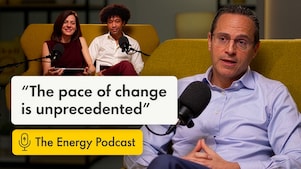
Shell’s CEO talks transformation, leadership, and the future of energy
Episode 7: In the season finale, Shell’s CEO Wael Sawan reflects on a year of significant change globally. He discusses navigating through uncertainty, accelerating the energy transition, and embracing AI. He also shares how Shell is transforming into a fitter, more competitive company – one better equipped to navigate whatever lies ahead.
Play on...
The role of oil in the energy mix: today and in the future
Episode 6: Featuring Shell's President of Upstream, Peter Costello, this episode of The Energy Podcast explores the evolving role of oil in the energy mix.
Keeping the world moving: shipping’s lead role in the energy system
Episode 5: Karrie Trauth, Executive Vice President for Shipping and Maritime at Shell, explains shipping’s vital, non-stop role as the backbone of today’s global energy system, connecting supply with demand across continents.
Apple Podcasts | Spotify | YouTube
The future of road transport: Shell and BMW on emissions, EVs and innovation
Episode 4: From adoption of electric vehicles and biofuels to policy, infrastructure and consumer behaviour, this episode unpacks the challenges of reducing emissions of road travel and what it’ll take to progress further.
Apple Podcasts | Spotify | YouTube

What’s next for carbon capture and storage technology?
Episode 3: Hosts Bryony and Eddie are joined by Shell’s Vice-president for CCS, Bernhard Koudelka, to discuss the role of carbon capture and storage (CCS) in decarbonising heavy industry, and the challenges of scaling the industry to the level the world needs.
Apple Podcasts | Spotify | YouTube
LNG: the world’s secure, flexible, lower-carbon fuel?
Episode 2: In this episode, hosts Bryony and Eddie hear from Shell's President of Integrated Gas, Cederic Cremers, on why global demand for LNG is expected to grow, the importance of addressing methane emissions, and Shell's LNG ambitions.
Apple Podcasts | Spotify | YouTube
The role of oil in the energy mix: today and in the future
Energy transition explained
Episode 1: Peter Wood, Shell’s Chief Energy Advisor, takes stock of the world’s energy system today. How is it evolving – and where? What’s driving the pace of progress – and holding it back? And what’s Shell’s role in all of that?
Apple Podcasts | Spotify | YouTube
From lab to F1 track: the science behind Scuderia Ferrari’s sustainable race fuel
Bonus: Join Valeria Loreti, Principal Scientist and Delivery Manager in Motorsports at Shell, to explore the future of sustainable racing fuels for Formula 1 team Scuderia Ferrari HP.
Apple Podcasts | Spotify | YouTube
What it takes to store CO₂ under the seabed
Bonus: The Energy Podcast zooms in on Northern Lights, the world’s first commercial CO₂ transport and storage service, which started operations on August 25, 2025.
Apple Podcasts | Spotify | YouTube
Engineering one of the world’s most advanced LNG projects
Bonus: This episode takes you inside the engineering and partnerships helping to meet the world's growing demand for liquefied natural gas (LNG).
Apple Podcasts | Spotify | YouTube
What could the future of energy look like?
Bonus: In this bonus episode, explore how and why scenarios are developed – and the three distinct visions of the future presented by Shell’s latest report.
Apple Podcasts | Spotify | YouTube
Previous seasons of The Energy Podcast are available on Apple Podcasts and Spotify.
Frequently asked questions
What is The Energy Podcast?
What is The Energy Podcast?
The Energy Podcast from Shell is the home of conversation about the energy that powers our world. In the new season, we bring together expert voices from across energy, economics and climate to explore the questions shaping the future of energy.
How often are new episodes released?
How often are new episodes released?
New episodes are released every month on YouTube and audio streaming platforms, and bonus content shared on Shell's social channels.
Where can I listen to the podcast?
Where can I listen to the podcast?
You can listen to The Energy Podcast on audio streaming platforms such as Spotify and Apple Podcasts. Or you can watch it on YouTube.
What topics are covered in the podcast?
What topics are covered in the podcast?
We cover various energy-related topics, from reflecting on the impact of the Middle East crisis on the energy system, to liquefied natural gas (LNG), AI and electric vehicles.
In 2025, 80.85% of Shell’s global investments included oil & gas, 9.58% included low-carbon energy solutions and 9.58% non-energy products.
Cautionary note
Cautionary note
The companies in which Shell plc directly and indirectly owns investments are separate legal entities. In this content “Shell”, “Shell Group” and “Group” are sometimes used for convenience to reference Shell plc and its subsidiaries in general. Likewise, the words “we”, “us” and “our” are also used to refer to Shell plc and its subsidiaries in general or to those who work for them. These terms are also used where no useful purpose is served by identifying the particular entity or entities. ‘‘Subsidiaries’’, “Shell subsidiaries” and “Shell companies” as used in this content refer to entities over which Shell plc either directly or indirectly has control. The terms “joint venture”, “joint operations”, “joint arrangements”, and “associates” may also be used to refer to a commercial arrangement in which Shell has a direct or indirect ownership interest with one or more parties. The term “Shell interest” is used for convenience to indicate the direct and/or indirect ownership interest held by Shell in an entity or unincorporated joint arrangement, after exclusion of all third-party interest.
Forward-Looking statements
This content contains forward-looking statements (within the meaning of the U.S. Private Securities Litigation Reform Act of 1995) concerning the financial condition, results of operations and businesses of Shell. All statements other than statements of historical fact are, or may be deemed to be, forward-looking statements. Forward-looking statements are statements of future expectations that are based on management’s current expectations and assumptions, including (without limitation) those concerning Shell’s strategy and operating plans, macroeconomic conditions, future energy demand, supply and product mix, commodity prices, demand for Shell’s products, production results and reserve estimates, development, execution and management of projects, energy transition and climate change, management of safety and environmental risks, costs, cash capital expenditures, technology advancements, legislative, judicial, fiscal and regulatory developments, regional conflicts and trading conditions, and involve known and unknown risks and uncertainties that could cause actual results, performance or events to differ materially from those expressed or implied in these statements. Forward-looking statements include, among other things, statements concerning the potential exposure of Shell to market risks and statements expressing management’s expectations, beliefs, estimates, forecasts, projections and assumptions. These forward-looking statements are identified by their use of terms and phrases such as “aim”; “ambition”; ‘‘anticipate’’; “aspire”, “aspiration”, ‘‘believe’’; “commit”; “commitment”; ‘‘could’’; “desire”; ‘‘estimate’’; ‘‘expect’’; ‘‘goals’’; ‘‘intend’’; ‘‘may’’; “milestones”; ‘‘objectives’’; ‘‘outlook’’; ‘‘plan’’; ‘‘probably’’; ‘‘project’’; ‘‘risks’’; “schedule”; ‘‘seek’’; ‘‘should’’; ‘‘target’’; “vision”; ‘‘will’’; “would” and similar terms and phrases. There are a number of factors that could affect the future operations of Shell and could cause those results to differ materially from those expressed in the forward-looking statements included in this content, including (without limitation): (a) price fluctuations in crude oil and natural gas; (b) changes in demand for Shell’s products; (c) currency fluctuations; (d) drilling and production results; (e) reserves estimates; (f) loss of market share and industry competition; (g) environmental and physical risks, including climate change; (h) risks associated with the identification of suitable potential acquisition properties and targets, and successful negotiation and completion of such transactions; (i) the risk of doing business in developing countries and countries subject to international sanctions; (j) legislative, judicial, fiscal and regulatory developments including tariffs and regulatory measures addressing climate change; (k) economic and financial market conditions in various countries and regions; (l) political risks, including the risks of expropriation and renegotiation of the terms of contracts with governmental entities, delays or advancements in the approval of projects and delays in the reimbursement for shared costs; (m) risks associated with the impact of pandemics, regional conflicts, such as the Russia-Ukraine war and the conflict in the Middle East, and a significant cyber security, data privacy or IT incident; (n) the pace of the energy transition; and (o) changes in trading conditions. No assurance is provided that future dividend payments will match or exceed previous dividend payments. All forward-looking statements contained in this content are expressly qualified in their entirety by the cautionary statements contained or referred to in this section. Readers should not place undue reliance on forward-looking statements. Additional risk factors that may affect future results are contained in Shell plc’s Form 20-F for the year ended December 31, 2025 (available at www.shell.com/investors/news-and-filings/sec-filings.html and www.sec.gov). These risk factors also expressly qualify all forward-looking statements contained in this content and should be considered by the reader. Each forward-looking statement speaks only as of the date of this content. Neither Shell plc nor any of its subsidiaries undertake any obligation to publicly update or revise any forward-looking statement as a result of new information, future events or other information. In light of these risks, results could differ materially from those stated, implied or inferred from the forward-looking statements contained in this content.
Shell’s net carbon intensity and net-zero emissions target
In this content we may refer to Shell’s “net carbon intensity” (NCI), which includes Shell’s carbon emissions from the production of our energy products, our suppliers’ carbon emissions in supplying energy for that production and our customers’ carbon emissions associated with their use of the energy products we sell. Shell’s NCI also includes the emissions associated with the production and use of energy products produced by others which Shell purchases for resale. Shell only controls its own emissions. The use of the terms Shell’s “net carbon intensity” or NCI is for convenience only and not intended to suggest these emissions are those of Shell plc or its subsidiaries.
Shell’s operating plan and outlook are forecasted for a three-year period and ten-year period, respectively, and are updated every year. They reflect the current economic environment and what we can reasonably expect to see over the next three and ten years. Accordingly, the outlook reflects our combined Scope 1 and 2 target, NCI target and our oil products ambition over the next ten years. However, Shell’s operating plan and outlook cannot reflect our 2050 net-zero emissions target, as this target is outside our planning period. Such future operating plans and outlooks could include changes to our portfolio, efficiency improvements and the use of carbon capture and storage and carbon credits. In the future, as society moves towards net-zero emissions, we expect Shell’s operating plans and outlooks to reflect this movement. However, if society is not net zero in 2050, as of today, there would be significant risk that Shell may not meet this target.
The information provided above regarding Shell’s NCI and net zero emissions target are not intended, nor should they be construed as introducing, suggesting or making any claim, target or representation thereof other than what is included in the content.
Forward-Looking non-GAAP measures
This content may contain certain forward-looking non-GAAP measures such as free cash flow and underlying operating expenses. We are unable to provide a reconciliation of these forward-looking non-GAAP measures to the most comparable GAAP financial measures because certain information needed to reconcile those non-GAAP measures to the most comparable GAAP financial measures is dependent on future events some of which are outside the control of Shell, such as oil and gas prices, interest rates and exchange rates. Moreover, estimating such GAAP measures with the required precision necessary to provide a meaningful reconciliation is extremely difficult and could not be accomplished without unreasonable effort. Non-GAAP measures in respect of future periods which cannot be reconciled to the most comparable GAAP financial measure are calculated in a manner which is consistent with the accounting policies applied in Shell plc’s consolidated financial statements. These forward-looking non-GAAP measures are provided to assist readers in understanding management’s use and expectations of such measures and may not be appropriate for other purposes.
The contents of websites referred to in this content do not form part of this content.
We may have used certain terms, such as resources, in this content that the United States Securities and Exchange Commission (SEC) strictly prohibits us from including in our filings with the SEC. Investors are urged to consider closely the disclosure in our Form 20-F, File No 1-32575, available on the SEC website www.sec.gov.