Shell Hydrogen Projects
Shell is developing large-scale hydrogen production projects, such as Holland Hydrogen 1 and REFHYNE 2, to produce renewable hydrogen for industrial operations. These projects are intended to support the use of hydrogen in sectors where lower-emissions alternatives are being explored.
Shell is developing a renewable hydrogen business supported by hydrogen production projects and infrastructure development. REFHYNE 1 is currently producing renewable hydrogen, and multiple Final Investment Decisions (FIDs) have been taken for additional projects. REFHYNE 2 in Germany and Holland Hydrogen 1 in the Netherlands are under construction.
Our approach focuses on integrating low-carbon hydrogen into our Energy and Chemicals Parks while also developing infrastructure intended to support industrial and transport applications. Through technology development, investment and collaboration, we are working to support the continued development of hydrogen value chains and hydrogen markets.
Shell Hydrogen Projects
Holland Hydrogen 1
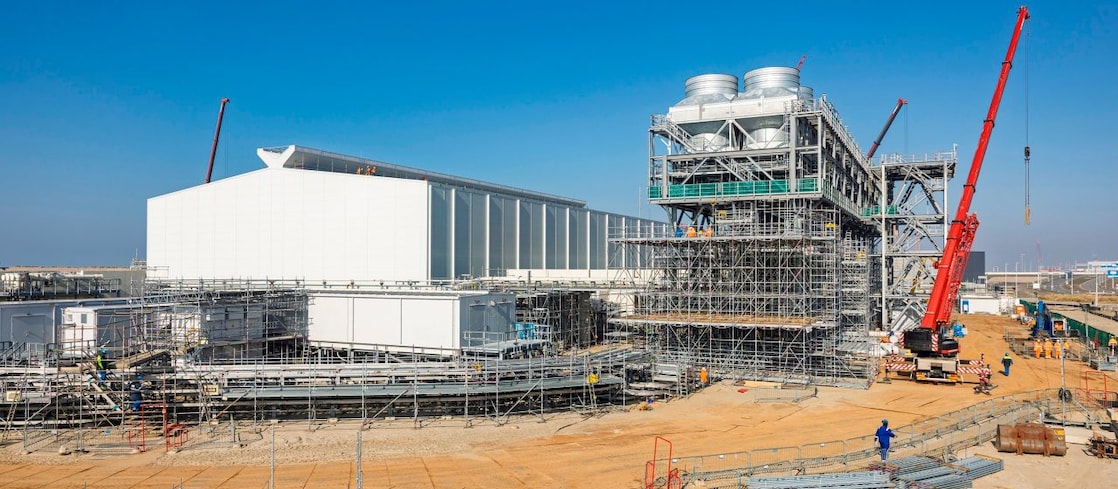
Holland Hydrogen 1 (HH1) is Shell’s renewable hydrogen project currently under construction in the Netherlands. Powered by offshore wind from the Hollandse Kust Noord farm, its 200 MW electrolyser is expected to produce around 60 tonnes of hydrogen per day. The hydrogen is intended to be used at Shell Pernis, where it is expected to replace a portion of fossil-based hydrogen used in refining processes and support efforts to reduce associated emissions.
Holland Hydrogen 1 takes shape
HH1 will be one of Europe’s largest renewable hydrogen plants when operational. We expect to start commissioning in 2027.
Read the transcript
Read the transcript
Title: Holland Hydrogen 1 Construction Timelapse
Duration: 0:24 minutes
Description:
A short timelapse video shows the ongoing construction of the Holland Hydrogen 1 renewable hydrogen plant in Rotterdam, the Netherlands.
Drone footage and construction timelapse imagery highlight the large industrial site, showing buildings, scaffolding, equipment installation, and surrounding offshore wind turbines while on-screen text explains the project’s progress and significance.
Holland Hydrogen 1 Construction Timelapse Transcript
[Background music plays]
No background music or notable sound is audible.
[Text displays]
In Rotterdam in the Netherlands...
...we continue building
Holland Hydrogen 1.
The highest point has been reached
and construction is progressing steadily.
One of Europe’s largest
renewable hydrogen plants.
Powered by offshore wind.
This is how we are shaping the
future of renewable hydrogen.
[Visuals]
Aerial drone footage shows a large industrial construction site near the coastline in Rotterdam. Large rectangular buildings, storage areas, and construction equipment are visible. Offshore wind turbines stand in the distance across the water.
The view shifts to a closer aerial angle of the facility. A large white industrial building with a blue roof sits beside roads and rail tracks. Surrounding areas contain construction materials, cranes, and temporary structures.
A timelapse view shows a massive building under construction. Scaffolding surrounds a tall structure while cranes and workers move around the site. The sky changes rapidly between cloudy and brighter conditions, indicating the passage of time.
Another angle shows the same building as exterior structures and frameworks become more complete. Construction activity continues around the base of the structure.
The scene cuts to a detailed view of large cylindrical equipment units installed on an elevated metal framework surrounded by scaffolding.
A high aerial shot reveals the full scale of the site, showing the large main building, surrounding infrastructure, and multiple industrial units arranged across the facility.
The camera transitions to a slightly different overhead view highlighting the size of the complex compared with nearby roads and industrial areas.
A closer view shows a smaller building with bright green vertical panels on its exterior beside the larger structures.
The drone camera moves to frame the central industrial installation with wind turbines clearly visible in the background near the coastline.
The final aerial shot looks down at the large rectangular building and surrounding equipment, emphasizing the scale of the facility as the project message about renewable hydrogen appears on screen.
REFHYNE 2
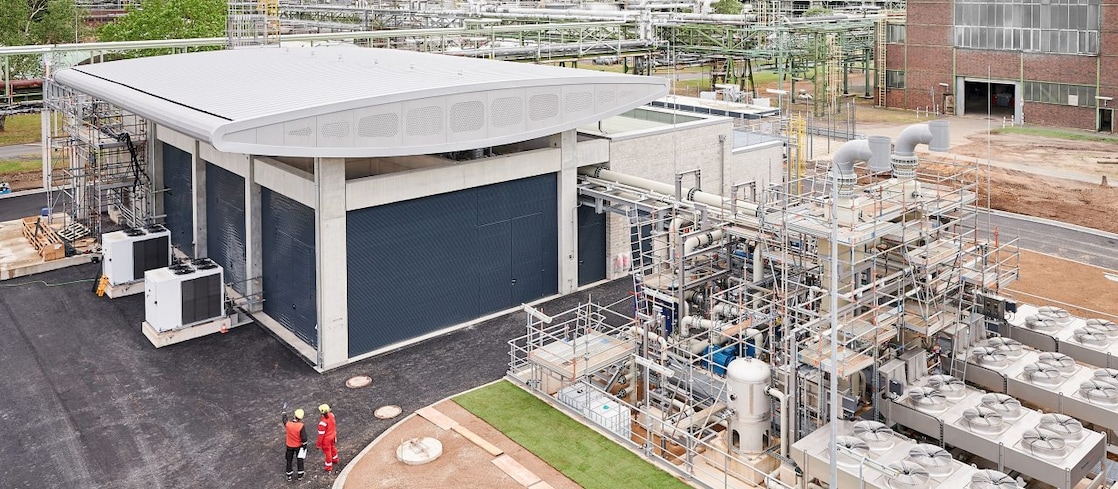
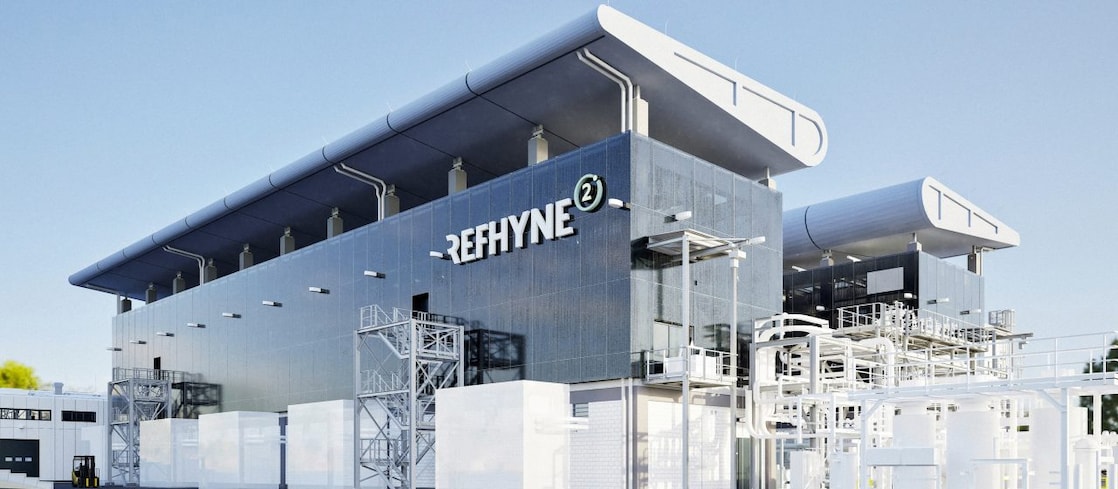
In 2024, Shell took Final Investment Decision (FID) on REFHYNE 2, a 100 MW PEM electrolyser at the Energy and Chemicals Park Rheinland. The project is expected to start up in 2027 and is designed to produce up to 44 tonnes of hydrogen per day, subject to the availability of renewable electricity. The hydrogen is intended to be used within site operations and may support efforts to reduce associated emissions. Subject to applicable certification requirements, the hydrogen is expected to meet relevant EU certification criteria.
REFHYNE 2 coming to life
The REFHYNE 2 project has been enabled by supportive policies, including the European Union’s (EU) binding targets for the use of renewable hydrogen, and the German Federal Government’s regulatory framework. The project has also received funding from the EU’s Horizon 2020 research and innovation programme.
Read the transcript
Read the transcript
Title: REFHYNE 2 Showcasing Construction Progress
Duration: 1:41 minutes
Description:
A time-lapse video shows construction progress on the REFHYNE 2 site at an industrial facility from November 2024 to June 2026.
Overlaid captions mark monthly milestones as foundations, building floors, facade panels, roof sections, and equipment installation are completed, ending with the Shell logo.
REFHYNE 2 Showcasing Construction Progress Transcript
[Background music plays]
Instrumental background music plays throughout. No speech is discernible.
[Animated sequence]
A Shell-branded title card fades over moving construction footage. The title card recedes to reveal the time-lapse. At the end, the video fades to a white screen with the Shell logo centered.
[Text displays]
November 2024
December 2024
REFHYNE 2
Showcasing Construction Progress
January 2025
Foundations for electrolyser buildings complete!
February 2025
First floors already in progress
March 2025
Substation emerging in the background
April 2025
May 2025
First floors of the electrolyser buildings completed
June 2025
Framing underway on the water purification unit
July 2025
Second floors rising on the electrolyser buildings
August 2025
Facade panel installation in progress
September 2025
October 2025
Preparation and installation of first roof sections
November 2025
Roof installation on second electrolyser building
December 2025
Work continues on the roof while cabling kicks-off behind the scenes
January 2026
February 2026
The last roof section is placed and...
March 2026
...the distinctive roofline is complete!
April 2026
Electrolyser modules & O₂ separators delivered and installation in progress
May 2026
June 2026
Installation of equipment continues and building facade is completed
[Visuals]
The video begins with a fixed, elevated view of a construction area within a large industrial plant. Existing towers, pipes, tanks, roads, and industrial buildings surround the site. Bare earth, excavated rectangular areas, concrete foundations, barriers, machinery, and workers in high-visibility clothing are visible. The footage moves quickly as a time-lapse, so vehicles, cranes, shadows, weather, and work activity change rapidly.
As the months progress, the foundations and base slabs take shape. Columns rise for the electrolyser buildings, scaffolding surrounds the structures, and the substation appears in the background. Large cranes, lifts, construction vehicles, and workers move around the site as walls, floors, and structural frames are added.
A steel frame for the water purification unit is assembled in the foreground. Facade panels are installed across the buildings, and second floors rise on the electrolyser buildings. The view stays elevated while the site changes from exposed foundations and columns into enclosed grey industrial buildings.
The camera later shifts to closer and wider views of the buildings. Large curved roof sections are lifted and placed, forming a distinctive rounded roofline. Day, night, rain, cloudy weather, and bright sunlight pass quickly in the time-lapse while work continues on and around the roof.
Additional aerial and close-up views show the completed roofline and grey facade from different angles. A large yellow crane lifts equipment modules and O₂ separators into position. Workers and access platforms are visible around the installation areas, with materials and machinery arranged across the site.
In the final construction view, the building facade appears complete while equipment installation continues around the structure. The video ends by fading to a white background with the Shell logo centered on screen.
Co-funded by the European Union
This project has received funding from the European Union's Horizon 2020 Research and Innovation Programme under Grant Agreement Number 101036970
REFHYNE 1
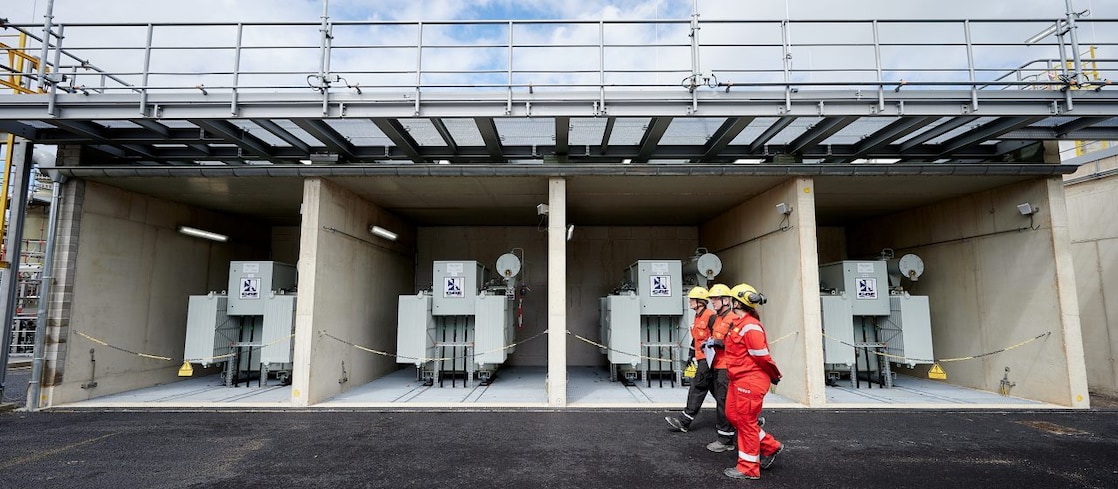
REFHYNE 1, located at Shell’s Energy and Chemicals Park Rheinland in Germany, is a large-scale PEM electrolyser that has been operational since 2021. The 10 MW unit produces renewable hydrogen and has helped inform subsequent hydrogen project development, including REFHYNE 2.
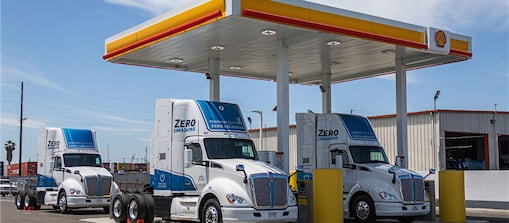
Heavy-duty transport
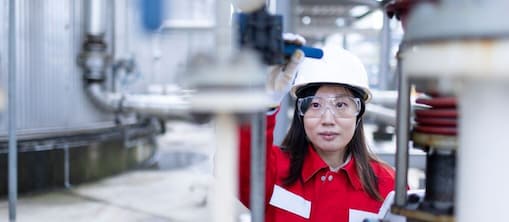
We operate hydrogen refuelling stations for buses and trucks in Europe and the US, aiming to help reduce emissions from heavy-duty transport.
Disclaimers
*Refers to renewable hydrogen and decarbonised hydrogen
Disclaimer
Disclaimer
Cautionary Note
The companies in which Shell plc directly and indirectly owns investments are separate legal entities. In this content “Shell”, “Shell Group” and “Group” are sometimes used for convenience to reference Shell plc and its subsidiaries in general. Likewise, the words “we”, “us” and “our” are also used to refer to Shell plc and its subsidiaries in general or to those who work for them. These terms are also used where no useful purpose is served by identifying the particular entity or entities. ‘‘Subsidiaries’’, “Shell subsidiaries” and “Shell companies” as used in this content refer to entities over which Shell plc either directly or indirectly has control. The terms “joint venture”, “joint operations”, “joint arrangements”, and “associates” may also be used to refer to a commercial arrangement in which Shell has a direct or indirect ownership interest with one or more parties. The term “Shell interest” is used for convenience to indicate the direct and/or indirect ownership interest held by Shell in an entity or unincorporated joint arrangement, after exclusion of all third-party interest.
Forward-Looking statements
This content contains forward-looking statements (within the meaning of the U.S. Private Securities Litigation Reform Act of 1995) concerning the financial condition, results of operations and businesses of Shell. All statements other than statements of historical fact are, or may be deemed to be, forward-looking statements. Forward-looking statements are statements of future expectations that are based on management’s current expectations and assumptions, including (without limitation) those concerning Shell’s strategy and operating plans, macroeconomic conditions, future energy demand, supply and product mix, commodity prices, demand for Shell’s products, production results and reserve estimates, development, execution and management of projects, energy transition and climate change, management of safety and environmental risks, costs, cash capital expenditures, technology advancements, legislative, judicial, fiscal and regulatory developments, regional conflicts and trading conditions, and involve known and unknown risks and uncertainties that could cause actual results, performance or events to differ materially from those expressed or implied in these statements. Forward-looking statements include, among other things, statements concerning the potential exposure of Shell to market risks and statements expressing management’s expectations, beliefs, estimates, forecasts, projections and assumptions. These forward-looking statements are identified by their use of terms and phrases such as “aim”; “ambition”; ‘‘anticipate’’; “aspire”, “aspiration”, ‘‘believe’’; “commit”; “commitment”; ‘‘could’’; “desire”; ‘‘estimate’’; ‘‘expect’’; ‘‘goals’’; ‘‘intend’’; ‘‘may’’; “milestones”; ‘‘objectives’’; ‘‘outlook’’; ‘‘plan’’; ‘‘probably’’; ‘‘project’’; ‘‘risks’’; “schedule”; ‘‘seek’’; ‘‘should’’; ‘‘target’’; “vision”; ‘‘will’’; “would” and similar terms and phrases. There are a number of factors that could affect the future operations of Shell and could cause those results to differ materially from those expressed in the forward-looking statements included in this content, including (without limitation): (a) price fluctuations in crude oil and natural gas; (b) changes in demand for Shell’s products; (c) currency fluctuations; (d) drilling and production results; (e) reserves estimates; (f) loss of market share and industry competition; (g) environmental and physical risks, including climate change; (h) risks associated with the identification of suitable potential acquisition properties and targets, and successful negotiation and completion of such transactions; (i) the risk of doing business in developing countries and countries subject to international sanctions; (j) legislative, judicial, fiscal and regulatory developments including tariffs and regulatory measures addressing climate change; (k) economic and financial market conditions in various countries and regions; (l) political risks, including the risks of expropriation and renegotiation of the terms of contracts with governmental entities, delays or advancements in the approval of projects and delays in the reimbursement for shared costs; (m) risks associated with the impact of pandemics, regional conflicts, such as the Russia-Ukraine war and the conflict in the Middle East, and a significant cyber security, data privacy or IT incident; (n) the pace of the energy transition; and (o) changes in trading conditions. No assurance is provided that future dividend payments will match or exceed previous dividend payments. All forward-looking statements contained in this content are expressly qualified in their entirety by the cautionary statements contained or referred to in this section. Readers should not place undue reliance on forward-looking statements. Additional risk factors that may affect future results are contained in Shell plc’s Form 20-F for the year ended December 31, 2025 (available at www.shell.com/investors/news-and-filings/sec-filings.html and www.sec.gov). These risk factors also expressly qualify all forward-looking statements contained in this content and should be considered by the reader. Each forward-looking statement speaks only as of the date of the publication mentioned in this website. Neither Shell plc nor any of its subsidiaries undertake any obligation to publicly update or revise any forward-looking statement as a result of new information, future events or other information. In light of these risks, results could differ materially from those stated, implied or inferred from the forward-looking statements contained in this content.
Shell’s net carbon intensity and net-zero emissions target
In this content we may refer to Shell’s “net carbon intensity” (NCI), which includes Shell’s carbon emissions from the production of our energy products, our suppliers’ carbon emissions in supplying energy for that production and our customers’ carbon emissions associated with their use of the energy products we sell. Shell’s NCI also includes the emissions associated with the production and use of energy products produced by others which Shell purchases for resale. Shell only controls its own emissions. The use of the terms Shell’s “net carbon intensity” or NCI is for convenience only and not intended to suggest these emissions are those of Shell plc or its subsidiaries.
Shell’s operating plan and outlook are forecasted for a three-year period and ten-year period, respectively, and are updated every year. They reflect the current economic environment and what we can reasonably expect to see over the next three and ten years. Accordingly, the outlook reflects our combined Scope 1 and 2 target, NCI target and our oil products ambition over the next ten years. However, Shell’s operating plan and outlook cannot reflect our 2050 net-zero emissions target, as this target is outside our planning period. Such future operating plans and outlooks could include changes to our portfolio, efficiency improvements and the use of carbon capture and storage and carbon credits. In the future, as society moves towards net-zero emissions, we expect Shell’s operating plans and outlooks to reflect this movement. However, if society is not net zero in 2050, as of today, there would be significant risk that Shell may not meet this target.
The information provided above regarding Shell’s NCI and net zero emissions target are not intended, nor should they be construed as introducing, suggesting or making any claim, target or representation thereof other than what is included in the content.
Forward-Looking non-GAAP measures
This content may contain certain forward-looking non-GAAP measures such as free cash flow and underlying operating expenses. We are unable to provide a reconciliation of these forward-looking non-GAAP measures to the most comparable GAAP financial measures because certain information needed to reconcile those non-GAAP measures to the most comparable GAAP financial measures is dependent on future events some of which are outside the control of Shell, such as oil and gas prices, interest rates and exchange rates. Moreover, estimating such GAAP measures with the required precision necessary to provide a meaningful reconciliation is extremely difficult and could not be accomplished without unreasonable effort. Non-GAAP measures in respect of future periods which cannot be reconciled to the most comparable GAAP financial measure are calculated in a manner which is consistent with the accounting policies applied in Shell plc’s consolidated financial statements. These forward-looking non-GAAP measures are provided to assist readers in understanding management’s use and expectations of such measures and may not be appropriate for other purposes.
The contents of websites referred to in this content do not form part of this content.
We may have used certain terms, such as resources, in this content that the United States Securities and Exchange Commission (SEC) strictly prohibits us from including in our filings with the SEC. Investors are urged to consider closely the disclosure in our Form 20-F, File No 1-32575, available on the SEC website www.sec.gov.