Engaging with communities
Many of our operations are located close to communities and we aim to be a good neighbour. This includes strong community engagement, managing the negative social impacts of our operations and delivering a range of benefits through jobs, local business opportunities and social investment programmes.
Working with communities
We engage with communities to help us understand their needs and expectations. This engagement enables us to identify and manage impacts from our activities and provide access to remedy. Engagement is a continuous process that helps us improve our decision-making and performance. Shell's Safety, Environment and Asset Management (SEAM) Standards are designed to help us to operate responsibly and avoid or minimise any potentially negative environmental and social impacts that may result from our operations.
Communities can raise concerns in a number of ways. At large projects and assets, community engagement practitioners act as a bridge between local communities and our operations. Community feedback mechanisms allow us to receive, track and respond to questions and complaints.
Our SEAM standards require us to apply special procedures in situations involving involuntary resettlement, cultural heritage, Indigenous Peoples or operations in environments with high or unusual social risks.
Case study: Considering cultural heritage from the start
Location: Australia
Key facts: Around 1,000 culturally significant sites discovered
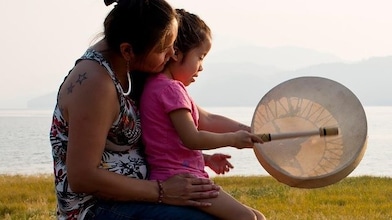
Shell’s QGC business collaborated with the Mandandanji People on cultural heritage surveys ahead of Shell QGC’s gas exploration in the Taroom Trough, Queensland, between 2022 and 2024. The cultural heritage surveys aimed to identify, protect, and manage any culturally significant sites and artefacts for the Mandandani People prior to potentially ground-disturbing exploration.
The search for artefacts across an area of approximately 1,000 square kilometres led to the discovery of around 1,000 culturally significant sites. By mapping these out from the start of the project, the business team knew early on which areas to avoid for any gas exploration activities.
This helped mitigate possible risks of later exploration delays and damage to the culturally significant sites. It also helped to strengthen relations with the Mandandanji People, supporting our licence to operate.

Social investment
Social investment is our focused contribution to communities in countries where we work. Our social investment programmes help tackle important social issues, strengthen relationships with our local communities and build trust in Shell.
Case study: Investing in skills to help build the energy workforce of the future
Location: UK
Key facts: The Shell UK SkillsTransition programme aims to help 15,000 people into jobs with a focus on the energy transition by 2035.
In alignment with the social investment strategy, Shell UK is helping to upskill, reskill, and empower people to take advantage of emerging opportunities in the energy sector. Shell works with partners providing funding and support to initiatives across the UK, including Energy Transition Skills Hubs in Fife in Scotland, and Pembrokeshire in Wales. Shell is also a founding partner of the Energy Transition Skills Hub in Aberdeen. The skills hubs provide teaching space and equipment demonstrating the latest energy technologies, giving students the opportunity to learn and refine critical industry skills. Offerings include welding and fabrication workshops, virtual control room facilities and lessons in nano grid design technology. By expanding regional training capacity and tailoring learning to meet workforce needs and industry demand, the hubs play a vital role in building the skilled talent required to support the UK’s net zero ambitions. Together, these initiatives strengthen local capabilities, open new opportunities for workers and students, and help ensure that communities across Scotland and Wales can actively participate in – and benefit from – the evolving energy landscape.