Sparta: unlocking energy once thought out of reach
Under deep-sea pressures equivalent to the force of a plane concentrated on an area the size of a football, Shell’s latest project in the Gulf of America will deliver energy people rely on every day.

On June 3, 2026
Listen to this story
At a glance
- Sparta is Shell’s latest deep-water project in the Gulf of America, designed to safely produce oil and gas at pressures up to 20,000 pounds per square inch.
- Currently under construction, Sparta is expected to start operations in 2028 and produce up to 90,000 barrels of oil equivalent a day, enough to fuel the daily journeys of about 2 million cars in the USA.
- Sparta will follow Shell’s simplified, replicable design first used on the Vito and Whale platforms and will be the first to feature compression equipment powered by electricity instead of gas.
- Shell is a leading producer in the Gulf of America with 10 production hubs today.
Thousands of metres below the waves in the Gulf of America, at a depth greater than Mount Everest is tall, lie oil reservoirs long considered inaccessible. At such depths, extreme pressures and thick salt layers have historically pushed conventional drilling systems beyond their limits.
To overcome these challenges, Shell’s Sparta development will access those oil resources using a new class of subsea “20K technology,” equipment designed to operate in pressures about a third higher than in most deep-water platforms.
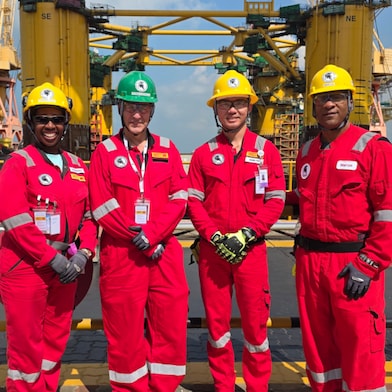
“Imagine the force of a big passenger plane concentrated on an area the size of a football – that is what 20,000 pounds per square inch (psi) of pressure represents,” says Martin Buchan, Shell’s Well Operations 20K Manager, who oversees engineering and operations for Sparta. “At these pressures, even small changes in the rock can quickly shift the forces in the well, so we need to monitor and adjust the pressure in real time to keep the well stable.”
Supporting energy supply
With construction and drilling underway, first production from Sparta is anticipated in 2028. At its peak, it is expected to produce up to 90,000 barrels of oil equivalent a day, enough to fuel the daily journeys of about 2 million cars in the USA. It will also support Shell’s goal of sustaining at least 1.4 million barrels a day of liquids production through 2030. The platform will follow Shell’s simplified, replicable design first used on the Vito and Whale platforms. This approach helps reduce costs and construction times.
Photo gallery
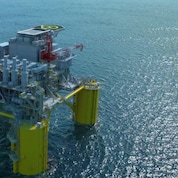
Designed for extreme pressures
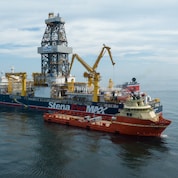
At 20,000 psi, the well must behave like a high-pressure fire hose. Every connection must contain the extreme pressure because a single weak point can compromise the entire system. Shell engineers redesigned and tested each component, from the reservoir to the seabed wellhead, through the blowout preventer – a safety device that seals the well – and up through the pipe known as a riser that carries fluids to the drillship, which is a vessel designed to drill oil and gas wells.
Keeping the system stable while drilling through salt and into the reservoir required new methods. The team uses what is known as managed pressure drilling, supported by a subsea system that raises or lowers the mud level in the riser to fine-tune pressure. Positioned around 425 metres (1,400 feet) below the rig, it continually adjusts the pressure inside the well, allowing the drill bit to advance safely through challenging rock formations. This is paired with a high-density fluid system that protects the Palaeogene rock formation from damage.

Transcription of infographic
Transcription of infographic
Infographic on a dark grey background explaining what 20,000 psi of pressure feels like. The title reads: “What does 20,000 psi of pressure feel like?” A comparison scale lists: 2.5 psi (pressure felt when taking a step), 160 psi (maximum human bite force), 1,500 psi (force of a car-wash jet), 10,000 psi (force of hydraulic rescue “jaws of life”), and 20,000 psi (force equivalent to a plane pressing on an area the size of a football). A note explains this is the pressure a deep-water platform like Sparta has to deal with beneath the ocean surface. Yellow icons illustrate each example, and a large yellow airplane silhouette appears on the right.
Every part of the system exposed to pressure had to be reinforced. Stronger pipes, designed with advanced steel technology, carry fluids between the seabed and the surface, while precision-engineered valves regulate and isolate flow if required.
At the seabed, the 20K blowout preventer – an 18-metre-tall (60-foot) device weighing more than 10 heavy-duty trucks – acts as one of the system’s final safeguards. Mounted at the wellhead, it uses multiple redundant sealing mechanisms to shut in the well within seconds if abnormal pressures are detected.
“Every component undergoes extensive testing,” says Martin. “Shell’s experience in high-pressure, high-temperature fields such as Appomattox – our pioneering 15,000 psi Gulf of America development – shaped the standards Sparta follows.”
From construction to production
In the coming years, the team will complete drilling and start up the subsea systems to prepare for first production. Once operational, Sparta will help deliver the secure energy people rely on every day.
“Sparta is built by incredible people who are shaping the future of energy,” says Martin. “Day after day, they make complex work look effortless in conditions few ever experience, thousands of metres below the surface and under pressures found almost nowhere else on Earth.”
Frequently asked questions about Sparta and Shell’s deep-water operations
What is the Sparta platform?
What is the Sparta platform?
Sparta is a Shell deep-water platform designed to safely produce oil and gas from reservoirs with pressures up to 20,000 pounds per square inch.
Currently under construction, Sparta is expected to start production in the Gulf of America in 2028 and produce up to 90,000 barrels of oil equivalent a day. The platform will follow Shell’s simplified, replicable design first used on the Vito and Whale platforms and will be the first to feature compression equipment powered by electricity instead of gas.
How does Sparta fit into Shell’s deep-water portfolio?
How does Sparta fit into Shell’s deep-water portfolio?
Sparta is Shell’s eleventh development in the Gulf of America and the first to produce from reservoirs with pressures up to 20,000 pounds per square inch.
Shell’s deep-water experience in the Gulf of America stretches back five decades. In 1978, Shell’s Cognac platform marked a groundbreaking achievement as the first to produce oil in waters exceeding 300 metres (1,000 feet) in depth.
Today, as a leading producing leaseholder in the Gulf of America, we are leveraging our significant geological and technical expertise to deliver energy profitably and at lower costs, while reducing emissions.
The Gulf of America is our major Upstream production area in the USA. It is also a heartland for our wider deep-water operations, which include interests in Brazil — where Shell is the second-largest oil and gas producer — and Nigeria.
What does “deep water” mean in terms of oil and gas production?
What does “deep water” mean in terms of oil and gas production?
Deep-water drilling involves extracting oil and natural gas from beneath the ocean floor at significant depths, typically greater than 200 metres (around 656 feet).
This process requires specialised equipment and techniques to safely and efficiently navigate the challenging conditions of deep-water environments.
How is Shell decarbonising its deep-water operations?
How is Shell decarbonising its deep-water operations?
Shell is proactively managing the greenhouse gas intensity of our deep-water operations through innovative project designs, efficient operations, and strategic handling of late-life assets. In the Gulf of America, Shell’s production is among the lowest greenhouse gas (GHG) intensity in the world for producing oil.1
1 The reference to our Gulf of America production being among the lowest GHG intensity in the world is a comparison among other oil and gas producing members of the International Association of Oil & Gas Producers.
Why is new oil and gas production still needed today?
Why is new oil and gas production still needed today?
The role of oil and gas will be critical to the energy system for decades to come.
Shell believes continued investment in oil and gas will be needed to ensure a balanced energy transition. Our investments are needed to maintain oil and gas supplies as existing fields naturally decline at a rate of 4-5% a year, faster than reductions in demand.
Cautionary note
Cautionary note
The companies in which Shell plc directly and indirectly owns investments are separate legal entities. In this content “Shell”, “Shell Group” and “Group” are sometimes used for convenience to reference Shell plc and its subsidiaries in general. Likewise, the words “we”, “us” and “our” are also used to refer to Shell plc and its subsidiaries in general or to those who work for them. These terms are also used where no useful purpose is served by identifying the particular entity or entities. ‘‘Subsidiaries’’, “Shell subsidiaries” and “Shell companies” as used in this content refer to entities over which Shell plc either directly or indirectly has control. The terms “joint venture”, “joint operations”, “joint arrangements”, and “associates” may also be used to refer to a commercial arrangement in which Shell has a direct or indirect ownership interest with one or more parties. The term “Shell interest” is used for convenience to indicate the direct and/or indirect ownership interest held by Shell in an entity or unincorporated joint arrangement, after exclusion of all third-party interest.
Forward-Looking statements
This content contains forward-looking statements (within the meaning of the U.S. Private Securities Litigation Reform Act of 1995) concerning the financial condition, results of operations and businesses of Shell. All statements other than statements of historical fact are, or may be deemed to be, forward-looking statements. Forward-looking statements are statements of future expectations that are based on management’s current expectations and assumptions, including (without limitation) those concerning Shell’s strategy and operating plans, macroeconomic conditions, future energy demand, supply and product mix, commodity prices, demand for Shell’s products, production results and reserve estimates, development, execution and management of projects, energy transition and climate change, management of safety and environmental risks, costs, cash capital expenditures, technology advancements, legislative, judicial, fiscal and regulatory developments, regional conflicts and trading conditions, and involve known and unknown risks and uncertainties that could cause actual results, performance or events to differ materially from those expressed or implied in these statements. Forward-looking statements include, among other things, statements concerning the potential exposure of Shell to market risks and statements expressing management’s expectations, beliefs, estimates, forecasts, projections and assumptions. These forward-looking statements are identified by their use of terms and phrases such as “aim”; “ambition”; ‘‘anticipate’’; “aspire”, “aspiration”, ‘‘believe’’; “commit”; “commitment”; ‘‘could’’; “desire”; ‘‘estimate’’; ‘‘expect’’; ‘‘goals’’; ‘‘intend’’; ‘‘may’’; “milestones”; ‘‘objectives’’; ‘‘outlook’’; ‘‘plan’’; ‘‘probably’’; ‘‘project’’; ‘‘risks’’; “schedule”; ‘‘seek’’; ‘‘should’’; ‘‘target’’; “vision”; ‘‘will’’; “would” and similar terms and phrases. There are a number of factors that could affect the future operations of Shell and could cause those results to differ materially from those expressed in the forward-looking statements included in this content, including (without limitation): (a) price fluctuations in crude oil and natural gas; (b) changes in demand for Shell’s products; (c) currency fluctuations; (d) drilling and production results; (e) reserves estimates; (f) loss of market share and industry competition; (g) environmental and physical risks, including climate change; (h) risks associated with the identification of suitable potential acquisition properties and targets, and successful negotiation and completion of such transactions; (i) the risk of doing business in developing countries and countries subject to international sanctions; (j) legislative, judicial, fiscal and regulatory developments including tariffs and regulatory measures addressing climate change; (k) economic and financial market conditions in various countries and regions; (l) political risks, including the risks of expropriation and renegotiation of the terms of contracts with governmental entities, delays or advancements in the approval of projects and delays in the reimbursement for shared costs; (m) risks associated with the impact of pandemics, regional conflicts, such as the Russia-Ukraine war and the conflict in the Middle East, and a significant cyber security, data privacy or IT incident; (n) the pace of the energy transition; and (o) changes in trading conditions. No assurance is provided that future dividend payments will match or exceed previous dividend payments. All forward-looking statements contained in this content are expressly qualified in their entirety by the cautionary statements contained or referred to in this section. Readers should not place undue reliance on forward-looking statements. Additional risk factors that may affect future results are contained in Shell plc’s Form 20-F for the year ended December 31, 2025 (available at www.shell.com/investors/news-and-filings/sec-filings.html and www.sec.gov). These risk factors also expressly qualify all forward-looking statements contained in this content and should be considered by the reader. Each forward-looking statement speaks only as of the date of this content. Neither Shell plc nor any of its subsidiaries undertake any obligation to publicly update or revise any forward-looking statement as a result of new information, future events or other information. In light of these risks, results could differ materially from those stated, implied or inferred from the forward-looking statements contained in this content.
Shell’s net carbon intensity and net-zero emissions target
In this content we may refer to Shell’s “net carbon intensity” (NCI), which includes Shell’s carbon emissions from the production of our energy products, our suppliers’ carbon emissions in supplying energy for that production and our customers’ carbon emissions associated with their use of the energy products we sell. Shell’s NCI also includes the emissions associated with the production and use of energy products produced by others which Shell purchases for resale. Shell only controls its own emissions. The use of the terms Shell’s “net carbon intensity” or NCI is for convenience only and not intended to suggest these emissions are those of Shell plc or its subsidiaries.
Shell’s operating plan and outlook are forecasted for a three-year period and ten-year period, respectively, and are updated every year. They reflect the current economic environment and what we can reasonably expect to see over the next three and ten years. Accordingly, the outlook reflects our combined Scope 1 and 2 target, NCI target and our oil products ambition over the next ten years. However, Shell’s operating plan and outlook cannot reflect our 2050 net-zero emissions target, as this target is outside our planning period. Such future operating plans and outlooks could include changes to our portfolio, efficiency improvements and the use of carbon capture and storage and carbon credits. In the future, as society moves towards net-zero emissions, we expect Shell’s operating plans and outlooks to reflect this movement. However, if society is not net zero in 2050, as of today, there would be significant risk that Shell may not meet this target.
The information provided above regarding Shell’s NCI and net zero emissions target are not intended, nor should they be construed as introducing, suggesting or making any claim, target or representation thereof other than what is included in the content.
Forward-Looking non-GAAP measures
This content may contain certain forward-looking non-GAAP measures such as free cash flow and underlying operating expenses. We are unable to provide a reconciliation of these forward-looking non-GAAP measures to the most comparable GAAP financial measures because certain information needed to reconcile those non-GAAP measures to the most comparable GAAP financial measures is dependent on future events some of which are outside the control of Shell, such as oil and gas prices, interest rates and exchange rates. Moreover, estimating such GAAP measures with the required precision necessary to provide a meaningful reconciliation is extremely difficult and could not be accomplished without unreasonable effort. Non-GAAP measures in respect of future periods which cannot be reconciled to the most comparable GAAP financial measure are calculated in a manner which is consistent with the accounting policies applied in Shell plc’s consolidated financial statements. These forward-looking non-GAAP measures are provided to assist readers in understanding management’s use and expectations of such measures and may not be appropriate for other purposes.
The contents of websites referred to in this content do not form part of this content.
We may have used certain terms, such as resources, in this content that the United States Securities and Exchange Commission (SEC) strictly prohibits us from including in our filings with the SEC. Investors are urged to consider closely the disclosure in our Form 20-F, File No 1-32575, available on the SEC website www.sec.gov.

