Helping the shipping industry transition to a cleaner future
By offering integrated solutions that help to reduce emissions and increase operational efficiency, we are supporting the maritime industry transition towards cleaner, more sustainable energy sources.
Marine Electrification
We work with a range of providers to explore sustainable electrification solutions for ports and short-sea vessels, such as tugboats, inland cargo vessels, ferries, and offshore support vessels (O&M). These solutions aim to lower emissions, improve energy efficiency, and support the broader transition toward decarbonisation.
By prioritising innovative technology and collaboration, Shell Marine’s electrification efforts are aligned with the International Maritime Organization’s (IMO) decarbonisation goals, providing cleaner energy solutions for the future of marine operations.
Read Transcript
Read Transcript
Title: Decarbonizing Marine and Road Transport | Episode 1 | All Hands on Deck
Time: 3.17 min
Description
At the Energy Transition Campus Amsterdam, we are at the forefront of developing technological solutions for the energy transition in an open campus concept.
In this two-part video series, we particularly focus on decarbonizing heavy-duty transport—a challenging sector for both marine and road transport.
In this episode, we will take you along into the diverse and innovative solutions from our campus members:
• Value Maritime: Pioneering exhaust gas cleaning systems for seagoing vessels.
• Kvasir Technology: Transforming waste-based plant biomass into marine biofuel.
• Corvus Energy: Advancing marine battery and hydrogen fuel cell technology.
Watch Episode 1 here and see how our members are setting sail for sustainable transport!
[video]
00:00:00:18 - 00:00:03:10
Here, at the Energy Transition Campus Amsterdam...
00:00:03:10 - 00:00:07:15
...we are at the forefront of developing technological solutions for the energy transition
00:00:07:15 - 00:00:11:01
in an open campus concept with more than 25 organisations.
00:00:11:15 - 00:00:14:03
Today, we are focusing particularly on
00:00:14:03 - 00:00:16:01
decarbonizing heavy duty transport,
00:00:16:01 - 00:00:19:05
a challenging sector for both marine and road transport.
00:00:19:05 - 00:00:21:16
We will explore the solutions together with Rogier.
00:00:22:03 - 00:00:24:02
He has played a key role in the realization
00:00:24:02 - 00:00:27:14
of the Megawatt Charger here at the Energy Transition Campus Amsterdam.
00:00:27:14 - 00:00:30:11
This Megawatt Charger will actually charge ships
00:00:30:11 - 00:00:31:12
and also trucks.
00:00:31:18 - 00:00:35:01
I will take Rogier on a tour to discover what other solutions
00:00:35:01 - 00:00:38:03
our members have developed to decarbonize the marine sector.
00:00:42:04 - 00:00:45:23
For example, Value Maritime, who invented a product called Filtree.
00:00:46:03 - 00:00:49:02
Let me introduce you to Maarten from Value Maritime.
00:00:49:02 - 00:00:50:16
Maarten, this is Rogier.
00:00:50:16 - 00:00:53:01
Can you tell Rogier a bit more about Value Maritime?
00:00:53:01 - 00:00:53:16
Yeah, of course.
00:00:53:16 - 00:00:56:17
We make exhaust gas cleaning systems for seagoing vessels,
00:00:56:21 - 00:00:59:13
cleaning the exhaust gases and capturing the carbon.
00:00:59:13 - 00:01:02:03
This is a unique technology that filters sulfur
00:01:02:03 - 00:01:04:00
as well as ultrafine particles
00:01:04:00 - 00:01:05:23
from the exhaust fumes of ships.
00:01:05:23 - 00:01:09:01
We have plug and play systems which you can place at the back of the vessel
00:01:09:01 - 00:01:11:19
and connect it to the exhaust gases of these vessels.
00:01:11:19 - 00:01:14:07
They also invented a carbon capture module
00:01:14:07 - 00:01:17:05
that can be integrated into the Filtree system,
00:01:17:05 - 00:01:18:24
And the CO2 is brought back to shore
00:01:18:24 - 00:01:21:24
to be applied in other sectors as a feedstock.
00:01:21:24 - 00:01:23:05
This avoids the CO2
00:01:23:05 - 00:01:25:05
from being emitted into the atmosphere
00:01:25:05 - 00:01:27:09
and makes this a circular process.
00:01:27:09 - 00:01:28:20
But why don't those ships
00:01:28:20 - 00:01:31:20
actually move away from fossil fuels completely?
00:01:31:20 - 00:01:35:09
Most ships can’t change overnight to power or alternative fuels,
00:01:35:09 - 00:01:36:16
especially the larger ones.
00:01:36:16 - 00:01:38:23
What about biofuels then? Great question.
00:01:38:23 - 00:01:42:20
I'll tell you a bit more about Kvasir Technologies, our other member.
00:01:42:20 - 00:01:45:19
Kavsir Technologies has developed a scalable technology
00:01:45:19 - 00:01:46:24
that transforms waste
00:01:46:24 - 00:01:49:24
based plant biomass into a marine biofuel.
00:01:50:01 - 00:01:52:01
This biofuel has similar properties
00:01:52:01 - 00:01:55:01
to marine fuel oils delivering high yields.
00:01:55:04 - 00:01:58:04
The biofuel is applicable to existing engines.
00:01:58:11 - 00:02:01:00
This means that this solution does not require ships
00:02:01:00 - 00:02:04:04
to be retrofitted, and it also doesn't require investment
00:02:04:04 - 00:02:06:24
in new fleets designed for alternative fuels.
00:02:06:24 - 00:02:10:02
Sounds like for every vessel there’s a different solution.
00:02:10:02 - 00:02:11:07
Now, as you know,
00:02:11:07 - 00:02:13:15
we are also working on the Megawatt Charger.
00:02:13:15 - 00:02:17:10
Megawatt Chargers can ramp up charging speeds for many types of electric vessels.
00:02:17:10 - 00:02:18:11
Yeah, and here at ETCA
00:02:18:11 - 00:02:21:16
we have Corvus Energy working in that field of expertise.
00:02:22:08 - 00:02:23:04
Hey, Koen!
00:02:23:04 - 00:02:25:12
Can you tell Rogier a bit more about what you brought today?
00:02:25:12 - 00:02:25:23
Hey!
00:02:25:23 - 00:02:27:10
I brought you these two lithium
00:02:27:10 - 00:02:29:17
battery modules for the maritime industry.
00:02:29:17 - 00:02:33:07
Yeah, with this we are powering a clean future for the ocean space.
00:02:33:12 - 00:02:35:16
Since the start in 2009,
00:02:35:16 - 00:02:37:16
Corvus Energy has been leading the way in
00:02:37:16 - 00:02:39:06
marine battery technology
00:02:39:06 - 00:02:41:09
with the required safety standards.
00:02:41:09 - 00:02:45:03
Our biggest project has more than 40 megawatt hours installed
00:02:45:03 - 00:02:47:17
and is able to charge overnight.
00:02:47:17 - 00:02:49:23
To further reduce emissions from shipping,
00:02:49:23 - 00:02:51:12
the company has also developed
00:02:51:12 - 00:02:53:08
a maritime hydrogen fuel cell
00:02:53:08 - 00:02:57:07
system, together with a world leader in this technology, Toyota.
00:02:57:07 - 00:02:59:10
Thanks for giving me this tour, Simone!
00:02:59:10 - 00:03:03:14
In the next part, I will show you our latest project, the Megawatt Charger.
Read Transcript
Read Transcript
Title: Decarbonizing Marine and Road Transport | Episode 2 | Megawatt charger
Time: 3.44 min
Description
At the Energy Transition Campus Amsterdam, we are at the forefront of developing technological solutions for the energy transition in an open campus concept.
In this two-part video series, we particularly focus on decarbonizing heavy-duty transport—a challenging sector for both marine and road transport.
In this episode, we will visit the new Megawatt Charger here on the campus.
We will show you what it looks like, how it works, and what the potentials are.
Exciting, isn’t it?
[video]
00:00:04:12 - 00:00:07:04
Here, at the Energy Transition Campus Amsterdam...
00:00:07:04 - 00:00:10:24
...we are at the forefront of developing technological solutions for the energy transition
00:00:10:24 - 00:00:12:04
in an open campus concept.
00:00:12:18 - 00:00:15:16
Today, we are focusing particularly on decarbonizing
00:00:15:16 - 00:00:20:14
heavy duty transport, a challenging sector for both marine and road transport.
00:00:20:14 - 00:00:24:07
This powerhouse is one of Europe's fastest charging electric trucks,
00:00:24:07 - 00:00:27:07
capable of being charged at one megawatt.
00:00:28:01 - 00:00:30:09
My name is Simone and in the previous episode
00:00:30:09 - 00:00:32:06
I took Rogier on a tour to explore
00:00:32:06 - 00:00:34:04
our marine decarbonization solutions.
00:00:34:06 - 00:00:37:22
Today, Rogier will take me on a visit to the new Megawatt Charger
00:00:37:22 - 00:00:39:06
here on the campus.
00:00:44:12 - 00:00:47:07
Rogier has worked on the realization of this Megawatt Charger.
00:00:47:24 - 00:00:51:02
He will tell you a bit more about what it looks like, how it works,
00:00:51:02 - 00:00:52:16
and what the potentials are.
00:00:52:16 - 00:00:53:24
Exciting, isn’t it?
00:00:53:24 - 00:00:56:21
We have been working so hard to make this happen,
00:00:56:21 - 00:00:59:20
and now you actually see it in real life.
00:00:59:20 - 00:01:00:20
It's reality.
00:01:00:20 - 00:01:03:05
How will this be utilized in the real world?
00:01:03:05 - 00:01:07:01
For example, if you look at trucks, think about long distance trucking.
00:01:07:13 - 00:01:12:02
So you have a driver that needs to have a break in between driving.
00:01:12:08 - 00:01:14:13
And that break is normally 45 minutes.
00:01:14:13 - 00:01:17:13
And that's a great opportunity to actually charge their truck.
00:01:17:14 - 00:01:22:09
And if you look at marine, for instance, inland shipping or
00:01:22:09 - 00:01:25:18
if you look at ferries, this Megawatt Charger could be a solution.
00:01:26:03 - 00:01:29:16
So this solution will contribute to the CO2 reductions
00:01:30:02 - 00:01:33:05
of marine and heavy duty road transportation.
00:01:33:11 - 00:01:33:21
Okay.
00:01:33:21 - 00:01:36:14
And with such high power levels, how do we manage that
00:01:36:14 - 00:01:39:09
we don't go over the limit of the local power supply?
00:01:39:09 - 00:01:42:16
Now, that's a great question because if it indeed is charging a ship
00:01:42:21 - 00:01:45:18
or a truck, it can go up to one megawatt.
00:01:45:18 - 00:01:47:09
And that's quite a lot of power.
00:01:47:09 - 00:01:51:02
And we here at ETCA are building our own microgrid
00:01:51:02 - 00:01:54:22
behind the meter with different electrification assets.
00:01:55:02 - 00:01:56:18
And we are trying to optimize that.
00:01:56:18 - 00:02:01:04
So once one element is pulling more power, then others will be a bit less.
00:02:01:04 - 00:02:04:10
And therefore we stay below that limit of our grid connection.
00:02:09:05 - 00:02:11:16
So we just had a closer look at the Megawatt Charger.
00:02:11:16 - 00:02:12:18
Can you explain a bit more
00:02:12:18 - 00:02:15:16
why we have two different connectors in this integrated solution?
00:02:15:16 - 00:02:17:12
Sure. We have two connectors.
00:02:17:12 - 00:02:20:12
So two on the road side and two on the marine side.
00:02:20:23 - 00:02:22:16
And if you look at the road side
00:02:22:16 - 00:02:25:15
on the right hand side we have the Combined Charging Standard..
00:02:25:15 - 00:02:26:17
...So CCS.
00:02:26:17 - 00:02:29:04
And that is a widespread connector.
00:02:29:06 - 00:02:34:09
And on the left hand side you see the innovative Megawatt Charging Connector
00:02:34:09 - 00:02:36:02
for the high power charging.
00:02:51:13 - 00:02:53:10
Who can benefit from this technology?
00:02:53:10 - 00:02:57:23
Any organisation that wants to electrify their transport can benefit from this.
00:02:58:04 - 00:03:01:04
And specifically, this installation here in Amsterdam
00:03:01:06 - 00:03:04:10
is open on appointment for customers to test.
00:03:04:16 - 00:03:06:17
And then if they like it, they can actually
00:03:06:17 - 00:03:09:21
also implement it at their location and we can help them with that.
00:03:16:12 - 00:03:17:23
And this is just the beginning.
00:03:17:23 - 00:03:20:22
We are very curious to see how this technology will develop
00:03:20:22 - 00:03:22:09
further in the future.
00:03:22:09 - 00:03:25:13
Follow the Energy Transition Campus Amsterdam, where we solve
00:03:25:13 - 00:03:29:01
the world's biggest energy challenges in an open campus concept
00:03:29:06 - 00:03:31:22
through collaboration, technology and innovation
00:03:31:22 - 00:03:33:10
together with Shell.
Charging system
High-power, automated charging tailored to vessel needs, reducing port emissions.
Battery in e-vessel
Sized and integrated batteries for safe, reliable operation in marine environments.
Microgrid and site energy management
Balancing power sources for stableenergy management.
Power provisioning
Continuous, reliable energy with green energy tracing for transparency.
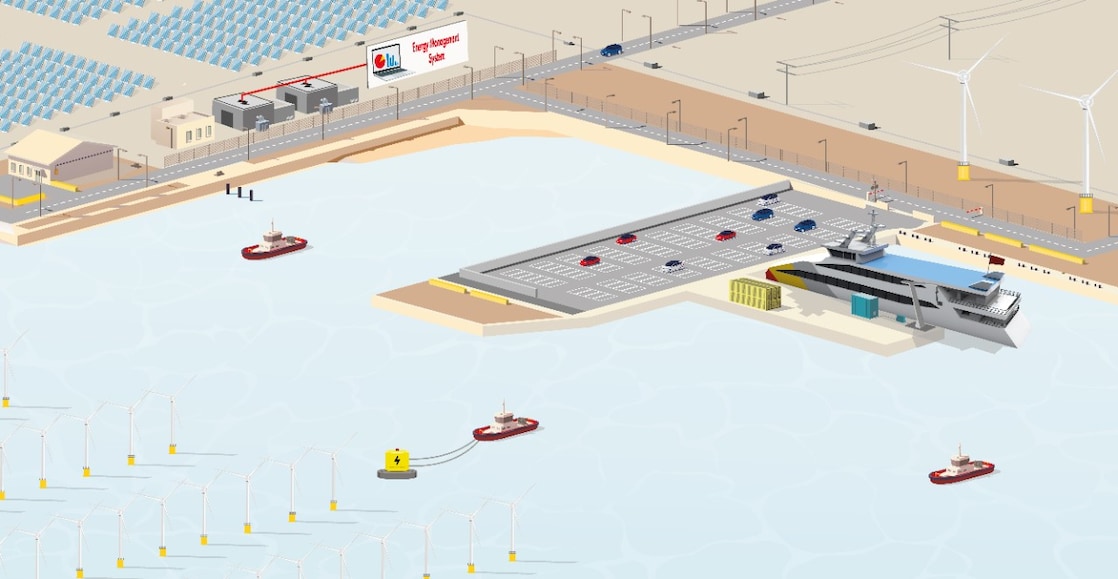
An integrated electrification solutions can be designed to be:
End-to-end
Designed as a complete system to ensure effective performance and support decarbonisation goals.
Priced flexibly
Flexible pricing options to reduce upfront investment barriers and foster sustainable progress.
Modular
Allows for adaptability by adding, removing, or upgrading parts to match evolving vessel and operational needs.
Optimised
Tailored to meet specific vessel and journey demands, ensuring minimal disruption to operations.
A cleaner fossil fuel alternative
Reduces emissions without sacrificing operational safety or efficiency, supporting decarbonisation efforts.
Shell’s first fully electric ferry
Shell’s first fully electric ferry
Nick Potter
General Manager of Shell Shipping & Maritime Asia Pacific and the Middle East
The replacement of the existing ferries gave us a fantastic opportunity to look at Shell's decarbonisation solutions and ultimately land on full electrification. Tapping into Singapore's unique environment where industry, academia and government collaborate together around decarbonisation created an excellent platform to be able to work with our partners, Penguin and the full support of MPA to make this project a success.
Er Tham Wai Wah
Chief Sustainability Officer Maritime & Port Authority of Singapore
It is heartening to see corporate leaders such as Shell launching full electric harbour craft for its Bukom operations well ahead of the recently announced 2030 timeline for all new harbour craft to be fully electric, be apable of using 100% biofuels or be compatible with net-zero fuels.
Two more electric ferries to be launched in Singapore in 2023
The three ferries will save 6,258 tonnes of CO2 emissions and 1,952 tonnes in fuel consumption*
* Based on data from existing conventional ferries carrying out similar service
At Shell, we're doing our part by providing excess capacity from our marine charging infrastructure to industry players. And longer term, we're looking at growing that marine charging infrastructure. Beyond electrification of ports, harbour craft and short sea shipping, Shell's working with its customers to provide biofuels, LNG and energy efficient technologies to deep sea shipping.
Shell Marine
Featured content
Decarbonising Shipping
Shell Marine offers solutions to drive vessel efficiency and leverage emerging technologies, offering practical pathways toward a decarbonised future with innovative fuel solutions.
Marine Fuels
As a global supplier, Shell provides a diverse range of marine fuels, from high-sulphur to LNG, helping your fleet comply with international regulations.
Marine Lubricants
Our high-performance lubricants are tailored to ensure operational efficiency and reliability while reducing costs, supporting the sustainability goals of modern maritime operations.
Disclaimers:
1 Efficient, reliable and continuous energy: dependent on supply & location, cannot be guaranteed.
2 A cleaner fossil fuel alternative/with reduced emissions: Electrified mobile equipment emits fewer CO2 emissions whilst operational and therefore offers a reduction vs fossil fuel operated machinery.