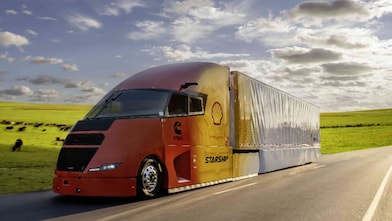
Our Triple 10 Challenge Concept Car Unveiled
In June 2026, we unveiled Shell's ground-breaking Triple 10 Challenge concept car, a proof-of-concept vehicle using Shell's latest thermal fluid technology to improve efficiency, performance and costs for the next-generation of battery electric vehicles (EVs).
Rising to the Triple 10 Challenge
Our Triple 10 Challenge focused on three ambitious technical targets in a single vehicle, demonstrating technologies relevant to mass-market electric mobility.

10-minute charge time

10km/kWh driving efficiency

10 tonnes CO2e lifecycle emissions
The results

How did we do it?
This B-segment vehicle demonstrates next‑generation electric vehicle capability, and offers the industry an alternative to the current reliance on ever-larger batteries by re‑imagining the fundamentals of thermal management.
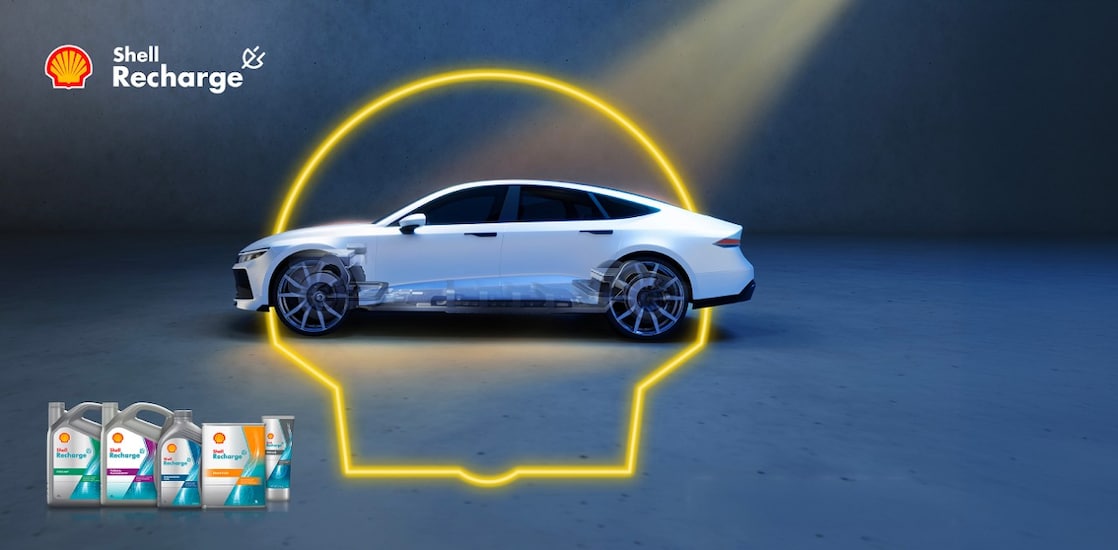
Re-imagining the fundamentals of thermal management
The key to the Triple 10 Challenge carʼs performance is Shell Recharge thermal fluid. Unlike traditional cooling systems that use water-ethylene-glycol, Shellʼs dielectric fluid allows direct immersion cooling of the battery and powertrain components including the motor and power electronics.
This is the first road-worthy vehicle to have successfully demonstrated the potential of a simplified, single-circuit cooling architecture to efficiently manage the thermal load of the entire powertrain, even under the most extreme fast-charging scenario in real-world conditions.
By changing the physics of heat management across the battery and powertrain, weʼve unlocked the potential for faster charging, lighter systems and improved lifecycle efficiency – using technologies that exist and can scale today.
Our Partners

Horiba Mira
The engineering and testing expertise helped Shell validate its EV-Plus thermal fluid for electric vehicles, showing it can cool all EV powertrain components and support faster charging, improved performance and simpler design.

RML
They bring advanced EV and battery system expertise to the Triple 10 Challenge. Working with Shell, they helped develop a compact battery pack that charges from 10-80% in under 10 minutes using Shell EV‑Plus thermal fluid


The Triple 10 Challenge
Join the race to rewrite EV performance
A bold new benchmark for mass-market EVs: a sub-10-minute charging, energy efficiency of 10 km per kWh, and a lifecycle CO₂ footprint of 10 tonnes. Shell is co-developing with world-class partners to transform the performance of the next-generation of EVs.
Cara Tredget, VP Mobility & Lubricants Technology for Shell.“With the Triple 10 Challenge concept car, we have unlocked the potential for faster charging, lighter systems and improved lifecycle efficiency by using our advanced thermal fluids. Together with our co-engineering partners, we are proud to use technologies that are available today and are scalable to support customers for their business into the future”
FAQs
There are plenty of cars that can charge from 10-80% in under 10 minutes already?
There are plenty of cars that can charge from 10-80% in under 10 minutes already?
Typically, Electric Vehicles (EVs) capable of a 10-minute charge require ultra-rapid chargers exceeding 300kW. However, the Triple Ten Challenge concept car takes a different approach. By pairing a smaller battery with Shell’s advanced thermal fluid, the system manages heat much more effectively than conventional base-plate cooled cells. This superior cooling allows a higher electrical current to safely flow through each cell. As a result, the vehicle achieves greater overall efficiency and can complete its 10-minute charge using standard 175kW chargers, which are widely available on today's public charging networks.
You’re not the first with immersion cooling for batteries - what makes Shell Thermal Management Fluid distinctive?
You’re not the first with immersion cooling for batteries - what makes Shell Thermal Management Fluid distinctive?
Shell’s Thermal Fluid has demonstrated through rigorous independent validation to have successfully rejected all the collected heat using a standard, off-the-shelf radiator. This proves our specialised fluid can be a highly suitable replacement for traditional Water-Ethylene-Glycol coolants to cool the immersed battery, motor, and power electronics.
Our Thermal Fluid has proven potential to unlock the thermal management needs required for next-generation battery designs.
What are the top benefits of an immersion fluid over other battery cooling technologies?
What are the top benefits of an immersion fluid over other battery cooling technologies?
Simplified Design & Manufacturing: It moves BEV design from “a patchwork of cooling systems” to an elegant single fluid, single-circuit system. When implemented, this can help simplify manufacturing, reduce the number of required components, and streamline the supply chain.
Reduces Cost & Weight: By eliminating components (like dedicated WEG circuits, pumps and reservoirs), the system reduces overall vehicle weight, which in turn drives operational economy and cost-efficiency.
Enables Ultra-Fast Charging (UFC): Shell’s thermal fluid specially designed for advanced thermal management of EVs is the key enabler for sub-10-minute charging (from 10% to 80%). We have now proven this same fluid can also handle all other powertrain cooling needs simultaneously.
Boosts Performance: The system promotes enhanced vehicle performance and allows for optimal drivetrain operation.
What do you hope to achieve from the Triple 10 Challenge?
What do you hope to achieve from the Triple 10 Challenge?
Our goal is to prove to the industry that Shell’s advanced thermal fluids can unlock entirely new levels of performance in EV thermal management.
Building on the real-world data and experience we’re gathering from the Triple Ten Challenge concept car, we hope to partner with OEMs and battery suppliers to share our expertise. Together, we want to collaborate on the development of next-generation EVs that are lighter, highly efficient, simpler to manufacture, and more cost-effective.