Shell and Genesis debut Hypercar at FIA World Endurance Championship 2026
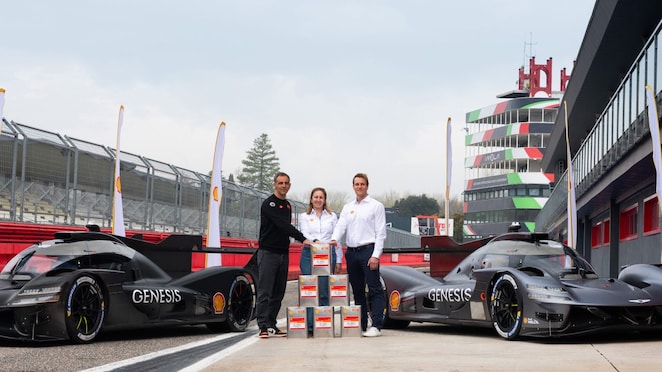
Shell and Genesis will unveil an all-new endurance model – Genesis GMR-001 Hypercar - at the 2026 FIA World Endurance Championship (WEC).
Shell and Hyundai Motor Company, partners of more than 20-years, will unveil their newest project at the globally-renowned endurance championship – bringing together the very latest in lubricant technology and automotive engineering under one roof.
Genesis Magma Racing, backed by Hyundai Motor Company and Hyundai Motorsport, will feature the GMR-001 Hypercar in WEC’s top-tier category, which includes the iconic 24-hours of Le Mans - widely considered one of the world’s toughest races.
Shell, as Performance and Innovation Partner to Genesis Magma Racing, have developed a dedicated formulation of 0W-40 engine oil for the GMR-001 Hypercar, which was extensively tested1 on and off the track. It combines Shell’s PurePlus technology2 with bespoke components3 to achieve maximum performance, thermal stability and component protection over extreme distances.
“WEC unlocks a thrilling new arena for Shell and Hyundai to keep pushing boundaries and co-engineer lubricants like Shell Helix Ultra,” said Aysun Akik, Vice President of New Business Development and Global Key Accounts, Shell Lubricants. “When races last for six, eight or more hours, scientists and drivers can test innovative new technologies using endurance as the ultimate testbed. Together, we intend to continue delivering quality solutions to our customers.”
On its new journey to hyperspeed, Genesis Magma Racing joins a group of 13 manufacturers in the 2026 series, which begins in Imola from 17 April. As Genesis Magma Racing prepares to take to the track, Shell, Hyundai and the team are ready to apply those insights to the development of new lubricant and fluid solutions, strengthening a shared focus on efficient, reliable mobility.
“Genesis Magma Racing is rooted in Korean heritage; a culture shaped by precision, perseverance and a constant drive to improve,” said Cyril Abiteboul, President, Hyundai Motorsport. “We now have a new platform to express that philosophy through engineering and performance, while inspiring a new motorsport culture. Partnering with Shell is central to turning that ambition into reality.”
Shell and Hyundai Motorsport are longstanding technical partners in the World Rally Championship, celebrating more than a hundred podiums, a Drivers’ Championship victory, and a long record of engine reliability.
For Shell, the WEC provides an opportunity to develop future lubricant technologies that prioritise durability and reliability – as road vehicles become more powerful, more electrified and more complex.
Notes to editors
About Shell:
Shell is the world’s #1 supplier of finished lubricants for 19 years running.4 Our people and technology power some of the world’s most iconic racing teams, including Hyundai Motorsport, Scuderia Ferrari HP in Formula 1, Ducati Corse, and BMW M Motorsport.
These are deep, hands‑on collaborations where Shell scientists work directly with race engineers to extract every possible drop of performance. Each race pushes our fuels and lubricants to extreme limits, and the innovations we prove on the track translate into real benefits for our customers - delivering greater efficiency, protection and performance on the road.
About Hyundai Motorsport:
Hyundai Motorsport GmbH (HMSG) was established in 2012 to participate in global motorsports by Hyundai Motors. The corporate headquarters is located in Alzenau, Germany, and is currently in charge of Hyundai Motor's global motorsports activities, including the WRC (World Rally Championship), customer racing, and the development of high-performance electric racing cars. In addition, HMSG is responsible for the design, testing, and manufacturing of racing cars participating in motorsports, and shares high-performance-related technologies with the mass-production car development department based on the data obtained from the race. it is playing an important role in leading eco-friendly high-performance technology by developing a high-performance electric race car, and participating in competitions.
About Genesis:
Founded as the luxury arm of Hyundai Motor Group in 2015, Genesis places customer comfort at the center of every decision, redefining luxury with a distinctly Korean perspective and an audacious spirit. Rooted in its Athletic Elegance design philosophy, Genesis delivers an award-winning lineup that blends progressive design, advanced safety technologies, and dynamic performance. Each model is engineered to provide a secure and sophisticated driving experience. Committed to a more sustainable future, Genesis is leading the shift toward electrification with models like the Electrified G80, GV60, and Electrified GV70, with plans to expand electrified powertrains across its portfolio. As Genesis moves beyond its 10th anniversary, the brand sets its sights on the future, driving forward with an unwavering commitment to refining disruption in every aspect of its business.
About Genesis Motor Racing:
Genesis Magma Racing is the official motorsport program of Genesis, representing the brand’s bold entry into the motorsport arena. Rooted in Genesis’ core ethos of “Disruption, Refined,” Genesis Magma Racing combines precision engineering, dynamic performance, and advanced technology to compete at the highest levels. The team will debut the GMR-001 Hypercar in the FIA World Endurance Championship (WEC) in 2026 and the IMSA SportsCar
Cautionary Note
Cautionary Note
The companies in which Shell plc directly and indirectly owns investments are separate legal entities. In this content “Shell”, “Shell Group” and “Group” are sometimes used for convenience to reference Shell plc and its subsidiaries in general. Likewise, the words “we”, “us” and “our” are also used to refer to Shell plc and its subsidiaries in general or to those who work for them. These terms are also used where no useful purpose is served by identifying the particular entity or entities. ‘‘Subsidiaries’’, “Shell subsidiaries” and “Shell companies” as used in this content refer to entities over which Shell plc either directly or indirectly has control. The terms “joint venture”, “joint operations”, “joint arrangements”, and “associates” may also be used to refer to a commercial arrangement in which Shell has a direct or indirect ownership interest with one or more parties. The term “Shell interest” is used for convenience to indicate the direct and/or indirect ownership interest held by Shell in an entity or unincorporated joint arrangement, after exclusion of all third-party interest.
Forward-Looking statements
This content contains forward-looking statements (within the meaning of the U.S. Private Securities Litigation Reform Act of 1995) concerning the financial condition, results of operations and businesses of Shell. All statements other than statements of historical fact are, or may be deemed to be, forward-looking statements. Forward-looking statements are statements of future expectations that are based on management’s current expectations and assumptions and involve known and unknown risks and uncertainties that could cause actual results, performance or events to differ materially from those expressed or implied in these statements. Forward-looking statements include, among other things, statements concerning the potential exposure of Shell to market risks and statements expressing management’s expectations, beliefs, estimates, forecasts, projections and assumptions. These forward-looking statements are identified by their use of terms and phrases such as “aim”; “ambition”; ‘‘anticipate’’; “aspire”, “aspiration”, ‘‘believe’’; “commit”; “commitment”; ‘‘could’’; “desire”; ‘‘estimate’’; ‘‘expect’’; ‘‘goals’’; ‘‘intend’’; ‘‘may’’; “milestones”; ‘‘objectives’’; ‘‘outlook’’; ‘‘plan’’; ‘‘probably’’; ‘‘project’’; ‘‘risks’’; “schedule”; ‘‘seek’’; ‘‘should’’; ‘‘target’’; “vision”; ‘‘will’’; “would” and similar terms and phrases. There are a number of factors that could affect the future operations of Shell and could cause those results to differ materially from those expressed in the forward-looking statements included in this content, including (without limitation): (a) price fluctuations in crude oil and natural gas; (b) changes in demand for Shell’s products; (c) currency fluctuations; (d) drilling and production results; (e) reserves estimates; (f) loss of market share and industry competition; (g) environmental and physical risks, including climate change; (h) risks associated with the identification of suitable potential acquisition properties and targets, and successful negotiation and completion of such transactions; (i) the risk of doing business in developing countries and countries subject to international sanctions; (j) legislative, judicial, fiscal and regulatory developments including tariffs and regulatory measures addressing climate change; (k) economic and financial market conditions in various countries and regions; (l) political risks, including the risks of expropriation and renegotiation of the terms of contracts with governmental entities, delays or advancements in the approval of projects and delays in the reimbursement for shared costs; (m) risks associated with the impact of pandemics, regional conflicts, such as the Russia-Ukraine war and the conflict in the Middle East, and a significant cyber security, data privacy or IT incident; (n) the pace of the energy transition; and (o) changes in trading conditions. No assurance is provided that future dividend payments will match or exceed previous dividend payments. All forward-looking statements contained in this content are expressly qualified in their entirety by the cautionary statements contained or referred to in this section. Readers should not place undue reliance on forward-looking statements. Additional risk factors that may affect future results are contained in Shell plc’s Form 20-F for the year ended December 31, 2025 (available at www.shell.com/investors/news-and-filings/sec-filings.html and www.sec.gov). These risk factors also expressly qualify all forward-looking statements contained in this content and should be considered by the reader. Each forward-looking statement speaks only as of the date of this content, 27 March 2026. Neither Shell plc nor any of its subsidiaries undertake any obligation to publicly update or revise any forward-looking statement as a result of new information, future events or other information. In light of these risks, results could differ materially from those stated, implied or inferred from the forward-looking statements contained in this content.
Shell’s net carbon intensity
Also, in this content we may refer to Shell’s “net carbon intensity” (NCI), which includes Shell’s carbon emissions from the production of our energy products, our suppliers’ carbon emissions in supplying energy for that production and our customers’ carbon emissions associated with their use of the energy products we sell. Shell’s NCI also includes the emissions associated with the production and use of energy products produced by others which Shell purchases for resale. Shell only controls its own emissions. The use of the terms Shell’s “net carbon intensity” or NCI is for convenience only and not intended to suggest these emissions are those of Shell plc or its subsidiaries.
Shell’s net-zero emissions target
Shell’s operating plan and outlook are forecasted for a three-year period and ten-year period, respectively, and are updated every year. They reflect the current economic environment and what we can reasonably expect to see over the next three and ten years. Accordingly, the outlook reflects our combined Scope 1 and 2 target, NCI target and our oil products ambition over the next ten years. However, Shell’s operating plan and outlook cannot reflect our 2050 net-zero emissions target, as this target is outside our planning period. Such future operating plans and outlooks could include changes to our portfolio, efficiency improvements and the use of carbon capture and storage and carbon credits. In the future, as society moves towards net-zero emissions, we expect Shell’s operating plans and outlooks to reflect this movement. However, if society is not net zero in 2050, as of today, there would be significant risk that Shell may not meet this target.
Forward-Looking non-GAAP measures
This content may contain certain forward-looking non-GAAP measures such as free cash flow and underlying operating expenses. We are unable to provide a reconciliation of these forward-looking non-GAAP measures to the most comparable GAAP financial measures because certain information needed to reconcile those non-GAAP measures to the most comparable GAAP financial measures is dependent on future events some of which are outside the control of Shell, such as oil and gas prices, interest rates and exchange rates. Moreover, estimating such GAAP measures with the required precision necessary to provide a meaningful reconciliation is extremely difficult and could not be accomplished without unreasonable effort. Non-GAAP measures in respect of future periods which cannot be reconciled to the most comparable GAAP financial measure are calculated in a manner which is consistent with the accounting policies applied in Shell plc’s consolidated financial statements.
The contents of websites referred to in this content do not form part of this content.
We may have used certain terms, such as resources, in this content that the United States Securities and Exchange Commission (SEC) strictly prohibits us from including in our filings with the SEC. Investors are urged to consider closely the disclosure in our Form 20-F, File No 1-32575, available on the SEC website www.sec.gov.
1 Refers to laboratory and bench testing (viscometric profile, high and ultra high shear behaviour, warm and cold temperature properties, friction and wear measurements, coking resistance, foaming resistance), conducted at Shell Technology Centre Hamburg, as well as multiple on-track vehicle tests exceeding 30 hours of runtime per test.
2 Shell PurePlus Technology is a revolutionary process that produces a cleaner, purer form of base oil, the main component of car engine motor oils. By converting natural gas into crystal clear base oil, Shell’s patented technology process creates an oil that’s 99.5% pure*
*Based on paraffinic hydrocarbon content and significantly higher level of iso-paraffins compared to typical Group II and III base oils.
3 Bespoke components’ refers to limited‑availability additives selected for the specific performance requirements of the GMR‑001 Hypercar. All components meet Shell’s safety, quality and regulatory standards.
4 Shell tops global lubricants market for 19ᵗʰ consecutive year | Shell Global
Media Contacts:
UK / International Media Relations: +44 20 7934 5550
Americas Media Relations: Contact Shell US Media Team
Asia Pacific Media Relations: apac-media@shell.com
Middle East and North Africa Media Relations: mena.media@shell.com