Shell and Rolls-Royce sign agreement to accelerate progress towards net zero
The companies will join forces to progress the use of sustainable aviation fuel (SAF) in aircraft engines and shape policies that support a net zero pathway for the industry.
Shell and Rolls-Royce today signed a memorandum of understanding (MoU) which aims to support the decarbonisation of the aviation industry and their progress towards net zero emissions. The long-term agreement builds on more than a century of cooperation between the two companies, and embodies a shared perspective that collaboration across the aviation value chain is necessary for the decarbonisation of the sector.
In recognition of the scale of the challenge, the MoU will expand and accelerate several existing areas of cooperation between the companies such as advancing the use of SAF. This includes Rolls-Royce’s new SAFinity service, for which Shell is the exclusive SAF supplier, and working together on demonstrating the use of 100% SAF as a full “drop-in” solution. This will see the companies explore opportunities to help progress the use of 100% SAF towards certification, building on Rolls-Royce’s ongoing 100% SAF testing programme.
“The heritage of collaboration between Rolls-Royce and Shell is a strong foundation for the future, particularly when it comes to our shared ambitions for achieving net zero emissions,” said Anna Mascolo, President, Shell Aviation. “Being from different parts of the aviation value chain means Rolls-Royce and Shell bring complementary expertise, experiences and ideas to the table. Wide-ranging cooperation can drive new solutions that will help the aviation industry and our customers navigate a pathway to net zero.”
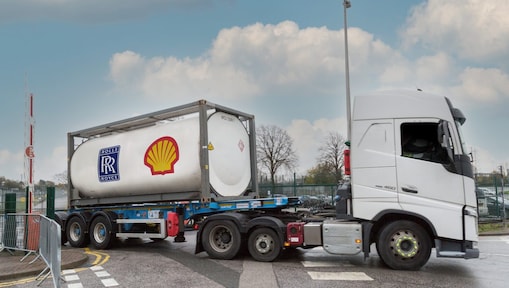
“Supporting the decarbonisation of aviation while continuing to enable progress in flight are goals that Rolls-Royce and Shell both share,” said Paul Stein, Chief Technology Officer at Rolls-Royce. “We believe that working together on these aims can deliver benefits for both the development of new innovations as well as collaborating to find ways to unlock the net carbon emissions reduction potential of technology that is already in use today. SAFs will not only power large aircraft and business aviation, but also hybrid electric Urban Air Mobility (‘Flying taxis’) and the forthcoming generation of hybrid fixed wing city hoppers, which is why we place such importance on the ramp up of SAF adoption across the industry.”
The MoU will explore opportunities for Shell and Rolls-Royce to provide decarbonisation solutions to meet their respective targets to achieve net zero emissions by 2050. This will include both companies contributing technologies and expertise to help reduce operational emissions. Shell will assess opportunities to support Rolls-Royce in reducing travel emissions through the supply of SAF, while Rolls-Royce will lend its technical expertise to advise Shell in its new fuels development, as well as innovative low carbon energy alternatives for new aircraft and power systems.
The MoU will also set the foundation for Rolls-Royce and Shell to work together to proactively engage industry bodies and forums to progress strategic policy issues, and address existing barriers associated with the aviation sector’s pathway to decarbonisation. As part of this, Rolls-Royce and Shell also expect to work closely with stakeholders from across the aviation community to help support wider progress towards net zero.
As part of the MoU, Rolls-Royce and Shell will assess broader opportunities for cooperation across aviation as well as infrastructure in other mobility sectors such as shipping and rail.
About Shell Aviation:
With one of the most extensive refuelling networks in the world, Shell Aviation supplies fuel, lubricants and solutions in more than 60 countries. Customers range from the world’s largest airlines to private pilots. As part of our carbon management strategy, we actively collaborate across the industry to deliver more sustainable solutions for aviation. Examples include our work with World Energy, SkyNRG, Amazon Air, Neste and Red Rock, and at San Francisco Airport and Stuttgart Airport. Shell Aviation is proud to be a member of “The Clean Skies for Tomorrow Coalition” and the UK government’s Jet Zero Council. Further information can be found at Shell Aviation.
Media Enquiries:
Ralph van Mook, Spokesperson, Shell Media Relations
T: +44 20 7934 5550
E: Ralph.vanMook@shell.com
About Rolls-Royce Holdings plc
Rolls-Royce pioneers the power that matters to connect, power and protect society. We have pledged to achieve net zero greenhouse gas emissions in our operations by 2030 [excluding product testing] and joined the UN Race to Zero campaign in 2020, affirming our ambition to play a fundamental role in enabling the sectors in which we operate achieve net zero carbon by 2050. Rolls-Royce has customers in more than 150 countries, comprising more than 400 airlines and leasing customers, 160 armed forces and navies, and more than 5,000 power and nuclear customers. Annual underlying revenue was £11.76 billion in 2020 and we invested £1.25 billion on research and development. We also support a global network of 28 University Technology Centres, which position Rolls-Royce engineers at the forefront of scientific research.
Media Enquiries:
Daisy Omissi, Head of External Communications, Rolls-Royce plc
T: +44 (0)75 0099 0583
E: daisy.omissi@rolls-royce.com
Disclaimer
Disclaimer
Cautionary Note
The companies in which Shell plc directly and indirectly owns investments are separate legal entities. In this content “Shell”, “Shell Group” and “Group” are sometimes used for convenience to reference Shell plc and its subsidiaries in general. Likewise, the words “we”, “us” and “our” are also used to refer to Shell plc and its subsidiaries in general or to those who work for them. These terms are also used where no useful purpose is served by identifying the particular entity or entities. ‘‘Subsidiaries’’, “Shell subsidiaries” and “Shell companies” as used in this content refer to entities over which Shell plc either directly or indirectly has control. The terms “joint venture”, “joint operations”, “joint arrangements”, and “associates” may also be used to refer to a commercial arrangement in which Shell has a direct or indirect ownership interest with one or more parties. The term “Shell interest” is used for convenience to indicate the direct and/or indirect ownership interest held by Shell in an entity or unincorporated joint arrangement, after exclusion of all third-party interest.
Forward-Looking statements
This content contains forward-looking statements (within the meaning of the U.S. Private Securities Litigation Reform Act of 1995) concerning the financial condition, results of operations and businesses of Shell. All statements other than statements of historical fact are, or may be deemed to be, forward-looking statements. Forward-looking statements are statements of future expectations that are based on management’s current expectations and assumptions, including (without limitation) those concerning Shell’s strategy and operating plans, macroeconomic conditions, future energy demand, supply and product mix, commodity prices, demand for Shell’s products, production results and reserve estimates, development, execution and management of projects, energy transition and climate change, management of safety and environmental risks, costs, cash capital expenditures, technology advancements, legislative, judicial, fiscal and regulatory developments, regional conflicts and trading conditions, and involve known and unknown risks and uncertainties that could cause actual results, performance or events to differ materially from those expressed or implied in these statements. Forward-looking statements include, among other things, statements concerning the potential exposure of Shell to market risks and statements expressing management’s expectations, beliefs, estimates, forecasts, projections and assumptions. These forward-looking statements are identified by their use of terms and phrases such as “aim”; “ambition”; ‘‘anticipate’’; “aspire”, “aspiration”, ‘‘believe’’; “commit”; “commitment”; ‘‘could’’; “desire”; ‘‘estimate’’; ‘‘expect’’; ‘‘goals’’; ‘‘intend’’; ‘‘may’’; “milestones”; ‘‘objectives’’; ‘‘outlook’’; ‘‘plan’’; ‘‘probably’’; ‘‘project’’; ‘‘risks’’; “schedule”; ‘‘seek’’; ‘‘should’’; ‘‘target’’; “vision”; ‘‘will’’; “would” and similar terms and phrases. There are a number of factors that could affect the future operations of Shell and could cause those results to differ materially from those expressed in the forward-looking statements included in this content, including (without limitation): (a) price fluctuations in crude oil and natural gas; (b) changes in demand for Shell’s products; (c) currency fluctuations; (d) drilling and production results; (e) reserves estimates; (f) loss of market share and industry competition; (g) environmental and physical risks, including climate change; (h) risks associated with the identification of suitable potential acquisition properties and targets, and successful negotiation and completion of such transactions; (i) the risk of doing business in developing countries and countries subject to international sanctions; (j) legislative, judicial, fiscal and regulatory developments including tariffs and regulatory measures addressing climate change; (k) economic and financial market conditions in various countries and regions; (l) political risks, including the risks of expropriation and renegotiation of the terms of contracts with governmental entities, delays or advancements in the approval of projects and delays in the reimbursement for shared costs; (m) risks associated with the impact of pandemics, regional conflicts, such as the Russia-Ukraine war and the conflict in the Middle East, and a significant cyber security, data privacy or IT incident; (n) the pace of the energy transition; and (o) changes in trading conditions. No assurance is provided that future dividend payments will match or exceed previous dividend payments. All forward-looking statements contained in this content are expressly qualified in their entirety by the cautionary statements contained or referred to in this section. Readers should not place undue reliance on forward-looking statements. Additional risk factors that may affect future results are contained in Shell plc’s Form 20-F for the year ended December 31, 2025 (available at www.shell.com/investors/news-and-filings/sec-filings.html and www.sec.gov). These risk factors also expressly qualify all forward-looking statements contained in this content and should be considered by the reader. Each forward-looking statement speaks only as of the date of the publication mentioned in this website. Neither Shell plc nor any of its subsidiaries undertake any obligation to publicly update or revise any forward-looking statement as a result of new information, future events or other information. In light of these risks, results could differ materially from those stated, implied or inferred from the forward-looking statements contained in this content.
Shell’s net carbon intensity and net-zero emissions target
In this content we may refer to Shell’s “net carbon intensity” (NCI), which includes Shell’s carbon emissions from the production of our energy products, our suppliers’ carbon emissions in supplying energy for that production and our customers’ carbon emissions associated with their use of the energy products we sell. Shell’s NCI also includes the emissions associated with the production and use of energy products produced by others which Shell purchases for resale. Shell only controls its own emissions. The use of the terms Shell’s “net carbon intensity” or NCI is for convenience only and not intended to suggest these emissions are those of Shell plc or its subsidiaries.
Shell’s operating plan and outlook are forecasted for a three-year period and ten-year period, respectively, and are updated every year. They reflect the current economic environment and what we can reasonably expect to see over the next three and ten years. Accordingly, the outlook reflects our combined Scope 1 and 2 target, NCI target and our oil products ambition over the next ten years. However, Shell’s operating plan and outlook cannot reflect our 2050 net-zero emissions target, as this target is outside our planning period. Such future operating plans and outlooks could include changes to our portfolio, efficiency improvements and the use of carbon capture and storage and carbon credits. In the future, as society moves towards net-zero emissions, we expect Shell’s operating plans and outlooks to reflect this movement. However, if society is not net zero in 2050, as of today, there would be significant risk that Shell may not meet this target.
The information provided above regarding Shell’s NCI and net zero emissions target are not intended, nor should they be construed as introducing, suggesting or making any claim, target or representation thereof other than what is included in the content.
Forward-Looking non-GAAP measures
This content may contain certain forward-looking non-GAAP measures such as free cash flow and underlying operating expenses. We are unable to provide a reconciliation of these forward-looking non-GAAP measures to the most comparable GAAP financial measures because certain information needed to reconcile those non-GAAP measures to the most comparable GAAP financial measures is dependent on future events some of which are outside the control of Shell, such as oil and gas prices, interest rates and exchange rates. Moreover, estimating such GAAP measures with the required precision necessary to provide a meaningful reconciliation is extremely difficult and could not be accomplished without unreasonable effort. Non-GAAP measures in respect of future periods which cannot be reconciled to the most comparable GAAP financial measure are calculated in a manner which is consistent with the accounting policies applied in Shell plc’s consolidated financial statements. These forward-looking non-GAAP measures are provided to assist readers in understanding management’s use and expectations of such measures and may not be appropriate for other purposes.
The contents of websites referred to in this content do not form part of this content.
We may have used certain terms, such as resources, in this content that the United States Securities and Exchange Commission (SEC) strictly prohibits us from including in our filings with the SEC. Investors are urged to consider closely the disclosure in our Form 20-F, File No 1-32575, available on the SEC website www.sec.gov.