
Electric vehicle charging
For over a century, Shell has played a part in the essential journeys people make every day through our trusted service stations. With mobility demands evolving, our aim is to help customers as they transition to electric vehicles (EVs) by providing innovative charging solutions that meet their needs on the go, on streets or in fleet depots.

Growing our public network of electric vehicle charging points
We currently have more than 80,000 public charge points globally at forecourts, on-street locations, mobility hubs and destinations such as supermarkets.
Shell Recharge is present in around 39 markets worldwide; however, the majority of Shell’s investment in EV charging is currently prioritised towards leading markets for EV adoption.
As more and more drivers switch to EVs, we expect to see a shift away from at home charging towards public charging. This is because we anticipate less drivers to have access to off-street park, especially in busy urban cities, which is one of the reasons why we acquired on-street charging operator “ubitricity” in 2021.
Through ubitricity we offer over 10,000 lamp post charge points to drivers without private parking in a growing number of cities across the UK and Europe. We are also working with strategic partners, such as retailers, hotels, and car park owners, to help customers be more productive with their charging time by providing EV destination charging at convenient locations.
Enhancing the electric charging experience
As well as investing in our charging infrastructure, we know that EV drivers are looking to use their time in a positive way while they are charging at our locations.
Our 2025 “Shell Recharge Driver Programme ” surveyed drivers across Europe, China and North America and found that a significant majority (75% of EV drivers and 80% of non-EV drivers) purchasing at least one non-fuel retail item monthly. Coffee emerged as the most popular choice among all drivers with four in ten (41%) drivers enjoying at least a cup each month.
That is why we offer convenience retail options at many of our forecourts and mobility hubs - creating destinations where customers can enjoy high-quality food and beverages, allowing them to recharge themselves while their vehicles recharge!

Delivering smarter electric fleet solutions
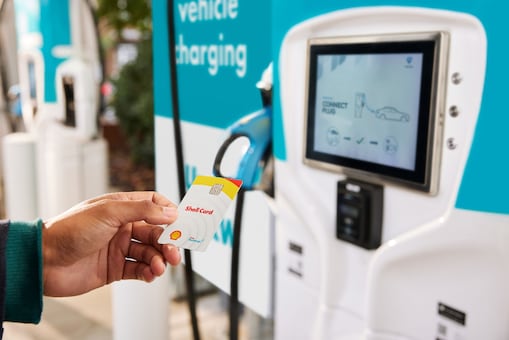
Business-related travel accounts for roughly one-third of all journeys. Through our integrated solutions, we help customers electrify their fleets by providing comprehensive charging infrastructure and services. On the road, we offer a wide network of charge points at forecourts, retail destinations, and highways for light and medium-duty fleets, as well as hybrid and dedicated Shell Recharge stations for heavy-duty vehicles. Drivers also benefit from access to an extensive roaming network of charge points operated by third parties via the Shell Card.
For heavy-duty fleets, we deliver tailored depot charging solutions to design, implement, and manage EV infrastructure. These can be private (eDepot), shared with selected partners (eDepot+), or semi-public with scheduled availability. Through SBRS, a Shell Group company, we provide specialist depot charging expertise for heavy-duty operations.
Additionally, we support customers in decarbonising through smart, sustainable fleet management programmes. Our four-step “Accelerate to Zero” framework helps fleet and mobility managers assess their carbon footprint, explore decarbonisation options, and develop a roadmap to achieve net-zero on-road emissions.
Integrating the EV charging ecosystem
Shell participates in virtually every aspect of the energy system, from production to distribution to retail sales. This integration is an enormous advantage in the EV charging ecosystem, particularly when it comes to the provision of renewable energy.
We have set ourselves a target to ensure that our EV network is powered by 100% certified renewable electricity, wherever possible, because we’ll only realise the full benefits of the electric revolution if we decarbonise our supply.*
*Disclaimer: Our renewable electricity is certified by Renewable Energy Guarantees of Origin (REGOs), which means that all of the electricity Shell purchases to supply our Shell Recharge sites is matched with the equivalent amount of units from 100% renewable sources in the UK, Netherlands and Germany.
Cautionary Note
Cautionary Note
The companies in which Shell plc directly and indirectly owns investments are separate legal entities. In this content “Shell”, “Shell Group” and “Group” are sometimes used for convenience to reference Shell plc and its subsidiaries in general. Likewise, the words “we”, “us” and “our” are also used to refer to Shell plc and its subsidiaries in general or to those who work for them. These terms are also used where no useful purpose is served by identifying the particular entity or entities. ‘‘Subsidiaries’’, “Shell subsidiaries” and “Shell companies” as used in this content refer to entities over which Shell plc either directly or indirectly has control. The terms “joint venture”, “joint operations”, “joint arrangements”, and “associates” may also be used to refer to a commercial arrangement in which Shell has a direct or indirect ownership interest with one or more parties. The term “Shell interest” is used for convenience to indicate the direct and/or indirect ownership interest held by Shell in an entity or unincorporated joint arrangement, after exclusion of all third-party interest.
Forward-Looking statements
This content contains forward-looking statements (within the meaning of the U.S. Private Securities Litigation Reform Act of 1995) concerning the financial condition, results of operations and businesses of Shell. All statements other than statements of historical fact are, or may be deemed to be, forward-looking statements. Forward-looking statements are statements of future expectations that are based on management’s current expectations and assumptions and involve known and unknown risks and uncertainties that could cause actual results, performance or events to differ materially from those expressed or implied in these statements. Forward-looking statements include, among other things, statements concerning the potential exposure of Shell to market risks and statements expressing management’s expectations, beliefs, estimates, forecasts, projections and assumptions. These forward-looking statements are identified by their use of terms and phrases such as “aim”; “ambition”; ‘‘anticipate’’; “aspire”, “aspiration”, ‘‘believe’’; “commit”; “commitment”; ‘‘could’’; “desire”; ‘‘estimate’’; ‘‘expect’’; ‘‘goals’’; ‘‘intend’’; ‘‘may’’; “milestones”; ‘‘objectives’’; ‘‘outlook’’; ‘‘plan’’; ‘‘probably’’; ‘‘project’’; ‘‘risks’’; “schedule”; ‘‘seek’’; ‘‘should’’; ‘‘target’’; “vision”; ‘‘will’’; “would” and similar terms and phrases. There are a number of factors that could affect the future operations of Shell and could cause those results to differ materially from those expressed in the forward-looking statements included in this content, including (without limitation): (a) price fluctuations in crude oil and natural gas; (b) changes in demand for Shell’s products; (c) currency fluctuations; (d) drilling and production results; (e) reserves estimates; (f) loss of market share and industry competition; (g) environmental and physical risks, including climate change; (h) risks associated with the identification of suitable potential acquisition properties and targets, and successful negotiation and completion of such transactions; (i) the risk of doing business in developing countries and countries subject to international sanctions; (j) legislative, judicial, fiscal and regulatory developments including tariffs and regulatory measures addressing climate change; (k) economic and financial market conditions in various countries and regions; (l) political risks, including the risks of expropriation and renegotiation of the terms of contracts with governmental entities, delays or advancements in the approval of projects and delays in the reimbursement for shared costs; (m) risks associated with the impact of pandemics, regional conflicts, such as the Russia-Ukraine war and the conflict in the Middle East, and a significant cyber security, data privacy or IT incident; (n) the pace of the energy transition; and (o) changes in trading conditions. No assurance is provided that future dividend payments will match or exceed previous dividend payments. All forward-looking statements contained in this content are expressly qualified in their entirety by the cautionary statements contained or referred to in this section. Readers should not place undue reliance on forward-looking statements. Additional risk factors that may affect future results are contained in Shell plc’s Form 20-F for the year ended December 31, 2025 (available at www.shell.com/investors/news-and-filings/sec-filings.html and www.sec.gov). These risk factors also expressly qualify all forward-looking statements contained in this content and should be considered by the reader. Each forward-looking statement speaks only as of the date of this content. Neither Shell plc nor any of its subsidiaries undertake any obligation to publicly update or revise any forward-looking statement as a result of new information, future events or other information. In light of these risks, results could differ materially from those stated, implied or inferred from the forward-looking statements contained in this content.
Shell’s net carbon intensity
Also, in this content we may refer to Shell’s “net carbon intensity” (NCI), which includes Shell’s carbon emissions from the production of our energy products, our suppliers’ carbon emissions in supplying energy for that production and our customers’ carbon emissions associated with their use of the energy products we sell. Shell’s NCI also includes the emissions associated with the production and use of energy products produced by others which Shell purchases for resale. Shell only controls its own emissions. The use of the terms Shell’s “net carbon intensity” or NCI is for convenience only and not intended to suggest these emissions are those of Shell plc or its subsidiaries.
Shell’s net-zero emissions target
Shell’s operating plan and outlook are forecasted for a three-year period and ten-year period, respectively, and are updated every year. They reflect the current economic environment and what we can reasonably expect to see over the next three and ten years. Accordingly, the outlook reflects our combined Scope 1 and 2 target, NCI target and our oil products ambition over the next ten years. However, Shell’s operating plan and outlook cannot reflect our 2050 net-zero emissions target, as this target is outside our planning period. Such future operating plans and outlooks could include changes to our portfolio, efficiency improvements and the use of carbon capture and storage and carbon credits. In the future, as society moves towards net-zero emissions, we expect Shell’s operating plans and outlooks to reflect this movement. However, if society is not net zero in 2050, as of today, there would be significant risk that Shell may not meet this target.
Forward-Looking non-GAAP measures
This content may contain certain forward-looking non-GAAP measures such as free cash flow and underlying operating expenses. We are unable to provide a reconciliation of these forward-looking non-GAAP measures to the most comparable GAAP financial measures because certain information needed to reconcile those non-GAAP measures to the most comparable GAAP financial measures is dependent on future events some of which are outside the control of Shell, such as oil and gas prices, interest rates and exchange rates. Moreover, estimating such GAAP measures with the required precision necessary to provide a meaningful reconciliation is extremely difficult and could not be accomplished without unreasonable effort. Non-GAAP measures in respect of future periods which cannot be reconciled to the most comparable GAAP financial measure are calculated in a manner which is consistent with the accounting policies applied in Shell plc’s consolidated financial statements.
The contents of websites referred to in this content do not form part of this content.
We may have used certain terms, such as resources, in this content that the United States Securities and Exchange Commission (SEC) strictly prohibits us from including in our filings with the SEC. Investors are urged to consider closely the disclosure in our Form 20-F, File No 1-32575, available on the SEC website www.sec.gov.