
Sketch: The Digitalisation of society
Digital technologies like artificial intelligence are already changing the way we live, work and think – and in the Shell Scenarios team we’ve explored how they could affect the world in the years ahead.
While it’s impossible to know exactly what the world will look like twenty or thirty years from now, it’s clear that digitalisation and associated technologies represent a significant ‘fork in the road’.
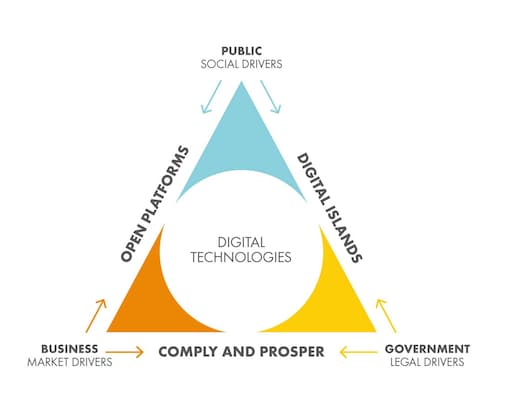
Working with experts from all over the world, we’ve sketched out three distinct worlds illustrating three very different digital futures. In all these potential worlds there is a strong technical dimension and a strong human dimension.
The future is moulded by how these elements fit together and drive each other – how technology interacts with social, market and legal drivers and the actions of individuals, businesses and governments. In reality, elements of the three worlds are likely to co-exist – both across the world, and within individual communities and governments.
The truth is that drivers have already been unleashed which could shape the world in ways we cannot yet predict but which we can explore. Just as technologies like the printing press, telegraph and internal combustion engine changed the world, so new technologies coming onstream look set to do the same.
By stretching how we all think about the digital future, people can be in a better position to make resilient choices today for a world in which digital technology will be increasingly important.
The choices we all make, the way we work together or compete, and how we apply technology will shape the quality of all our lives. In this, the human dimension will undoubtedly be as important as code. You can explore the three worlds for yourself by following the links below.

Digital Islands
Digital Islands explores a world which fragments, in part, as a consequence of digitalisation and new technologies. It’s a future in which populist political approaches are enabled by digital media, but techno-scepticism and resistance to new technology also become widespread. There is a resurgence in local and national identities as well as traditional values – and greater focus is put on face-to-face interaction and privacy. Algorithmically-derived insights may complement human decision-making but it’s flesh-and-blood people who always make the final decisions. As a result of a backlash against globalisation, the world is once again made up of a kaleidoscope of different states – some successful, some not so – which struggle to see past their own interests and rarely cooperate for the ‘common good’. It is a digital world primarily shaped by local, public actions and interventions by government.

Open Platforms
The Open Platforms world explores the transition – albeit bumpy – to a world characterised by global digital connectivity and a renewal of internationalist values. It’s a future where people increasingly delegate their day-to-day lives to algorithms and where, as social interaction becomes ever more digital and virtual, traditional social structures weaken. Technological advances lead to an economic boom – one where jobs are increasingly computational rather than manual – although the fruits of the boom aren’t always perceived to be fairly distributed. Social tensions eventually lead to additional regulation, but the backbone of international digital architecture is already in place. Ultimately, the digital world is largely shaped in the coming years by business and public actions, with government influence in the digital arena only becoming prominent late in the day.

Comply and Prosper
Comply and Prosper is a world in which people choose stability and prosperity over privacy and freedom – where personal data is used to assess and determine individuals’ abilities, health and education, and people are both rewarded and sanctioned for the way they live their lives. Despite the concerns of a vocal minority, ‘digital autocracy’ becomes accepted as an effective and orderly way of managing society. By the 2030s, government has aligned with major technology corporations in an increasing number of countries to take significant control of digital platforms – indeed, in extreme cases, participation in those platforms becomes mandatory. It’s a world where people are a little richer and safer but where they’ve also consented to having less privacy and becoming more restricted. The digital world has been largely shaped by government and business actions.
Definitions & cautionary note
Definitions & cautionary note
This website contains insights from Shell’s new Scenarios Sketch “The Digitalisation of Society”. The New Lens Scenarios and Scenario Sketches are a part of an ongoing process used in Shell for almost 50 years to challenge executives’ perspectives on the future business environment.
Scenarios don’t describe what will happen, or what should happen, rather they explore what could happen. We base them on plausible assumptions and quantification, and they are designed to stretch management’s thinking and even to consider events that may only be remotely possible. Scenarios, therefore, are not intended to be predictions of likely future events or outcomes or a strategy. Investors should not rely on them when making an investment decision with regard to Royal Dutch Shell plc securities.
The companies in which Royal Dutch Shell plc directly and indirectly owns investments are separate legal entities. In this website “Shell”, “Shell Group” and “Royal Dutch Shell” are sometimes used for convenience where references are made to Royal Dutch Shell plc and its subsidiaries in general. Likewise, the words “we”, “us” and “our” are also used to refer to Royal Dutch Shell plc and its subsidiaries in general or to those who work for them. These terms are also used where no useful purpose is served by identifying the particular entity or entities.
This Digitalisation of Society scenarios Sketch contains forward-looking statements that may affect Shell’s financial condition, results of operations, and businesses of Royal Dutch Shell. All statements other than statements of historical fact are, or may be deemed to be, forward-looking statements. Forward-looking statements are statements of future expectations that are based on management’s current expectations and assumptions and involve known and unknown risks and uncertainties that could cause actual results, performance or events to differ materially from those expressed or implied in these statements. Forward-looking statements include, among other things, statements concerning the potential exposure of Royal Dutch Shell to market risks and statements expressing management’s expectations, beliefs, estimates, forecasts, projections and assumptions. These forward-looking statements are identified by their use of terms and phrases such as “aim”, “ambition”, ‘‘anticipate’’, ‘‘believe’’, ‘‘could’’, ‘‘estimate’’, ‘‘expect’’, ‘‘goals’’, ‘‘intend’’, ‘‘may’’, ‘‘objectives’’, ‘‘outlook’’, ‘‘plan’’, ‘‘probably’’, ‘‘project’’, ‘‘risks’’, “schedule”, ‘‘seek’’, ‘‘should’’, ‘‘target’’, ‘‘will’’ and similar terms and phrases. There are a number of factors that could affect the future operations of Royal Dutch Shell and could cause those results to differ materially from those expressed in the forward-looking statements included in this website, including (without limitation): (a) price fluctuations in crude oil and natural gas; (b) changes in demand for Shell’s products; (c) currency fluctuations; (d) drilling and production results; (e) reserves estimates; (f) loss of market share and industry competition; (g) environmental and physical risks; (h) risks associated with the identification of suitable potential acquisition properties and targets, and successful negotiation and completion of such transactions; (i) the risk of doing business in developing countries and countries subject to international sanctions; (j) legislative, fiscal and regulatory developments including regulatory measures addressing climate change; (k) economic and financial market conditions in various countries and regions; (l) political risks, including the risks of expropriation and renegotiation of the terms of contracts with governmental entities, delays or advancements in the approval of projects and delays in the reimbursement for shared costs; and (m) changes in trading conditions. No assurance is provided that future dividend payments will match or exceed previous dividend payments. All forward-looking statements contained in this website are expressly qualified in their entirety by the cautionary statements contained or referred to in this section. Readers should not place undue reliance on forward-looking statements. Additional risk factors that may affect future results are contained in Royal Dutch Shell’s Form 20-F for the year ended December 31, 2018 (available at www.shell.com/investor and www.sec.gov). These risk factors also expressly qualify all forward-looking statements contained in this website and should be considered by the reader. Each forward-looking statement speaks only as of the date of this website, 4 November. Neither Royal Dutch Shell plc nor any of its subsidiaries undertake any obligation to publicly update or revise any forward-looking statement as a result of new information, future events or other information. In light of these risks, results could differ materially from those stated, implied or inferred from the forward-looking statements contained in this website.
U.S. investors are urged to consider closely the disclosure in our Form 20-F, File No 1-32575, available on the SEC website www.sec.gov.