Shell Rimula R4
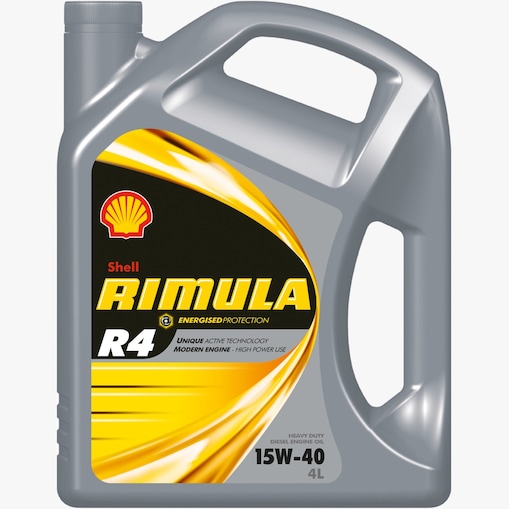
Unique, active technology for high power, modern engines
No matter how hot, cold, steep, dusty, muddy or extended your operations, you need to know that your oil will protect your engine under all conditions.
The Energised Protection of Shell Rimula heavy-duty diesel engine oils works relentlessly in three critical areas:
- Acid control – well-proven performance additives help to protect against corrosion from acids formed as fuel burns.
- Deposit control – helps to keep the engine clean for consistent performance and long life.
- Wear control – keeps moving metal engine surfaces apart for long engine life.
Shell Rimula R4
Shell Rimula R4 technology is designed to protect modern engines with turbochargers, intercooling and exhaust gas recirculation. From the high-pressure contacts in the valve train to the extreme temperatures of the pistons and rings, Shell Rimula R4 adapts to all the conditions within your engine, and helps you to minimise your maintenance and operating costs by providing a versatile one-oil solution for modern fleets.
Protective power
A highly stable dual-function additive component provides extra protection against oil thickening within the high soot and contamination levels found in modern low emission engines. This ensures that the oil continues to flow and protect even under heavy-duty operations found in US 2004, Euro 3 and Euro 4 turbocharged engines.
Active technology for better protection
Shell Rimula R4 contains dual-function molecules that work with conventional additives to enhance performance. They do this by helping to capture soot found in high power modern engines, for wear and deposit control.
Unique active technology
The performance benefits of the unique combination of dispersants and detergents boosted by the use of the dual-function additive component are seen in enhanced engine cleanliness and viscosity control compared to previous generation oils (API CH-4/ACEA E5).
Improved Cleanliness: In the ASTM Caterpillar 1R engine test, Shell Rimula R4 technology shows clear visible improvements compared to previous generation oils.
Better flow: the advanced dispersant systems help keep the oil flowing properly, resisting thickening caused by build up of soot. In the Mack T8E test, Shell Rimula R4 clearly out-performs the minimum requirements for ACEA and API specifications by up to 75% and demonstrates improvements compared to a typical API CH-4 technology.
Engine wear: in the Mack T10 and Cummins M-11 EGR tests, Shell Rimula R4 exceeds the API CI-4 and ACEA E7 limits for piston ring and crosshead wear. In particular, it exceeds the crosshead wear of API CI-4 requirements by up to 50%.
Visibly Lower Wear: in the Cummins M-11 EGR wear test, the difference between Shell Rimula R4 and passing API CI-4 oil is visible in the crosshead wear scars.
High power use
Lasting over 30% longer than competitors in laboratory oxidation tests, Shell Rimula R4 is proven to resist breakdown even under high temperature. Combined with its proven performance, delivering up to 30% lower iron wear in the real world conditions of the Australian road-trains, Shell Rimula provides the Energised Protection your engine needs.
Should you use Shell Rimula R4?
- With its wide range of approvals and specifications from many of the world’s leading engine makers, Shell Rimula R4 is an excellent choice for on-highway logistics, general haulage and public transport operators.
- Suitable for a wide range of heavy-duty engine applications. Suitable for Euro 2, 3 and certain Euro 4 engine technologies.
- With its excellent protection against wear and deposits, Shell Rimula R4 is ideal for a wide range of high power heavy-duty diesel engine applications where resistance to increased heat and stress is required.
For vehicles fitted with the latest emissions control technology such as diesel particulate traps, we recommend the use of our low-emissions products such as Shell Rimula R4 L, R6 LM or LME.
Specifications and approvals
SAE Viscosity Grade: 15W-40
API CI-4, CG-4, CF-4, CF; ACEA E7, E5; Global DHD-1, Cummins CES 20071, 72, 76, 77, 78; Cat ECF-1-A; DDC 93K215; Mack EO-M, EO-M+; MAN 3275; MB Approval 228.3; Renault Trucks RLD-2; Volvo VDS-3


Cautionary note
Cautionary note
The companies in which Shell plc directly and indirectly owns investments are separate legal entities. In this content “Shell”, “Shell Group” and “Group” are sometimes used for convenience to reference Shell plc and its subsidiaries in general. Likewise, the words “we”, “us” and “our” are also used to refer to Shell plc and its subsidiaries in general or to those who work for them. These terms are also used where no useful purpose is served by identifying the particular entity or entities. ‘‘Subsidiaries’’, “Shell subsidiaries” and “Shell companies” as used in this content refer to entities over which Shell plc either directly or indirectly has control. The terms “joint venture”, “joint operations”, “joint arrangements”, and “associates” may also be used to refer to a commercial arrangement in which Shell has a direct or indirect ownership interest with one or more parties. The term “Shell interest” is used for convenience to indicate the direct and/or indirect ownership interest held by Shell in an entity or unincorporated joint arrangement, after exclusion of all third-party interest.
Forward-Looking statements
This content contains forward-looking statements (within the meaning of the U.S. Private Securities Litigation Reform Act of 1995) concerning the financial condition, results of operations and businesses of Shell. All statements other than statements of historical fact are, or may be deemed to be, forward-looking statements. Forward-looking statements are statements of future expectations that are based on management’s current expectations and assumptions and involve known and unknown risks and uncertainties that could cause actual results, performance or events to differ materially from those expressed or implied in these statements. Forward-looking statements include, among other things, statements concerning the potential exposure of Shell to market risks and statements expressing management’s expectations, beliefs, estimates, forecasts, projections and assumptions. These forward-looking statements are identified by their use of terms and phrases such as “aim”; “ambition”; ‘‘anticipate’’; “aspire”, “aspiration”, ‘‘believe’’; “commit”; “commitment”; ‘‘could’’; “desire”; ‘‘estimate’’; ‘‘expect’’; ‘‘goals’’; ‘‘intend’’; ‘‘may’’; “milestones”; ‘‘objectives’’; ‘‘outlook’’; ‘‘plan’’; ‘‘probably’’; ‘‘project’’; ‘‘risks’’; “schedule”; ‘‘seek’’; ‘‘should’’; ‘‘target’’; “vision”; ‘‘will’’; “would” and similar terms and phrases. There are a number of factors that could affect the future operations of Shell and could cause those results to differ materially from those expressed in the forward-looking statements included in this content, including (without limitation): (a) price fluctuations in crude oil and natural gas; (b) changes in demand for Shell’s products; (c) currency fluctuations; (d) drilling and production results; (e) reserves estimates; (f) loss of market share and industry competition; (g) environmental and physical risks, including climate change; (h) risks associated with the identification of suitable potential acquisition properties and targets, and successful negotiation and completion of such transactions; (i) the risk of doing business in developing countries and countries subject to international sanctions; (j) legislative, judicial, fiscal and regulatory developments including tariffs and regulatory measures addressing climate change; (k) economic and financial market conditions in various countries and regions; (l) political risks, including the risks of expropriation and renegotiation of the terms of contracts with governmental entities, delays or advancements in the approval of projects and delays in the reimbursement for shared costs; (m) risks associated with the impact of pandemics, regional conflicts, such as the Russia-Ukraine war and the conflict in the Middle East, and a significant cyber security, data privacy or IT incident; (n) the pace of the energy transition; and (o) changes in trading conditions. No assurance is provided that future dividend payments will match or exceed previous dividend payments. All forward-looking statements contained in this content are expressly qualified in their entirety by the cautionary statements contained or referred to in this section. Readers should not place undue reliance on forward-looking statements. Additional risk factors that may affect future results are contained in Shell plc’s Form 20-F for the year ended December 31, 2025 (available at www.shell.com/investors/news-and-filings/sec-filings.html and www.sec.gov). These risk factors also expressly qualify all forward-looking statements contained in this content and should be considered by the reader. Each forward-looking statement speaks only as of the date of this content. Neither Shell plc nor any of its subsidiaries undertake any obligation to publicly update or revise any forward-looking statement as a result of new information, future events or other information. In light of these risks, results could differ materially from those stated, implied or inferred from the forward-looking statements contained in this content.
Shell’s net carbon intensity
Also, in this content we may refer to Shell’s “net carbon intensity” (NCI), which includes Shell’s carbon emissions from the production of our energy products, our suppliers’ carbon emissions in supplying energy for that production and our customers’ carbon emissions associated with their use of the energy products we sell. Shell’s NCI also includes the emissions associated with the production and use of energy products produced by others which Shell purchases for resale. Shell only controls its own emissions. The use of the terms Shell’s “net carbon intensity” or NCI is for convenience only and not intended to suggest these emissions are those of Shell plc or its subsidiaries.
Forward-Looking non-GAAP measures
This content may contain certain forward-looking non-GAAP measures such as free cash flow and underlying operating expenses. We are unable to provide a reconciliation of these forward-looking non-GAAP measures to the most comparable GAAP financial measures because certain information needed to reconcile those non-GAAP measures to the most comparable GAAP financial measures is dependent on future events some of which are outside the control of Shell, such as oil and gas prices, interest rates and exchange rates. Moreover, estimating such GAAP measures with the required precision necessary to provide a meaningful reconciliation is extremely difficult and could not be accomplished without unreasonable effort. Non-GAAP measures in respect of future periods which cannot be reconciled to the most comparable GAAP financial measure are calculated in a manner which is consistent with the accounting policies applied in Shell plc’s consolidated financial statements.
The contents of websites referred to in this content do not form part of this content.
We may have used certain terms, such as resources, in this content that the United States Securities and Exchange Commission (SEC) strictly prohibits us from including in our filings with the SEC. Investors are urged to consider closely the disclosure in our Form 20-F, File No 1-32575, available on the SEC website www.sec.gov.