People Powering Progress: Hector MacQuarrie on purposefully investing in innovation
In the latest instalment of our People Powering Progress series, Hector retraces his career to date, shares what makes a successful founder, and explains why personal decisions made outside his portfolio are just as significant as those within.

Professional careers rarely unfold exactly as planned.
This was certainly the case for Shell Ventures Principal Hector MacQuarrie, who describes his career as having been “forged through a series of fortunate events”.
From his early days in upstream engineering in Canada, to earning a business degree and eventually joining Shell’s internal strategy consultancy, Hector’s path was shaped by curiosity, cross-discipline thinking, and a readiness to seize every opportunity.
A passionate advocate for startups driving the energy transition, Hector channels his experience to support some of the most promising technologies in low-carbon innovation — spanning carbon capture, mobility, digital innovation and more.
But as he explains, his role is not just about financial returns: equally, it is about helping founders at a moment when bold ideas have the potential to scale and shape the future.
In the latest instalment of our People Powering Progress series, Hector retraces his career to date, shares what makes a successful founder, and explains why personal decisions made outside his portfolio are just as significant as those within.
What initially drew you to corporate venturing, and how did you find your way into Shell Ventures?
I wish I could say there was this grand plan at the outset of my career to get to where I am today, but the reality is that it’s been a series of fortunate events. I studied mechanical engineering at university, as technical topics have always inspired me. After my graduation, I joined Shell’s Upstream business in Calgary.
Over the years, I held technical roles across asset development and exploration. However, I realised early on that I didn’t want to spend my entire career focused solely on technical work. I found myself naturally gravitating towards the commercial aspects of my work, such as structuring deals and evaluating investments. With that in mind, I completed a business degree, which I enjoyed tremendously.
Following an academic interlude, I was lined up for a role in mergers and acquisitions — but when an opportunity arose to join Shell’s internal strategy consultancy, I snapped it up. This was a chance to take on fast-paced projects working alongside some of Shell’s most senior leaders on some highly critical and strategic challenges.
After some time in strategy, an opening emerged at Shell Ventures in Boston. This was a natural bridge from the strategy work, enabling me to leverage both my technical and commercial experience. I’ve loved every day since.
Startups start with a blank slate, often challenging established industry paradigms and norms. Thanks to my diverse career experiences, I can assess these startups and, in the right instances — work with them to enable their growth and success.
Hector MacQuarrie, Principal, Shell Ventures“Startups start with a blank slate, often challenging established industry paradigms and norms.“
You have been with Shell for 16 years. What drew you to the company?
From conversations I had with people in the industry, the one insight that stuck with me was the depth of Shell’s technical bench. The quality of work and the breadth of expertise amongst individuals really stood out from competitors — including both major and mid-sized players. That was probably one of the defining reasons why I decided to join Shell.
Is there something about corporate venturing that keeps you motivated and energised?
First, the external ecosystem: every day, you’re speaking with founders and investors who are moving the needle in innovation. These are high-calibre people. The environment is fast-paced, intellectually demanding, and broad in scope. You’ve got to show up with your A-game every day, and I find that very motivating.
From an internal perspective, I work with Shell’s business leaders and technical experts who have spent decades in the industry. These individuals offer a critical dose of reality that counterbalances the enthusiasm of the startup world, as they know what scaling looks like at an industrial level. My job is often to bridge those two perspectives, which isn’t always easy — but ultimately deeply rewarding.
Hector MacQuarrie, Principal, Shell Ventures“You’ve got to show up with your A-game every day, and I find that very motivating.“
Can you share some of the standout projects you’ve worked on at Shell Ventures?
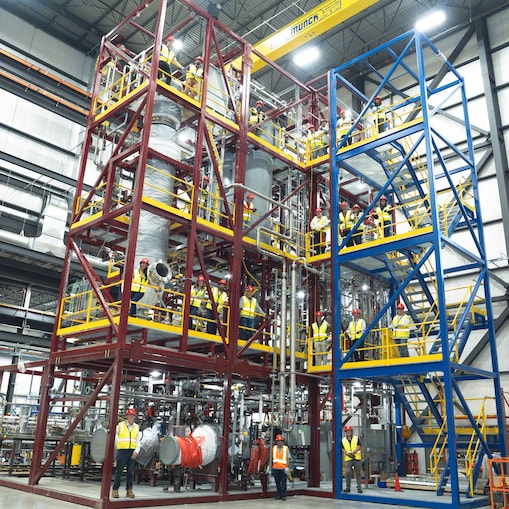
Two come to mind. The first one is Mantel, a point-source carbon capture startup focused on industrial emissions. Mantel is developing a novel molten salt absorbent technology that addresses the energy penalty of carbon capture. If the technology can be scaled, it could provide a step change in the levelised cost of capture for industrial emitters.
Mantel is a good example of our ability to leverage Shell’s various domains of expertise. We worked with our technical experts to assess the technology, our carbon capture experts to assess the competitiveness, and industry experts to understand customer purchasing behaviour. Each of these inputs alone wouldn’t have been enough to take an investment decision, but in aggregate, they enabled us to de-risk the investment and build conviction.
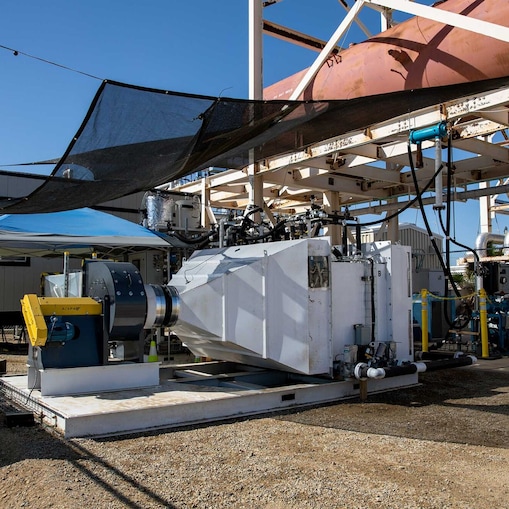
Second is Avnos, a direct air capture company. Our Direct Air Capture business had identified the company as a leading technology developer and wanted to collaborate, but it was early-stage and the resulting commercial partnership structures were complex and didn’t properly account for the early-stage risk capital being provided to the company. We worked alongside our Direct Air Capture business to structure a deal that blended venture investment with future project financing.
This was important because it meant initial investments into Avnos would enable Shell project work through the purchase of Avnos equity — creating potential return opportunities even if a more substantial Shell-Avnos partnership didn’t materialise. This particular case demonstrates how corporate venturing can, in the right circumstances, both de-risk business activities and unlock long-term value.
What does successful collaboration between Shell Ventures and startups look like?
I think it takes having an open dialogue, setting clear expectations, and providing a realistic view of what it takes to scale. Some startups present great technological innovations but have unrealistic timelines and expect us to deploy unproven solutions at industrial scale in just a few years without de-risking. Understanding how a company like Shell operates and aligning all parties accordingly is key.
What are currently the biggest opportunities and obstacles in scaling technologies like carbon capture and storage (CCS), hydrogen, or digital tools?
There’s a big difference between ‘hard’ tech — like CCS and hydrogen — and digital tools. The former requires significant capital and long maturation timelines, and founders (and sometimes investors) can underestimate how long it takes to get steel in the ground. That’s where Shell’s operational experience can help to calibrate risk properly.
With digital tools, it’s more about product-market fit, market size, and sales cycles. Energy companies can be slow to adopt. Broadly in that space, we're looking at the same things as with other types of software businesses — average revenue per user, customer acquisition cost, churn rates, customer lifetime value, net revenue retention, and more. Essentially, we’re looking at standard software metrics to get a sense of the health of the business and its scaling potential.
How has your work in the energy transition impacted your personal day-to-day?
It has fundamentally shifted how I think about the energy system. It also has cemented where I want to be: working on the energy transition. I think we really are at a sort of Precambrian explosion point in terms of renewable energy innovation, and it’s only going to get more exciting in the future. I want to be a part of that. On a personal level, I’ve made some adjustments — such as enrolling in a renewable power plan offered by my local utility company and driving an EV. That's the fun part of it.
Hector MacQuarrie, Principal, Shell Ventures“I think we really are at a sort of Precambrian explosion point in terms of renewable energy innovation, and it’s only going to get more exciting in the future.”
Has the shifting regulatory environment on sustainability, particularly in the US, impacted the startup landscape?
There absolutely have been changes. Many startups’ capital plans, or even overall business strategies, were overly reliant on regulatory programs, which can generate risk due to their inherent uncertainty. Some also assumed that certain types of incentives, tax credits or loans, would be stable and long-lasting, and baked those directly into the unit economics of their technology. Through our investment due diligence process, we are aware of these types of risks early on.
While we haven’t seen a significant shift in overall investment levels in the US venture market, compared to Europe, we are seeing a clear change in the types of opportunities that attract capital. The external venture and energy innovation ecosystem is prioritising startups that have a clear path to profitability within a reasonable timeframe, even without regulatory tailwinds.
Finally, what advice would you give to founders entering climate tech today?
Stay grounded. This is a cyclical industry, and valuations go through hype cycles. Some founders chase sky-high valuations early on — only to face tough down rounds later. Other prioritise price over investor quality, which can make it harder to raise future rounds or scale strategically. I would recommend choosing your investors wisely and building for resilience.
Date of publication: November, 2025
Shell Ventures
Shell Ventures invests in companies developing technologies and business models that can support developments in energy and mobility.
Disclaimer
Disclaimer
Cautionary Note
The companies in which Shell plc directly and indirectly owns investments are separate legal entities. In this content “Shell”, “Shell Group” and “Group” are sometimes used for convenience to reference Shell plc and its subsidiaries in general. Likewise, the words “we”, “us” and “our” are also used to refer to Shell plc and its subsidiaries in general or to those who work for them. These terms are also used where no useful purpose is served by identifying the particular entity or entities. ‘‘Subsidiaries’’, “Shell subsidiaries” and “Shell companies” as used in this content refer to entities over which Shell plc either directly or indirectly has control. The terms “joint venture”, “joint operations”, “joint arrangements”, and “associates” may also be used to refer to a commercial arrangement in which Shell has a direct or indirect ownership interest with one or more parties. The term “Shell interest” is used for convenience to indicate the direct and/or indirect ownership interest held by Shell in an entity or unincorporated joint arrangement, after exclusion of all third-party interest.
Forward-Looking statements
This content contains forward-looking statements (within the meaning of the U.S. Private Securities Litigation Reform Act of 1995) concerning the financial condition, results of operations and businesses of Shell. All statements other than statements of historical fact are, or may be deemed to be, forward-looking statements. Forward-looking statements are statements of future expectations that are based on management’s current expectations and assumptions, including (without limitation) those concerning Shell’s strategy and operating plans, macroeconomic conditions, future energy demand, supply and product mix, commodity prices, demand for Shell’s products, production results and reserve estimates, development, execution and management of projects, energy transition and climate change, management of safety and environmental risks, costs, cash capital expenditures, technology advancements, legislative, judicial, fiscal and regulatory developments, regional conflicts and trading conditions, and involve known and unknown risks and uncertainties that could cause actual results, performance or events to differ materially from those expressed or implied in these statements. Forward-looking statements include, among other things, statements concerning the potential exposure of Shell to market risks and statements expressing management’s expectations, beliefs, estimates, forecasts, projections and assumptions. These forward-looking statements are identified by their use of terms and phrases such as “aim”; “ambition”; ‘‘anticipate’’; “aspire”, “aspiration”, ‘‘believe’’; “commit”; “commitment”; ‘‘could’’; “desire”; ‘‘estimate’’; ‘‘expect’’; ‘‘goals’’; ‘‘intend’’; ‘‘may’’; “milestones”; ‘‘objectives’’; ‘‘outlook’’; ‘‘plan’’; ‘‘probably’’; ‘‘project’’; ‘‘risks’’; “schedule”; ‘‘seek’’; ‘‘should’’; ‘‘target’’; “vision”; ‘‘will’’; “would” and similar terms and phrases. There are a number of factors that could affect the future operations of Shell and could cause those results to differ materially from those expressed in the forward-looking statements included in this content, including (without limitation): (a) price fluctuations in crude oil and natural gas; (b) changes in demand for Shell’s products; (c) currency fluctuations; (d) drilling and production results; (e) reserves estimates; (f) loss of market share and industry competition; (g) environmental and physical risks, including climate change; (h) risks associated with the identification of suitable potential acquisition properties and targets, and successful negotiation and completion of such transactions; (i) the risk of doing business in developing countries and countries subject to international sanctions; (j) legislative, judicial, fiscal and regulatory developments including tariffs and regulatory measures addressing climate change; (k) economic and financial market conditions in various countries and regions; (l) political risks, including the risks of expropriation and renegotiation of the terms of contracts with governmental entities, delays or advancements in the approval of projects and delays in the reimbursement for shared costs; (m) risks associated with the impact of pandemics, regional conflicts, such as the Russia-Ukraine war and the conflict in the Middle East, and a significant cyber security, data privacy or IT incident; (n) the pace of the energy transition; and (o) changes in trading conditions. No assurance is provided that future dividend payments will match or exceed previous dividend payments. All forward-looking statements contained in this content are expressly qualified in their entirety by the cautionary statements contained or referred to in this section. Readers should not place undue reliance on forward-looking statements. Additional risk factors that may affect future results are contained in Shell plc’s Form 20-F for the year ended December 31, 2025 (available at www.shell.com/investors/news-and-filings/sec-filings.html and www.sec.gov). These risk factors also expressly qualify all forward-looking statements contained in this content and should be considered by the reader. Each forward-looking statement speaks only as of the date of the publication mentioned in this website. Neither Shell plc nor any of its subsidiaries undertake any obligation to publicly update or revise any forward-looking statement as a result of new information, future events or other information. In light of these risks, results could differ materially from those stated, implied or inferred from the forward-looking statements contained in this content.
Shell’s net carbon intensity and net-zero emissions target
In this content we may refer to Shell’s “net carbon intensity” (NCI), which includes Shell’s carbon emissions from the production of our energy products, our suppliers’ carbon emissions in supplying energy for that production and our customers’ carbon emissions associated with their use of the energy products we sell. Shell’s NCI also includes the emissions associated with the production and use of energy products produced by others which Shell purchases for resale. Shell only controls its own emissions. The use of the terms Shell’s “net carbon intensity” or NCI is for convenience only and not intended to suggest these emissions are those of Shell plc or its subsidiaries.
Shell’s operating plan and outlook are forecasted for a three-year period and ten-year period, respectively, and are updated every year. They reflect the current economic environment and what we can reasonably expect to see over the next three and ten years. Accordingly, the outlook reflects our combined Scope 1 and 2 target, NCI target and our oil products ambition over the next ten years. However, Shell’s operating plan and outlook cannot reflect our 2050 net-zero emissions target, as this target is outside our planning period. Such future operating plans and outlooks could include changes to our portfolio, efficiency improvements and the use of carbon capture and storage and carbon credits. In the future, as society moves towards net-zero emissions, we expect Shell’s operating plans and outlooks to reflect this movement. However, if society is not net zero in 2050, as of today, there would be significant risk that Shell may not meet this target.
The information provided above regarding Shell’s NCI and net zero emissions target are not intended, nor should they be construed as introducing, suggesting or making any claim, target or representation thereof other than what is included in the content.
Forward-Looking non-GAAP measures
This content may contain certain forward-looking non-GAAP measures such as free cash flow and underlying operating expenses. We are unable to provide a reconciliation of these forward-looking non-GAAP measures to the most comparable GAAP financial measures because certain information needed to reconcile those non-GAAP measures to the most comparable GAAP financial measures is dependent on future events some of which are outside the control of Shell, such as oil and gas prices, interest rates and exchange rates. Moreover, estimating such GAAP measures with the required precision necessary to provide a meaningful reconciliation is extremely difficult and could not be accomplished without unreasonable effort. Non-GAAP measures in respect of future periods which cannot be reconciled to the most comparable GAAP financial measure are calculated in a manner which is consistent with the accounting policies applied in Shell plc’s consolidated financial statements. These forward-looking non-GAAP measures are provided to assist readers in understanding management’s use and expectations of such measures and may not be appropriate for other purposes.
The contents of websites referred to in this content do not form part of this content.
We may have used certain terms, such as resources, in this content that the United States Securities and Exchange Commission (SEC) strictly prohibits us from including in our filings with the SEC. Investors are urged to consider closely the disclosure in our Form 20-F, File No 1-32575, available on the SEC website www.sec.gov.