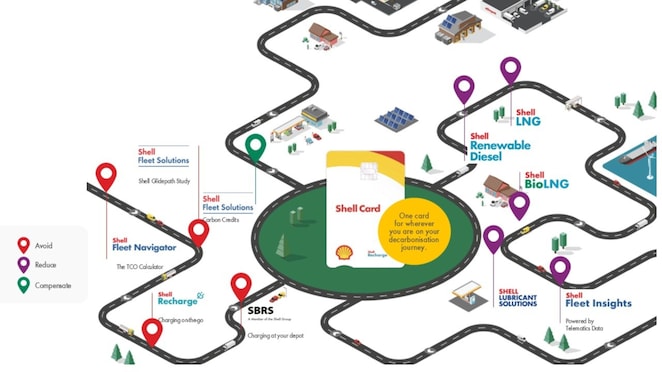
Shell LNG and Shell BioLNG
Discover the benefits for your fleet.
With higher energy density than conventional diesel, these fuels are suitable for fleets covering both short and long distances.
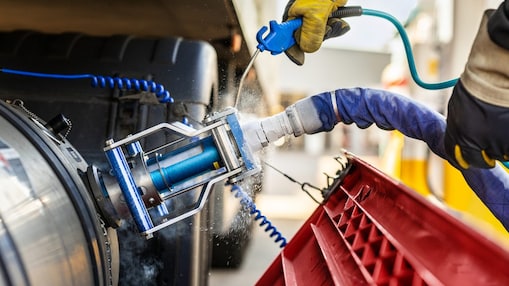
Shell LNG and Shell BioLNG are cooled at cryogenic temperatures, reducing volume by 600 times compared to gaseous form and offering a higher energy density than conventional diesel.
Shell LNG
Shell LNG is designed to offer quieter operation and performance comparable to diesel-fuelled heavy-duty vehicles.
Lower Emissions
In Europe, Shell LNG can help to emit less life cycle CO2e1 emissions of heavy-duty vehicle operation by up to 18% compared to B7 diesel2, depending on engine type. LNG is less polluting than diesel, producing fewer air pollutants such as NOX, SOX and PM.
Quieter engines
Perceived engine noise reduction by up to 50% in noise loudness as compared to heavy-duty diesel engines. This can contribute to improved driver well-being and fleet utilisation in noise abatement zones3.
Performance
Enjoy the benefits of LNG performance. Shell LNG provides similar driving range, engine power and performance to that of equivalent conventional heavy-duty diesel-fuelled vehicles4.
Infrastructure
Fill up without fuss. Our LNG network features more than 65 Shell-owned sites across seven countries in Europe plus over 100 partners’ locations currently accepting Shell Card.
Shell BioLNG
Discover Shell BioLNG.
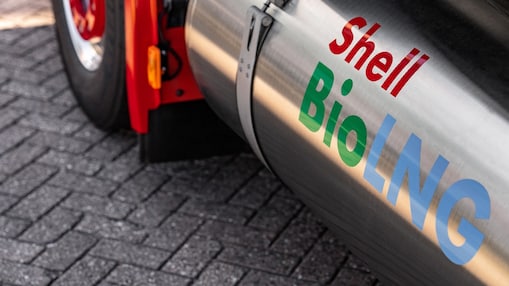
Shell BioLNG is a drop-in fuel for existing LNG vehicles5, made from renewable feedstock6 leading to less CO2e1 emissions on a life cycle basis7 compared to LNG8.
How is Shell BioLNG produced?
In Europe Shell BioLNG only comes from biomethane from renewable9 feedstocks following the guidelines in the latest version of the Renewable Energy Directive (RED)10.
Bio-LNG production can work in a similar way to the composting process, since feedstocks such as organic waste can be anaerobically digested to form biogas - a mix of biomethane, carbon dioxide, water and other trace gases. After removing these by-products, the remaining biomethane can be liquefied to create bio-LNG.
Explore the benefits of bio-LNG's and its role in heavy-duty road transport.
No retrofitting required
Because bio-LNG’s chemical properties are practically identical to those of liquified natural gas (LNG), the switch from LNG to bio-LNG doesn’t require a change in infrastructure or equipment5.
Same trusted network
Just as no modifications are needed to your LNG vehicles to benefit from Shell BioLNG, our stations do not need to be converted either. Our network, one of the largest in Europe, remains available and covers the most important long-distance routes.
Growing BioLNG production and supply network
We are investing in bio-LNG production and supply infrastructure to expand the availability of bio-LNG for heavy-duty transport.
To increase production and supply of Shell BioLNG to our network, we have acquired the largest producer of renewable natural gas (RNG) in Europe – Nature Energy – with its portfolio of 14 operating plants and associated feedstock supply and infrastructure, pipeline of growth projects, and in-house expertise in innovative RNG plant technology.
In 2024, an LNG liquefaction plant was opened at our Shell Energy and Chemicals Park in Rheinland, Germany, with an annual sales capacity of up to 100,000 tonnes of bio-LNG through mass balance accounting.
We work across the bio-LNG value chain with collaborators to offer Shell BioLNG to customers with bio-LNG contracts in the Netherlands, Germany, the Czech Republic and Belgium.
Find your nearest location

Disclaimers
Disclaimers
1. CO2e (CO2 equivalent) refers to CO2, CH4, N2O.
2. The reduced GHG emissions are calculated by comparing the LNG Well-to-Wheel emissions for the High Pressure Direct Injection (HPDI) engine from the “Greenhouse Gas Intensity of Natural Gas” study by Thinkstep for NGVA Europe (2017). This was compared to a GHG baseline intensity of 90.2 gCO2e/MJ on a Well-to-Wheel basis, which is representative of a European Union market B7 diesel. The carbon intensity of the B7 diesel is calculated by Shell using emission factors from the JEC Well-to-Tank report v5. (European Commission, Joint Research Centre, Prussi, M., Yugo, M., De Prada, L., et al., JEC well-to-tank report V5 : JEC well-to-wheels analysis : well-to-wheels analysis of future automotive fuels and powertrains in the European context, Publications Office, 2020, https://data.europa.eu/doi/10.2760/959137).
3. A truck running on an LNG gas engine will produce noise levels at 72dB(A), equal to a passenger car. An average diesel-powered truck will produce 82 dB(A). Every 3dB(A) reduction in noise halves the intensity of the sound because sound is scientifically measured on a logarithmic scale. A decrease of 10 dB roughly corresponds to a half of the perceived volume.
4. Based on OEM Data. Applies to all LNG ICE road engines.
5. As outlined in the European Biomethane Association Biomethane Factsheet, that after biogas upgrading, biomethane is predominantly methane (>96% by mass). As the chemical composition and energy content of biomethane are similar to natural gas, it can likewise be used in the same way as vehicle fuel. http://energy.cleartheair.org.hk/wp-content/uploads/2016/01/eba_biomethane_factsheet.pdf (PDF)
Always consult your equipment manufacturer’s manual for guidance before making any fuel changes.
6. Renewable refers to certified non-fossil, biomass feedstocks used for fuel production that qualify as renewable under the latest version of the EU Renewable Energy Directive. The most common feedstocks include solid and liquid manure, agricultural waste and residues, industrial food and beverage waste, and the organic fraction of municipal solid waste.
7. Product life cycle CO2e emissions are associated with the production and use of a specific product, from well to wheel, including emissions from feedstock production and collection, processing, storage, transport, distribution and combustion.
8. Baseline LNG GHG emissions are calculated by comparing the LNG Well-to-Wheel emissions for the High Pressure Direct Injection (HDPI) engine from the “Greenhouse Gas Intensity of Natural Gas” study by Thinkstep for NGVA Europe (2017). The specific calculation of reduced CO₂e emissions of using bio-LNG compared to LNG may vary from region to region depending upon feedstocks used and accounting methodology allowed within the market.
9. Renewable refers to certified non-fossil, biomass feedstocks used for fuel production that qualify as renewable under the latest version of the EU Renewable Energy Directive.
10. https://eur-lex.europa.eu/legal-content/EN/TXT/?uri=CELEX%3A02018L2001-20240716
How can we help?
Cautionary note
Cautionary note
The companies in which Shell plc directly and indirectly owns investments are separate legal entities. In this content “Shell”, “Shell Group” and “Group” are sometimes used for convenience to reference Shell plc and its subsidiaries in general. Likewise, the words “we”, “us” and “our” are also used to refer to Shell plc and its subsidiaries in general or to those who work for them. These terms are also used where no useful purpose is served by identifying the particular entity or entities. ‘‘Subsidiaries’’, “Shell subsidiaries” and “Shell companies” as used in this content refer to entities over which Shell plc either directly or indirectly has control. The terms “joint venture”, “joint operations”, “joint arrangements”, and “associates” may also be used to refer to a commercial arrangement in which Shell has a direct or indirect ownership interest with one or more parties. The term “Shell interest” is used for convenience to indicate the direct and/or indirect ownership interest held by Shell in an entity or unincorporated joint arrangement, after exclusion of all third-party interest.
Forward-Looking statements
This content contains forward-looking statements (within the meaning of the U.S. Private Securities Litigation Reform Act of 1995) concerning the financial condition, results of operations and businesses of Shell. All statements other than statements of historical fact are, or may be deemed to be, forward-looking statements. Forward-looking statements are statements of future expectations that are based on management’s current expectations and assumptions and involve known and unknown risks and uncertainties that could cause actual results, performance or events to differ materially from those expressed or implied in these statements. Forward-looking statements include, among other things, statements concerning the potential exposure of Shell to market risks and statements expressing management’s expectations, beliefs, estimates, forecasts, projections and assumptions. These forward-looking statements are identified by their use of terms and phrases such as “aim”; “ambition”; ‘‘anticipate’’; “aspire”, “aspiration”, ‘‘believe’’; “commit”; “commitment”; ‘‘could’’; “desire”; ‘‘estimate’’; ‘‘expect’’; ‘‘goals’’; ‘‘intend’’; ‘‘may’’; “milestones”; ‘‘objectives’’; ‘‘outlook’’; ‘‘plan’’; ‘‘probably’’; ‘‘project’’; ‘‘risks’’; “schedule”; ‘‘seek’’; ‘‘should’’; ‘‘target’’; “vision”; ‘‘will’’; “would” and similar terms and phrases. There are a number of factors that could affect the future operations of Shell and could cause those results to differ materially from those expressed in the forward-looking statements included in this content, including (without limitation): (a) price fluctuations in crude oil and natural gas; (b) changes in demand for Shell’s products; (c) currency fluctuations; (d) drilling and production results; (e) reserves estimates; (f) loss of market share and industry competition; (g) environmental and physical risks, including climate change; (h) risks associated with the identification of suitable potential acquisition properties and targets, and successful negotiation and completion of such transactions; (i) the risk of doing business in developing countries and countries subject to international sanctions; (j) legislative, judicial, fiscal and regulatory developments including tariffs and regulatory measures addressing climate change; (k) economic and financial market conditions in various countries and regions; (l) political risks, including the risks of expropriation and renegotiation of the terms of contracts with governmental entities, delays or advancements in the approval of projects and delays in the reimbursement for shared costs; (m) risks associated with the impact of pandemics, regional conflicts, such as the Russia-Ukraine war and the conflict in the Middle East, and a significant cyber security, data privacy or IT incident; (n) the pace of the energy transition; and (o) changes in trading conditions. No assurance is provided that future dividend payments will match or exceed previous dividend payments. All forward-looking statements contained in this content are expressly qualified in their entirety by the cautionary statements contained or referred to in this section. Readers should not place undue reliance on forward-looking statements. Additional risk factors that may affect future results are contained in Shell plc’s Form 20-F and amendment thereto for the year ended December 31, 2024 (available at www.shell.com/investors/news-and-filings/sec-filings.html and www.sec.gov). These risk factors also expressly qualify all forward-looking statements contained in this content and should be considered by the reader. Each forward-looking statement speaks only as of the date of this content. Neither Shell plc nor any of its subsidiaries undertake any obligation to publicly update or revise any forward-looking statement as a result of new information, future events or other information. In light of these risks, results could differ materially from those stated, implied or inferred from the forward-looking statements contained in this content.
Shell’s net carbon intensity
Also, in this content we may refer to Shell’s “net carbon intensity” (NCI), which includes Shell’s carbon emissions from the production of our energy products, our suppliers’ carbon emissions in supplying energy for that production and our customers’ carbon emissions associated with their use of the energy products we sell. Shell’s NCI also includes the emissions associated with the production and use of energy products produced by others which Shell purchases for resale. Shell only controls its own emissions. The use of the terms Shell’s “net carbon intensity” or NCI is for convenience only and not intended to suggest these emissions are those of Shell plc or its subsidiaries.
Shell’s net-zero emissions target
Shell’s operating plan and outlook are forecasted for a three-year period and ten-year period, respectively, and are updated every year. They reflect the current economic environment and what we can reasonably expect to see over the next three and ten years. Accordingly, the outlook reflects our Scope 1, Scope 2 and NCI targets over the next ten years. However, Shell’s operating plan and outlook cannot reflect our 2050 net-zero emissions target, as this target is outside our planning period. Such future operating plans and outlooks could include changes to our portfolio, efficiency improvements and the use of carbon capture and storage and carbon credits. In the future, as society moves towards net-zero emissions, we expect Shell’s operating plans and outlooks to reflect this movement. However, if society is not net zero in 2050, as of today, there would be significant risk that Shell may not meet this target.
Forward-Looking non-GAAP measures
This content may contain certain forward-looking non-GAAP measures such as adjusted earnings and divestments. We are unable to provide a reconciliation of these forward-looking non-GAAP measures to the most comparable GAAP financial measures because certain information needed to reconcile those non-GAAP measures to the most comparable GAAP financial measures is dependent on future events some of which are outside the control of Shell, such as oil and gas prices, interest rates and exchange rates. Moreover, estimating such GAAP measures with the required precision necessary to provide a meaningful reconciliation is extremely difficult and could not be accomplished without unreasonable effort. Non-GAAP measures in respect of future periods which cannot be reconciled to the most comparable GAAP financial measure are calculated in a manner which is consistent with the accounting policies applied in Shell plc’s consolidated financial statements.
The contents of websites referred to in this content do not form part of this content.
We may have used certain terms, such as resources, in this content that the United States Securities and Exchange Commission (SEC) strictly prohibits us from including in our filings with the SEC. Investors are urged to consider closely the disclosure in our Form 20-F and amendment thereto, File No 1-32575, available on the SEC website www.sec.gov.