The road to a more efficient fleet
Explore a comprehensive range of solutions to optimise your fleet with lower-carbon1 energy products and solutions for customers seeking to diversify their energy mix.
1The term "low carbon" is used to describe fuels that may have lower lifecycle greenhouse gas emissions than a conventional fossil fuel comparator when assessed using an applicable lifecycle assessment methodology. The term should not be interpreted as meaning zero-emission, carbon-neutral, climate-neutral, sustainable, environmentally friendly, or free from environmental impacts. Greenhouse gas emissions are still generated throughout the fuel lifecycle and during use.
Explore vehicle fleet energy solutions and operational scenarios through a tailored roadmap designed around your business objectives.
A2Z offers products, insights, and support including lower-carbon1 energy products and solutions for customer seeking to diversify their energy mix. We help customers evaluate energy options, explore operational scenarios and develop tailored roadmaps aligned to their business goals.
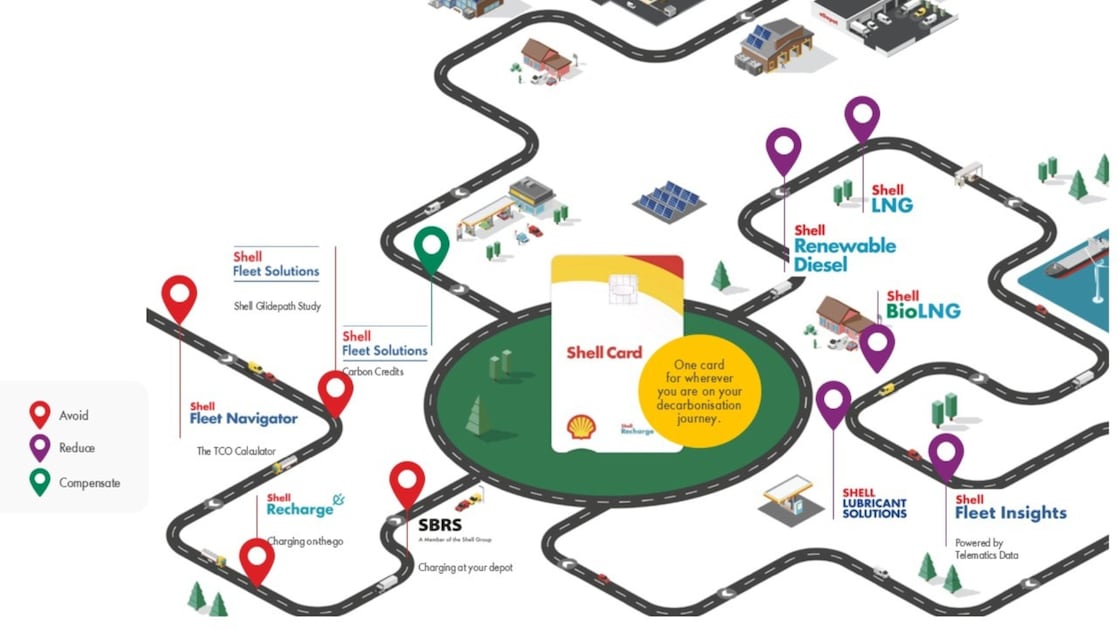
Find your route towards fleet decarbonisation
Avoid Emissions
Ready to go electric? Avoid vehicle fleet emissions by adopting solutions that are emission-free when used. Such as, using renewable energy to power your Electric Vehicles and buildings. At Fleet Solutions, we provide EV Charging for all fleet types – from depot charging to office integrations and even home charging for employees though our trusted partnerships. When recharging at Shell Recharge, we offer 100% certified renewable energy1.
Reduce Emissions
We appreciate there is no single solution for all fleets, and a complete transition is unlikely to happen overnight. You can reduce your vehicle fleet emissions by making use of lower-carbon fuels and technologies. We offer a range of lower-carbon fuels and solutions that can help reduce your life cycle CO₂e emissions10.
Compensate for your unavoidable Emissions
For situations where further reduction or avoidance of your fleet’s CO2 emissions isn’t feasible, through the use of Carbon Credits7,8 fleets can help lower their CO2e emissions10.
Explore our solutions for fleet decarbonisation
Disclaimers
Disclaimers
1. 100% renewable energy is not available in all markets. Our renewable electricity is certified, which means that all of the electricity Shell purchases to supply our Shell Recharge sites is matched with the equivalent amount of units from 100% renewable sources.
2. The actual savings are highly dependent on the customer use case, other customer inputs such as energy prices, cost of infrastructure, and geography. The Total Cost of Ownership (TCO) reduction figures presented herein are estimates derived using Shell’s TCO calculation model. Energy savings are estimated using the Gridcog web-based tool for energy optimisation.
3. Helps to clean and protect key fuel system components such as intake valves and/or fuel injectors from the build up of performance robbing deposits. Shell gasoline compared with typical market average deposit level. Shell diesel compared with industry standard reference fuel. Actual effects and benefits may vary according to vehicle type, vehicle condition and driving style. No guarantees provided. Actual effects and benefits may vary according to vehicle type, vehicle condition and driving style. No guarantees provided.
4. Shell Renewable Diesel is derived from allocated waste or residue non-food and non-feed biofuel feedstocks compliant with the RED II directive including but not limited to feedstocks listed under the Annex IX-A and IX-B [Link].
5. When switching from diesel. Based on Shell’s operability studies and market experience to date. Vehicle handbook and/or label at the fuel tank socket must be checked for OEM approval. Not applicable for passenger cars.
6. Based on OEM Data. Applies to all LNG ICE road engines
7. We aim to support high quality carbon credit projects that help make a positive impact by helping to avoid or reduce emissions, and often delivering other co-benefits such as improved biodiversity, protection of wildlife and support for local communities. As part of our commitment to supporting high quality projects, we only offer carbon credits that hold independent third-party accreditation under an internationally recognised standard (e.g. Verra, Gold Standard, American Carbon Registry) and undertake our own enhanced due diligence processes to assess projects against Shell's quality markers.
8. The term “Product with carbon credits” does not imply that the product is a substitute for switching to low-emission energy solutions or reducing fossil fuel usage. Although carbon credits aim to compensate for CO2 emissions, actual emissions will still be released into the atmosphere. These carbon credits have been generated in accordance with international carbon standards, but the compensation is based on best available estimates and may not be exact. Shell businesses encourage their customers to focus first on emissions that can be avoided or reduced and only then compensate the remaining emissions through the purchase and retirement of voluntary carbon credits.“Product with carbon credits” indicates that Shell will engage in a transaction where an amount of CO2 equivalent to the estimated emissions from the product’s lifecycle including raw material extraction, transport, production, distribution and usage / end-of-life is intended to be compensated through the purchase and retirement of carbon credits. As the full lifecycle emissions cannot be calculated, the compensation is based on best available estimates.
9. Based on OM646LA engine test compared with ACEA C3 specification
10. CO2e (CO2 equivalent) refers to CO2, CH4, N2O.
11. The reduced GHG emissions are calculated by comparing the LNG Well-to-Wheel emissions for the High Pressure Direct Injection (HPDI) engine from the “Greenhouse Gas Intensity of Natural Gas” study by Thinkstep for NGVA Europe (2017). This was compared to a GHG baseline intensity of 90 gCO2e/MJ on a Well-to-Wheel basis, which is representative of a European Union market B7 diesel. The carbon intensity of the B7 diesel is calculated by Shell using emission factors from the JEC Well-to-Tank report v5. (European Commission, Joint Research Centre, Prussi, M., Yugo, M., De Prada, L., et al., JEC well-to-tank report V5 : JEC well-to-wheels analysis : well-to-wheels analysis of future automotive fuels and powertrains in the European context, Publications Office, 2020, https://data.europa.eu/doi/10.2760/959137).
Tools and services to help you on your journey to a lower emissions fleet
Whether you’re starting your fleet transition journey or want to understand when your transition is going to have TCO benefits, our tools and services can help. They provide guidance on when to take steps to avoid fleet emissions or whether to continue to reduce and compensate for your life-cycle emissions.
Fleet Total Cost of Ownership Calculator
Looking to evaluate different fleet energy options? Choosing the right fleet mix can have a significant impact on operating costs and fleet emissions. The TCO Calculator helps you assess potential total cost of ownership and estimated CO2e emission impacts for different fuel and energy options using defined calculation methodologies and input assumptions.
Shell Glidepath Study
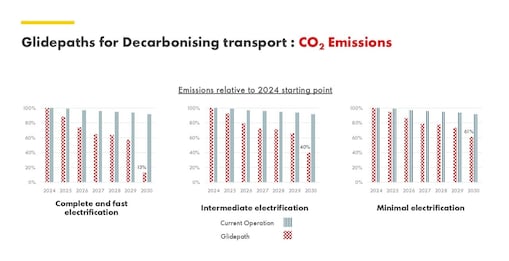
Our Glidepath Study can build a tailored fleet transition roadmap using emissions insights, operational data and scenario modelling so you can choose the best path based on data, potential savings and strategic goals.
Glidepath outcome graph details
Glidepath outcome graph details
Graphic 1: title: Complete and fast electrification
two bullet points: Sharp decrease in emissions in 2030 due to grid reinforcement in 2029. 13% of current emissions in 2030.
Graphic 2 - Title: Intermediate electrification
Two bullet points: harp decrease in emissions in 2030 due to grid reinforcement in 2029. 40% of current emissions 2030.
Graphic 3 - Title: Minimal electrification
Two bullet points: harp decrease in emissions in 2030 due to grid reinforcement in 2029. 61% of current emissions 2030.
View the latest customer stories and expert insights on fleet energy management
Transcript
Transcript
Hear from Euan Moir, UK Head of Fleet Solutions on How fleets can avoid, reduce and compensate for carbon emissions with Shell Fleet Solutions.
Choosing the right fleet mix can have a significant impact on operating costs and fleet emissions. Euan Moir shares how Fleet Solutions products and services can help customers evaluate energy options and optimise fleet performance. A2Z provides end-to-end fleet energy management support, helping customers assess, plan and implement solutions that meet their operational and business needs.
Hear from Shell and Frost and Sullivan on how to help reduce emissions and boost fleet performance.
The mobility industry is evolving quickly, and fleet operators are central to driving this change. That’s why we’ve developed our Fleet Focus Content Hub, which features a collection of regularly updated videos and articles from some of the world’s best industry thinkers, giving business leaders the insights they need to successfully navigate the road ahead.
Transcript
Transcript
How G4S is evaluating fleet energy options with Shell Fleet Solutions
G4S is working with Shell Fleet Solutions to assess fleet energy options using data, insights and operational analysis. Watch the video to learn how G4S is using products, services and fleet management tools to support informed decision-making and fleet planning.
Navigating roadblocks in the long-haul road freight industry
Watch as two experts share the top challenges faced by the industry today. Patrick Carré, SVP Mobility & Convenience Europe & South. Africa at Shell, and Franck Leveque, Vice President for Mobility Group at Frost & Sullivan, discuss the key findings from their joint whitepaper ‘Navigating Roadblocks in the Long-Haul Road Freight Industry’.
Transcript
Transcript

Discover how fleet operators can use telematics and mobility data to generate actionable insights.
Unlock the power of your fleet data to build an understanding of current energy usage patterns and evaluate suitable energy transition solutions. Read our new report to discover how to use your fleet’s data to make informed decisions and support your choice of energy solutions. Find out how your data – from vehicle telematics to the data from your mobility payment solutions - can be gathered and analysed by fleet operators to reveal actionable insights that can guide your transition strategy.
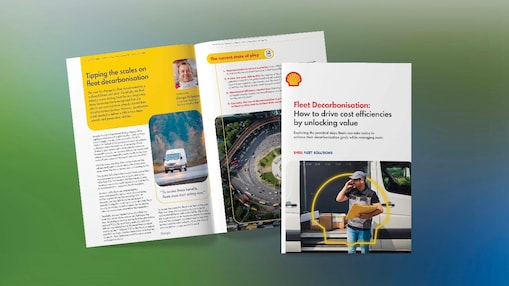
Fleet Energy Pathways: How to drive cost efficiencies by unlocking value
Learn how to identify cost efficiencies across your fleet operations and evaluate a range of energy and mobility solutions to support your business objectives. Our report explores practical approaches to:
- Understand the TCO of EVs versus ICE vehicles in your fleet
- Learn about the charging infrastructure to you need to power your fleet
- Increase efficiency to lower costs and life-cycle CO2e emissions.
Read the ‘How to drive cost efficiencies by unlocking value’ report