
Introducing Shell Marine Sensor Service
A new solution designed to help shipping crews provide proactive protection for a wider range of critical equipment and improve vessel uptime through proactive maintenance is here.
Shell Marine Sensor Service (SMSS) key benefits
Shell Marine has developed Shell Marine Sensor Service to join its portfolio of technical solutions. This service will provide your crews with:
Helps prevent failures with real-time oil condition information
Optimise oil changes and top-ups
Proactively manage oil and equipment condition
Shore-based trend monitoring
Easy to deploy with two small components
Increase oil drain interval by 30% as per case study below
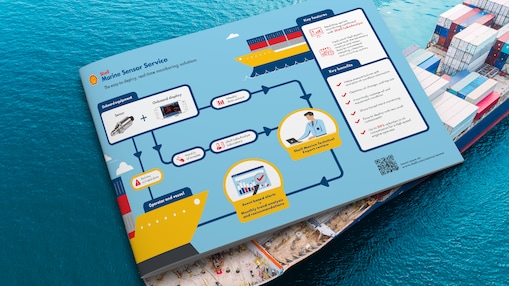
How it works
Built for the demands of marine environments, Shell Marine Sensor Service is a simple two-component, plug-and-play system that provides crews with real-time onboard alerts through continuous sensor monitoring. In addition, weekly data readouts are combined with laboratory analysis, enabling Shell’s experts to interpret trends, flag anomalies such as water ingress or degradation, and recommend corrective actions.
Introducing Shell Marine Sensor Service
Transcript
Transcript
Title: Shell Marine Sensor Service Explainer
Duration: {02:00} minutes
Description:
An explainer product video to introduce the Shell Marine sensor service.
Shell Marine Sensor Service Explainer Transcript
[Background music plays]
Futuristic digital music plays
Opening scene
The video starts on a drone shot of a vessel at sea; we pan around the vessel and graphics depict digital signals around the vessel.
Voice over
At sea, the smallest signal can mean everything.
A subtle shift. A quiet warning. The difference between smooth sailing and costly failure.
Animated sequence
We move to a blue control room on a vessel and see a spinning 3D model of the sensor, labelled sensor and surrounded by circular graphics followed by the text smart, pro-active.
A 3D model of the monitor appears in circular graphics at the centre of the screen.
Voice over
Introducing Shell Marine Sensor Service Smart, proactive lubricant monitoring with...
Footage sequence
We now see 3 technical experts consulting at a computer.
Now we see a technical expert consulting with a customer on vessel.
We see two mariners in the bridge, both in PPE and one speaking into a walkie talkie, with the text avoid failure.
We see the left side of a vessel sailing in rough waters and the text optimise performance.
We see the bow of a red vessel crashing through waves and the text extend engine life.
Voice over
..Shell technical expertise that helps you avoid failure, optimise performance, and extend engine life.
Animated sequence
We transition to traditional animation style. The blue screen has light blue digital graphics and 4 animated vessels on screen – Why it matters animates in the middle of screen.
The white screen has blue digital graphics the stat and a male with a hard hat and spanner with a warning triangle behind him.
Voice over
Why it matters: 56% of marine casualties are caused by machinery failure.
Animated sequence
We swipe to the male speaking to a female in hard hat and Shell high vis and tablet in hand - he gives a thumbs up, behind them the digital graphics slowly animate.
Voice over
But with the right information alongside expert advice, risk can be mitigated, and confidence restored.
Animated sequence
The blue screen has light blue digital graphics and 4 animated vessels on screen – what it does- animates in the middle of screen.
Voice over
What it does:
Animated sequence
An illustration of the monitor spins on to screen and the text real-time data, trend monitoring and event alerts animates on.
Voice over
Real-time data on oil condition, trend monitoring and event alerts.
Animated sequence
The blue screen has light blue digital graphics and 4 animated vessels on screen – installation- animates in the middle of screen.
Voice over
Installation? Effortless.
Animated sequence
The white screen has blue digital graphics and a blue model of an engine. The sensor model animates in a yellow circle on the right side of screen, followed by the text: Sensor, fitted to oil pipe, Fitted to sump. The display animates on the spot in a blue circle replacing the sensor. The text display, pre-programmed, own wifi hotspot appear on screen.
Voice over
Two compact components:
A sensor fitted to the oil piping or sump
A pre-programmed display with its own Wi-Fi hotspot
Animated sequence
We see a blue control room with a 3D model of the display spinning central on the screen and the words Plug in. Power up. Monitor. Scroll behind.
Voice over
Plug in. Power up. Monitor.
Animated sequence
The display moves to the centre of the screen and Oil status, oil quality, temperature and event warning are labelled using text and a white line to the location.
Voice over
The display shows:
Oil status
Condition
Temperature
Event warnings
It flags risks early- giving you time to act, not react.
Footage & animated sequence
We move to a scene of the sea with multiple vessels visible and surrounded by circular graphic.
We see text and icon for Sensor data, Shell LubeAnalyst laboratory results and results, advice and recommendations.
Voice over
But it’s more than just data. Sensor readings are combined with Shell’s LubeAnalyst laboratory results and the deep expertise of Shell’s technical team.
Footage & animated sequence
We see a bulk carrier in the sea with data graphics animating around it – oil pressure, oil temperature, Engine RPM and the text optimise maintenance schedules.
Voice over
Together, they deliver powerful insights to help you: optimise maintenance schedules
Footage
We see the hull of a red bulk carrier moving through blue waters with data animating around and the text minimise lubricant consumption.
Voice over
Minimise lubricant consumption
Footage
A beautiful sunset scene at sea – showing the ripples in the sea from a vessel sailing and the text reduce unplanned downtime.
Voice over
Reduce unplanned downtime
Animated sequence
We revert to traditional animation; the blue screen has light blue digital graphics and 4 animated vessels on screen – the result- animates in the middle of screen.
Voice over
The result?
Animated sequence
The pecten animates on scree to reveal a white screen that has blue digital graphics and a fleet of vessels on screen.
Voice over
The result? Smarter decisions. Longer equipment life. Greater confidence at sea.
Animated sequence
We see 3D models of the sensor and monitor rotating in front of blue digital graphics.
Voice over
Shell Marine Sensor Service. Know more, go further
Animated sequence
Pecten

Disclaimer
Disclaimer
Cautionary Note
The companies in which Shell plc directly and indirectly owns investments are separate legal entities. In this content “Shell”, “Shell Group” and “Group” are sometimes used for convenience to reference Shell plc and its subsidiaries in general. Likewise, the words “we”, “us” and “our” are also used to refer to Shell plc and its subsidiaries in general or to those who work for them. These terms are also used where no useful purpose is served by identifying the particular entity or entities. ‘‘Subsidiaries’’, “Shell subsidiaries” and “Shell companies” as used in this content refer to entities over which Shell plc either directly or indirectly has control. The terms “joint venture”, “joint operations”, “joint arrangements”, and “associates” may also be used to refer to a commercial arrangement in which Shell has a direct or indirect ownership interest with one or more parties. The term “Shell interest” is used for convenience to indicate the direct and/or indirect ownership interest held by Shell in an entity or unincorporated joint arrangement, after exclusion of all third-party interest.
Forward-Looking statements
This content contains forward-looking statements (within the meaning of the U.S. Private Securities Litigation Reform Act of 1995) concerning the financial condition, results of operations and businesses of Shell. All statements other than statements of historical fact are, or may be deemed to be, forward-looking statements. Forward-looking statements are statements of future expectations that are based on management’s current expectations and assumptions, including (without limitation) those concerning Shell’s strategy and operating plans, macroeconomic conditions, future energy demand, supply and product mix, commodity prices, demand for Shell’s products, production results and reserve estimates, development, execution and management of projects, energy transition and climate change, management of safety and environmental risks, costs, cash capital expenditures, technology advancements, legislative, judicial, fiscal and regulatory developments, regional conflicts and trading conditions, and involve known and unknown risks and uncertainties that could cause actual results, performance or events to differ materially from those expressed or implied in these statements. Forward-looking statements include, among other things, statements concerning the potential exposure of Shell to market risks and statements expressing management’s expectations, beliefs, estimates, forecasts, projections and assumptions. These forward-looking statements are identified by their use of terms and phrases such as “aim”; “ambition”; ‘‘anticipate’’; “aspire”, “aspiration”, ‘‘believe’’; “commit”; “commitment”; ‘‘could’’; “desire”; ‘‘estimate’’; ‘‘expect’’; ‘‘goals’’; ‘‘intend’’; ‘‘may’’; “milestones”; ‘‘objectives’’; ‘‘outlook’’; ‘‘plan’’; ‘‘probably’’; ‘‘project’’; ‘‘risks’’; “schedule”; ‘‘seek’’; ‘‘should’’; ‘‘target’’; “vision”; ‘‘will’’; “would” and similar terms and phrases. There are a number of factors that could affect the future operations of Shell and could cause those results to differ materially from those expressed in the forward-looking statements included in this content, including (without limitation): (a) price fluctuations in crude oil and natural gas; (b) changes in demand for Shell’s products; (c) currency fluctuations; (d) drilling and production results; (e) reserves estimates; (f) loss of market share and industry competition; (g) environmental and physical risks, including climate change; (h) risks associated with the identification of suitable potential acquisition properties and targets, and successful negotiation and completion of such transactions; (i) the risk of doing business in developing countries and countries subject to international sanctions; (j) legislative, judicial, fiscal and regulatory developments including tariffs and regulatory measures addressing climate change; (k) economic and financial market conditions in various countries and regions; (l) political risks, including the risks of expropriation and renegotiation of the terms of contracts with governmental entities, delays or advancements in the approval of projects and delays in the reimbursement for shared costs; (m) risks associated with the impact of pandemics, regional conflicts, such as the Russia-Ukraine war and the conflict in the Middle East, and a significant cyber security, data privacy or IT incident; (n) the pace of the energy transition; and (o) changes in trading conditions. No assurance is provided that future dividend payments will match or exceed previous dividend payments. All forward-looking statements contained in this content are expressly qualified in their entirety by the cautionary statements contained or referred to in this section. Readers should not place undue reliance on forward-looking statements. Additional risk factors that may affect future results are contained in Shell plc’s Form 20-F for the year ended December 31, 2025 (available at www.shell.com/investors/news-and-filings/sec-filings.html and www.sec.gov). These risk factors also expressly qualify all forward-looking statements contained in this content and should be considered by the reader. Each forward-looking statement speaks only as of the date of the publication mentioned in this website. Neither Shell plc nor any of its subsidiaries undertake any obligation to publicly update or revise any forward-looking statement as a result of new information, future events or other information. In light of these risks, results could differ materially from those stated, implied or inferred from the forward-looking statements contained in this content.
Shell’s net carbon intensity and net-zero emissions target
In this content we may refer to Shell’s “net carbon intensity” (NCI), which includes Shell’s carbon emissions from the production of our energy products, our suppliers’ carbon emissions in supplying energy for that production and our customers’ carbon emissions associated with their use of the energy products we sell. Shell’s NCI also includes the emissions associated with the production and use of energy products produced by others which Shell purchases for resale. Shell only controls its own emissions. The use of the terms Shell’s “net carbon intensity” or NCI is for convenience only and not intended to suggest these emissions are those of Shell plc or its subsidiaries.
Shell’s operating plan and outlook are forecasted for a three-year period and ten-year period, respectively, and are updated every year. They reflect the current economic environment and what we can reasonably expect to see over the next three and ten years. Accordingly, the outlook reflects our combined Scope 1 and 2 target, NCI target and our oil products ambition over the next ten years. However, Shell’s operating plan and outlook cannot reflect our 2050 net-zero emissions target, as this target is outside our planning period. Such future operating plans and outlooks could include changes to our portfolio, efficiency improvements and the use of carbon capture and storage and carbon credits. In the future, as society moves towards net-zero emissions, we expect Shell’s operating plans and outlooks to reflect this movement. However, if society is not net zero in 2050, as of today, there would be significant risk that Shell may not meet this target.
The information provided above regarding Shell’s NCI and net zero emissions target are not intended, nor should they be construed as introducing, suggesting or making any claim, target or representation thereof other than what is included in the content.
Forward-Looking non-GAAP measures
This content may contain certain forward-looking non-GAAP measures such as free cash flow and underlying operating expenses. We are unable to provide a reconciliation of these forward-looking non-GAAP measures to the most comparable GAAP financial measures because certain information needed to reconcile those non-GAAP measures to the most comparable GAAP financial measures is dependent on future events some of which are outside the control of Shell, such as oil and gas prices, interest rates and exchange rates. Moreover, estimating such GAAP measures with the required precision necessary to provide a meaningful reconciliation is extremely difficult and could not be accomplished without unreasonable effort. Non-GAAP measures in respect of future periods which cannot be reconciled to the most comparable GAAP financial measure are calculated in a manner which is consistent with the accounting policies applied in Shell plc’s consolidated financial statements. These forward-looking non-GAAP measures are provided to assist readers in understanding management’s use and expectations of such measures and may not be appropriate for other purposes.
The contents of websites referred to in this content do not form part of this content.
We may have used certain terms, such as resources, in this content that the United States Securities and Exchange Commission (SEC) strictly prohibits us from including in our filings with the SEC. Investors are urged to consider closely the disclosure in our Form 20-F, File No 1-32575, available on the SEC website www.sec.gov.