Shell LubeMonitor
Shell Marine has deployed a suite of exciting enhancements to its Shell LubeMonitor service, to go beyond all other traditional “cylinder condition monitoring” programmes and position itself as the go-to place for all your engine monitoring needs.
Shell's LubeMonitor service lets users understand their ship's 2-stroke engine performance better and helps reduce maintenance costs.
Read the transcript
Read the transcript
Shell Marine LubeMonitor - Full - No Subs
0:00
Hello and welcome to our introduction of Shell Lube Monitor, our cylinder condition monitoring service for two stroke engine cylinders and how it goes beyond traditional monitoring.
0:10
With your data reviewed by our technical experts, Shell Lube Monitor helps reduce maintenance costs, extend maintenance intervals, manage cylinder oil consumption and improve overall engine performance.
0:24
Operating 2 stroke engines presents unique challenges.
0:27
Engine design, current and alternative fuels, various lubricant grades, regulations and crew experience all affect the condition of the propulsion engines combustion chamber, thereby impacting overall vessel performance, maintenance costs and reliability.
0:43
To manage this complexity, engine manufacturers recommend three important aspects.
0:48
One cylinder inspections, 2 regular onboard oil monitoring and 3 laboratory based oil testing.
0:56
These cheques are vital for controlling wear rates and component life.
1:01
Cylinder condition management focuses on 2 main challenges.
1:04
Deposit control and corrosion control both affect engine efficiency and increase maintenance costs.
1:11
Shell Lube Monitor combines expert data management with insights to address these challenges.
1:17
Cylinder condition data like running hours, fuel specs, and oil reports are often scattered across platforms, making them difficult to access, interpret, and evaluate.
1:27
Our intuitive digital platform centralises all this data, allowing you to easily track trends, compare engines, and deep dive into specific cylinders with just a few clicks.
1:38
But the real value lies in the expert support Shell Lube Monitor offers.
1:42
Your dedicated technical expert reviews your data and can help provide guidance on how you can improve the performance of your vessel.
1:49
Whether it's reducing costs, adjusting feed rates, or identifying potential issues early, we're here to steer you in the right direction every step of the way.
1:59
At Shell, we understand that engine reliability and avoiding unplanned maintenance are key to your vessel's performance.
2:06
Shell Lube Monitor isn't just at all.
2:08
It's a service to help you manage engines with confidence.
2:12
By shifting from traditional time based maintenance to our condition based model, you can better manage your engine overalls and through shell loop monitors, continuous monitoring, trending and support, you can significantly extend maintenance intervals and improve engine reliability.
2:29
Additionally, the service is compatible with all cylinder oils as we evaluate the conditions to comply with OEM guidelines.
2:36
Whether reducing onboard issues, saving on operating costs, or optimising maintenance, Shell Lube Monitor provides the data and expertise you need to take control for supporting, understanding, measuring and reporting engine performance.
2:50
Please contact your technical expert for a full demonstration.
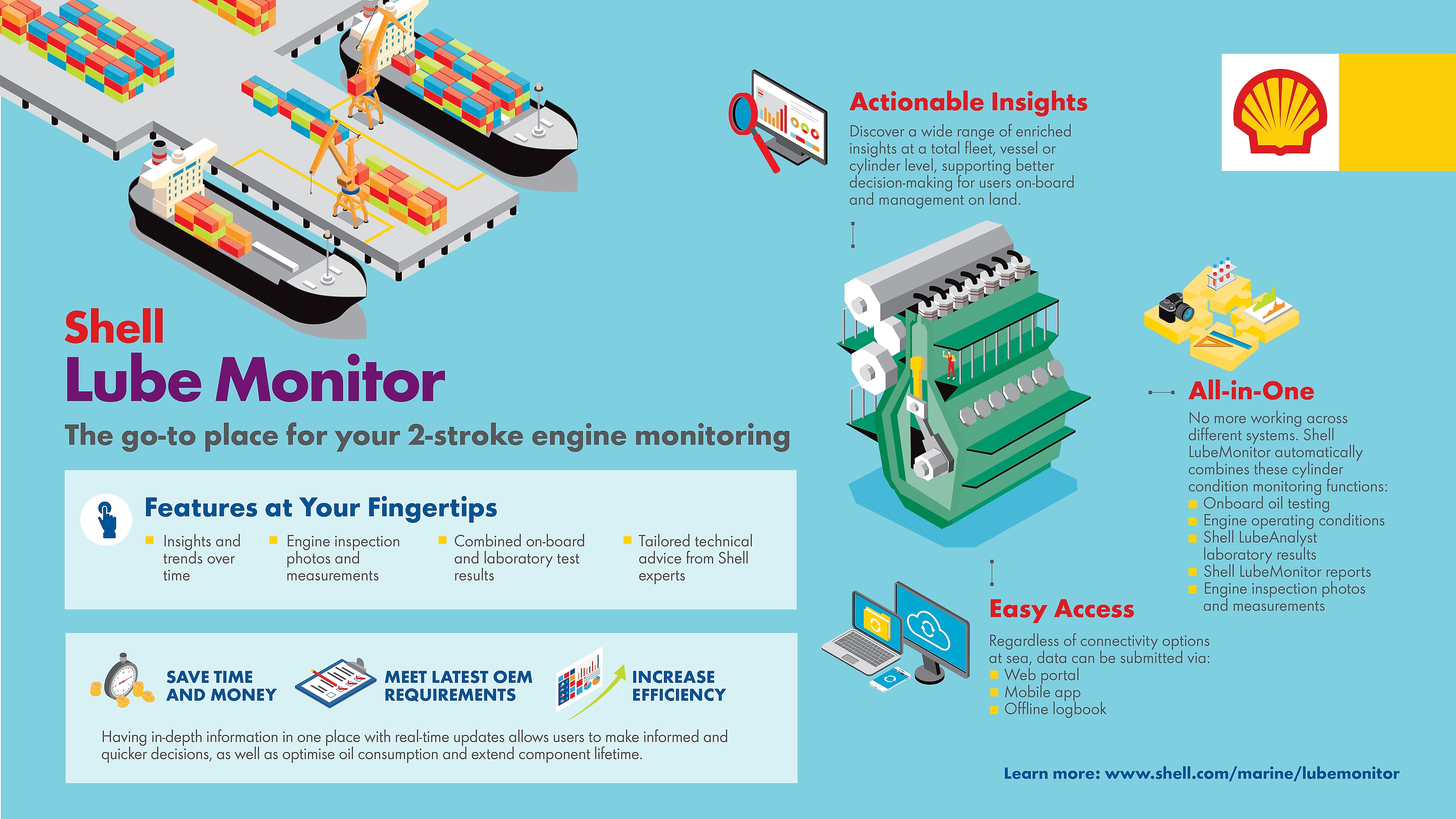
Features at your fingertips

Insights and trends over time

Engine inspection photos and measurements

Combined on-board and laboratory test results

Tailored technical advice from Shell experts
Your benefits
Save time and money
Meet latest OEM requirements
Increase efficiency
Having in-depth information in one place with real-time updates allows users to make informed and quicker decisions, as well as optimise oil consumption and extend component lifetime.
Experience the digital age of cylinder monitoring

1. All-in-One
No more working across different systems. Shell LubeMonitor automatically combines the cylinder condition monitoring functions; Onboard oil testing, Engine operating conditions, Shell LubeAnalyst laboratory results, Shell LubeMonitor reports, and Engine inspection photos and measurements.
2. Actionable Insights
Discover a wide range of enriched insights at a total fleet, vessel or cylinder level, supporting better decision-making for users on-board and management on land.
3. Easy Access
Regardless of connectivity options at sea, data can be submitted via Web portal, Mobile app or Offline logbook.
Shell X Everllence (MAN) Webinar - 11 June 2025
Learn more about navigating the energy transition in this webinar below. The session discusses the impact of the IMO midterm measures on alternative fuel choices, Shell’s research on lubricants amidst these range of fuels, Everllence’s latest engine updates and the importance of cylinder monitoring.
Read the transcript
Read the transcript
1:14
Hello everyone, thank you for joining.
1:17
We will be starting in just a couple of minutes to allow more people to join.
1:21
So thank you.
1:22
Just give us a few minutes.
3:44
Ladies and gentlemen, members of the media, a very good morning, good afternoon and good evening to all of you.
3:51
I hope wherever you are in this world, you are safe, and you are aware of your emergency exits should the need arise.
3:59
My name is Jade from Shell Marine and on behalf of all of us and Everllence formerly known as MAN, we'd like to welcome you to our webinar Navigating the Energy Transition.
4:12
We're delighted to have over 1200 of yourselves sign up across 80 countries representing over half the world today.
4:20
That's really amazing.
4:23
We hope you've taken time to explore our virtual lobby where you can try our quiz and stand a chance to win a prize, go through our resources, and much more.
4:33
If not, don't worry, we will still have time.
4:36
You will still have time because the lobby is open until this Friday, 5:00 PM UK time.
4:44
Before I continue further, please let me go through a quick slide.
4:50
And this is mainly to say that the information you're about to see is solely used for information sharing purposes and not to be construed as financial advice or used for financial, for investment purposes.
5:07
Allow me to quickly go through the agenda.
5:10
So very shortly we will be hearing from Dr. Alexandra Ebbinghaus, our General Manager of decarbonization, who will bring us through the IMO midterm measures and how it will impact the attractiveness as well as the choices of alternative fuels.
5:27
You know, it's a very interesting topic.
5:29
So we will have Dr. Luis Garcia, our technology Manager for large engine lubricants, share with us the Shell research and findings of our lubricants on these fuels.
5:41
And then we will have Kristian Mogensen, the promotion Manager of Everllence to share also the latest engine technology updates on these alternative fuels.
5:52
And Speaking of engines, we will then have Marcus Scherer, our General Manager of Technical Services, to highlight the importance of cylinder monitoring.
6:03
But those of you who are joining us in our Chinese room, we will have our both our technical managers, Flanco and Martin Liu, translate and present the exact same topics and slides for us today.
6:20
Yeah.
6:20
And then we will all convene back together where we will have a live Q&A session.
6:27
So the Q&A S could be those that have been put in the lobby, or you can feel free to put them into your chat box now at any time during the event in English or Chinese.
6:38
And then we will try to raise as many as possible.
6:42
Without further ado, may I please invite Dr. Ebinghaus and Flanco in the Chinese Room to bring us through the IMO MIT term measures.
6:52
Thank you very much, Jade, for the introduction.
6:55
It is great to see so many of you joining us for this webinar.
6:59
I have the pleasure of kicking us off today by talking about the IMO metre measures, which have been approved in April and are due to be adopted in October.
7:10
The International Maritime Organisation agreed its initial greenhouse gas strategy in 2018, followed in 2023 by revising the strategy to aim for near net zero by or around 2050, which and setting also short term measures which defined technical and operational efficiency targets for the existing fleet.
7:38
We shouldn't forget that this is quite novel for any transport sector.
7:44
Now, the midterm measures take a significant step forward to implement the IMO decarbonisation ambition by setting a global fuel standard, which requires a carbon intensity of the energy used on board to be reduced over time.
7:58
Let me just define the carbon intensity.
8:01
It's basically the amount of greenhouse gas emissions.
8:04
So that's your CO2, methane and nitrous oxide emitted per unit of energy defined from the production to the end.
8:14
Use with other words on the complete well-to-wake basis.
8:18
So what was agreed?
8:20
Well, from 2028 the carbon intensity of the energy used on board will be reduced annually.
8:28
And as you can see here, there are two reduction targets, a base in red and a yellow target in yellow.
8:35
To be compliant, A vessel needs to reach the direct target.
8:39
The annual reduction targets already have been set until 2035 and the base reduction target in 24 is 65% compared to the baseline, with other values to be agreed later.
8:55
The EU has already a similar fuel standard in place, Fuel U Maritime, shown in blue here.
9:02
As you can see, the reduction trajectory of the IMO is much steeper and as the scope is global will result in a significant increase in demand for low calm fuels.
9:13
So This is why you can see as a fuel supplier we are excited about this development.
9:20
So how does the measure work?
9:22
Well, if the vessel exceeds the direct target is in the green area, it generates surplus units which it can use in future years or transfer to other vessels to help them meet the base target.
9:34
And when I say transfer, you know, I really mean sell.
9:39
If the vessel exceeds the base target and isn't the yellow region, then it has only one compliance option, which is to purchase RU ones.
9:48
These are remedial units initially priced at $100 per tonne of CO2, which is paid into the IMO net zero fund.
9:58
Now if the vessel does not actually achieve the base target, it has two options, pay for RU2's remedial units priced at $380 per tonne of CO2 or acquire IE buy surplus units from another vessel to get to the base target.
10:18
It still has to pay for the RU ones to cover the deficit from base to direct trajectory.
10:26
In a sense the remedial units are the stick to encourage the use of low carb fuels.
10:32
The price of $100 and $380 per tonne of CO2 have been set by the IMO for the first three years and their review is likely to lead an increase of these cost going forward.
10:46
But there's also carrot, if a vessel uses a 0 or near the euro fuel that and that.
10:53
So that is a fuel with very low carbon intensity.
10:57
These are also eligible to receive reward units for the use of these fuels.
11:02
Now we do not know yet how much these are worth, but in the effect is that the attractiveness of alternative fuels will be influenced by whether they meet that definition of that and that now the rewards for these units will be funded from the IMO Net Zero fund.
11:20
So the remedial units you buy fund the IMO Net Zero fund, but the fund will also be used for research and development, to help shipping, to decarbonise, supporting national action plans and addressing disproportionate negative impact on state resulting from this regulation.
11:39
So there's still, you know, there's uncertainty of how much money will be going into the fund and how that money will be distributed.
11:46
Hence also the uncertainty what the reward is going to be valued at.
11:53
But these will be all defined before 2028.
11:57
Now what we what do we expect ship owners will do?
12:02
The regulation is expected to apply from January 2028, which is really not long to go.
12:08
Therefore, for the first years of the regulation change the fuel type of a vessel is not really an option, which means to that to reduce the carbon intensity, a drop in fuel will be needed IEO fuel which can be blended and used on the existing vessels.
12:24
Considering the price differential between bio and fossil fuels, carbon abatement cost is expected to be above the $100 per tonne.
12:34
Therefore really makes no sense to use the more expensive biofuels to avoid purchasing RU ones.
12:41
However it makes sense to look for and lock in biofuel supply which has a lower carbon cost than RU 2's if a ship owner has sufficient supply exceeding the need to get to base level.
12:55
It would also make sense to over comply beyond the direct target and have an income stream of selling surplus units, but depend depending on the fuel price differential.
13:08
This may only be effective if biofuel use is maximised.
13:11
Just exceeding the direct target with a conventional vessel is unlikely to make sense commercial sense as demand for drop in fuels for the conventional fleet will be significant compared to the known supply, especially after the initial years.
13:28
Dual fuel vessels could help the conventional fleet by generating surplus units using bio methane biomethan or in the future of ammonia.
13:39
This incon stream then also can make the case for more dual fuel vessels to be built because longer term ship owners need to consider now what fuels to select for new vessels and the options for retrofitting existing vessels.
13:56
Here I would like to make a call out for efficiency.
13:59
The business case to have the most fuel efficient vessel is only strengthening as energy costs are going up.
14:06
As an example, using wind assist, the power not only reduces fuel consumption, but also improves the vessel carbon intensity.
14:14
I hate to meet the global fuel standard, so it's a double benefit.
14:19
Now, selecting the most competitive fuel is not easy and it's gone more difficult as in addition to considering the technology readiness, which does vary a lot between ammonia, methanol and methane, capital and operating costs need to be compared.
14:36
In the past, fuel availability has not been a concern as the industry was running on fuel oil which is available everywhere.
14:43
This is definitely going to change.
14:45
With such a significant transformation of the fuel landscape, it is not sufficient to look at fuel availability and fuel pricing today.
14:54
Views on future development need to be taken into account.
14:57
Can only say speak to your fuel supplier now.
15:04
What does it actually mean for shipping?
15:08
Life is certainly getting more complex with more choices and difficult decisions ahead, but let's not forget that these midterm measures will enable shipping to reduce greenhouse gas emissions by providing a technical framework to reduce carbon intensity as well as a financial incentive to actually reduce emissions.
15:30
So to go ahead, move and transform the whole industry as a whole value chain from fossil to alternative fuels and, and, and this way for the shipping industry to do our part for the environment.
15:47
Indeed it will be difficult and it will be more complex, much more complex than today's environment.
15:54
On the operational side, it is very likely that a wider range of fuels is being used on board.
16:00
So maintenance and daresay lubrication is important.
16:04
However, by working together, and here I would like to include also the regulator solutions can be found.
16:12
On this note, I would like to thank you for your attention and hand over to Dr. Lewis Garcia.
16:33
You are muted.
16:37
Thank you very much, Alexandra.
16:38
So for giving us that real outlook on what is coming for the marine industry in terms of alternative fuels and choice this right.
16:47
So now I would like to speak to you about our perspective on lubrication, particularly for marine to stroke dual fuel engines when burning alternative fuels.
16:59
We have been gathering some experience, and I want to take this opportunity to share that with you.
17:06
But first, let me tell that Shell Marine is committed to help this industry to meet the need 0 greenhouse emissions started by 2050 and as a proof of that I mean or cylinder lubricants portfolio but also or portfolio in lubricants in general continues to evolve to deliver performance in the existing but also the new applications rights.
17:30
As a proof of that or most recent product launch, Shell Alexia 4 TXC or Category 2 product in the market since end of 2022 has been designed of course to cope with latest engine generation technology providing exceptional cleaning ability, but also so to provide effective lubrication for fuels with which contain non sulphur.
17:54
I mean this is LNG but also methanol biofuels.
17:58
And we are confident that also many applications will be suited for this lubricant.
18:07
But as a fuel future fuels landscape is taking shape.
18:13
Engine technology continues to evolve and it's really moving into higher efficiencies, particularly to use more effectively these alternative fuels, but also the existing fuels as is part of the solutions to reduce greenhouse emissions.
18:31
Power densities continue to increase as part of the efficiency increase of these engines and these power densities really result from increasing pressures and temperatures in the power cylinder.
18:45
These conditions mean more demanding needs on lubrication, especially with focus on the cleaning ability of the lubricant but also on the thermo-oxidative resistance of lubricating products.
19:06
But what does this means?
19:08
I mean higher efficient engine and then the alternative fuels.
19:11
What are really the requirements for lubricants?
19:14
As we see with alternative fuels, sulphur is out of the equation, so the need for corrosion protection is done and we only require low alkalinity reserve to actually deal with small amounts of acidic species from the combustion process.
19:32
But with higher fission engines, dual fuel engines in particular, we really need very good thermal oxidative stability of the lubricants as temperatures and pressures have gone higher without really compromising the cleaning ability and a robust anti wear performance of these lubricants that has brought the industry to land on the 40 base number category level for being used with all this type of 0 Sulphur lubricants, sorry, 0 sulphur fuels, right.
20:07
So and major OEMs in this space recommend 40 base numbers for being applied for engines running on LNG.
20:16
Methanol, biofuel and is also the case in the first recommendations appearing now for ammonia.
20:26
Let me talk to you about the specific examples of a portfolio on the 40 base number level with the different fuel options.
20:33
Shell Alexia 40 FC in this example is showing 7000 hours, nearly 7000 hours of operating on AB100.
20:40
So biofuel, purely biofuel operation as you can see in the upper left picture, at the beginning of the operation, there was there were slightly discoloration on the first ring land.
20:53
But after let's say the power unit is completely running in and sealing, then the unit becomes clean.
21:00
What we see is a very good condition after nearly 7000 hours of operation.
21:05
And what you see in the drain oil analysis of this engine on the monitoring is that there is very low iron content on the drain oil samples, indicating very low wear rates.
21:14
And also the base number is not really demanded.
21:17
So it's almost at fresh level.
21:22
Similarly, but for another type of engine, so from an older generation, we also have experience with our Alexia 40 product or category one in this K98 engine.
21:33
So we have managed to monitor down to .7 grammes per kWh lubrication also with very good experience after 3000 hours on AB bio blend with B24 induce.
21:47
What you can see is that when the engine started trialling, so there were some deposits on the first ring land, whereas we move across the monitoring.
21:57
Then deposits start to to clean up.
22:01
Now let me move into the LNG case, which is an important bridging fuel, but also has a relevant role to play in the future and in your decarbonization journey.
22:12
Alexia 40 has recently completed a 4000 hour validation trial with Wingity in this gas admission engine and what you can see that after 4000 running hours, the unit condition is almost as new.
22:25
This is actually your cleanest trial ever and we see the same very low wear rates and very low iron content on the drains and base number at nominal level.
22:36
The experience has been similar for Alexia 40 in the same type of application.
22:41
So both products are actually recommended by Wingd for LNG so validated but also for ammonia and methanol on high pressure engines like the MINGI design.
22:55
We also have excellent experience with Alexia 40 XC.
22:59
After running in units completely seal and maintain clean rim packs, We have gathered over the last couple of years almost half a million hours of operation on pure LNG service on MGI engines and we are very confident that Alexia 4 DXC will continue to be the product for the years to come.
23:21
Now I want to share with you a case for methanol.
23:24
Yeah.
23:24
So we also have been monitoring a fleet of methanol ships that actually operating more than 80% of the time on methanol since new.
23:33
Yeah, Similarly to the other cases, we have seen some discoloration on 1st ring land at start of testing or monitoring, but after cylinders run in and the first ring completes the seals, then the units completely clean up.
23:50
So very good condition.
23:54
Similarly to the other cases, we also see very low iron content on the oil drain samples and extremely low wear rates on the ring coatings.
24:05
As fair to say that we could predict that on these applications and particularly in this case the the metro engines, we expect to extend bring back overhaul periods from 16,000 up to 40,000 running hours or beyond.
24:29
Last not least, I would like to talk about the case of ammonia.
24:33
Until today, we are still waiting for the opportunity to gather our first experience in the field with ammonia running engine.
24:41
But for now, we have been really focusing on understanding and warranting that all products like Alexa 4 TXC will be able to cope with the lubrication needs of such application.
24:54
As with the other fuels, we don't expect corrosion to be any of a concern and cleanliness and Thermo oxidative stability has been already proven for this product in multiple applications as I have shown you in the previous examples.
25:08
So our interest has been really to ensure that the product can guarantee very good anti wear performance when operating in this fuel.
25:21
So for now, our efforts have been concentrated on ensuring that studies of tribology and wear protection give proof of the strength of this product.
25:31
I invite you to read or see my paper from this year paper #510, where we discuss more in detail these observations.
25:43
Finally, I want to summarise what I have presented to you.
25:47
We will continue to ensure our lubricants apply to the range of alternative fuels and we have solid proof that Alexa 40 XC is actually suitable for all these applications.
26:00
The 40 base number level is performing very well on wear protection and clean suspects at the rates at feed rates at or below .8 grammes per kWh and some engines have more space actually to continue to reduce and optimise feed rates.
26:15
And in general, we will see that alkalinity is not necessarily needed, although we need to consider that these engines also run alternate and on digital fuels as a backup fuel.
26:25
So therefore steel base number is requiring these products and the future probably of lubrication when we see more penetration of these fuels, right.
26:35
So and the engines are not really switching back as a backup fuel for diesel fuel oils, maybe we could operate with lower base numbers.
26:44
And of course, we will need to continue to focus on warranting very high thermoxative resistance and why not maybe also moving in the future towards lowest viscosities to try to gain or maximise engine efficiency.
26:59
With this, I thank you very much.
27:01
I want to pass now the word to to Kristian from Everllence to talk about engine technology.
27:09
Thank you very much.
27:12
Thank you very much, Louis.
27:13
And thank you very much for inviting me to, to speak at your webinar.
27:18
So in in evidence I have to remember not to say main energy solutions anymore, but in evidence looking at the the complete fleet and, and and what is going on in service, then 80 to 90% of all transported goods is actually done by sea.
27:38
All in all, there is around 33,000 large merchant vessels in service and of these 24,000 with evidence brand on it.
27:52
And of course the times are changing and and we are seeing a huge uptake of alternative fuel engines.
28:00
We started from in 2014 with our methane burning engines, then came our methanol and ethane laid out our LPG and of course now we're working on the ammonia engine which we expect to get in service around 2026.
28:20
One important thing and one one thing to notice is that that we started off with a with a rather small share of dual fuel engines.
28:30
But since 2020, then we have actually started to see that half of what is being ordered and contracted, it is actually with dual fuel.
28:41
And listening in to Alexander and all of the things that the regulatory things that is ongoing with IMO and EU.
28:49
Then we actually expect that bigger majority or bigger share of the future orders of of vessels will be with the 2 fuel.
29:00
But of course we also have to look a little bit back especially when we are talking about lubrication oils.
29:08
So looking at what has been delivered since 20, since 2000 and all the way up to 2023, then we then we can see that that that the majority being delivered up until 2012 was actually MC engines.
29:26
These engines are here.
29:29
These engines are lubricated typically with ABN 40, Cat One or BN 70 lubrication, right?
29:36
But around 2013, then we started to see the switch from MC to ME engines.
29:42
And as Dr. Lewis also mentioned then power density pressures, temperatures has steadily increased since then.
29:52
So this is actually calling for a new lubrication oil, which I will come back to.
29:59
Of course, one thing is that the power density is increasing, but we also have to look at the fuel share.
30:05
Looking at let's say the conventional fuels then then as of today when we're looking at the the bunker market, then around 5055% of all fuels being bunkered is 0.5.
30:21
And there is still a remaining 13% on high sulphur fuel line.
30:26
And these high sulphur fuel oil obviously needs to be lubricated with BN 40 or BN one, sorry, BN 100 or BN 140.
30:37
Now moving into what we believe is the duplication oil for the future.
30:45
So of course with the changes from high sulphur fuel to low sulphur fuel as Lewis also described then now we're not looking at neutralisation of the sulphic acid, we are more looking at the cleaning ability.
31:00
So how well is the lubrication oil?
31:04
How well does the lubrication oil manage to clean up deposit from the from the piston ground?
31:11
We started already back.
31:16
As mentioned we had the MGI engines which is running on a mix between methane and at at the early days high sulphur fuel line.
31:26
This meant that we actually here we saw a mix between high sulphur and methane giving an an equal or a sulphur equivalent of around 0.5.
31:38
So we had some let's say early indications back in 2017 eighteen on how these new engines will cope with 0.5% fuel.
31:49
And what we could see is that the BN 25 were simply not sufficient in order to manage the the deposit builder.
31:59
The thermal stability of the BN 25 is five were not able to cope with with the new performances of these entries.
32:06
So what we did in the early days and then there was before the BN 40 KET 2 was that we asked the crews to alternate between BN25BN40 and the BN 100 in order to maintain a clean piston ring pack.
32:23
And this actually reduced the amount of unscheduled overhauls that we had to that we had to do.
32:34
So what is BN 40K2 lubrication oil and what is the requirements?
32:40
So basically from our side, we have said that we would like to see a lubrication oil which have a, let's say low calcium level, low neutralisation level, but high cleaning ability.
32:54
So the requirement for BN 40K2 oil is that it has the same cleaning ability as traditional BN 100.
33:03
And here is here I show a test where the engine was operating on the BN 100 to begin with and then it was changed over to BN 40 Cat 2.
33:15
And here we can see the performance of the BN 40 Cat 2 is actually a little bit better than what we had on on the BN 100.
33:25
So this leads on to service experiences as Lewis said he they have the the BM40K2IN service since or available for the market since 2022.
33:39
And of course we have seen it throughout the year.
33:42
So now we are getting more used to it.
33:45
As also mentioned by by Lewis then the cleaning ability is the key driver for good Selena condition for our new engine portfolio.
33:59
Here I have some example of our midway burning engines which have a very low wear rate.
34:05
So what you see on the X axis is running hours and on the Y axis we have the coding thickness and we can actually see that that the that the coding, the wear of of the of the ring coding is actually very low.
34:22
And all the way back in 2019, we could actually extend the the guided overhaul intervals between 35 and 50% upwards for these medi entrance.
34:35
And today with the experiences that we have is that actually LNT carriers we can actually see and that they are able to run with a ring pack between 2 dry dockings.
34:49
So we expect to see five year overhaul on on the piercing ring back for methanol and for LPG.
35:02
We are also seeing similar very low rare rates.
35:09
And and also when we're doing scrap oil drain oil analysis, when we are doing inspections, we can actually see that they are performing very, very well when they are lubricated with a high with a location oil with a high cleaning ability such as the BM folic head 2.
35:28
As of today, we do not have let's say sufficient data, rare data in order to be able to extend the guided ore hole in cells.
35:39
But it is our clear expectation that these engines will also be able to run for a five year docking.
35:51
And of course, in order for all of this to, to, to, to be possible, then it is required that you have proactive monitoring of the cylinder condition of the scrape oil samples, doing frequent port inspections and are able to do proactive mitigation of proactive changes towards how you duplicate these engines.
36:19
And of course, this is where various monitoring tools comes into the picture.
36:29
I would like to say thank you very much.
36:31
And I would like to give also the word to Marcus.
36:39
Thank you very much, Kristian.
36:45
Hello everybody and thank you for joining this call.
36:49
I like to use the next 10 minutes to talk a bit about the monitor offer we have in the market.
36:57
We call it the monitor.
36:58
It's our two go to solution for two stroke engine condition monitoring.
37:04
I think what we've learned is that the operational context for two stroke engines is constantly changing.
37:11
We heard from Alexandra about fuels and and the variety of fuels that we can expect.
37:19
We heard from Louis how we develop loops and how lubricants are playing an important role.
37:25
Kristian talked about the engines in relation with the lubricants.
37:30
And on your ship there's a fourth component, which is the group and all these four elements are coming together on your ship and it's in a very tiny space called combustion chamber.
37:44
If these four elements are well in balance, then then I think we we can achieve what has been despite by Kristian before even five year intervals on LNG power chips.
37:58
If they are not in balance, we will see deposits scarfing or ocean depending on the fuel.
38:08
What do energy manufacturers you heard it before from Kristian from England and vintage is is clear as well right?
38:17
Engine manufacturers recommend monitoring and saline inspections in addition to train oil analysis.
38:24
This helps to control wear rates and optimise device component service life.
38:33
There are two distinct challenges depending on the fuel content.
38:38
Sulphur content of your fuel in the high sulphur area we still have corrosion control in the and it means we need to find the optimum feed rate to manage corrosion control in conjunction with the lubricant and in the alternative fuel close solar for fuel we have deposit.
39:02
The aim to extend intervals between up to five years depends on one important factor.
39:10
It means that you don't get deposit and you control the deposit build up from your.
39:15
A picture tells more than 1000 words, but only together with the right data and the right trend lines and the right information, you can make informed decisions in the right moment and and and take proactive measures as described described by question.
39:39
But we see in the market and if you talk to our customer, we realise that this data which is needed to make these decisions is very often scattered.
39:49
You have lock books, maintenance records somewhere in an excel spreadsheet.
39:53
Eventually you have scavenge inspection reports in another file.
39:58
You might have some pictures somewhere.
40:01
You have onboard train analysis and on board locks.
40:05
Other Excel files.
40:05
Then you get the old reports from from your supplier and you have infant performance data sheets.
40:13
Scattered data has one big challenge.
40:16
It's very difficult, big trend lines, trends upfront.
40:31
What we offer in Loop Monitor is a synchronised and and platform that summarises data and simplifies it for you as a fleet director.
40:41
You can see your whole fleet.
40:43
You can see with a simple ample system if your ships are reporting, if there are issues on the ship and you can eat the drill into a ship, into the engine to various cylinders down to sea.
40:58
Looking at the pictures and look at look at the challenges you might face and take proactive actions.
41:06
We are very happy.
41:07
I realised this slide is not telling the full show the full picture.
41:11
We are very happy to give you an online view and and show you the full for you.
41:21
And if you'd like to have this, just give me a ping, contact me.
41:25
We are more than happy to connect with you and show me the full, the full scale of this platform.
41:34
You might ask, how are we managing now all these, all these pictures and we have hundreds of chips on our platform already.
41:43
We have thousands of pictures and there's one big challenge.
41:48
Deposits can't be detected by lab tests.
41:52
It requires a manual image inspections.
41:56
You might hear in the market that yeah, you can see in the drainer analyse deaf deposits, yes, but this is usually too late.
42:05
The engine is already reacting to deposits physically, which is clearly the situation we're trying to avoid.
42:12
The solution is that we've sent our developers on board of ships and and created the Dell owned deep dive learning tool that is that is able to detect deposits with a 95% accuracy.
42:32
Does that mean we don't have the human factor and experts looking at it anymore?
42:37
No, but it allows our shell expert to focus on the deal issues and get in contact with our customers and don't need to crawl check all the pictures.
42:50
So big help of deep dive and most modern technology to help you to make sure your end performance is in essence this condition.
43:04
Now 2 examples out of real life.
43:08
What we see here as a case study is an engine.
43:14
After inspection, what we see are clearly lubricator malfunctioning, no uniform application of lubricant, too much residual oil in the sectors of piston ring pack.
43:26
And the recommendation was to overhaul the lubricators and reduce the feed rate gradually.
43:33
You see we have 553 thousand running hours roughly and the feed rate of 0.78.
43:47
Only only 400 running hours later we see lubricate this overhauled.
43:54
We see a very clean well, well duplicated surfaces.
43:58
We save the lubricants and money for the ship owner we reduced.
44:02
And the good news is that the feed rate can be further reduced, but only by proper model monitoring.
44:10
SO1 case where Look Monitor helped to get an engine clean, avoid further about any damages and even save money to our customer Case study #2 changing from time based to condition based maintenance.
44:27
We talked about the five year interval.
44:29
We also talked about how confident evidence is in in giving this advice with the caveat that proper monitoring is done.
44:41
So what we see here is that also the wear rate is low, monitoring condition is very important.
44:46
You see already small deposit building and this are exactly the moments where we get excited because we see the deposit building in a moment where you still can recommendation was to change to a catch to oil for better detergency.
45:03
As a result, we saw that the piston rings currently at 16,000 hours don't need to be changed.
45:14
It can be, it can be extended, but obviously with close monitoring.
45:19
So deposit disappeared and pistol rings are good for further use.
45:24
I mean, this is a very strong example how you can extend the maintenance, how can push changes pistol rings back and, and in line with the recommendation and the statement of MAN.
45:43
If your pistol rings have no deposits, you run on LNG or methanol and you make sure your pistol rings are running free, you can extend your the lifetime of your equipment tremendously.
45:59
So in summary, life is not becoming easier.
46:04
Complexity and environment is changing.
46:08
New fuels, new loops, new engine designs, new crew.
46:15
All this has an impact on your ship and your combustion chamber.
46:20
But the good news is we have we have a solution with problem called the monitor.
46:26
It combines data it helps on in engine inspections.
46:31
It it have piston ring bear calculator.
46:35
It helps you to lubricate your engine properly.
46:38
And there's always the customer comment.
46:40
We, we, we take as a as a feedback and we and you have the human element, our experts helping you keep the four factors in balance and keep your engine running in a well maintained way.
46:56
Thank you very much.
47:00
All right, thank you so much, Marcus.
47:02
And to all our speakers earlier today, Thank you.
47:05
Thank you.
47:07
As you know, we will, We are also broadcasting into the Chinese Room and I believe we'll need about just one more minute while they are going to finish in that time.
47:16
I know we've been getting a lot of questions, so we will get to that.
47:19
But one question we've been getting a lot is, is this session being recorded?
47:24
And it is, yeah, it is being recorded and it will be published onto our Shell Marine website at a later date.
47:32
Please follow us on our Shell Marine LinkedIn page and or our Shell Marine WeChat channel.
47:38
We will be sharing the details by e-mail to everyone who registered after this.
47:45
Yeah.
47:45
So again, just to say that while waiting for the Chinese Room, they're almost done now we have the virtual lobby that we hope you can visit.
47:55
In that virtual lobby, you can check out all the resources we have there stand a chance to win a prize in the quiz.
48:01
And also we have a post event survey form.
48:05
It would be be really good if you guys could fill up and let us know your thoughts on this survey.
48:12
Let me just check if our Chinese colleagues are done.
48:19
OK, great.
48:21
So I understand that Chinese presentations are complete.
48:24
I hope everyone enjoyed the four presentations.
48:28
It was a lot of topics crammed into one, but we hope you enjoyed all that.
48:33
So right now, we are going to go to our Q&A.
48:37
So we've got a few questions.
48:38
Our moderators have kindly tried their best to cluster question similar questions together.
48:45
And the first question we have is for Marcus, and it comes from someone who says, I have several Maggi engines running on liquefied natural gas LNG in my fleet, average free rate of 0.9 grammes per kWh.
49:03
So far, they've been performing well with your Alexia 40 XC.
49:07
Could you help me understand how we can help my engines will further benefit from Shell Lube Monitor.
49:17
Thanks for this question.
49:20
And well if if you remember regarding regarding the challenges we like to solve with a low sulphur or alternative fuels is to find the lowest possible feed rate.
49:37
This helps to avoid deposits.
49:39
So if I hear that the energy ships are run on 0.9, which it's always difficult to make a diagnosis without seeing the patient, it's it's it's relatively clear that 0.9 is a too high feed rate for that product.
49:56
So I'm relatively sure a loop shell loop monitor can help you to reduce your feed rate to a safe level and then find the optimised feed rate per vessel to make sure you don't run the risk of deposits.
50:11
You still lubricate your engine properly in line with away under recommendations.
50:17
And last but not least, you save lots of money, I assume.
50:23
All right, thank you so much, Marcus.
50:28
And our second question, let me scroll.
50:30
We've got a few.
50:31
I think it's for Alexandra.
50:34
Alexandra, based on what we know about the IMO International Maritime Organisation midterm measure so far, which fuel pathway is looking the most viable?
50:46
And that's a very difficult question.
50:49
But the methane pathway has really a structural advantage because, you know, generally fossil fuels are lower costs than alternatives, a bio and synthetic option.
51:00
And what you have this LNG is that LNG already has lower emissions than a fuel oil.
51:06
So basically you have a better starting point as LNG depending on the engine choice of course can get you to almost a direct target immediately.
51:15
But you know that advantage goes through as you need to put in more bio and synthetic options to actually reduce your emissions.
51:24
So therefore you need less of the more expensive fuel.
51:29
Also from a structural point of view, you know, you already have the conquering infrastructure very well developed and you have the engine technology, the operational aspects which give it an edge over methanol and of course ammonia.
51:49
But you know we, we never claimed that this is the best solution for everyone.
51:53
It will really depend on the the individual operational profiles, the vessel type etcetera.
52:01
Makes sense.
52:02
Thank you, Alexandra.
52:04
All right, next question and that's for Kristian.
52:08
The recent emissions cap of 0.1% sulphur oxide and nitrous oxide globally has led me to observe the progress in the Alaska, Canada and Norway and a few weeks ago the East Mediterranean, the 5th emission control area as I sailed on the cruise liners.
52:26
Vessels in these areas are up to speed with compliance.
52:30
Various usage of alternative fuels and control of emissions is extraordinary.
52:35
It will be interesting to hear regards the effects of lubricants with the use of all these alternative fuels.
52:43
Thank you very much for let's say the comprehensive question and I would actually like to split my reply into two.
52:50
So one is concerning, let's say what happens inside the combustion chamber when burning methane, methanol or any other alternative fuels.
53:01
Basically the the combustion happens inside and it's not touching the walls of of the liners.
53:08
This means that the BN 40 Cat 2 lubrication oil will be able to to cope with with the with these alternative fumes.
53:17
The biggest challenge that we see from MA perspective is the the increased performance.
53:22
The higher power density, the the higher pressures, the higher temperatures.
53:27
So this is inside the combustion chamber.
53:29
But here as Lewis also mentioned, the M40K2 will be able to cope with it.
53:34
And we actually also believe that the M40K2 will be able to cope with our ammonia burning engine.
53:41
The second part is actually the after treatment system, which is also mentioned, the SCR, the ETR.
53:46
And here our clear recommendation is also to use duplication oil with a low calcium level because this gives list deposits both in the after treatment system such as the ETR, the CR, but also in the triple charger.
54:03
And combining these two perspective in together, then then, then the answer from our side is being 40 KET 2 as it provides cleaning ability and low deposit amounts in the after treatment systems as well.
54:21
OK, Thank you so much Kristian.
54:25
One more question for Marcus regarding shallow new monitor.
54:29
How much can these changes save the ship owner?
54:35
Oh the the how much is is difficult to answer in dollar terms.
54:40
Again we need to see the patient first to make a diagnosis.
54:44
What for sure can be saved is manpower of technical people because you have aligned and structured data and you don't need to search this, but it can tour is extending life lifetime of of spare parts like piston rings.
55:02
To Kristian's point, making overhauls during your dry docking instead of during it during the charter or the inner unexpected moment for sure is a very convenient convenient place to be.
55:15
Last but not least there are places and BT to be very honest if you look at average fee trades we see a lot of over lubrication and for sure there are there are feed rates that can be adjusted downwards especially when using LMG or methane.
55:36
So all these components are resulting in savings for the ship owner if you ask me for a dollar amount.
55:41
Again, this depends case by case, ship by ship, engine by Amazon makes sense.
55:47
Thank you, Marcus.
55:49
And just to mention, we still have a lot of questions to go, but we are happy to extend our webinar another 10 to 15 minutes.
55:56
But if any of you have to leave soon, we understand and want to thank you right now for the participation today.
56:02
While we continue with questions in a bit, Please note that the recording of this webinar will be posted on our Shell Marine page at a later date.
56:11
You should be, you should be receiving an e-mail on this after the event.
56:16
OK, let me just continue on with the questions.
56:21
Question 5 is for Dr. Luis Garcia.
56:24
How is Shell different from the other oil suppliers?
56:26
From what I understand, the oil suppliers are also purchasing the additives from the additive companies.
56:33
Yeah, thank you very much for the question.
56:36
I think I must make, make you aware that Shell has a, a team of experts and scientists actually working on the development of the marine lubricants.
56:47
We have a, a research centre in Hamburg, Germany and we have a marine testing centre in Hamburg, Germany where actually we test all, all developments.
56:54
It is true Shell does not manufacture additives, but we do put together, let's say the recipes, the design, let's say products together.
57:05
And then we specify to additive companies how they should actually manufacture then the additives together for us, right.
57:11
So we cover with this approach several aspects AI mean the performance, which is really kind of assuring that we cover all the performance needs for multiple applications from our understanding of engine needs.
57:28
B we of course get the knowledge on how our own formulation right reacts to every application when we are actually having these products in the field.
57:40
So and as, as you can see, I mean, that will give us really insights on what to do for the next generation.
57:46
So that that's really kind of very helpful and very vulnerable to shell and 3rd.
57:50
But even more important it help us or supply, let's say chain position because then we can specify more easily in different locations, right.
58:02
So to multi suppliers, how to actually blend to our specification or additives for making them the products ready.
58:10
So he has all these three aspects and I hope this answers the question.
58:16
Thank you, Lewis, for that is a tricky question, but that was good.
58:20
All right, we have another question, this time it's for Kristian.
58:24
Will Evelyn's reconsider the reintroduction of base #25 Cat 2 for alternative fields?
58:31
What about mega engines and their cylinder condition?
58:37
Thank you very much for the question.
58:39
So BN 25 Cat 2 is not something that we have that we're looking at right now.
58:47
And that is because the comprehensive reply is that because even though that we say today's focus is on cleaning ability, then there is still some sulfic sulfic acid in in the fuse when you're operating on 0.5.
59:02
And in case that you're operating on 0.5, then the BN 25 will not be able to not necessarily be able to cope with with this duplicate with this fuel.
59:13
In terms of being able to neutralise the sulphic acid, then it would mean that if you have ABN 25 then you would need to go to very high feed rates and that is not something that we desire for the shape owners.
59:30
So the short answer is right now we're not looking for PM 25 Cat 2 location, right.
59:38
The MEJ engines, yes, with all of our engines when they comes into service, when they goes into service, then there is a period where we need to familiarise with how to operate these engines in the best possible way.
59:53
And yes, we had some challenges with the META engine like we had when the with the methanol engines back in 2016 where we needed to adjust the duplication oil and give some specific recommendations for how to operate these engines.
1:00:08
But today the META engines are looking very good in solenoid condition perspective.
1:00:17
All right.
1:00:17
Thank you, Kristian.
1:00:18
Good to know.
1:00:20
Our next question is for Alexandra again.
1:00:23
Are the carbon dioxide penalties fixed or likely to increase over time as we approach the deadline?
1:00:33
Good to say.
1:00:34
I mean, if you think about it, the IMO set a value of 100 and 380 for the initial.
1:00:41
And then defined that guidelines would be developed on how this would be calculated or determined going forward.
1:00:48
But if you take a step back, the RU 2, the higher values are definitely designed, designed to make vessel owners use the fuels because more attractive than paying the penalty.
1:01:03
So if we look at it longer term, we need to go from biofuels to synthetic fuels.
1:01:09
The synthetic fuels are more expensive.
1:01:11
So that would indicate that you actually need to increase the cost for the RU twos.
1:01:17
Value ones are more designed for actually, you know, between the direct and the base target to provide funding for the iron ore net zero fund.
1:01:27
So what is the appetite of the member states to have a significant fund there?
1:01:31
And that has been one of the big political questions, you know, debated at the iron ore.
1:01:37
But I think it's fair to say that the general expectation is that the values are likely to go up and then over time will go down as the eternity fuels become established.
1:01:50
And what I mean over time is probably after 20352040.
1:01:55
But it's all guesswork.
1:01:56
We have to wait what the guidelines say on the methodology on how these values will be determined going forward.
1:02:05
Arnab, OK, thank you.
1:02:08
Marcus, can I invite you for this next question, Interesting platform you have on loop monitor.
1:02:14
I like how the data is available for my company to access compared to the Excel spreadsheets we've been using.
1:02:20
But is the liner scanning available as liner ovality is also something we look at?
1:02:29
Yeah, thanks for this question.
1:02:31
No, it is not.
1:02:33
That's the easy answer.
1:02:35
The longer extent to it, we are looking at early indications at the piston.
1:02:40
There are no limits for liner overlay ability.
1:02:44
So it is allowed until blown by happening and this is exactly what we are spotting.
1:02:52
Got you.
1:02:56
OK.
1:02:57
Thank you.
1:02:58
And next question is for Alexandra again.
1:03:02
Sorry.
1:03:02
Sorry, I don't think so.
1:03:04
Yeah, sorry, Alexandra, that's right.
1:03:07
What will be what will 2027 look like?
1:03:09
Will it only be dual fuel engines due to the MEPC ES2?
1:03:14
Will single fuel engines be redundant crystal balling?
1:03:19
Wow.
1:03:20
Of course, I mean, if you just look at the existing fleet, it's complete and utterly dominated by the conventional and nothing can change.
1:03:27
But if your question is on the order book, I think that we already see this year is for the first time then in in ghost tonnage dual fuel vessels exceeded the number of or the volume of conventional vessels.
1:03:42
And you have a lot of conventional vessels which also have like future optionality, you know, future fuel ready.
1:03:49
And I think what we, what I hope for at least is that the, the dual fuels will take over in 27.
1:03:56
So that the order book is really dominated by dual fuel vessels because what it then gives you, I mean, the key is in the word dual, you still can use fuel oil.
1:04:07
So, so really the IT just gives more opportunity for different fuels coming forward and you know, that gives more certainty or more flexibility in in the future.
1:04:20
But the main fact is even if you change all fuel new orders to a dual fuel vessel, the conventional fleet will take a long time to disperse in a sense to be replaced.
1:04:34
But we have solutions for the convention of it.
1:04:37
You have your biodiesel, your fame, you have paralysis or you have all kinds of different options.
1:04:44
It is just a pure volume required, which really gives you more opportunity space for alternative, other alternative fuels which need Geo fuel vessels.
1:04:53
So gotcha, Alexandra.
1:04:58
Thank you, Kristian, Next question is for you.
1:05:04
Is the BN base #40 cylinder oil the new standard from now on?
1:05:10
There are other cylinder oils with lower BN numbers on the market.
1:05:14
How should we select correct cylinder oil for optimum benefit?
1:05:18
And is the cleaning ability of BN 40 CAT to equal to 100 BN across all your engines?
1:05:27
Yes, thank you very much also for the quite comprehensive question.
1:05:32
Our recommendations for all for Mark 9 engines and above is that they are operating on ABN 40 KET 2 lubrication oil.
1:05:40
And this is simply in order to ensure the cleaning ability of the lubrication oil.
1:05:49
And so, so yes, this is as per standard from from our side.
1:05:54
Of course, we also as Alexander mentioned then the the fleet in service right now also contains a lot of older MC engines and they will probably be able to operate on APN 40 or BN 70 lubrication, right.
1:06:08
So the question is what should they choose then?
1:06:12
Of course then I would like to quote Marcos and say it's difficult to diagnose without having the haven't seen the patient.
1:06:20
But from our side, we recommend to do scrantage port inspections, drain oil analysis and also use the tools that that you are supplying with the loop monitoring as this will give you some indications if the lubrication oil that is in use on the specific engine is also fit for the purpose.
1:06:42
Concerning the last part of the question, the cleaning ability of ABN 40 Cat 2 is equal to BN hundred across all of our entrance, then this the simple answer is yes, because this is an ability that is required from the lubrication oil in order to be ABN 40 Cat 2 lubrication oil.
1:07:02
Simply that it is that it has the same cleaning ability across all of our entrance.
1:07:08
OK.
1:07:11
Thank you, Kristian.
1:07:13
Once again alternative fuels question.
1:07:15
So Alexander, may I invite you again, how do we decide which future fuel will be better?
1:07:21
What factors do you think will influence in selecting which alternate fuel to be used by marine methanol or methane or ammonia or hydrogen?
1:07:30
It's certainly not a very any of the question at all.
1:07:35
Well, first I would say on hydrogen itself as a fuel, there seems to be not a lot of interest because it's it's very challenging as a fuel because you need a liquid to go for international voyages, which gives you a very cryogenic fuel at -252°C.
1:07:55
It's relatively difficult to burn in an engine.
1:07:58
So at the moment, I think hydrogen is perhaps more of an option which may come back in the in the longer term.
1:08:05
On the other ones, I mean everybody is looking at the vessel technology.
1:08:10
So, so methane, very mature methanol, mature ammonia in development.
1:08:15
So you have that kind of aspect.
1:08:17
The other one is, you know, fuel availability is, is clearly key.
1:08:21
What a lot of people don't necessarily consider is actually the intimate point, how do you get the fuel to the vessel, IE the port infrastructure.
1:08:31
Now it's not easy to actually put a new fuel to the market because the demand is very low, but you have very high upfront costs with regard to storage and bunker vessels.
1:08:44
Now LNG or on the methane pathway really benefited very strongly from the existing LNG infrastructure import export.
1:08:54
So you have somebody who's already using the infrastructure who has the tank and if the vessel doesn't come or is delayed or you're customer, you have other outlets for the LNG.
1:09:05
Now, if you're going for ammonia or methanol, that infrastructure needs to be built and if this is going to be relatively expensive, so you know, so how is that going to to develop is, is part of the consideration.
1:09:20
So you have to look at can I get the vessel?
1:09:23
What is the cost of the vessel?
1:09:25
What is the operational profile?
1:09:27
What is the likelihood or my confidence that the fuel will be produced in the 1st place?
1:09:35
We'll get to a port, What are the costs competitive and then really thinking about where am I going?
1:09:43
Is the fuel going to be available in those ports.
1:09:45
So it will be a very individual decision from each ship owner, each vessel segment and and then really looking at a clear analysis, like clear analysis is perhaps very difficult, but, but it needs to be a structured analysis to really find out what is a feasible solution.
1:10:05
What I would warn against is to say, oh, that's difficult.
1:10:09
Yes, it is difficult.
1:10:10
But by not thinking about it now, you're just pushing the the problem into the future and then clarity may not come for a long time.
1:10:20
So you need to prepare and need to consider the options today.
1:10:26
Good point, Alexandra, please stay on the line.
1:10:28
The next question is for you still.
1:10:31
Yep, given the IM OS increasingly stringent emission targets and the current limitations in alternative fuels availability, do you believe there is sufficient drop in fuel available to meet regulations through from 2028 till 2030?
1:10:51
Whatever you go for, you know, there's not a kind of, you know, a secret stash of alternative fuels somewhere in the world just waiting for maritime to say we want it.
1:11:03
So so whatever you look for, you know, these kind of changes will require investment into new fuel solutions.
1:11:12
So the the question is really is that investment coming?
1:11:16
Because you know, is there a, a business case to develop these drop in fuels?
1:11:22
So, so nothing is available today there because you know, where would it go?
1:11:28
So you need to grow the, the, the supply.
1:11:31
Now we do know that if you use fame and so on, you use lipids as a feedstock.
1:11:36
So that would be, for example, you've used cooking oil that is going into aviation, that is going into Rd that is very well known.
1:11:44
It's very easy to use.
1:11:45
It's understood, but there's also a natural limit because it's raised and it's already very well exploited.
1:11:52
So what you need to do is actually invest in new opportunities.
1:11:56
So where's the feedstock?
1:11:57
So you have some velocic feedstock, can that be converted into a drop in fuel for conventional fleet?
1:12:02
Yes, it's called pyrolysis oil, for example, bio crude HDL.
1:12:06
But it needs to have that investment.
1:12:10
What the industry always has been saying is where's the demand?
1:12:13
Why invest into something when you isn't the demand?
1:12:16
Then the next question is if there's a demand, is there actually the ability of the willingness to pay?
1:12:21
Because if the RU vine is are too low, then it's like where ship owners will not buy the fuel.
1:12:26
So you have this kind of natural limit of the $380 per tonne.
1:12:30
So, so really what is worthwhile now to look at is where's the investment coming from, in which area it goes?
1:12:37
If you're thinking about bio methane, honourable digestion has a wide range of feedstock, mainly manure residues from farming residues from, you know, just living basically wastewater and things like that.
1:12:51
So, so there is a huge potential.
1:12:54
It's also relatively mature technology and and relatively straightforward to to extend the the production.
1:13:03
So all these elements come together.
1:13:05
So yes, there is a feasibility to significantly increase the biofuel, but when you look at the other compare completing sectors, shipping is taking a lead.
1:13:16
I mean it, it's really great to see that the ambition of the shipping sector that doesn't negate also the ambitions of other sectors, energy security, you know, aviation and so on coming into it.
1:13:31
So there will be competition for those bio.
1:13:33
So I think there's an agreement that long term you really need to move from bio to synthetic fuels.
1:13:40
And there you you're on, on the synthetic fuels.
1:13:44
It's really difficult to see to have a drop in fuel for fuel oil because what you have is for synthetic fuel.
1:13:50
You need your, your basically produce your hydrogen and then you combine your hydrogen to make it more accessible for ship to use for storage and engine use.
1:14:01
So you have your ammonia, which is easy because it doesn't have any calm in it.
1:14:05
However, ammonia is very toxic, may have some challenges with regard to operonization.
1:14:13
If you look at methane and metheno, the advantage is they only have one calm atom each, so they're relatively low cost to produce.
1:14:21
Whereas for a synthetic drop in fuel like a diesel, you need like 20-30 calm atoms because they're much longer chain and that makes it much more expensive.
1:14:32
So on the longer term, we're really looking at ammonia, methane and methadone.
1:14:38
And then you are starting today with having a strong network of methane of the bunkering infrastructure.
1:14:45
That advantage will then carry through in in the long term.
1:14:49
But yes, in the short term synthetic really challenged with regard to the current framework of the support provided.
1:14:58
So in the short term it really encourages more the use of the biofuels.
1:15:03
But This is why we're really looking forward also what the IM was doing with the methodology of setting the future are you value values of how the reward system could, for example, favour synthetic fuels.
1:15:19
So that is something to look forward to.
1:15:21
And I'm sorry this is a relatively long answer, but it's a very complex theme to to consider.
1:15:29
Understandable.
1:15:30
I think we've got time for a couple more questions because we see them coming in now for on lubricants.
1:15:36
So Lewis, I have been using SHA lubricants for part of my fleet for years, but is there any difference in performance in a product since my vessels are picking them up from different locations?
1:15:48
No, there should not be difference in performance in the products we manufacture to a brand standard under strict quality controls across the globe, right.
1:15:55
So I think if you observe differences in performance in different engines is because each engine behaves a little bit different.
1:16:04
So that's why it's important to have kind of a monitoring approach to each of the engines.
1:16:11
So you can, yeah, optimally manage lubrication on each of them, right.
1:16:16
So and variables like a fuel quality, so speed, even the weather where the the the vessel is sailing has an influence on the performance of the lubricant in each particular application.
1:16:30
So, but you should not really see a difference from a product being picked up from Singapore or from North America, right.
1:16:38
So if it's the same product, it will deliver the same performance envelope.
1:16:41
If across different engines, of course, you can see differences, but then that is more related to the specific appetite of that particular engine and the fuel induced.
1:16:50
All right, thank you.
1:16:53
Thank you.
1:16:53
Lewis.
1:16:55
One more question.
1:16:57
I think this one's a follow up on the first question.
1:16:59
Marcus, you mentioned earlier that the .9 grammes kilowatt per hour on the Maggie could still be optimised further now, but what happens after my fleet fully optimised?
1:17:12
Well, I think you answered half of the question already.
1:17:15
Let me say theoretically nothing changed.
1:17:18
Weather stays the same, trade doesn't change, remains captain is using the engine, same speed, nothing else changed, fuel stay the same and probably you don't do anything.
1:17:32
But I'm not describing situations happening in the shipping industry, right?
1:17:37
All these factors are influencing the engine performance and the requirement environment on the lubricants, hence keeping the elements in balance, engine, fuel, lubricant and crew.
1:17:50
And how you use your ship requires for sure less severe monitoring but constant monitoring to make sure that you don't see deposit and your piston rings are running free and you can be in the five year, five year interval.
1:18:07
Which is which is the theme fully optimised, fully optimised, patient V try to achieve them.
1:18:17
Got it.
1:18:18
Thank you Marcus.
1:18:19
And I think time has run out because we did wanted to only extend 15 minutes.
1:18:23
So thank you all so much again for your participation.
1:18:26
So I know we have still some questions.
1:18:29
So Please remember the webinar will be recorded and posted on our Shell Marine website later on.
1:18:35
And again, our lobby is open until this Friday, 5:00 PM UK time.
1:18:40
Yep.
1:18:40
Until next time, thank you all.
1:18:42
Again, stay safe and happy week ahead.
1:18:45
Thank you.
Shell X MAN ES Webinar - 2023
Watch the webinar where Shell Marine technical experts and Jesper Pederson, Head of Cylinder Conditioning of MAN Energy Solutions share more information on the 2023 MAN Service Letters, and how to optimize them.
Read the transcript
Read the transcript
Title: Shell X MAN ES Webinar
Duration: {1.13} minutes
Description:
Shell Marine x MAN ES Webinar (English Language) Transcript
Hello, good morning, good afternoon and good evening. My name is Jade and I do communications for Shell Marine.
Thank you for joining us here today at our first-ever Shell Marine and Man Energy Solutions Webinar on optimising the new 2023 service letters.
We're delighted to host all of you today from marinas, academics and the media from over 35 countries spanning across Asia, Europe, Middle East, Africa and even America. So thank you to those who have woken up very early to join us today.
Together with me today are my colleagues Marcus Schaerer, General Manager of Technical Services and Dirk Hoek, Technical Product Manager.
We are also very privileged to be joined today by Jesper Mark Petersen, Head of Cylinder Condition of MAN ES, a renowned OEM of the industry.
Before I proceed, we have a quick disclaimer to show whereby please understand that the content that you will see today is purely for information sharing purposes. This is not supposed to be construed as investment advice.
Over in Shell, we also prioritise on safety and health, so allow me to just say a few quick reminders.
If you're at home, please make sure your workplace is ergonomically sound. If you're on site, please know your locations of the fire alarms, extinguishers and emergency exits. And please make sure that the fire alarm is audible to you.
If you're on the move. We hope you are not taking this call while driving.
Please also continue to follow COVID guidelines and in the event of any kind of emergency, please do leave this call promptly and safely.
For our agenda today, we will be shortly listening to Jesper speak about the new 2023 service letters and then Dirk will come on and let us know how to apply the latest cylinder lubrication guidelines with Shell LubeMonitor and then Marcus will recap the key takeaways anytime throughout the event. Please do ask us questions because we will be ending with a live Q&A with the speakers. So click on the icon that you see on the screen and type in your questions.
It's optional for you to put in your name, but in case we don't get a chance to address your questions in time, we hope you could leave your name and e-mail. We can come back to you now. Without further ado, please allow me to hand over the stage to Jesper.
Thank you, Jade. Thank you for the introduction and thank you all for this opportunity to address so many people at the same time it's always a pleasure to be able to give some information about our development and our latest service that has been issued.
I will be talking today on the low sulphur service experience that we have.
So this is a huge change for the industry and for our agents in itself and also something that is tied together with our dual fuels setup that is which is evolving.
And we talk about dual fuels, alternative fuels and they are becoming more and more profound in our development and in the market in general, not just because of the dual fuels. But if you look at this timeline for example, you can see here that the quest for these alternative fuels started back in 2011 when we started the first test in our research centre in Copenhagen.
They soon evolved into the first deliveries that came out with the ME-GI engines. So they came into service in 2014 and then it evolved into methanol and LGIP’s. What is coming at the moment is ammonia for the future. The ME-GA engines which are just coming into service as we speak is very interesting with a lot of changes and something of course that has to be taken into our design of the engine but also into the cylinder condition especially that as always challenged by changes that comes into this.
It's not only the fuels but the dual fuels concept which is challenging this as a whole. The sulphur cap brought on similar challenges to this as we see with the dual fuel engines and the new fuels which are coming in. So the sulphur cap has really changed a lot for the cylinder condition. We were very much afraid of what would happen in 2020. We put numerous services into the market also to try and buffer the transition.
It went rather well. We had a very hectic year with a lot of reliable teachers coming from the fuel switch. But since then we have gotten to know how the engines are behaving onto these new fuels.
And it's interesting to think about that. What actually happened was an overnight switch from let's say 80/90% high sulphur operation which had its impact on certain condition into 80% low sulphur. And I say low sulphur because very low sulphur and ultra-low sulphur behave evenly inside the engine. When we look at the cylinder condition and what is remaining, there is a very small portion of the industry still running on high sulphur and even for this small fraction running on what you would say, ‘the same as in the past.’ They have also seen a lot of changes because the fuel sulphur content has been pushed all the way to the limits of 3 ½ % sulphur making corrosive engines even more corrosive or even more impacted by the core corrosion that comes from the sulphur and the fuels.
So we actually have two types of fleet. You could say we have a high sulphur fleet which has to be dealt with in that aspect and we have a low sulphur fleet that must be dealt with in their aspects. When we talk about a cylinder condition.
Now the normal issues that we need to address when we look at cylinder condition is looking at the wear trends or the wear rates and the impacts of wear that we have and these are profoundly these three types of wear regimes.
So abrasive wear originates typically from abrasives in the fuels and could also be in the increased air. So it could be cat fines, could be sand dust. These are causing wear, especially to ring groups and to some extent to piston rings also. We have the adhesive wear or line of scoffing that we are all fearing. We feared also with 2020, it is actually not as extensive as you would imagine. We see some cases but theres not many issues we're having.
Co-corrosion remains an issue for the high sulphur fleet and what has become a new interesting challenge is the low sulphur fleet which is now the predominant market share. So let's say the 80% of the fleet is operating on low sulphurs, very low sulphur, ultra-low sulphurs or the dual fuel engine groups, they're all, faced with an issue of keeping piston rings, piston ring lands and ring roofs completely clean. And if we don't, we end up with serious issues to the Pistons. This is the challenge that we see for low sulphur. So I tend to say it's controlled corrosion for high sulphur and it's controlled deposit for low sulphur.
Now the reason why detergency cleanliness is important is that you have to look at the piston rings and imagine the function that they have inside the engine. They are the ceiling surface between the piston and the line of surface and they are flexible and they have to move, they have to fit to the deformation of the liner service. They have to adjust to deformation of the piston crown itself. They have to adjust to line aware. It’s also caused over time and for this, they need to move freely. We need to get combustion pressures to the back of the piston ring to secure a seal against the line of surface. And all these things are challenged if there is heavy deposits.
We've tried to address this from both a mechanical point of view, so you say there are different solutions to this from the engine design. We have opted our ring packages. We have moved from 4 piston rings which have a continuous leakage of gases to a training package configuration. This seals up the gas flow through the ring package and this gives less thermal stress to the cylinder oils, gives less pressure loss inside the engine. So it's a benefit for both operators as well as for the cylinder condition.
And we have just as much addressed it in our cooperation with the oil industry where we are cooperating with the oil majors in developing the new oils. And these category 2 oils are coming from a push from our side to ask for higher-performance oils. This has a huge impact on this cleanliness. The category 2 concept is to break away from the relationship between cleanliness and BN. So keeping the low BN oils at the same detergency level as the high BN oils are so that we keep the engines just as clean, regardless of whatever sulphur level the engine is operating on.
Pushing forward a little bit, I can tell you there are some positive sides to this and that's also the reason why we need to focus on cleanliness. If we look at the wear trends for the engines which are operating on both sulphur wear or sulphur, it's very low and this means that you can achieve a 5-year time dock-to-dock operation without having a piston ring exchange as long as you keep the engine clean and everything operating to our satisfaction.
This is reflected in the fact that we have increased the TBO for the low sulphur fleet. We can also broadcast this, you can see the wear trends for the ME-GI engines here. These are actual numbers, actual wear trends that you're seeing from 3 different ships and you can see here that they actually managed to run the 33,000 running hours between drydocks. So it is realistic, we are seeing ships already which are able to run doc to doc and if you look at the liner wear trends here in the bottom right-hand corner, you can also see that the liner wears are extremely low and this again challenges the engines. You have to keep everything spotless and clean to achieve this dock-to-dock opportunity. But it's something that we encourage you to try and achieve to keep the piston rings running for as long as possible. And for that, we need to pay much attention to cleanliness when we look at the loss of the fleet.
If you have any interest in studying more on this, there is a Cimac paper from this year that you can have a deep dive into if you want to address it. I can only encourage you because there's not enough time today to elaborate that much on those actual service experiences. But there is information that can be gathered if you go into the Cimac website.
Now all this culminates in these two services which we're addressing today. The service that was issued in was summer this year - the 737 and the 738 service. It is a sister pair, one is the guideline for lubrication, the other one is the guideline for drain oil sampling or for follow up on the lubrication scheme. So one putting the scheme, the other one giving you tools to actually control the behaviour inside the engine.
The key takeaway from the service letters is that the lubrication guideline 37 is the fact for all engines Mark 9 and higher. We are recommending to use category 2 oils. So these high-performance oils, are what we are specifying for the new engines and future engines. These oils I would like to stress is also something that you can use for older engines. They can be applied to mark 6’s and whatever ratio you have. The engines and the new oils are fully compatible. We see no issues in using it for MC engines if that should be the case.
They will give solutions if you have deposits on the older engines for the high sulphur fleet, we see a necessity to also stress that you keep the possibility of moving to 140 oils. These are not new in the market. These have been in the market for a long time, but we're not seeing that much use of them. And we see a lot of owners who could benefit quite a lot from moving into higher BN oils when they're operating on high sulphur. And especially since the sulphur in the fuel market has moved to the high BN, then this makes perfect sense to move also to the high BN oils. This was also addressed in these service letters.
The service letters also contain a list of these recommended oils. It's quite a list, very full of different scenarios. But again, the takeaway is simply saying if it’s a mark 9 or higher then it's category 2 oils then you choose your BN in relation to your fuel sulphur. As long as it's a category 2 oil, the detergency will be in scope. With the sulphur utilisation, you have a little bit more freedom when we look at the old engine types as it is. But still category 2 oil is the solution oil here. other changes to the service pay attention to the CPP for controllable pitch propellers, we are moving our breakpoint, increasing it from 25% power, 40% map to 63% map which is 50% engine power. This is to secure against the higher wear rates that we typically see on these CPP plans. So that's a note to take away also for the crew to remember if they are running with a CPP pillar looking at the other service letter, the 738 which as I said is the sister to the 737. So this is looking at how do you evaluate the scheme that you have put forward for your lubrication.
We have opted for our iron BN chart. We have removed the board policy section that we had in the lower corner. The reason for this is actually service experience showing that you can run with high BN oils for prolonged periods without seeing necessarily any line of seizures.
This has been a necessity as we had problems with keeping the engines clean. So there's still no other solution than to move into high BN oils to secure the cleanliness with the fear of ending up with an issue. But actually, we did not see any increase in liner seizures as a result of running on high BN oils. So it seems difficult to obtain. So today we are saying that you can use a high BN oil. well even with low sulphur and it should not pose a threat against the line of seizures. But of course, there are other issues that is pushing us to say that you should use the lowest BN possible. And these other issues is that you have to take into account there is particular cylinder oils which will be following up your exhaust system. It will be filling out, polluting the air, but also for agents running with EGR systems. So you will be putting extra strain on the EGR cleaning system. To try and to keep with the lowest possible BN will help the other systems. Not as much cylinder condition, but there are other aspects to take into account.
Collecting drain oil from the engine and sending it ashore for analysis. Still, something that we are recommending both for high sulphur and low sulphur. We recommend that this is done for every 1,500 running hours for onshore, and ashore analysis. Very important to keep track of this. It gives you an insight into whether there are any pollutants coming into the cylinder system. It gives you an insight into other issues that might arrive from coolers, stuffing boxes and whatever it's not performing to the task and therefore we keep this for high sulphur. It's of course very important to do this to make sure that the code corrosion is under control and there is this possibility of running onboard drain oil analysis which is also something that we recommend. It gives a huge benefit both for low sulphur and for high sulphur. of course, with high sulphur, it's important to keep note that the BN also has to be checked and kept in accordance with our recommendations, otherwise, there is a risk of having high wear inside the engine.
The sweep test which has been in our recommendations for a number of years is still valid, but only valid for the highest sulphur fleet. So please don't do sweep test and stress tests on engines which are running on various sulphur or dual fuel engines. You will end up with straight lines. You won't see any corrosion pickup when you lower the feed rates.
So this is a tool intended for new high sulphur operated engines to give you an indication of where the feed rate factor should be adjusted and from this you can of course adjust your lubrication scheme. But you can also use this to guide you towards which grade of cylinder oil you should be using.
Again, a new recommendation from our side. If you observe that the feed rate factor is higher than 0.32, we recommend that you try to address whether you can have a higher BN. So if you're running 0.32 on a BN 100, then we would recommend you to seek a 140 BN oil to see if you can lower this feed rate factor. The reason why we want to reduce the feed rate factor is that there is a loss of oil inside the engine and the higher feed rate you are using the higher the internal losses. So your usability of the oils is not as good with high feed rates as it is with low feed rates. So the optimum is to go for a higher BN with a lower feed rate instead of running with a low BN oil with a high feed rate. It's it makes sense to go the other way. So choosing the lowest possible feed rate factor using the highest BN grade available, that's our recommendation for the high sulphur fleet.
We've also changed a little bit on our guidelines for the iron levels that you see in the drain oil. And the reason for this is that instead of having four specific relations, we say it's more important that you evaluate it against the fuel type you're running. If you're running on an ultra-low, very low sulphur, you will observe very low iron levels and you should be alerted much earlier than if you're operating on high sulphur. So these have been changed and also new ways that we are actually putting in some levels for an onboard magnetic reading and this is especially for the low sulphur fleet, not as much for the high sulphur fleet. But for the low sulphur fleet it makes sense to have an onboard test kit and do some testing here. You can use this as a guideline whether there is anything happening inside the engine and get a fast and easy readout. But for high sulphur be careful, BN is very important in these cases and please make note that both normal and raised are actually what we would refer to as green values there.
It's only when you come into the abnormal and alert values you should react. A take away from my side is so much coating. Very important to record this. This is your indication of wear inside the engine. If you have liner wear you will also have circuit code wear if you have corrosive wear the server code will reflect it also. So this is an easy way to have a view of whether there is wear or not wear inside the engine. So I cannot stress enough to take these measurements. They're very easy to take and we recommend running with cermet code and piston rings on all engines regardless of whether it's high or low sulphur taking this measurement gives you an insight and keeping this is very important.
I hope that was a fast run-through, I might add, but I hope that gives you some insight to the service and the importance of looking at these things.
This is a finishing up with me and I'd like to switch over to Dirk who will then continue on Shell's behalf.
Thank you. Yes, a really good kickstart to this webcast.
Thank you everybody from joining from all over the world and greetings from Rotterdam.
These guidelines from MAN. these updated guidelines have our Shell LubeMonitor service ready and we’re going to present you some actual cases that we have locked in this service. all of this is backed up by the OEM guidelines in this case. We will look at MAN engines and I will quickly go through the agenda for the for the coming 20 minutes.
So it will start with the Cylinder Lubrication feedback loop and then we focus on the importance of the running in-procedure also highlighted by service letter 737 mentioned by Jesper.
Then the two challenges that Jesper also reflected on are corrosion control and deposit control. We will look at example cases, this is important to monitor closely, and we end up with the summary with Marcus and the key takeaways.
We start with the cylinder lubrication feedback loop because different to other lubricated systems like trunk piston engines where we typically just top up as per consumption, 2-stroke engines have a lubricator and the lubricator needs to be set. First of all the right lubricant has to be selected and then it comes back to the feed rate. The feed rate has to be selected and then years ago we saw some cold corrosion coming up in the market. There we have learned to look at the cylinder Draino samples to get more information. Now we will see what is important these days as Jesper also reflected on the engine portfolio. There is a huge variety of fuels that will be coming to the market and the engines which are basically just an energy converter will be ready to convert these different types of fuels into mechanical power.
Challenges are really trying it. It comes from engines that are different because the fuels are different. The legislation will be different. Its sustainability is a clear angle and the CII, the Carbon Intensity Index, will demand the speed to reduce.
All these different aspects are coming together in the combustion chamber.
The combustion chamber has all the information required to come up with the right lubrication that this cylinder oil selection and setting off the feed rate, all these different aspects we need to look at. So that is quite well described in the service letters and it's all implemented in LubeMonitor as we will show in these cases here.
Here we're looking at the case, it's a Mark 9 engine running on very low sulphur fuel. It's a Category 1 Shell Alexia 40 and has 1.3 grammes per kWh.
The measured iron concentration was 16 PPM.
So the service letter is telling us to correct the iron on a reference level and the reference level is 1 gramme per kWh. And then to judge whether the iron is OK or not.
So here we're looking at a low sulphur fuel-burning engine. So if we correct the 60 PPM to the refuge level of 1 gramme per kWh we see it's 21 PPM which is quite low.
But please have a look at the picture next to it and remember what Jesper has shown on the function of the piston rings and the importance of keeping the ring lines clean and keeping the deposits and the ring grooves open to make the gas pressure press the rings into the liner. Here we see a challenge and that is not reflected by the cylinder Draino samples because the iron level is low.
But does that mean the cylinder condition is OK? I don't think so.
So what is important to look at?
It's the feedback loop and the thread that Shell LubeMonitor is playing a key role. What we need to collect is the cylinder oil and use, the current feed rate and the fuel sulphur percentage. Next to that, we want to judge the inspections from the engine, the onboard testing, and elaborate test laboratory testing as reflected by the service letters. This complete picture gives us the information to advise on the cylinder lubrication. Again that is the cylinder selection and the feed rate to start with the running-in procedure because we have seen often it has not been completed towards the minimum feed rate and that's a very important one.
On this case we have documented in LubeMonitor. Here we see a Mark 10 engine while going through the steps of running-in. On the graph below you can see coating thickness, it's made of cermic coating and alacove. So the aluminium coating is the running-in coating and the cermic coating is the wear-resistant layer that's underneath that.
So the actual coating thickness is the sum of both. You can see the colour of the rings change through the steps, so the points on the graphs show the hours where it has been taken and we can see the colour changing of the rings.
That's the other aluminium running wearing off. So it's all for normal procedure and each time for each step the feed rate is reduced so we can see it through the steps that the feed rate is reduced. It is confirmed the cylinder condition is clean, and slender condition is clean amd next step is reduced. That's the loop that we are going through. Check the condition produce feed rate and document it. LubeMonitor would help with that to get you to the lowest possible feed rate and that's important to achieve the two challenges. We want to reflect that is on the sulphur percentage. So here we can see a simple graph with feed rates versus fuel sulphur percentage. So the challenges are already mentioned by Jesper and it really depends on the fuel sulphur percentage it's polarised. So we can see deposit control in the low sulphur area where we recommend aiming to operate the engines in the yellow areas.
For deposit control, stay below 1 gramme kWh, preferably between 0.6 and 0.8 grammes per kWh, in the high sulphur case, typically above 2% as Jesper has shown.
We are aiming to stay within this yellow graph that we are seeing here.
So it depends on the feed rate factor determined and that's in fact the sensitivity of the engine to form sulphuric acid for a certain fuel sulphur percentage.
Let us start with corrosion control.
That's what we have been focusing on since the last decade and mainly until 2020. But it still exists because there are quite a substantial number of the fleet has a scrubber and there we can see really high sulphur fuel that is used. So it's a corrosion control challenge. So let us look at one of these cases here.
It shows what we're looking at here. It's our sister engines, so sister-ships, and these are measurements from the liner.
it's a really trumpet shape. For both graphs, we can see at the top there is quite high wear, in particular on the left-hand side.
There you can see the red line is really chewing and higher wear at the top than the other one on the right-hand side. So this is typical. Both are typical for cold corrosion.
The protection is required at the top dead centre and here is the only difference. Here the fuel is similar, the engine type is the same, and the trait is the same in these vessels. The only difference is lubrication, as you can see here. So on the left-hand side, it is Shell Alexia 100 at 1.2 grammes kWh, and at the right-hand side, it's Shell Alexia 140 against 0.8 grammes per kWh. So what the arrow is pointing at is the level of injection of the oil. It's 1/3 from the top.
We are collecting the analysis symbols that are completely at the bottom and you can see that both are indicated they're normal.
On the left-hand side there is more wear but as there is more oil injected of course the cylinder drain or sample at the bottom will tend to go to the fresh oil.
The more you inject, the more you will lose to the bottom and that will dilute your view.
This shows that it's really essential to select the right oil and get to the right dosage of the feed rate. So if we go to the evaluation we can see for both it is the first overall, so roughly at 16:17 thousand hours.
But there is an obvious difference in wear at the top, so one is close to 0.8 millimetres and the other one 0.4 millimetres. So here we can see the difference in wear rate, and this is only because the right lubrication has been set at the right-hand side, so we can see the wear rate of 0.02 millimetres per thousand hours. That is satisfactory, that's an important one.
Every look at such a case looked in and LubeMonitor. Remember the service letter indicates to check the coating thicknesses even for, the cases where corrosion is a challenge.
We can see here in the graph it would plot the lubrication in the graph that's at the red cross we can see it's outside the yellow area. To get inside the yellow area it means that we must reduce the feed rate factor and that can only be done by increasing the BN. So from BN 100 to BN 140 that would mean the cylinder is better protected.
There is no risk to corrosion anymore, the sensitivity is increasing and the coating thickness is suddenly lost as we can see at the graph at the bottom here the top ring, the coating thickness from the top ring is the line at the bottom and at some point it’s between 2 inspections. it's certainly kind of disappeared as you can see from the coating thicknesses next to the piston rings. So you can even see it if you look at the ring, that ring number two, ring number two and three are much more shiny compared to number one. Here he lost the rare resistant coating because wear-resistant coating as wear resistance against mechanical wear but not really to sulphuric acid attack.
So that's the importance of checking the cylinder condition and making sure you select the right feed rate.
The next challenge that we're going to focus on is deposit control.
Again the graph, but now we're looking at a low sulphur area.
We have seen and yes, but it was also shown that the wear rates are really, low. This is a graph from Shell LubeMonitor for the case we're looking at it's a Mark 9 engine, very low sulphur fuel. The feed rate is 0.86 grammes per kWh.
Initially. The coating thickness is coming down relatively fast.
That is the running encoding. And then for the last, let's say 10,000 hours, it has been quite stable and there's no actual wear anymore.
And the expected service life is 16,000 hours. It's clear that the wear rate is not a challenge at all.
If we then look into the inspection results, we can see that the first ring length is typically most sensitive to deposit formation there is a challenge and that's the deposit control challenge. So, it is indeed recommended to go to a grade with higher detergency to make sure that the rings are kept. We keep the range moving to potentially run from dock to dock because the wear rate isn't the issue. And if we then also solve with a Category 2 lubricant, the deposit challenge, then we have nailed it and you may run from dock to dock. With the change now we're keen on this first ring land and even any tendency of deposit formation.
As we can see here.
When this vessel started to look into LubeMonitor, we found early signs of deposit and you can see at the left-hand side, it's very thin and there's no way this picture or this cylinder condition is not critical at all. But there is an early sign of deposit formation and by default, this customer was mixing a category one with a category two oil, just 50/50.
Upon these results, we have recommended to go for a category 2 lubricant and it was even possible to reduce to 0.6. As you can see at the right-hand side here, the deposits have disappeared completely clean.
Then if we from that moment on we're looking here at the same engine but we kept on monitoring it. So the customer kept on confirming the cylinder condition is good and we can still see here this golden yellow running ring coating. So even though it's at 0.6 grams per kWh, the running-in coating is slowly, really slowly disappearing. And when we use the LubeMonitor to make this extrapolation to see where the Piston overall would be required, we see it's way beyond the expected service lives of 16K even though the full wear-resistant Cermet coating is not exposed to the liner yet.
So even if this is a pessimistic fuel view it will only improve and the wear rate will even further stabilise. The cylinder condition is perfectly clean, so there is no need, no need to go for an overall at all here.
For the key takeaways, we will go to Marcus Schaerer, our General Manager from Technical Services. Over to you Marcus.
Thanks. yeah. Well, firstly my heartfelt appreciation to MAN ES parents for their insightful and informative sharing and also to the audience who have joined us today. I think it's not every day we have so many shipping experts gathered.
Literally shortly after I've joined Shell, this was April 2001. Something revolutionary happened, and by the way, totally not related to me. After decades of using a 70 BN cylinder oil with a feed rate of 1 gramme per kWh, Shell introduced the 40 BN cylinder oil. Suddenly we had two cylinder oils in the market.
Why was this needed? In South America, there was a low sulphur fuel in the market mainly driven by crude and after decades of using a 70 BN we needed an oil that can cope with the sulphur content of below 2%.
An engine design recommended a lower baseline number to reduce the risk of sudden severe wear, that's what we call that, that time I think today we would say is coughing.
Today in our world we have 5-cylinder oils in the market, 3 of them are category two. We have a wide variety of fuels and we have far more efficient engine designs.
It's very obvious that the complexity has increased, and the focus has changed.
The combustion of very low and ultra-low sulphur fuels has resulted in a shift from corrosive control to deposit control. The visual inspection can be used to provide essential feedback on cylinder lubrication settings. There's an increased need to identify the minimum acceptable feed rate and there's higher emphasis on ensuring that the maintenance records are kept in a structured way.
Can someone move to the next slide, please? Thank you very much.
As we have learned, the way we manage and monitor 2 stroke engines is certainly way more complex now, but Complexity with a capital C can be managed by three other C’s. And at these Three Cs, number 1 for me is Collaboration or how I would call it ‘connecting the dots’. I usually start with the customer 1st, but in this case, please accept that they would like to appreciate the strong collaboration with OEM's and especially with the team from MAN ES represented by yesterday, without which we would not be able to support our customers the way we can.
And then it's a great collaboration with our customers. Many of you are in the call today and I'm super happy and appreciative of it. Who openly shared challenges and observations and even allowed us to use their ships to test new solutions and learn together in collaboration.
The second C for me is Competence. And again, people like coming up with modern and highly efficient engines that can burn various fuels but also require a different type of monitoring. We have people who can support you by designing modern and intuitive platforms like Shell LubeMonitor that not only use data science but also is enhanced by our technical insights from real human experts. Which leads me to our Shell Marine technical advisers in the field who work closely with you, our customers supporting superintendents and chief engineers, the experts of our customers, which by the way is a very another very important C.
Last but not least, it's Care. It's care for details to ensure your engines are monitored and lubricated in an optimal way. It's care for your crew who more and more need to deal with all this increased complexity We talked about in this code by providing meaningful advice and support and creating Peace of Mind with tools to simplify and standardise the monitoring of your engines.
So Shell Marine with its range of Alexis cylinder oils offer the right products and the right Technical Support and service to maintain and monitor your cylinder condition in line with the latest guidelines from engine manufacturers like MAN ES.
Thank you very much. With this, I hand over to Jade.
Thanks so much Marcus, as well as to Drik And yes, for that informative session. This concludes our content-sharing session. But we're happy now to take on your questions. Once again, Please click the question mark icon that you see on the screen in the top right-hand corner and you can type in your questions. With that, let me just start. We have a lot of questions coming in. So thank you very much. First question and I think Marcus, mainly, you can take this on.
Will Shell LubeMonitor work with future engine designs?
LubeMonitor started as an Excel spreadsheet many years back and we developed it during that time and we developed it based on collaboration with engine manufacturers and OEMs. I think today we don't know what future designs will look like. What we know is complexity with increase and we will manage this by collaborating, we will get new service letters, we will get new requirements and we will learn on the go. So for sure, we will adjust to show collaboration will continue. We will see new complexities and new situations that need to be managed and LubeMonitor will evolve to help our customers and crews to manage that complexity. So maybe Jesper you want to you want to say something on.
Yes, I fully agree. The guidelines no doubt will be updated in the future. They have always been and they will continue to do so. We continue to adapt our schemes and our instructions for how to maintain the engines, optimise on time between overhauls, to optimise on wear rates to give the best benefits to any operator. We have this cooperation with the oil companies with Shell and others and we of course always give our guidance, and we give all the assistance we can to achieve the best guidelines for the operators whether it's coming from us or whether it's coming from Shell. We are trying to achieve the best cooperation and the best recommendations. So as long as there updating the LubeMonitor and we have our corporation then I'm sure that you will be in key with our latest recommendations that's for sure, right.
That's great to hear. I'll move on to the next question.
What is the difference between Shell LubeMonitor from other competitors?
Okay. Interesting one, Dirk. Would you like to take that one?
Sure.
This difference is what we have been building over the l five years when the deposit control came up, when we saw the challenge and that is to take in all the observations from physical inspections. So the engine stuff is recommended to do on a monthly basis a scavenge spot inspection to measure the vertical clearance between rings and groups, to measure the coating thicknesses and to assess or make a rating of the cleanliness of the different businesses and the lubrication condition, preferably with pictures. So we are collecting all that. So together with the onboard results from the onboard test equipment and the laboratory equipment, what we have seen with other oil majors as well, we haven't seen another service provider coming up with a system to collect all the required information
related to detergency, related to coating thicknesses. As you have seen from the presentations, please take the service letters as a reference. That is key to the assessment of the cylinder condition, and that is key to giving the proper recommendation on lubrication.
Select the right lubricant and aim for the lowest possible feed rate. And that can only be done. Detergency cannot be read from a laboratory report based on cleanliness.
We need to have access to the visuals of a patient to assess the cleanliness and only there we can recommend the right lubricant and make sure you will reach the next docking and not.
There are certain overall required of the units. So that's the biggest difference between LubeMonitor and the offering from other service providers.
All right. Thank you so much, Dirk. Moving on, what's happening to BN 70 oils in the market?
Jesper, do you want to take that?
Yes, I can discuss it. It's interesting actually. We have been accustomed to this 70 BN oil which was one-size-fits-all for the past decades that we have had. It's interesting to look at the high sulphur market as it is. As I said the sulphur is moved to very high sulphur levels and the predominant fleet is moved to extremely low sulphur levels. And where that means sulphur level where there's 70 fit into the picture is actually missing.
There's nobody operating on a 1.5, 2.5% sulphur. Most operators on high sulphurs running above and they need 100 BN oil, they need 140. For those sorts of fleets, we do not need 70 and for most of them the traditional 70 to not keep enough detergency to keep the engine clean. So as it is the 70 as we know it is becoming not high enough in performance levels. So I see that it’s not really suitable for the future. We will be looking at category 2 oils for all future engines. All our focus, regardless of being level, it will be on a category two solution. If the sulphur actually becomes in that mid-section 1.5 to 2.5% sulphur then we would be looking at a BN 70 category two oil, not the old traditional 70. So I think that we have to come to terms with the 70, it's not, completely fully applicable to the future we have at the moment.
Alright, thank you, Jesper. Moving on.
Dirk, I think you could take this one, does Shell have any plans for the conversion process?
Our existing ships have been doing inspections and sample analysis with the cleanliness of the engines have not been showing good results.
So good question and that's the typical deposit control challenge service to 737 is having a very good appendix looking at that. If there is a certain amount of heavy or medium deposits on the ring lands, it's recommended to increase the feed rate. Increase it by 0.2 grammes per kWh.
But, and as we often see, feed rates are already high.
If you're already at 1.0 grammes per kWh, that means further increasing. It doesn't necessarily help. So it's recommended to go to a higher detergent grade.
In such a case, when a category one oil is in use, you've already reached the wrong grade kWh. It is necessary to change over to a Cat 2 and that can be done well in the next orders, and then keep on monitoring and for sure the detergency or the testing cleanliness will improve.
So that's the conversion process. It's simply to apply a category 2 lubricant and to make sure you optimise the feed rate. And it sounds strange, maybe representing an oil company, but I have to say in Shell LubeMonitor we've seen the best results with the lowest feed rate.
So aim for the lowest possible feed rate and keep on doing all the checks that are required.
Alright. Thank you so much.
I think we're getting a lot of questions. Jesper, I think this one might be for you.
For running new lines or rings, we utilised mineral oils. What is the MAN's position on this now?
Well, our position is to have a lubricant that is suitable both for running-in as well As for normal operation. we don't want to have too many grades. We're really trying to minimise the number of grades which it needs to be carried on the ships say. It's a complexity if you have multiple grades. So if you were to move away from mineral oils for running-in purposes that would be a complexity added on. No doubt also an extra cost - that is not in our scope at all. So we're looking at using the oils which we use for service also for the running-in purpose and it works. We're looking at multiple use oil, that's our goal to secure a ease of delivery of oils worldwide. not having specific oils for different purposes.
Thanks. Jesper and Marcus, I think I have a question for you.
Looking at the variety in fuel including alternative fuels, will it be going to one-cylinder oil in the future or will it be tailored to each type of vessels, engine types and fuel types?
it's probably something in between. I don't think we will produce a tailored per engine type and fuel type but we will have more cylinder oils. I mean at the moment we are relative. We are sure that the Alexia we have in the market, especially the category two is suitable for methanol use. If you talk about ammonia, I think we talked already about something different where we need to develop a new fuel and I think we talked about the 70 BN which might disappear sometime. Our portfolio will vary and our portfolio will change. While we talk and have this webinar, our friends from research and development in Shell are looking in collaboration with the OEMs and with MAN and with Jesper into what is needed to run an ammonia engine safely and properly and there will be new fuels, new designs and new challenges we are not aware of today which leads back to we need to connect the dots. We need to stay close. We need to collaborate, and we do and step by step we will progress. We will see new complexities. We need those situations where we see new service letters and this will evolve. It has evolved over the last 20 years and it will continue to evolve and we will stay on top of this curve together with our friends, colleagues, partners and customers.
Thank you Marcus.
Jesper has a view on this.
Oh, I agree if I can or if we could stay with a single oil or purpose. We have that at the moment. I think for low sulphur, very low sulphur you can operate sulphur, ultra-low sulphur on a single lubricant. You can run with the BN 40 category two, and I would secure you on both sides of fuel. So going in and out of Acre on a variable sulphur fleet you are in that beneficiary condition that you can use a single lubricant which makes it easier for you to actually secure it for the ship and less complexity for the owner in that aspect of having to carry different brands.
You don't need that. We're not in that lucky situation. You can operate for a period with a high BN oil as I said these four polishes have been omitted which means you can actually go into an area with a high sulphur fleet and then continue with your high BN oil. We don't see that as a big issue and that again gives you the benefit of possibly being on one lubricant. But for the full portfolio across all the engine types, we still need a high sulphur solution and an ultra-low sulphur solution and maybe an ammonia solution because we're not sure how that will be. If we could have a one-size-fits-all that would be nice. But then again I'm not sure if financially is feasible. We wouldn't want to push an extremely expensive oil on all operators just to benefit a couple of fuel operators.
Thank you, Marcus and Jesper. And that is actually a very popular question and I think Dirk this came from your presentation.
Why is deposit an issue of recent focus?
Because for traditional oils, the detergency is coupled to the BN level. So high BN gave good proper cleanliness as Jesper's experience explained for the low sulphur cases and it's not directly an issue for the cylinder condition to use a high BN oil where there is no sulphur to neutralise, but it's for the systems more downstream.
So basically, the recovery boiler, A catalyst or whatever for that it's important to apply a low BN oil. Traditionally the BN is coupled with the detergency, Jesper had this graph with the clouds where it was explained. Now it is required to decouple that and have a low BN oil with a high detergency. So at least similar to a BN 100. So that means a BN 40 and BN 100 with the same cleanliness ability and that we have seen the challenge when a traditional BN 40 plus as category one has been used, the deposit issues came up.
So for that category 2 lubricant is required and low BN high detergent oil is required for satisfactory operation.
So that mainly came with the INO 2020 fuels that's answering your question.
Yeah. Thank you so much. Drik.
Just for you, I think this one is directed at you now. you mentioned that the high BN cylinder oil can affect the scrubber system or other components of the engine. Do you have any case studies to show the results which is use of low BN against the high BN oil and how and where exactly it had an impact?
Let me know if you want me to break up the questions for you to answer because it's quite a long one.
No, no, it's OK. OK, I'll bring it up myself.
It is right perhaps the scrubber system is not the big issue. If we're talking about the high stock scrapper, if we look at the new engines that we are that we're pushing into the market at the moment, we have a lot of engines running with what we call the EGR exhaust gas recirculation. And that means we're taking the exhaust gas with all the soot and all the deposits that may be coming from fuel and from the lubricants. And we need to clean this to be able to push it back into the intake air to load on the NOx. And this is something where we have to clean the water that we use to clean the air. And that extra that may come from using a hybrid oil will end up in that kind of system and end up as a pollutant that you have to take care of. And I know as it is today already the strain on these cleaning systems is very high.
There are a lot of particulars that need to be removed from the EGR systems and these are what we're trying to look at and whether we can reduce it. there is a higher number of engines with exhaust gas recirculation, not only the MBGA engines but also what we call the ECO ETR systems which are running continuously with this exhaust gas recirculation. And we will see that more in the future, I'm sure. And that's where we're saying that the system will then be strained by higher particulates that we see. So lower feed rates will mean less oil that will give fewer deposits, less particulate in the exhaust gas fumes, lower BN levels preferably will also give us lower gas levels and that again also will give us less strain on this cleaning side that we have.
Great. Thank you. And actually, we do have another question. Yes, so on feed rate, so if you could just stay on again, I think you're a popular man. If we reduce the feed rate as recommended by MAN, all that's going to happen is that the iron content is going to increase and lead to ring or liner failures. How do you mathematically balance it out?
You can if you look at the high sulphur fleet, you can look at feed rate and iron as a correlation to each other. So then you lower down the feed rate with a specific, if you're running with 100 BN oil and you're over the feed rate and you'll see the iron starts to increase. And so here you can see that correlation and here I wouldn't say just lower down the feed rate. If you lower the feed rate you have to move to a higher BN grade, and this will then keep the iron levels under control with the lower feed rates. But that's only for high sulphur. If we look at very low sulphur, ultra-low sulphur, and all the duel fuel, we don't have that correlation feed rate and iron doesn't impact to the same. So you can see the reduction in feed rate and the iron continues to be the same very low threshold. So you're seeing 20 PPM of iron regardless of the feed rate.
You can actually adjust the feed rate without any fear of higher iron levels. When we talk about very low sulphur and ultra-low sulphur.
it's only on high sulphur, you must do this. the disconnection between feed rate and iron and that's why I say that's the control component, control corrosion where the oil is no longer used for lubrication purposes it's used to bring in a quality to control the corrosion. And here the BN grade is extremely important to keep in the assessment when we talk about reducing feed rates, feed rate factors, sweepstakes etc. But the opportunities for striving for the low feed rates, are for the very low sulphur, ultra-low sulphur fleet. Here there are these possibilities to have a very low consumption of oil, still have a very low iron level and practically 0 wear inside the engine, and we should try to achieve that to everybody's benefit.
Thanks so much, Jesper.
Marcus, we have one for Shell. What are the available Shell Oil grades with low BN, and high detergency?
Oh my God, I will lose my job if I can't answer that question.
The grade is Shell Alexia 40 XC. The category 2 cylinder oil from Shell.
Thanks, Marcus. do stay on. I think we've got a question here from the ASEAN markets. So, in the ASEAN market, there are some rules from the government for using biodiesel. How will Shell and MAN respond to this regulation?
I think yes, but you might also want to answer after Marcus.
Well related to two-strokes. Now I'm not sure if you talk about four-stroke or two-stroke, but related to two-stroke and the use of biofuels isn't the problem or there hasn't shown to be a problem. We strongly recommend the condition monitoring as described in this case. I know there's a special MAN service letter on the use of biofuels and this is probably the avenue to hand over to Jesper to answer the question that's true. And I would say that if we look at the cylinder condition isolated, remember that the fuels are combusted when they have an impact on the lube oils and regardless of what fuel we're looking at whether it's a gaseous fuel or liquid fuel or biofuel, it's usually carbon hydrates and it ends up as the typical flu gas that we normally see and that impacts in a similar way as other fuels do. I don't expect necessarily any major issues running on biofuels towards the cylinder condition. We've run tests and have not seen any different impact.
Again, they're composted there and once they are into flue gas it impacts like other fuels that we see. There can be some other issues that come in and that can be on the fuel system itself, seals etc where the biofuels can be aggressive and that's more of a challenge, but that's a mechanical challenge you could say to the engine design. There may be some things that need to be updated in that aspect. For sure we can run on it and we can lubricate it and I don't expect that we would need different special lubricants for biofuels at all.
Thank you gentleman and I know we're running out of time, so let me just ask one last question and I hope I got this right. Lots of terms. Is 1.4 grammes per kWh not a very high consumption for an ME engine with an Alpha Lubricator
It is very high. Anything above 1.1 grams in my terms would be high. Many years ago, we requested these 140 BN oils actually to try and attack these very high feed rates. So, we are capable of running up to 1.5 grammes on the engines. But that's not the sweet spot. As I said anything above 1.1 grams you must realise that you're losing the amount of oil into the scavenge frame box by itself because we simply cannot obtain that high feed rate of oil. We don't get the full utilisation. These slides show the wear trends that you can see using a 100 BN oil towards a 140, you actually get better protection with the 140 than towards the 100 simply because you're increasing the feed rate with a low BN oil or lower BN grade, we cannot necessarily transport to the top of the liner for utilisation. We may lose a lot of it inside the engine and that loss also has to be compensated with a higher feed rate. And again, it just makes it even more evil to run with high feed rates. So the lowest feed rate possible, highest BN grade achievable, that's the sweet spot.
All right, thank you and thank you so much, gentlemen. We have gone over time, but it only goes to show there's a lot of participation. So, thank you to the audience as well for your many questions. As for the remaining ones, we hope you've put in your name and e-mail so we can come back to you.
So, for now please do go back to the lobby. We hope you can take the time to leave us feedback on this event. You may also put in within the open field your questions. You could also browse the lobby to go in and review the Shell LubeMonitor and the MAN service letter assets. And for those of you who want a bit of fun, why not try our Shell Marine Seaside Sprint game, we will be having prizes for the top five scorers and of course the lobby. The virtual lobby will also be where you can access to the webinar recording later. Please note the lobby will be open until this Friday, October 27th, so please browse it.
With that, we hope you have enjoyed the webinar. Thank you all again very much and goodbye.
Read the transcript
Read the transcript
Title: Shell LubeMonitor September 2023
Duration: {1.14} minutes
Description:
FIND OUT HOW WE HELP OPTIMISE YOUR OPERATIONS WITH TECHNICAL EXPERTISE AND DIGITAL INNOVATION Transcript
[Background music plays]
Uplifting
[Video Footage]
Vessel Sailing
[Text displays]
FIND OUT HOW WE HELP OPTIMISE YOUR OPERATIONS WITH TECHNICAL EXPERTISE AND DIGITAL INNOVATION
Shell LubeMonitor
[Text displays]
Marcus Schaerer
GM Services and Technical
[Marcus Schaerer]
As engines get more complex, we realise that the oil samples alone are not telling the whole truth.
[Video footage]
Employee in lab coat walking up to check engine
Employee working on the engine machine
[Marcus Schaerer]
We see the need to get more data from engines, insights from on board like BN and metal
[Video footage]
Scientist working in laboratory and looking into microscope
[Marcus Schaerer]
and combine this with the analysis we receive from the labs and augmented by digital solutions.
[Video footage]
Employees having online meeting
[Marcus Schaerer]
At Shell, we invested a lot of time talking to customers and understand their pain points.
What we learned is that the crew need help
[Video footage]
Clips showing
On board employees working
Wide shot of vessel about to dock
[Marcus Schaerer]
to maintain the reliability of their two stroke engines,
especially in a world with new fuels, new designs and new lubricants.
[Video footage]
On board employee checking data in computer
[Text displays]
Shell LubeMonitor
[Marcus Schaerer]
Shell LubeMonitor is the platform who can help you. It provides in-depth insights based on running data,
[Text displays]
In-depth insights
[Marcus Schaerer]
on lab analysis and on observations from the crew on board
[Video footage]
Close up shot of employee typing
[Video footage]
On board employee checking data in computer
[Marcus Schaerer]
It gives you clear advice that allows you to take
the appropriate actions at the right moment to reduce
[Video footage]
Close up shot of laptop with data shown on screen
[Text displays]
Advice to take appropriate actions
[Text displays]
Reduce issues on board
Adjust feed rates
Save costs
Reduce maintenance
[Marcus Schaerer]
issues on board, adjust your feed rates, save cost and reduce maintenance
[Video footage]
On board employee checking laptop.
[Video footage]
Top angle wide shot of vessel sailing smoothly
[Text displays]
That is how we can keep moving forward together
Shell Marine
[Visual]
Shell Pecten
[Background music plays]
Sound of Shell
Enquiry Form
Want to find out more? Submit your details and we'll get back to you.
Disclaimer
Disclaimer
Cautionary Note
The companies in which Shell plc directly and indirectly owns investments are separate legal entities. In this content “Shell”, “Shell Group” and “Group” are sometimes used for convenience to reference Shell plc and its subsidiaries in general. Likewise, the words “we”, “us” and “our” are also used to refer to Shell plc and its subsidiaries in general or to those who work for them. These terms are also used where no useful purpose is served by identifying the particular entity or entities. ‘‘Subsidiaries’’, “Shell subsidiaries” and “Shell companies” as used in this content refer to entities over which Shell plc either directly or indirectly has control. The terms “joint venture”, “joint operations”, “joint arrangements”, and “associates” may also be used to refer to a commercial arrangement in which Shell has a direct or indirect ownership interest with one or more parties. The term “Shell interest” is used for convenience to indicate the direct and/or indirect ownership interest held by Shell in an entity or unincorporated joint arrangement, after exclusion of all third-party interest.
Forward-Looking statements
This content contains forward-looking statements (within the meaning of the U.S. Private Securities Litigation Reform Act of 1995) concerning the financial condition, results of operations and businesses of Shell. All statements other than statements of historical fact are, or may be deemed to be, forward-looking statements. Forward-looking statements are statements of future expectations that are based on management’s current expectations and assumptions, including (without limitation) those concerning Shell’s strategy and operating plans, macroeconomic conditions, future energy demand, supply and product mix, commodity prices, demand for Shell’s products, production results and reserve estimates, development, execution and management of projects, energy transition and climate change, management of safety and environmental risks, costs, cash capital expenditures, technology advancements, legislative, judicial, fiscal and regulatory developments, regional conflicts and trading conditions, and involve known and unknown risks and uncertainties that could cause actual results, performance or events to differ materially from those expressed or implied in these statements. Forward-looking statements include, among other things, statements concerning the potential exposure of Shell to market risks and statements expressing management’s expectations, beliefs, estimates, forecasts, projections and assumptions. These forward-looking statements are identified by their use of terms and phrases such as “aim”; “ambition”; ‘‘anticipate’’; “aspire”, “aspiration”, ‘‘believe’’; “commit”; “commitment”; ‘‘could’’; “desire”; ‘‘estimate’’; ‘‘expect’’; ‘‘goals’’; ‘‘intend’’; ‘‘may’’; “milestones”; ‘‘objectives’’; ‘‘outlook’’; ‘‘plan’’; ‘‘probably’’; ‘‘project’’; ‘‘risks’’; “schedule”; ‘‘seek’’; ‘‘should’’; ‘‘target’’; “vision”; ‘‘will’’; “would” and similar terms and phrases. There are a number of factors that could affect the future operations of Shell and could cause those results to differ materially from those expressed in the forward-looking statements included in this content, including (without limitation): (a) price fluctuations in crude oil and natural gas; (b) changes in demand for Shell’s products; (c) currency fluctuations; (d) drilling and production results; (e) reserves estimates; (f) loss of market share and industry competition; (g) environmental and physical risks, including climate change; (h) risks associated with the identification of suitable potential acquisition properties and targets, and successful negotiation and completion of such transactions; (i) the risk of doing business in developing countries and countries subject to international sanctions; (j) legislative, judicial, fiscal and regulatory developments including tariffs and regulatory measures addressing climate change; (k) economic and financial market conditions in various countries and regions; (l) political risks, including the risks of expropriation and renegotiation of the terms of contracts with governmental entities, delays or advancements in the approval of projects and delays in the reimbursement for shared costs; (m) risks associated with the impact of pandemics, regional conflicts, such as the Russia-Ukraine war and the conflict in the Middle East, and a significant cyber security, data privacy or IT incident; (n) the pace of the energy transition; and (o) changes in trading conditions. No assurance is provided that future dividend payments will match or exceed previous dividend payments. All forward-looking statements contained in this content are expressly qualified in their entirety by the cautionary statements contained or referred to in this section. Readers should not place undue reliance on forward-looking statements. Additional risk factors that may affect future results are contained in Shell plc’s Form 20-F for the year ended December 31, 2025 (available at www.shell.com/investors/news-and-filings/sec-filings.html and www.sec.gov). These risk factors also expressly qualify all forward-looking statements contained in this content and should be considered by the reader. Each forward-looking statement speaks only as of the date of the publication mentioned in this website. Neither Shell plc nor any of its subsidiaries undertake any obligation to publicly update or revise any forward-looking statement as a result of new information, future events or other information. In light of these risks, results could differ materially from those stated, implied or inferred from the forward-looking statements contained in this content.
Shell’s net carbon intensity and net-zero emissions target
In this content we may refer to Shell’s “net carbon intensity” (NCI), which includes Shell’s carbon emissions from the production of our energy products, our suppliers’ carbon emissions in supplying energy for that production and our customers’ carbon emissions associated with their use of the energy products we sell. Shell’s NCI also includes the emissions associated with the production and use of energy products produced by others which Shell purchases for resale. Shell only controls its own emissions. The use of the terms Shell’s “net carbon intensity” or NCI is for convenience only and not intended to suggest these emissions are those of Shell plc or its subsidiaries.
Shell’s operating plan and outlook are forecasted for a three-year period and ten-year period, respectively, and are updated every year. They reflect the current economic environment and what we can reasonably expect to see over the next three and ten years. Accordingly, the outlook reflects our combined Scope 1 and 2 target, NCI target and our oil products ambition over the next ten years. However, Shell’s operating plan and outlook cannot reflect our 2050 net-zero emissions target, as this target is outside our planning period. Such future operating plans and outlooks could include changes to our portfolio, efficiency improvements and the use of carbon capture and storage and carbon credits. In the future, as society moves towards net-zero emissions, we expect Shell’s operating plans and outlooks to reflect this movement. However, if society is not net zero in 2050, as of today, there would be significant risk that Shell may not meet this target.
The information provided above regarding Shell’s NCI and net zero emissions target are not intended, nor should they be construed as introducing, suggesting or making any claim, target or representation thereof other than what is included in the content.
Forward-Looking non-GAAP measures
This content may contain certain forward-looking non-GAAP measures such as free cash flow and underlying operating expenses. We are unable to provide a reconciliation of these forward-looking non-GAAP measures to the most comparable GAAP financial measures because certain information needed to reconcile those non-GAAP measures to the most comparable GAAP financial measures is dependent on future events some of which are outside the control of Shell, such as oil and gas prices, interest rates and exchange rates. Moreover, estimating such GAAP measures with the required precision necessary to provide a meaningful reconciliation is extremely difficult and could not be accomplished without unreasonable effort. Non-GAAP measures in respect of future periods which cannot be reconciled to the most comparable GAAP financial measure are calculated in a manner which is consistent with the accounting policies applied in Shell plc’s consolidated financial statements. These forward-looking non-GAAP measures are provided to assist readers in understanding management’s use and expectations of such measures and may not be appropriate for other purposes.
The contents of websites referred to in this content do not form part of this content.
We may have used certain terms, such as resources, in this content that the United States Securities and Exchange Commission (SEC) strictly prohibits us from including in our filings with the SEC. Investors are urged to consider closely the disclosure in our Form 20-F, File No 1-32575, available on the SEC website www.sec.gov.