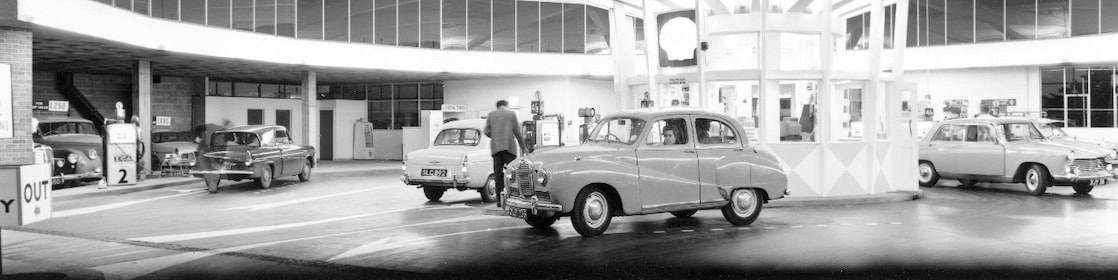
Shell's Journey: Pioneering Lubricants for the Transportation Revolution
Read Transcript
Read Transcript
Title: Shell's Journey: Pioneering Lubricants for the Transportation Revolution
Duration: 2:19
Description: The history of commercial transport going from horse and buggy to the modern big rig, intertwined with the history of Shell and its heavy-duty oil brands: Rotella and Rimula.
Transcript:
[Slow building Shell music]
[Graphic Display]
Shell pecten logo on a yellow background
[Video Footage]
Tight shot of a horse’s hooves as they are pulling a carriage. Shot pulls out to begin the timeline animation sequence.
[Animated Sequence]
2-D timeline animation featuring text and vintage footage of the first motor cars.
[Text Displays]
When the world changed the way it moved
1885: The first motor car appears
[Voiceover]
When the world changed the way it moved…
[Animated Sequence]
2-D timeline animation featuring text and an early image of a Shell Motor Spirit sign behind a horse drawn wagon.
[Text Displays]
We were there to help keep it moving
1891: The word “Shell’ becomes a trademark
[Voiceover]
We were there to help keep it moving.
[Shell music continues to build]
[Photo Display]
A vintage photograph of an early diesel truck.
[Text Displays]
1892: The first diesel truck is patented
[Animated Sequence]
2-D timeline animation continues across the screen with text and a photograph featuring the original Shell oyster
logo in the Trade Marks Journal.
[Text Displays]
1897: The Shell Transport and Trading company is established
[Voiceover]
Designing and innovating.
[Animated Sequence]
2-D timeline animation continues across the screen with text and a vintage photograph of a car winning a race.
[Text Displays]
Designing and Innovating
1905: The RAC Tourist Trophy - the first official victory for a Shell-powered car
[Shell music continues to build]
[Animated Sequence]
2-D timeline animation continues across the screen with text and a photo showing the evolution of the oyster shell
logo.
[Text Displays]
1907: The oyster shell first appears as a logo
[Voiceover]
Creating partnerships.
[Animated Sequence]
2-D timeline animation continues across the screen with text and a vintage photograph of a Shell service station.
[Text Displays]
1908: Shell begins making lubricants
[Shell music continues to build]
[Animated Sequence]
2-D timeline animation continues across the screen with text and vintage video of German military trucks driving
down a roadway.
[Text Displays]
1914-1918: The military start to use trucks extensively
[Voiceover]
And pushing boundaries.
[Photo Display]
A photograph featuring an early Alfa Romeo race car.
[Text Displays]
And pushing boundaries
1925: Grand Prix racing started
Alfa Romeo emerges victorious in partnership with Shell
[Shell music continues to build]
[Animated Sequence]
2-D timeline animation continues across the screen with text and a vintage photograph showcasing Shell’s
partnership with Ferrari. Enzo Ferrari is behind the wheel.
[Text Displays]
1929: A new partnership starts with Ferrari
[Voiceover]
Investing in R&D
[Animated Sequence]
2-D timeline animation continues across the screen with text and a vintage poster about the Richmond Trophy lap
record.
[Text Displays]
1933: Shell develops the first standardised tests for lubricants
[Animated Sequence]
2-D timeline animation continues across the screen with text and video footage of lithium-based greases.
[Text Displays]
1936: Lithium-based greases are invented by Shell
[Animated Sequence]
2-D timeline animation continues across the screen with text and a full-screen image featuring a Mercedes F1 car.
[Text Displays]
1938: A Mercedes F1 car driven for 1km on Shell fuel at an average of 268mph - a record that still stands
[Voiceover]
To create products that our customers needed.
[Animated Sequence]
2-D timeline animation continues across the screen with text and an image of a Shell advertisement for X-100 oil
featuring a recommendation by race driver Stirling Moss.
[Text Displays]
To create products that our customers needed
1960s: Shell X-100 10W-30: the first semi-synthetic fuel-saving engine oil
[Animated Sequence]
2-D timeline animation continues across the screen over film footage of a long-haul truck.
[Text Displays]
1975: Shell Rotella impresses Detroit Diesel with 300,000-mile test drive that produces less engine wear
[Animated Sequence]
2-D timeline animation continues across the screen with text and a photo of Rotella T multigrade oil can.
[Text Displays]
1976: Shell Rotella 15W-40 raises low-temperature performance and fuel economy
[Voiceover]
The world has kept on moving…
[Animated Sequence]
2-D timeline animation continues across the screen with text and a photo of a Shell Rimula Ultra oil can.
[Text Displays]
The world has kept on moving
1990’s: First to market with a low-SAPS HDEO
Shell Rimula Ultra 5W-30 demonstrates its fuel saving capability
[Voiceover]
…and we haven’t stopped
[Animated Sequence]
2-D timeline animation continues across the screen with text and another photo of Shell Rimula Signia engine oil
drum.
[Text Displays]
And we haven’t stopped
2004: First widely available low-SAPS HDEO, Shell Rimula Signia
[Voiceover]
Growing and developing
[Animated Sequence]
2-D timeline animation continues across the screen with text and a photo featuring Shell Rimula engine oil being
tested.
[Text Displays]
Growing and developing
2006: Shell Rotella Triple Protection & Shell Rimula Dynamic Protection are launched for improved engine
performance
[Animated Sequence]
2-D timeline animation continues across the screen with text and a photo of a Shell Rimula R6 LME sellsheet.
[Text Displays]
2008: A new world record in truck fuel efficiency is set at the Nardo test track using Shell Rimula R6 LME
[Voiceover]
To become a favoured partner
[Animated Sequence]
2-D timeline animation continues across the screen with text and video footage of Shell Eco-marathon racing crews
with their cars on a race track cheering.
[Text Displays]
To become a favoured partner
2009: French team sets Shell Eco-marathon record travelling 3,771km on 1 litre of fuel
[Voiceover]
Trusted by OEMS, drivers and mechanics
[Animated Sequence]
2-D timeline animation continues across the screen with text and video footage of a racing truck at the Dakar Rally
driving over a dirt ramp.
[Text Displays]
Trusted by OEMS, drivers and mechanics
2012: Shell partners with Iveco to win the Dakar Rally, racing on a 0W-20 grade engine oil
[Voiceover]
A leader in lubricants technology
[Animated Sequence]
2-D timeline animation continues across the screen with text and photograph of engine oil being poured out of a
bottle.
[Text Displays]
A leader in lubricants technology
2014: Shell patents gas-to-liquid technology
First to market premium lubricants made from natural gas in 100+ countries
[Voiceover]
Committed to improving how we move
[Animated Sequence]
2-D timeline animation continues across the screen with text and a photograph of electric heavy-duty trucks in a row.
[Text Displays]
Committed to improving how we move
2016: Electric heavy-duty truck concepts are unveiled
[Animated Sequence]
2-D timeline animation continues across the screen with text and a photograph of a heavy-duty truck driving on a
desert highway.
[Text Displays]
2016: Shell introduces sensors for real-time oil monitoring
Shell debuts engine oils formulated to meet API CK-4, FA-4 specifications
[Voiceover]
Now and in the future.
[Animated Sequence]
2-D timeline animation continues across the screen with text and video footage of a Shell Starship truck driving on a
road.
[Text Displays]
Now and in the future
2018: Shell Starship initiative begins
[Voiceover]
Constantly searching for new ways
[Animated Sequence]
2-D timeline animation continues across the screen with text and video footage of a lab worker experimenting.
[Text Displays]
Constantly searching for new ways
2019: Shell launches e-fluids range to optimise EV performance
[Voiceover]
To reduce fuel consumption
[Animated Sequence]
2-D timeline animation continues across the screen to reveal a full-screen graphic featuring text and a Shell Rimula
Oil drum.
[Text Displays]
To reduce fuel consumption,
2022: First 0W-20 HTHS 2.6 FFO
[Voiceover]
enhance reliability
[Animated Sequence]
2-D timeline animation continues to reveal a full-screen image of a man pouring Shell motor oil into an engine
through a funnel with text on the screen.
[Text Displays]
Enhance reliability
2023: #1 Global lubricants supplier for the 17th year in a row
[Voiceover]
and cut carbon emissions.
[Animated Sequence]
2-D timeline animation continues across to reveal a full-screen image of the Shell Starship truck with text on the
screen.
[Text Displays]
And cut carbon emissions
2023: Unveiling of Shell Starship 3.0 Natural Gas and Starship 3.0 Hybrid
[Voiceover]
So, we can keep the world moving towards better.
[Animated Sequence]
2-D timeline animation comes to an end and reveals an aerial image of a green landscape with roads and text on the
screen.
[Text Displays]
So, we can keep the world moving towards better
2050: Shell on track to become a net-zero emission energy business
[Shell music ends]
[Animated Sequence]
Shell pecten logo animates onto a yellow background
[Shell mnemonic]
Cautionary Note
Cautionary Note
The companies in which Shell plc directly and indirectly owns investments are separate legal entities. In this content “Shell”, “Shell Group” and “Group” are sometimes used for convenience to reference Shell plc and its subsidiaries in general. Likewise, the words “we”, “us” and “our” are also used to refer to Shell plc and its subsidiaries in general or to those who work for them. These terms are also used where no useful purpose is served by identifying the particular entity or entities. ‘‘Subsidiaries’’, “Shell subsidiaries” and “Shell companies” as used in this content refer to entities over which Shell plc either directly or indirectly has control. The terms “joint venture”, “joint operations”, “joint arrangements”, and “associates” may also be used to refer to a commercial arrangement in which Shell has a direct or indirect ownership interest with one or more parties. The term “Shell interest” is used for convenience to indicate the direct and/or indirect ownership interest held by Shell in an entity or unincorporated joint arrangement, after exclusion of all third-party interest.
Forward-Looking statements
This content contains forward-looking statements (within the meaning of the U.S. Private Securities Litigation Reform Act of 1995) concerning the financial condition, results of operations and businesses of Shell. All statements other than statements of historical fact are, or may be deemed to be, forward-looking statements. Forward-looking statements are statements of future expectations that are based on management’s current expectations and assumptions and involve known and unknown risks and uncertainties that could cause actual results, performance or events to differ materially from those expressed or implied in these statements. Forward-looking statements include, among other things, statements concerning the potential exposure of Shell to market risks and statements expressing management’s expectations, beliefs, estimates, forecasts, projections and assumptions. These forward-looking statements are identified by their use of terms and phrases such as “aim”; “ambition”; ‘‘anticipate’’; “aspire”, “aspiration”, ‘‘believe’’; “commit”; “commitment”; ‘‘could’’; “desire”; ‘‘estimate’’; ‘‘expect’’; ‘‘goals’’; ‘‘intend’’; ‘‘may’’; “milestones”; ‘‘objectives’’; ‘‘outlook’’; ‘‘plan’’; ‘‘probably’’; ‘‘project’’; ‘‘risks’’; “schedule”; ‘‘seek’’; ‘‘should’’; ‘‘target’’; “vision”; ‘‘will’’; “would” and similar terms and phrases. There are a number of factors that could affect the future operations of Shell and could cause those results to differ materially from those expressed in the forward-looking statements included in this content, including (without limitation): (a) price fluctuations in crude oil and natural gas; (b) changes in demand for Shell’s products; (c) currency fluctuations; (d) drilling and production results; (e) reserves estimates; (f) loss of market share and industry competition; (g) environmental and physical risks, including climate change; (h) risks associated with the identification of suitable potential acquisition properties and targets, and successful negotiation and completion of such transactions; (i) the risk of doing business in developing countries and countries subject to international sanctions; (j) legislative, judicial, fiscal and regulatory developments including tariffs and regulatory measures addressing climate change; (k) economic and financial market conditions in various countries and regions; (l) political risks, including the risks of expropriation and renegotiation of the terms of contracts with governmental entities, delays or advancements in the approval of projects and delays in the reimbursement for shared costs; (m) risks associated with the impact of pandemics, regional conflicts, such as the Russia-Ukraine war and the conflict in the Middle East, and a significant cyber security, data privacy or IT incident; (n) the pace of the energy transition; and (o) changes in trading conditions. No assurance is provided that future dividend payments will match or exceed previous dividend payments. All forward-looking statements contained in this content are expressly qualified in their entirety by the cautionary statements contained or referred to in this section. Readers should not place undue reliance on forward-looking statements. Additional risk factors that may affect future results are contained in Shell plc’s Form 20-F and amendment thereto for the year ended December 31, 2024 (available at www.shell.com/investors/news-and-filings/sec-filings.html and www.sec.gov). These risk factors also expressly qualify all forward-looking statements contained in this content and should be considered by the reader. Each forward-looking statement speaks only as of the date of this content. Neither Shell plc nor any of its subsidiaries undertake any obligation to publicly update or revise any forward-looking statement as a result of new information, future events or other information. In light of these risks, results could differ materially from those stated, implied or inferred from the forward-looking statements contained in this content.
Shell’s net carbon intensity
Also, in this content we may refer to Shell’s “net carbon intensity” (NCI), which includes Shell’s carbon emissions from the production of our energy products, our suppliers’ carbon emissions in supplying energy for that production and our customers’ carbon emissions associated with their use of the energy products we sell. Shell’s NCI also includes the emissions associated with the production and use of energy products produced by others which Shell purchases for resale. Shell only controls its own emissions. The use of the terms Shell’s “net carbon intensity” or NCI is for convenience only and not intended to suggest these emissions are those of Shell plc or its subsidiaries.
Shell’s net-zero emissions target
Shell’s operating plan and outlook are forecasted for a three-year period and ten-year period, respectively, and are updated every year. They reflect the current economic environment and what we can reasonably expect to see over the next three and ten years. Accordingly, the outlook reflects our Scope 1, Scope 2 and NCI targets over the next ten years. However, Shell’s operating plan and outlook cannot reflect our 2050 net-zero emissions target, as this target is outside our planning period. Such future operating plans and outlooks could include changes to our portfolio, efficiency improvements and the use of carbon capture and storage and carbon credits. In the future, as society moves towards net-zero emissions, we expect Shell’s operating plans and outlooks to reflect this movement. However, if society is not net zero in 2050, as of today, there would be significant risk that Shell may not meet this target.
Forward-Looking non-GAAP measures
This content may contain certain forward-looking non-GAAP measures such as adjusted earnings and divestments. We are unable to provide a reconciliation of these forward-looking non-GAAP measures to the most comparable GAAP financial measures because certain information needed to reconcile those non-GAAP measures to the most comparable GAAP financial measures is dependent on future events some of which are outside the control of Shell, such as oil and gas prices, interest rates and exchange rates. Moreover, estimating such GAAP measures with the required precision necessary to provide a meaningful reconciliation is extremely difficult and could not be accomplished without unreasonable effort. Non-GAAP measures in respect of future periods which cannot be reconciled to the most comparable GAAP financial measure are calculated in a manner which is consistent with the accounting policies applied in Shell plc’s consolidated financial statements.
The contents of websites referred to in this content do not form part of this content.
We may have used certain terms, such as resources, in this content that the United States Securities and Exchange Commission (SEC) strictly prohibits us from including in our filings with the SEC. Investors are urged to consider closely the disclosure in our Form 20-F and any amendment thereto, File No 1-32575, available on the SEC website www.sec.gov.


