
Reducing methane emissions
Shell uses technologies and operational practices to monitor and manage methane emissions and participates in industry initiatives to share best practices.
What is methane?
Methane (CH4) is the primary component of natural gas. Natural gas plays a critical role in the global energy transition, and can help reduce carbon dioxide (CO2) emissions when it replaces coal in power generation and industry, and oil in transport.
However, methane itself is a potent greenhouse gas. While it stays in the atmosphere for a shorter time than CO2, it traps far more heat. The Intergovernmental Panel on Climate Change (IPCC) estimates methane’s global warming potential is 30 times greater than CO2 over 100 years and more than 80 times greater over 20 years.
Many organisations, including the IPCC, identify methane emissions reduction as an important way of limiting additional warming.

Where do methane emissions come from?
Around 60% of global methane emissions come from human activities such as agriculture, oil and gas production, and landfill waste decomposition, according to the latest Global Methane Budget, while the remaining 40% occur naturally, mainly from wetlands.
The main sources of methane emissions from oil and gas operations are:
Venting
The intentional release of gas into the atmosphere, often necessary for safety or maintenance. It can also occur routinely from devices such as pneumatic controllers or storage tanks that are designed to vent gas.
Incomplete flaring
Flaring occurs when gas that cannot be used or sold is burned to convert it into CO₂ and water. If some of this gas is not fully combusted, it can escape into the atmosphere as methane.
Combustion equipment
Gas-fired equipment, such as engines and turbines, that are used to produce energy may contain small amounts of methane slip in their exhaust due to incomplete combustion.
Fugitive emissions
Unintentional leaks of gas from equipment such as faulty seals, leaking valves, or improperly sealed components. They can occur across production and processing equipment, storage tanks, and pipelines.
Between 2016 and 2025, reported methane emissions from assets under Shell operational control decreased from 138,000 tonnes to 31,000 tonnes, a reduction of 78%.
In January 2025, we eliminated routine gas flaring from our Upstream operated assets – five years ahead of the World Bank’s Zero Routine Flaring by 2030 initiative, of which we are a signatory.
How is Shell reducing methane emissions?
Transparent and enhanced reporting
Robust measurements provide actionable insights to reduce methane emissions where it matters most. As a founding signatory of the Oil and Gas Methane Partnership (OGMP) 2.0 framework – which requires signatory companies to report methane emissions for both operated and non-operated ventures that contribute to the top 95% of their total emissions – Shell is committed to enhanced accuracy and transparency on methane emissions.
We use advanced measurement technologies to quantify methane emissions more precisely and strengthen the quality of our reporting, which earned Shell the OGMP 2.0 Gold Standard in both 2023 and 2024.
Our methane emissions measurement and reduction initiatives also deliver wider benefits, including lower operating costs, improved equipment performance, and reduced safety risks.

Turning data into action
Insights from our OGMP 2.0 measurement programme help us identify and prioritise detected sources of methane emissions. These include:
- Enhancing leak management: Identifying equipment most prone to leaks, engineering them out of future processes, and prioritising their monitoring in leak‑detection programmes to enable repairs.
- Improving flaring efficiency: Replacing worn flare tips to improve combustion efficiency and maintain optimal performance.
- Strengthening operational controls: Maintaining our equipment for peak performance, keeping flares continuously lit, and managing maintenance to minimise methane flaring and venting.
- Addressing intermittent sources: Deploying drones to detect leaks and emissions from areas such as produced water ponds, relief valves, and vents, enabling teams to target inspections and repairs.
Methane abatement technologies
We use a range of technologies and work practices to detect, monitor, measure, and reduce methane emissions across our operations. These include:
Leak detection and repair (LDAR)
We use optical gas imaging (OGI) cameras, which visually detect methane releases, and high-flow samplers, which measure flow rate and methane concentration, to identify and quantify leaks, enabling targeted repairs.
Continuous monitoring
We are testing networks of fixed-point and long-range beam sensors that provide continuous, wide‑area monitoring of methane emissions. These systems help us track intermittent releases and give early warning of leaks.
Python Emission Localisation and Quantification (pyELQ)
Our open‑source AI tool uses methane concentration and wind data to detect, locate, and quantify emissions. We work with technology partners to integrate pyELQ into emerging continuous monitoring solutions.
Drone and aircraft surveys
We use drones, manned aircraft, and mobile labs to measure emissions across entire sites, including remote and offshore locations.
Satellite monitoring
We use data from public and commercial satellites to identify large methane releases worldwide. The data is used to support OGMP 2.0 reporting and to inform mitigation and investment strategies.
Shell methane reduction initiatives
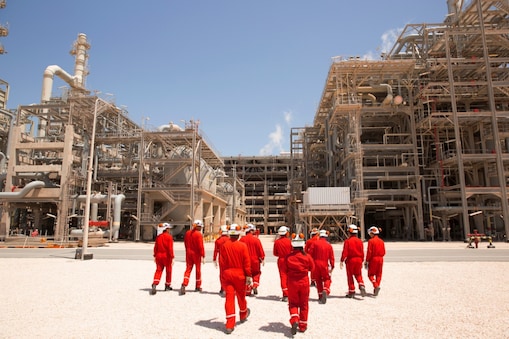
Pearl GTL
Pearl GTL, Shell’s gas-to-liquids plant in Qatar, converts natural gas into high-quality liquid fuels, lubricants, and chemical feedstocks – a process that requires significant energy and can generate emissions. To address this, Pearl launched a multi-year flaring reduction programme. The team upgraded catalysts at the plant for more efficient chemical reactions, improved reactor start-up and shutdown procedures to minimise flaring, and replaced natural gas with nitrogen for purging of the flare system. They also introduced real-time monitoring so operators can respond quickly to emerging issues and implemented direct leak detection and repair (LDAR) to identify and quantify leaks. By 2025, flaring had decreased by 87% compared to 2015, and methane emissions had fallen by 99% over the same period.2
Industry collaboration
We believe collaboration is key to reducing methane emissions across the industry. Shell works with governments, industry, and civil society to share best practices and inform effective policies through initiatives such as OGMP 2.0 (see above) and:
Oil and Gas Climate Initiative (OGCI)
Oil and Gas Decarbonisation Charter (OGDC)
The World Bank Global Flaring and Methane Reduction (GFMR) Partnership
Footnotes
Footnotes
1. Methane intensity is measured separately for oil and gas assets with marketed gas (gas, LNG and GTL available for sale) and assets without marketed gas (oil and gas assets where gas is reinjected).
2. Based on the methane reporting guideline at OGMP level 3.
3. BC Hydro states that tThe vast majority of BC Hydro’sits power is generated is through hydroelectric facilities, along with a small portion from other clean sources like wind, solar and biomass.
Cautionary note
Cautionary note
The companies in which Shell plc directly and indirectly owns investments are separate legal entities. In this content “Shell”, “Shell Group” and “Group” are sometimes used for convenience to reference Shell plc and its subsidiaries in general. Likewise, the words “we”, “us” and “our” are also used to refer to Shell plc and its subsidiaries in general or to those who work for them. These terms are also used where no useful purpose is served by identifying the particular entity or entities. ‘‘Subsidiaries’’, “Shell subsidiaries” and “Shell companies” as used in this content refer to entities over which Shell plc either directly or indirectly has control. The terms “joint venture”, “joint operations”, “joint arrangements”, and “associates” may also be used to refer to a commercial arrangement in which Shell has a direct or indirect ownership interest with one or more parties. The term “Shell interest” is used for convenience to indicate the direct and/or indirect ownership interest held by Shell in an entity or unincorporated joint arrangement, after exclusion of all third-party interest.
Forward-Looking statements
This content contains forward-looking statements (within the meaning of the U.S. Private Securities Litigation Reform Act of 1995) concerning the financial condition, results of operations and businesses of Shell. All statements other than statements of historical fact are, or may be deemed to be, forward-looking statements. Forward-looking statements are statements of future expectations that are based on management’s current expectations and assumptions, including (without limitation) those concerning Shell’s strategy and operating plans, macroeconomic conditions, future energy demand, supply and product mix, commodity prices, demand for Shell’s products, production results and reserve estimates, development, execution and management of projects, energy transition and climate change, management of safety and environmental risks, costs, cash capital expenditures, technology advancements, legislative, judicial, fiscal and regulatory developments, regional conflicts and trading conditions, [NM1] and involve known and unknown risks and uncertainties that could cause actual results, performance or events to differ materially from those expressed or implied in these statements. Forward-looking statements include, among other things, statements concerning the potential exposure of Shell to market risks and statements expressing management’s expectations, beliefs, estimates, forecasts, projections and assumptions. These forward-looking statements are identified by their use of terms and phrases such as “aim”; “ambition”; ‘‘anticipate’’; “aspire”, “aspiration”, ‘‘believe’’; “commit”; “commitment”; ‘‘could’’; “desire”; ‘‘estimate’’; ‘‘expect’’; ‘‘goals’’; ‘‘intend’’; ‘‘may’’; “milestones”; ‘‘objectives’’; ‘‘outlook’’; ‘‘plan’’; ‘‘probably’’; ‘‘project’’; ‘‘risks’’; “schedule”; ‘‘seek’’; ‘‘should’’; ‘‘target’’; “vision”; ‘‘will’’; “would” and similar terms and phrases. There are a number of factors that could affect the future operations of Shell and could cause those results to differ materially from those expressed in the forward-looking statements included in this content, including (without limitation): (a) price fluctuations in crude oil and natural gas; (b) changes in demand for Shell’s products; (c) currency fluctuations; (d) drilling and production results; (e) reserves estimates; (f) loss of market share and industry competition; (g) environmental and physical risks, including climate change; (h) risks associated with the identification of suitable potential acquisition properties and targets, and successful negotiation and completion of such transactions; (i) the risk of doing business in developing countries and countries subject to international sanctions; (j) legislative, judicial, fiscal and regulatory developments including tariffs and regulatory measures addressing climate change; (k) economic and financial market conditions in various countries and regions; (l) political risks, including the risks of expropriation and renegotiation of the terms of contracts with governmental entities, delays or advancements in the approval of projects and delays in the reimbursement for shared costs; (m) risks associated with the impact of pandemics, regional conflicts, such as the Russia-Ukraine war and the conflict in the Middle East, and a significant cyber security, data privacy or IT incident; (n) the pace of the energy transition; and (o) changes in trading conditions. No assurance is provided that future dividend payments will match or exceed previous dividend payments. All forward-looking statements contained in this content are expressly qualified in their entirety by the cautionary statements contained or referred to in this section. Readers should not place undue reliance on forward-looking statements. Additional risk factors that may affect future results are contained in Shell plc’s Form 20-F for the year ended December 31, 2025 (available at www.shell.com/investors/news-and-filings/sec-filings.html and www.sec.gov). These risk factors also expressly qualify all forward-looking statements contained in this content and should be considered by the reader. Each forward-looking statement speaks only as of the date of this content, September 27, 2026. Neither Shell plc nor any of its subsidiaries undertake any obligation to publicly update or revise any forward-looking statement as a result of new information, future events or other information. In light of these risks, results could differ materially from those stated, implied or inferred from the forward-looking statements contained in this content.
Shell’s net carbon intensity and net-zero emissions target
In this content we may refer to Shell’s “net carbon intensity” (NCI), which includes Shell’s carbon emissions from the production of our energy products, our suppliers’ carbon emissions in supplying energy for that production and our customers’ carbon emissions associated with their use of the energy products we sell. Shell’s NCI also includes the emissions associated with the production and use of energy products produced by others which Shell purchases for resale. Shell only controls its own emissions. The use of the terms Shell’s “net carbon intensity” or NCI is for convenience only and not intended to suggest these emissions are those of Shell plc or its subsidiaries.
Shell’s operating plan and outlook are forecasted for a three-year period and ten-year period, respectively, and are updated every year. They reflect the current economic environment and what we can reasonably expect to see over the next three and ten years. Accordingly, the outlook reflects our combined Scope 1 and 2 target, NCI target and our oil products ambition over the next ten years. However, Shell’s operating plan and outlook cannot reflect our 2050 net-zero emissions target, as this target is outside our planning period. Such future operating plans and outlooks could include changes to our portfolio, efficiency improvements and the use of carbon capture and storage and carbon credits. In the future, as society moves towards net-zero emissions, we expect Shell’s operating plans and outlooks to reflect this movement. However, if society is not net zero in 2050, as of today, there would be significant risk that Shell may not meet this target.
The information provided above regarding Shell’s NCI and net zero emissions target are not intended, nor should they be construed as introducing, suggesting or making any claim, target or representation thereof other than what is included in the content.
Forward-Looking non-GAAP measures
This content may contain certain forward-looking non-GAAP measures such as free cash flow and underlying operating expenses. We are unable to provide a reconciliation of these forward-looking non-GAAP measures to the most comparable GAAP financial measures because certain information needed to reconcile those non-GAAP measures to the most comparable GAAP financial measures is dependent on future events some of which are outside the control of Shell, such as oil and gas prices, interest rates and exchange rates. Moreover, estimating such GAAP measures with the required precision necessary to provide a meaningful reconciliation is extremely difficult and could not be accomplished without unreasonable effort. Non-GAAP measures in respect of future periods which cannot be reconciled to the most comparable GAAP financial measure are calculated in a manner which is consistent with the accounting policies applied in Shell plc’s consolidated financial statements. These forward-looking non-GAAP measures are provided to assist readers in understanding management’s use and expectations of such measures and may not be appropriate for other purposes.
The contents of websites referred to in this content do not form part of this content .
We may have used certain terms, such as resources, in this content that the United States Securities and Exchange Commission (SEC) strictly prohibits us from including in our filings with the SEC. Investors are urged to consider closely the disclosure in our Form 20-F, File No 1-32575, available on the SEC website www.sec.gov.

