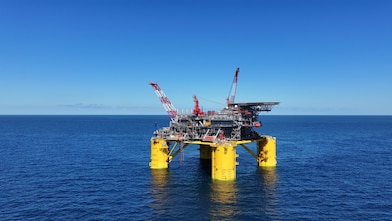
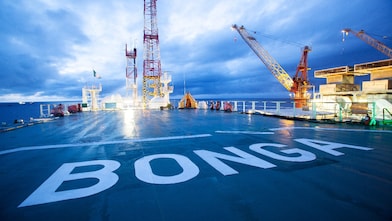
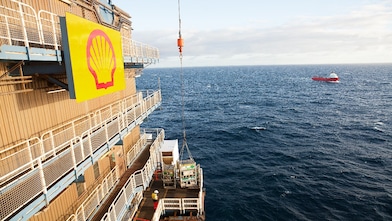
Penguins: Next generation platform starts production in the UK North Sea
More compact and efficient than its predecessor, Penguins will deliver secure energy from one of the North Sea’s most iconic oil and gas fields.
February 4, 2025
Read time: 2 mins
An engineering marvel reduces costs and emissions
The new floating production, storage and offloading (FPSO) vessel is one of the most technologically advanced platforms operated by Shell in the North Sea.
Video transcript
Video transcript
Title: Penguins│ A new era in the North Sea
Duration: 4:30 minutes
Description:
Introducing the new FPSO in the Penguins field in the UK North Sea.
[Background music plays]
Various instrumental adaptations of The Sound of Shell play through each segment, at times with a more ambient mood, at times more upbeat and rhythmic, and at other times building to dramatic crescendos at relevant moments.
Video footage
At sunrise, the Penguins FPSO, a massive floating production vessel, is towed through a Norwegian harbour, its dark form gliding across the misty waters as tugboats guide it forward. As the day unfolds, aerial views reveal the FPSO against an expanse of deep blue water.
Opening highlights
Kevin Lutton
This is the first new Shell-operated oil and gas platform in the North Sea in over 20 years.
Video footage
Aerial views of the Penguins FPSO tow transition to close-up footage of Kevin Lutton, who speaks directly into the camera.
Voiceover
This is Penguins, a state-of-the-art FPSO that will produce oil and gas in a more efficient way.
Video footage
The scene shifts back to the Penguins FPSO, gliding through shimmering waters as tugboats guide its steady journey.
Voiceover
As the iconic Brent field’s final platform is decommissioned, the next generation Shell facility is primed and ready for action.
Video footage
The scene transitions to the Brent Charlie topside being towed into port, followed by a view of workers from behind, gazing up at the towering underside of the decommissioned platform. A quick cut takes us to aerial shots of the Penguins FPSO in the shipyard.
Simon Roddy
This marks a new era for production in the North Sea.
Video footage
A close-up shows Simon Roddy speaking, his gaze slightly off-camera as he addresses the unseen interviewer. The scene then transitions to sweeping drone shots of the Penguins FPSO in the shipyard and during sail-away.
Perran Horrell
Yeah, I mean, we’re at a super exciting stage of the project now.
Video footage
A close-up shows Perran Horrell speaking, his gaze slightly off-camera as he addresses the unseen interviewer.
[Text displays]
Penguins FPSO
A New Era in the North Sea
Video footage
Drone shots capture the Penguins FPSO sailing away from the shipyard, flanked by tugboats. Title text appears at the centre of the frame. The screen fades to black.
Introduction to Penguins Field, history and FPSO construction
Voiceover
The Penguins field is located in the UK North Sea…
Video footage
The scene opens on archival footage of the North Sea’s stormy waters and of the Brent field, where its line of four platforms stand silhouetted against the distant horizon.
Voiceover
Roughly 150 miles northeast of the Shetland Isles. It had been producing oil and gas since 2003, and this was always fed through…
[Text displays]
Aberdeen – St Fergus – Shetland Isles – North Sea – Brent Charlie – Penguins
[Graphic]
A map graphic appears, highlighting a green route that begins at St. Fergus, Aberdeen, and extends past the Shetland Isles and across the North Sea. As it reaches Brent Charlie, the line shifts to a red, dashed path, continuing toward the Penguins location. The graphic zooms in, centring on the red, dashed path as it extends between Brent Charlie and Penguins.
Voiceover
The Brent Charlie platform.
Video footage
Archival aerial view of the deepwater Brent Charlie platform.
Interview with Kevin Lutton
[Title]
General Manager, Penguins
Kevin Lutton
But when Brent Charlie ceased production in 2021…
[Text displays]
Kevin Lutton
General Manager, Penguins
Video footage
A close-up shows Kevin Lutton speaking directly into the camera. His name strap appears in the lower-left corner of the frame.
Kevin Lutton
So did the Penguins field, until now.
Video footage
A panning drone shot captures Brent Charlie offshore, showcasing its massive structure against the open sea. The scene then returns to a close-up of Kevin Lutton speaking directly to the camera.
Split-screen footage
The frame splits into three screens which are inset against a white background, each displaying a different stage of the Penguins FPSO construction in China. On the left, the FPSO takes shape in the shipyard. In the upper right, it is seen at sail-away. In the lower right, the Chinese team stands gathered around a to-scale model of the vessel.
Kevin Lutton
The new Penguins FPSO is an engineering marvel. It’s taken over seven years to get it from its initial design through to being fully operational.
Video footage
A time-lapse sequence captures the Penguins FPSO construction in the Chinese shipyard, showing the vessel gradually taking shape over an extended period.
Voiceover
Penguins got the go-ahead in 2018, and from there, it’s taken thousands of people to get it fully built.
Video footage
The time-lapse continues, showing the construction progress in China, before cutting to workers unfurling mooring lines. Another time-lapse follows, capturing the tow away from the shipyard. The scene then shifts to the Norway sail-away, where shipyard workers, seen from behind, wave farewell as the Penguins FPSO departs.
Voiceover
The 32,000-tonne facility is a monumental structure.
Video footage
A series of drone shots from the Norway sail-away captures the massive Penguins FPSO being towed, its towering structure gliding steadily over the shimmering water.
Interview with Perran Horrell
[Title]
Penguins Project Director
Perran Horrell
It's 117 metres from the bottom of the keel all the way up to the top of the flare stack.
Video footage
Another drone shot captures the Penguins FPSO sail-away.
Perran Horrell
It's got 800,000 metres of cabling. It's got 34,000 metres of piping.
[Text displays]
Perran Horrell
Penguins Project Director
Video footage
A close-up shows Perran Horrell speaking directly into the camera, with his name strap appearing in the lower-left corner of the frame. The scene then transitions to more sail-away footage, highlighting the Penguins FPSO against the backdrop of deep blue seas..
Voiceover
And its unique shape is designed to withstand the North Sea’s harsh environment.
Video footage
A drone sequence captures an aerial view of the FPSO at sail-away, its massive form moving across the open water, the sun reflecting off the glistening sea surface.
Perran Horrell
The FPSO itself is a cylindrical design…
Video footage
A close-up shows Perran Horrell speaking directly into the camera.
Perran Horrell
Which means that it doesn't weather-vane round like a normal ship shaped FPSO, so it's the same in whichever direction those harsh conditions hit it.
Split-screen footage
The frame splits into two side-by-side insets against a white background. Initially, on the left, panning drone footage captures the FPSO sailing away from Norway, and on the right, a close-up shows Perran Horrell speaking, his gaze slightly off-camera. Both insets transition to aerial views of the platform, first drifting over calm waters, then set against a backdrop of stormy seas, waves churning beneath its massive structure.
Perran Horrell
And it is really, really safe in that northern North Sea environment.
Video footage
A view from the bridge reveals churning waves through the windows, the North Sea heaving and rolling as the vessel moves forward.
Voiceover
And to reduce footfall, the design team have equipped the platform with some cutting-edge technology.
Video footage
The scene transitions to a helicopter resting on the helipad as staff step out, the rotor blades still slowly spinning. They walk along a platform corridor, their movements purposeful. Next, the interior of the onshore HoloLens office comes into view, its walls lined with massive screens. Cameras are mounted above, capturing every detail. The screens display real-time footage from the offshore platform, while data and graphics fill other displays. A team member gestures toward the real-time footage on the screen. The scene then cuts to a close-up of the wall-mounted camera, its lens focused intently on the workspace.
Interview with Kevin Lutton continued
Kevin Lutton
We have a new onboard technology called HoloLens, which allows us to reduce our footprint of personnel offshore on the platform whilst maintaining the highest level of safety.
Video footage
We see footage of an offshore team member putting on his HoloLens headset. We cut to footage of the screens in the onshore office showing real-time footage of what the offshore person is seeing.
Split-screen footage
The frame splits into three screens inset against a white background. Each screen alternates between showing footage of the onshore HoloLens office with personnel, or offshore platform footage and personnel, with the views changing dynamically within each inset.
Jamie Jack
What we can see in that view is the verification of the data between the digital twin, and we can see the oil circulation unit there as well.
Video footage
Once again, footage from the onshore HoloLens office shows Jamie Jack pointing to the real-time offshore footage on a screen as he speaks. A brief cutaway shows footage of an offshore team member wearing the HoloLens as he works on a piece of equipment.
Interview with Kevin Lutton continued
Kevin Lutton
HoloLens is a fantastic tool. It’s a great piece of digital technology that’s a gamechanger for our business.
Video footage
Once again, we see the offshore team member wearing the HoloLens, working on equipment. The scene then returns to the onshore HoloLens office, where Kevin, seen from behind, watches the real-time offshore footage on the massive wall-mounted display. Finally, the shot cuts to a close-up of Kevin as he speaks, his gaze slightly off-camera..
Penguins’ Performance
Voiceover
When fully up and running and at its peak, Penguins will produce enough gas to heat around 700,000 UK homes every year…
Video footage
A series of drone shots captures Penguins at sail-away, its massive form gliding smoothly through the calm, deep blue waters.
Voiceover
But with a lower carbon footprint than previous platforms.
Split-screen footage
The frame splits into three screens inset against a white background. On the right, Penguins continues its sail-away, moving through the calm waters. In the upper-left, a residential street appears, lined with houses and parked cars. In the lower-left, the scene transitions to a close-up of a gas burner on a stove.
Interview with Renata Halim
[Title]
Facility HSE Lead
Renata Halim
The Penguins facility will operate with over 30% fewer emissions than the Brent Charlie platform.
[Text displays]
Renata Halim
Facility HSE Lead
Video footage
A close-up shows Renata Halim speaking directly into the camera. The scene then transitions to aerial footage of Penguins at sail-away, highlighting the massive topside as it moves through the open water.
Voiceover
And to maximise potential, Penguins aims to have less than 10% downtime every year.
Video footage
We continue with various views of Penguins’ sail-away, its towering form gliding through the glistening blue water under clear blue skies.
Interview with Bill Bryson
[Title]
Penguins Manager
Bill Bryson
The way that we're going to achieve these extremely high reliability targets is with our onshore and offshore teams, who are constantly surveying the performance of all of the equipment on Penguins, 24 hours a day, seven days a week.
[Text displays]
Bill Bryson
Penguins Manager
Video footage
A close-up shows Bill Bryson speaking directly into the camera, with his name strap appearing in the lower-left corner of the frame. The scene then switches between various footage of offshore and onshore teams, engaged in team meetings or surveying real-time footage and equipment. A close-up shows a team member typing purposefully on a keyboard, while a profile shot captures his focused concentration on the screen.
Bill Bryson
Have the auxiliaries been running on that compressor?
Offshore team member
Yes, they have [inaudible].
Video footage
A series of shots shows Bill and Jamie in the HoloLens office, observing real-time footage of offshore equipment on the screens. Bill speaks to an offshore team member, and we hear the team member’s response over the audio.
Interview with Sam Garrett
[Title]
Production Surveillance Engineer
Sam Garrett
We’ve got real-time data from all of the process conditions, everything from valve positions to pressures, temperatures, finding equipment performance problems early, when they’re small, so we can react quickly and deliver the best outcomes.
[Text displays]
Sam Garrett
Production Surveillance Engineer
Video footage
A close-up shows Sam Garrett speaking directly into the camera, with his name strap appearing in the lower-left corner of the frame. The scene transitions to footage of team members at work in the onshore HoloLens office, with multiple screens displaying masses of data, graphics and real-time footage. More footage shows a team meeting around a large boardroom table. The scene then returns to a close-up of Sam speaking to the camera.
Jamie Jack
And that’s spot on, just like that.
Video footage
Once again, footage from the onshore HoloLens office shows Jamie Jack pointing to the real-time offshore footage on a screen as he speaks. A low-angle shot captures the Penguins FPSO signboard mounted atop the topside, towering above the structure against the backdrop of a night sky.
Penguins’ People - Interview with Kevin Lutton continued
Kevin Lutton
We plan for this to be one of the best performing offshore installations in the world, so we need the best people.
Video footage
More aerial and side-view drone footage showcases Penguins’ massive structure, gracefully sailing away against the glistening ocean surface, the sunlight reflecting off the calm water. A close-up shows Kevin Lutton speaking directly into the camera. Close-up footage captures two smiling offshore team members aboard Penguins, as they approach the camera and pass by, their expressions reflecting the energy of the moment
Interview with Simon Roddy
[Title]
Senior Vice President, Shell UK Upstream
Simon Roddy
Thousands of people have been involved in Penguin's journey to date…
[Text displays]
Simon Roddy
Senior Vice President, Shell UK Upstream
Video footage and Split-screen footage
A close-up shows Simon Roddy speaking directly into the camera, with his name strap appearing in the lower-left corner of the frame.
Simon Roddy
From construction in China, through to commissioning in Norway…
Split-screen footage
The frame splits into three screens inset against a white background, with one on the right and two on the left. All three screens initially display miscellaneous footage from the Chinese construction, before transitioning to footage of the commissioning and sail-away in Norway.
Simon Roddy
And now to a location in the UK.
Video footage
Panning footage reveals onshore team members, seen from behind, at workstations in the office, their attention fixed on multiple mounted screens. The scene transitions to a sweeping shot of the FPSO out in calm seas, the sun setting on the horizon. Golden light casts a trail across the smooth ocean surface, creating a tranquil, breathtaking view.
Simon Roddy
We have a world-class supply chain. Thank you to everyone involved…
Split-screen footage
The frame splits into two side-by-side insets against a white background. On the right, close-up footage shows Simon Roddy speaking, his gaze slightly off-camera. On the left, a series of close-ups features individuals, each symbolising the numerous team members involved in the project.
Simon Roddy
And especially to my Shell colleagues.
[Graphic]
Inset against a white background, we see a still shot of a posed Shell team, fully outfitted in Shell-branded suits and complete safety gear.
Video footage
We end on a wide, panoramic shot of the FPSO in the North Sea, surrounded by calmly rippling waters beneath a wispy, cloudy sky, capturing the serene and vast expanse of the environment. This final shot transitions out of frame in the shape of a contracting Pecten, gradually giving way to a clean white background.
[Audio]
Shell brand mnemonic played on keys
[Text displays]
#PoweringProgress
© Shell International Limited 2025
[Animated sequence]
The small iconic red-and-yellow Pecten transitions in, positioning itself at the centre of the frame against a white background. Text then appears below the Pecten, as well as spanning across the lower part of the frame.
Penguins in numbers
45,000
barrels of oil equivalent a day expected peak production.
700,000
UK homes could be heated for a year with the gas that Penguins will produce when fully up and running.
30%
lower operational emissions compared with its predecessor Brent Charlie.
Providing the energy the world needs today
The Penguins FPSO will contribute towards Shell's commitment to bring on line projects with a total peak production of more than 500,000 barrels of oil equivalent a day from 2023 through 2025.
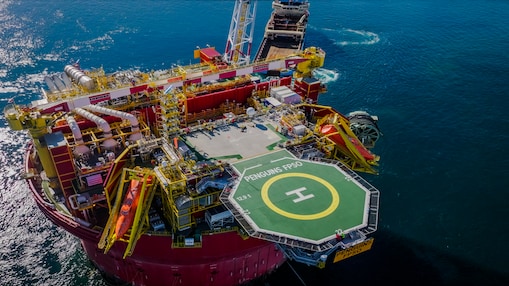
Zoom in on Penguins
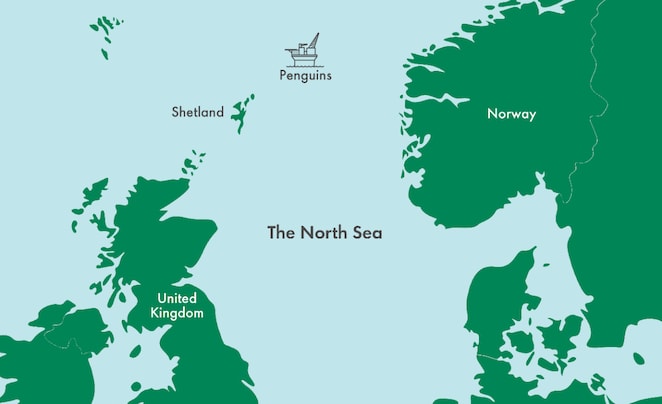
- Penguins is the first, new Shell-operated facility in the UK North Sea for over 20 years. It will be a source of secure domestic energy production, keeping homes and businesses running in the UK and beyond.
- The Penguins field lies beneath 165 metres (541 feet) of water, around 241 kilometres (150 miles) north-east of the Shetland Islands.
- Natural gas produced by Penguins will be exported through the existing pipeline to the St Fergus terminal in north-east Scotland. Oil will be transported by tankers to refineries outside of the UK.
Cautionary note
Cautionary note
The companies in which Shell plc directly and indirectly owns investments are separate legal entities. In this media release “Shell”, “Shell Group” and “Group” are sometimes used for convenience where references are made to Shell plc and its subsidiaries in general. Likewise, the words “we”, “us” and “our” are also used to refer to Shell plc and its subsidiaries in general or to those who work for them. These terms are also used where no useful purpose is served by identifying the particular entity or entities. ‘‘Subsidiaries’’, “Shell subsidiaries” and “Shell companies” as used in this media release refer to entities over which Shell plc either directly or indirectly has control. The term “joint venture”, “joint operations”, “joint arrangements”, and “associates” may also be used to refer to a commercial arrangement in which Shell has a direct or indirect ownership interest with one or more parties. The term “Shell interest” is used for convenience to indicate the direct and/or indirect ownership interest held by Shell in an entity or unincorporated joint arrangement, after exclusion of all third-party interest.
Forward-looking Statements
This media release contains forward-looking statements (within the meaning of the U.S. Private Securities Litigation Reform Act of 1995) concerning the financial condition, results of operations and businesses of Shell. All statements other than statements of historical fact are, or may be deemed to be, forward-looking statements. Forward-looking statements are statements of future expectations that are based on management’s current expectations and assumptions and involve known and unknown risks and uncertainties that could cause actual results, performance or events to differ materially from those expressed or implied in these statements. Forward-looking statements include, among other things, statements concerning the potential exposure of Shell to market risks and statements expressing management’s expectations, beliefs, estimates, forecasts, projections and assumptions. These forward-looking statements are identified by their use of terms and phrases such as “aim”; “ambition”; ‘‘anticipate’’; ‘‘believe’’; “commit”; “commitment”; ‘‘could’’; ‘‘estimate’’; ‘‘expect’’; ‘‘goals’’; ‘‘intend’’; ‘‘may’’; “milestones”; ‘‘objectives’’; ‘‘outlook’’; ‘‘plan’’; ‘‘probably’’; ‘‘project’’; ‘‘risks’’; “schedule”; ‘‘seek’’; ‘‘should’’; ‘‘target’’; ‘‘will’’; “would” and similar terms and phrases. There are a number of factors that could affect the future operations of Shell and could cause those results to differ materially from those expressed in the forward-looking statements included in this media release, including (without limitation): (a) price fluctuations in crude oil and natural gas; (b) changes in demand for Shell’s products; (c) currency fluctuations; (d) drilling and production results; (e) reserves estimates; (f) loss of market share and industry competition; (g) environmental and physical risks; (h) risks associated with the identification of suitable potential acquisition properties and targets, and successful negotiation and completion of such transactions; (i) the risk of doing business in developing countries and countries subject to international sanctions; (j) legislative, judicial, fiscal and regulatory developments including regulatory measures addressing climate change; (k) economic and financial market conditions in various countries and regions; (l) political risks, including the risks of expropriation and renegotiation of the terms of contracts with governmental entities, delays or advancements in the approval of projects and delays in the reimbursement for shared costs; (m) risks associated with the impact of pandemics, such as the COVID-19 (coronavirus) outbreak, regional conflicts, such as the Russia-Ukraine war, and a significant cybersecurity breach; and (n) changes in trading conditions. No assurance is provided that future dividend payments will match or exceed previous dividend payments. All forward-looking statements contained in this media release are expressly qualified in their entirety by the cautionary statements contained or referred to in this section. Readers should not place undue reliance on forward-looking statements. Additional risk factors that may affect future results are contained in Shell plc’s Form 20-F for the year ended December 31, 2023 (available at www.shell.com/investors/news-and-filings/sec-filings.html and www.sec.gov). These risk factors also expressly qualify all forward-looking statements contained in this media release and should be considered by the reader. Each forward-looking statement speaks only as of the date of this web page, 4 February 2025. Neither Shell plc nor any of its subsidiaries undertake any obligation to publicly update or revise any forward-looking statement as a result of new information, future events or other information. In light of these risks, results could differ materially from those stated, implied or inferred from the forward-looking statements contained in this media release.
Shell’s Net Carbon Intensity
Also, in this media release we may refer to Shell’s “Net Carbon Intensity” (NCI), which includes Shell’s carbon emissions from the production of our energy products, our suppliers’ carbon emissions in supplying energy for that production and our customers’ carbon emissions associated with their use of the energy products we sell. Shell’s NCI also includes the emissions associated with the production and use of energy products produced by others which Shell purchases for resale. Shell only controls its own emissions. The use of the terms Shell’s “Net Carbon Intensity” or NCI are for convenience only and not intended to suggest these emissions are those of Shell plc or its subsidiaries.
Shell’s net-zero emissions target
Shell’s operating plan, outlook and budgets are forecasted for a ten-year period and are updated every year. They reflect the current economic environment and what we can reasonably expect to see over the next ten years. Accordingly, they reflect our Scope 1, Scope 2 and NCI targets over the next ten years. However, Shell’s operating plans cannot reflect our 2050 net-zero emissions target, as this target is currently outside our planning period. In the future, as society moves towards net-zero emissions, we expect Shell’s operating plans to reflect this movement. However, if society is not net zero in 2050, as of today, there would be significant risk that Shell may not meet this target.
Forward-looking non-GAAP measures
This media release may contain certain forward-looking non-GAAP measures such as cash capital expenditure. We are unable to provide a reconciliation of these forward-looking non-GAAP measures to the most comparable GAAP financial measures because certain information needed to reconcile those non-GAAP measures to the most comparable GAAP financial measures is dependent on future events some of which are outside the control of Shell, such as oil and gas prices, interest rates and exchange rates. Moreover, estimating such GAAP measures with the required precision necessary to provide a meaningful reconciliation is extremely difficult and could not be accomplished without unreasonable effort. Non-GAAP measures in respect of future periods which cannot be reconciled to the most comparable GAAP financial measure are calculated in a manner which is consistent with the accounting policies applied in Shell plc’s consolidated financial statements.
The contents of websites referred to in this media release do not form part of this media release.
We may have used certain terms, such as resources, in this media release that the United States Securities and Exchange Commission (SEC) strictly prohibits us from including in our filings with the SEC. Investors are urged to consider closely the disclosure in our Form 20-F, File No 1-32575, available on the SEC website www.sec.gov.