Into the deep: the ground-breaking technology transforming gas production at Ormen Lange
The world’s deepest subsea compression system, located at a record distance from the shore, will boost energy supplies from a Norwegian gas field to homes and businesses across Europe.
August 26, 2025
Take a virtual voyage to the bottom of the sea to explore how Shell and its partners have developed a world-first compression system at the Ormen Lange gas field in Norway – one of the many ways Shell is delivering more value with less emissions. Engineered to withstand deep-sea pressure and freezing temperatures, this pioneering technology will unlock enough additional gas in the first year alone to heat all the homes in a city the size of Barcelona. Watch the video to take a deep dive into how the pioneering technology works.
Transcript
Transcript
Title: Ormen Lange: breaking subsea records
Duration: 5:13 minutes
Description:
The video showcases Shell’s groundbreaking subsea compression project at the Ormen Lange gas field in Norway, highlighting how innovative deep-sea technology and remote operations are boosting gas recovery and delivering reliable, lower-emission energy to millions of European homes.
[Background music plays]
A rock-style adaptation of The Sound of Shell drives the energy of the scene, easing into gentler moments as the visuals shift.
Video footage
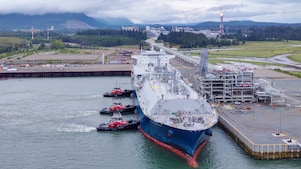
The sequence opens with a wide aerial view of the illuminated Nyhamna gas processing facility at dusk, its bright lights glowing against the surrounding water, forested hills, and distant mountains. A closer shot highlights part of the sprawling industrial complex, with interconnected platforms, pipes, and scaffolding beneath a cloudy evening sky. A Shell worker in orange protective gear and a yellow hard hat walks along a metal walkway toward a dense array of machinery and piping. The scene shifts to a large rectangular metal frame of curved industrial pipes, suspended above the water by red lifting straps with a forested shoreline in the background. A wider view reveals a crane vessel hoisting the structure. The sequence concludes with a large yellow subsea unit being manoeuvred on the deck of a red offshore vessel, surrounded by crew and nearby support ships along a rocky coastline.
Richard Crichton
Many in the industry really were questioning, can we do this?
Video footage
The montage continues with a worker standing on a large bright yellow industrial platform inside a warehouse, surrounded by scaffolding, railings, and structural components. A wide interior view shows the high-ceilinged facility as the yellow subsea structure is moved beneath overhead cranes, surrounded by equipment and workstations. The scene shifts to a massive cylindrical subsea suction pile, painted yellow at the top with depth markings, positioned beside a vessel with a wooded shoreline and houses in the background. Outdoors, Richard Crichton, in orange safety gear, a yellow hard hat, and protective glasses, gestures as he speaks near a waterfront industrial site framed by mountains. An aerial view then captures a construction crew working alongside a long pipeline on a gravel road, set within lush green hills overlooking a coastal inlet. The sequence closes on a close-up of an excavator laying pipe, with workers in safety gear standing nearby on the rocky roadside.
Fredrik Danielsen
Nothing like this has been done before. We have pushed the limits of what we thought was possible.
Video footage
Fredrik Danielsen, in orange protective clothing and a yellow hard hat, stands in profile within an industrial facility, speaking to an off-camera interviewer against a backdrop of metal structures, piping, and equipment. A wide shot then shows several workers in orange safety gear inside a large warehouse, gesturing toward a tall white metal structure with internal piping and platforms, surrounded by equipment and a blue scissor lift. The scene shifts to a close-up profile of a man concentrating on softly illuminated computer monitors, blurred against a dark background. A wider view reveals the dimly lit control room, where operators sit at desks with multiple screens, while a large wall display presents system diagrams, data charts, and live camera feeds.
Jen Carrano
It’s groundbreaking, is what we’ve done. This is a world record.
Video footage
An aerial view at sunset shows a large red offshore vessel docked at an industrial port, equipped with cranes and surrounded by buildings, equipment, and calm water. The scene shifts indoors to a partially submerged yellow-and-white subsea structure in a large water tank, surrounded by protective plastic sheeting and industrial equipment. A wide shot then captures a dense network of metallic pipes, valves, and structural supports forming part of the gas plant under clear daylight. At a construction site during sunset, a large grey modular building, a tall crane, scattered equipment, and workers in safety gear are set against a rocky landscape and glowing sky. Finally, Jen Carrano, in an orange safety uniform, gestures expressively while standing in a control room with multiple monitors and a large digital display wall in the background.
Richard
No one has ever put subsea compression so far from shore, at these water depths.
Video footage
The montage opens at night with a large offshore vessel using cranes to lift a massive suction pile, its deck illuminated and surrounded by industrial equipment. A wide aerial view follows, showing a snow-covered landscape with scattered buildings, winding roads, and distant mountains beneath a cloudy sky. A low-angle shot captures Shell workers in orange safety gear and yellow helmets observing a screen beside a large industrial machine inside a facility, with a reflective water surface in the foreground. The camera pans across a sprawling gas plant, highlighting extensive scaffolding, piping, and structural frameworks under a clear blue sky on a gravel-covered site. A high-angle shot shows a suction pile being manoeuvred by cranes alongside the white hull of a Subsea7 vessel. An aerial view at dusk captures an offshore vessel deck with scattered equipment and containers as a subsea structure is lowered into calm ocean waters beneath a dramatic sky. Finally, an underwater ROV documents a subsea lift-and-shift operation, with data overlays indicating task details and camera metrics.
[Text displays]
Ormen Lange
The World’s Deepest Subsea Compression System
Video footage
The scene transitions to centred text displaying over a serene aerial view of a fjord surrounded by snow-capped mountains.
Interview with Richard Crichton
[Title]
Project Director, Shell
[Text displays]
Richard Crichton
Project Director, Shell
Richard Crichton
This is the Nyhamna gas plant. Gas from the second-largest gas field in Norway, Ormen Lange, travels to this plant, where it’s processed and then exported to Europe.
Video footage
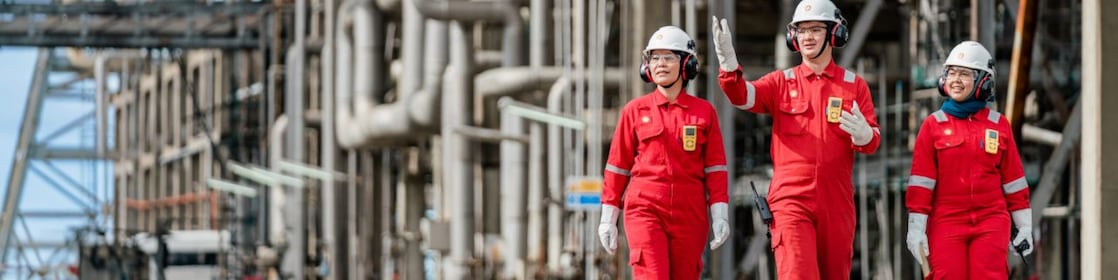
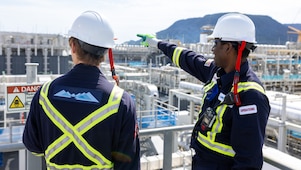
A bird’s-eye view reveals the expansive Nyhamna gas plant, situated between coastal waters and mountainous terrain under a cloudy sky, with extensive infrastructure and buildings across the site. Medium shots show three Shell workers in orange safety uniforms and yellow helmets walking through the illuminated facility, surrounded by complex piping and metal structures in a misty atmosphere, with two of them operating a valve onsite. Medium footage captures Richard speaking to an off-camera interviewer under bright sunlight, with the plant and coastal landscape behind him; his name and title briefly appear in the lower right of the frame. Wider shots from different angles show Richard walking through the plant with a colleague in high-visibility yellow safety gear.
Split-screen footage
The frame splits into three screens, separated by white and yellow lines. In the top left panel, a Shell worker in orange gear observes tall green processing towers under a clear blue sky. In the bottom left panel, workers observe a piece of equipment at the gas plant. In the right panel, a Shell technician turns a large valve wheel at the facility.
Richard Crichton
We’ve been powering hundreds of millions of homes and businesses in the last 20 years of production from this field.
Video footage
The video montage explores home energy usage through a series of aerial views. Central London is seen with a train curving along tracks through a dense urban landscape under a partly cloudy sky. A picturesque valley town appears next, with a sprawling residential area nestled among lush green hills. Warsaw, Poland, is shown at sunrise, highlighting the historic red-roofed Old Town in the foreground and the modern high-rise skyline bathed in golden light. Another European town under an overcast sky reveals densely packed red-roofed buildings, narrow streets, and a blend of traditional and modern architecture, with the surrounding landscape extending to the horizon. Finally, a European town at dusk features snow-covered rooftops glowing under warm streetlights, as the surrounding countryside fades into the twilight horizon.
Richard Crichton
This was the first deepwater development in Norway.
Video footage
High-angle footage shows a large offshore vessel performing a subsea deployment, lowering a suction pile into the calm ocean using a crane beneath an overcast sky. An underwater ROV view captures the deployment of a cooler module, with on-screen overlays displaying task details, coordinates, heading, and environmental conditions. Another green-tinted underwater shot shows the ROV’s manipulator arm interacting with a yellow valve assembly, accompanied by overlays indicating coordinates, depth, heading, and task information.
Richard Crichton
And ever since, we have been pushing those boundaries in technology and human endeavour.
Video footage
Medium footage captures Richard continuing to speak to the off-camera interviewer against the background of the plant and waterfront industrial area with mountains in the background.
Split-screen footage
The frame splits into three panels, divided by white and yellow lines. In the left panel, a large offshore vessel prepares to deploy a massive yellow subsea structure using cranes, with crew members in safety gear overseeing the operation. The top right panel shows two Shell workers walking along a network of elevated walkways and piping at a gas processing facility. In the bottom right panel, Shell personnel in high-visibility yellow gear observe pipeline infrastructure against a mountainous backdrop.
Video footage
An aerial view of a gas processing facility reveals multiple large pipelines emerging from a rocky embankment and stretching across a gravel-covered site. The scene transitions with a whip zoom out to the next sequence.
Richard Crichton
The Ormen Lange production equipment is situated 120 km offshore.
[Text displays]
120 km
[Animated sequence]
The camera pulls back from Nyhamna, gliding swiftly across the sea surface. It rises while tilting downward to reveal a wide aerial view of open water. Gannets fly across the frame before the camera plunges beneath the waves. Text appears in the lower-left corner, showing the distance from Nyhamna in kilometres, which steadily increases as the camera moves farther away from shore.
Richard Crichton
Nearly 1,000 m below sea level, at the base of an 800 m escarpment.
[Text displays]
- 1000 m
[Animated sequence]
A dramatic underwater scene unfolds as a burst of bubbles rises through the dark ocean depths. In the lower-left corner, text continues to display, now showing depth below sea level, counting downward. The bubbles fade as the camera enters a vast underwater canyon, softly illuminated to reveal rugged rock formations and layered sediment. The camera speeds along the mountainous terrain until the layout of the Ormen Lange field emerges from the darkness.
Richard Crichton
The field itself is 40 km long by 8 km to 10 km wide. The actual reservoir sits another 2.5 km below the sea bed. The equipment on the sea bed includes four templates through which connections and pipelines are made.
[Text displays]
10 km 2.5 km 40 km
[Animated sequence]
Sweeping views of the subsea landscape reveal a network of yellow structures and pipelines spread across the ocean floor. The dark, expansive seabed, punctuated by distant lights, emphasizes the scale and complexity of the installation. The camera pulls back to a high-angle perspective as the stylized gas reservoir beneath is gradually illuminated. Yellow well structures appear beneath each seabed template, while glowing blue pipelines extend across the seabed between subsea units and stretch into the distance. On-screen labels indicate the reservoir’s length, depth, and width. Each subsea template is briefly highlighted in turn, with blue circles pulsing around them.
Richard Crichton
The gas is naturally forced out by the pressure within the reservoir. It travels into the equipment at each template, before being mixed into two pipelines that send it back to Nyhamna for processing.
[Animated sequence]
A high-angle view again reveals the seabed installation. The camera zooms in on a single template before passing it, following the flow of gas through parallel pipelines connecting one subsea structure to another, then departing the structure to continue along the seabed. The camera tilts into a close-up, panning along the pipeline as it runs across the seabed. The scene gradually fades to black.
[Text displays]
Graphic needs slightly extending
[Graphic]
Text centred on black slate
Interview with Fredrik Danielsen
[Title]
Systems Engineer, Shell
Fredrik Danielsen
Over the course of the two decades that the field has been in production, as gas has been produced, pressure has gradually been declining.
[Text displays]
Fredrik Danielsen
Systems Engineer, Shell
Video footage
Close-up footage of Fredrik, wearing an orange Shell-branded coverall, walking through the industrial site.
Fredrik Danielsen
To boost this pressure has been a tough challenge.
Video footage
Close-up shots of Fredrik speaking to the off-camera interviewer within the industrial facility. Briefly, his name and title display in the lower left corner.
Fredrik Danielsen
When reservoir pressure drops, gas compression is a very attractive solution to sustain production. This would normally be installed on an offshore platform, but here, we installed it at the sea bed. This enables us to increase the velocity of the gas in the pipeline, boosting production and allowing us to get the most out of our asset.
[Animated sequence]
A computer-generated underwater scene reveals a large yellow subsea unit at the Ormen Lange field, featuring multiple structural frames and thick black pipes extending outward. The seabed is strewn with rocks, while the dark background is dotted with lights from numerous autonomous vehicles. Blue highlighting sweeps outward from the unit, illuminating the surrounding seabed. The camera follows gas moving along the subsea pipelines and between units, with the flow paths highlighted in bright purple. The purple flow enters a compression unit and moves through it, after which a resultant blue flow travels rapidly through the unit and out across the seabed.
[Text displays]
Graphic needs slightly extending
[Graphic]
Text centred on black slate
Interview with Jen Carrano
[Title]
Technical Integration Manager, Shell
Jen Carrano
The whole subsea control system is remotely operated from this control room here at Nyhamna.
[Text displays]
Jen Carrano
Technical Integration Manager, Shell
Video footage
Profile shots show Jen seated at a desk in the control room, using a computer mouse and keyboard, with multiple monitors and telephones in front of her. A close-up shot shows her hand operating the mouse. Next, a close-up shot captures Jen speaking to the off-camera interviewer while standing in the control room. Jen’s name and title display briefly in the lower right corner.
Jen Carrano
And the power that we sent from here was a record-breaking 120 km offshore to our compressors.
Video footage
A wide shot shows two workers in high-visibility yellow Shell coveralls and hard hats walking at the Nyhamna site, with one gesturing upward toward the facility. A bird’s-eye view then captures part of the plant, with modular structures, external staircases, and equipment set on a paved area surrounded by rocky terrain and sparse vegetation. The camera then moves outward across the calm sea under a clear blue sky.
Jen Carrano
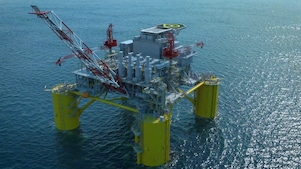
The power from onshore first reaches the transformers. The transformers step this power down and then feed it to where the magic happens. We’ve installed two 800-tonne compressing stations on the sea bed and integrated them into the existing production system. The compressor units are engineered to withstand the deep sea pressures and freezing temperatures. Inside each unit, electrically driven motors power the gas compressors. These increase the pressure and compensate for the natural pressure drop in the reservoir over time, enabling the gas to travel back to Nyhamna. Sophisticated sensors and control systems enable real-time monitoring and adjustment, all managed remotely from onshore.
[Animated sequence]
An underwater sequence once more reveals the vast Ormen Lange subsea facility illuminated by artificial lighting, with sediment drifting through the dark water. Bright green lines curve toward the installation, tracing flow paths along pipes/cables as they connect to the transformer units. The cables fed from the transformers to the two compression units are also highlighted in green. The compression units are shown from numerous angles as the process is described.
Interview with Fredrik Danielsen continued
Fredrik Danielsen
These are the world’s deepest subsea compressors. It’s more efficient, and over the lifetime of the field, it’s expected to push the recovery rate from 75% to a world-class 85% and unlock 30 to 50 billion more cubic metres of gas. The additional recovery equals enough gas to heat 5 million homes…
[Text displays]
Recovery rate: 75%
Recovery rate: 85%
30 - 50 billion cubic metres gas
[Animated sequence]
The sequence returns to several high-angle views of the two compression units with flow paths highlighted in bright purple and blue, respectively, as previously described. Text appears at the top of the frame, showing a percentage that counts upward, before being replaced by another displayed fact. The view then pulls back to a wide shot of the field, with flow paths highlighted in purple and blue.
[Text displays]
Graphic needs slightly extending
[Graphic]
Text centred on black slate
Fredrik Danielsen
Next year alone. That is equivalent to a city the size of Barcelona.
[Animated sequence]
The animation continues with a wide aerial view of the field, where flow paths are highlighted in purple and blue. The blue path extends from the installation, winding across the seabed before exiting at the top of the frame.
Interview with Richard Crichton continued
Richard Crichton
These pipes might not look like much, but they’re an essential part of the energy distribution system within Europe.
Video footage
A wide view of Nyhamna near the water’s edge shows multiple large silver pipelines running across a gravel-covered ground, bordered by rock embankments, with water, buildings and distant mountains in the background. A low-angle view captures a complex network of large silver pipes and metal structural supports under a clear blue sky. Medium footage captures Richard speaking to the off-camera interviewer in front of large industrial pipes and structures. Low-angle views capture a dense arrangement of silver pipelines, metal platforms and structural frames under a clear blue sky.
Richard Crichton
From this tiny, remote Norwegian island, gas flows thousands of kilometres across to Europe, providing reliable energy powering homes and businesses.
[Text displays]
Ormen Lange - Nyhamna - Easington - Emden - Etzel - Dunkerque - Zeebrugge - Poland - France – Italy
[Animated sequence]
We zoom out on a satellite-style view of northern Europe that shows cloud-covered landmasses and surrounding ocean under sunlight. At the Norwegian coast, two labelled points indicate the location of the Nyhamna plant and the Ormen Lange field and are connected by a glowing blue arc over land and sea. The gas network of glowing blue lines and nodes expands from Nyhamna to the UK and into Europe, with labels indicating country names. The network slowly dissolves.
Richard Crichton
The carbon emissions from production are also among the lowest on the Norwegian continental shelf, whereas the Ormen Lange field is powered by hydro-generated electricity…
[Animated sequence]
The sequence continues with the satellite view of the Earth, now with Norway’s continental shelf outlined and crisscrossed with glowing dots and white, yellow and blue lines, while blue icons display at various points. The icons comprise a blue teardrop with a lightning bolt, surrounded by circulating arrows.
Richard Crichton
And the gas is processed in a closed system at Nyhamna. This allows us to extract larger volume while not creating additional emissions in the processing of the gas.
[Animated sequence]
The sequence continues with the satellite view of the Earth, centred on Norway, and the view zooms in on the blue line extending out to the Ormen Lange site. Once again, we dive below the sea’s surface to the subsea installation, showing the yellow units stretched out across the seabed, as previously described.
Richard Crichton
This project is really showing Shell’s strategy in action.
Split-screen footage
The frame splits into three screens, separated by white and yellow lines. In the top left panel, a panning wide view captures the infrastructure of the Nyhamna facility, with the sun setting at the horizon. In the bottom left panel, a worker in high-visibility yellow protective gear inspects a wall of valves and gauges. In the right panel, a worker in orange protective clothing and a yellow helmet stands on a platform and looks out over the expansive industrial site.
Richard Crichton
We’re delivering more value with less emissions.
Video footage
Medium footage captures Richard speaking to the off-camera interviewer, with the plant and coastal landscape in the background.
Interview with Jen Carrano continued
Jen Carrano
What we’ve done is taken a technology to the next level, proving it can work and it can be deployable on lots of different projects.
Video footage
A low-angle profile view captures Jen walking onsite, with the infrastructure of the facility forming the backdrop. Another close-up view shows Jen onsite with her hand outstretched and resting on a large metal pipe. An extreme close-up view captures her hand moving over the surface of the pipe.
Interview with Fredrik Danielsen continued
Fredrik Danielsen
Seeing it all come to life is an amazing feeling. It makes me very proud to be part of a team that’s been pushing these boundaries.
Video footage
Medium footage shows Fredrik, seen from behind, walking onsite toward a modular building bearing OneSubsea signage. A low-angle shot captures him moving across the site, with pipes forming the backdrop.
Interview with Richard Crichton continued
Richard Crichton
We’re maximising the value from this field and providing reliable energy into Europe.
Video footage
Rear-view footage captures Richard standing on a grassy hilltop overlooking Nyhamna at sunset. Medium profile footage shows Richard looking out over the water as the sun dips towards the horizon. This scene finally transitions out in the shape of a contracting Pecten, revealing a white background.
[Audio]
Shell brand mnemonic played on keys
[Text displays]
Discover more shell.com/ormenlange
© Shell International Limited 2023
[Animated sequence]
The small, iconic red and yellow Pecten appears at the centre of the white background, with text displaying below it and along lower frame
[Text displays]
Operator
Petoro – Equinor – Orlen Upstream Norway – Vår Energi
License partners
[Graphic]
The Shell Pecten remains centred on a white background with text positioned beneath it. Further down, four partner logos are arranged across the frame, followed by a horizontal grey line extending across the width, with additional text placed below.
[Text displays]
The companies in which Shell plc directly and indirectly owns investments are separate legal entities. In this video “Shell”, “Shell Group” “Group”, “we”, “us” and “our” are sometimes used for convenience to reference Shell plc and its subsidiaries in general or to those who work for them. This video contains forward-looking statements (within the meaning of the U.S. Private Securities Litigation Reform Act of 1995) concerning the financial condition, results of operations and businesses of Shell. Forward-looking statements are statements of future expectations that are based on management’s current expectations and assumptions and involve known and unknown risks and uncertainties that could cause actual results, performance or events to differ materially from those expressed or implied in these statements. Each forward-looking statement speaks only as of the date of this video, 25th August 2025. Neither Shell plc nor any of its subsidiaries undertake any obligation to publicly update or revise any forward-looking statement as a result of new information, future events or other information. Please see the full Shell Cautionary Note at www.shell.com/investors/disclaimer-and-cautionary-note.html
[Graphic]
The Shell Pecten remains centred on a white background with text positioned beneath it.
30-50 billion
cubic meters (bcm) of additional output unlocked by the compressors, boosting gas recovery from 75% to 85%.
5 million
European homes could be heated next year with the additional gas recovered from the Ormen Lange field.
120
kilometres (75 miles) from the Nyhamna processing and export facility – a world record for remote control of a subsea compression system.
Getting more out of a Norwegian gas field
A pioneering project is increasing the amount of gas recovered from a field that supplies energy across Europe.

In 2024, 78.2% of Shell's global investments included oil & gas, 11.37% included low-carbon energy solutions and 10.43% non-energy products. Shell's target is to become a net-zero emissions (NZE) business by 2050. Disclaimers, including NZE target: shell.com/disclaimer
Cautionary note
Cautionary note
The companies in which Shell plc directly and indirectly owns investments are separate legal entities. In this content “Shell”, “Shell Group” and “Group” are sometimes used for convenience to reference Shell plc and its subsidiaries in general. Likewise, the words “we”, “us” and “our” are also used to refer to Shell plc and its subsidiaries in general or to those who work for them. These terms are also used where no useful purpose is served by identifying the particular entity or entities. ‘‘Subsidiaries’’, “Shell subsidiaries” and “Shell companies” as used in this content refer to entities over which Shell plc either directly or indirectly has control. The terms “joint venture”, “joint operations”, “joint arrangements”, and “associates” may also be used to refer to a commercial arrangement in which Shell has a direct or indirect ownership interest with one or more parties. The term “Shell interest” is used for convenience to indicate the direct and/or indirect ownership interest held by Shell in an entity or unincorporated joint arrangement, after exclusion of all third-party interest.
Forward-Looking statements
This content contains forward-looking statements (within the meaning of the U.S. Private Securities Litigation Reform Act of 1995) concerning the financial condition, results of operations and businesses of Shell. All statements other than statements of historical fact are, or may be deemed to be, forward-looking statements. Forward-looking statements are statements of future expectations that are based on management’s current expectations and assumptions and involve known and unknown risks and uncertainties that could cause actual results, performance or events to differ materially from those expressed or implied in these statements. Forward-looking statements include, among other things, statements concerning the potential exposure of Shell to market risks and statements expressing management’s expectations, beliefs, estimates, forecasts, projections and assumptions. These forward-looking statements are identified by their use of terms and phrases such as “aim”; “ambition”; ‘‘anticipate’’; “aspire”, “aspiration”, ‘‘believe’’; “commit”; “commitment”; ‘‘could’’; “desire”; ‘‘estimate’’; ‘‘expect’’; ‘‘goals’’; ‘‘intend’’; ‘‘may’’; “milestones”; ‘‘objectives’’; ‘‘outlook’’; ‘‘plan’’; ‘‘probably’’; ‘‘project’’; ‘‘risks’’; “schedule”; ‘‘seek’’; ‘‘should’’; ‘‘target’’; “vision”; ‘‘will’’; “would” and similar terms and phrases. There are a number of factors that could affect the future operations of Shell and could cause those results to differ materially from those expressed in the forward-looking statements included in this content, including (without limitation): (a) price fluctuations in crude oil and natural gas; (b) changes in demand for Shell’s products; (c) currency fluctuations; (d) drilling and production results; (e) reserves estimates; (f) loss of market share and industry competition; (g) environmental and physical risks, including climate change; (h) risks associated with the identification of suitable potential acquisition properties and targets, and successful negotiation and completion of such transactions; (i) the risk of doing business in developing countries and countries subject to international sanctions; (j) legislative, judicial, fiscal and regulatory developments including tariffs and regulatory measures addressing climate change; (k) economic and financial market conditions in various countries and regions; (l) political risks, including the risks of expropriation and renegotiation of the terms of contracts with governmental entities, delays or advancements in the approval of projects and delays in the reimbursement for shared costs; (m) risks associated with the impact of pandemics, regional conflicts, such as the Russia-Ukraine war and the conflict in the Middle East, and a significant cyber security, data privacy or IT incident; (n) the pace of the energy transition; and (o) changes in trading conditions. No assurance is provided that future dividend payments will match or exceed previous dividend payments. All forward-looking statements contained in this content are expressly qualified in their entirety by the cautionary statements contained or referred to in this section. Readers should not place undue reliance on forward-looking statements. Additional risk factors that may affect future results are contained in Shell plc’s Form 20-F and amendment thereto for the year ended December 31, 2024 (available at www.shell.com/investors/news-and-filings/sec-filings.html and www.sec.gov). These risk factors also expressly qualify all forward-looking statements contained in this content and should be considered by the reader. Each forward-looking statement speaks only as of the date of this content. Neither Shell plc nor any of its subsidiaries undertake any obligation to publicly update or revise any forward-looking statement as a result of new information, future events or other information. In light of these risks, results could differ materially from those stated, implied or inferred from the forward-looking statements contained in this content.
Shell’s net carbon intensity
Also, in this conent we may refer to Shell’s “net carbon intensity” (NCI), which includes Shell’s carbon emissions from the production of our energy products, our suppliers’ carbon emissions in supplying energy for that production and our customers’ carbon emissions associated with their use of the energy products we sell. Shell’s NCI also includes the emissions associated with the production and use of energy products produced by others which Shell purchases for resale. Shell only controls its own emissions. The use of the terms Shell’s “net carbon intensity” or NCI is for convenience only and not intended to suggest these emissions are those of Shell plc or its subsidiaries.
Shell’s net-zero emissions target
Shell’s operating plan and outlook are forecasted for a three-year period and ten-year period, respectively, and are updated every year. They reflect the current economic environment and what we can reasonably expect to see over the next three and ten years. Accordingly, the outlook reflects our Scope 1, Scope 2 and NCI targets over the next ten years. However, Shell’s operating plan and outlook cannot reflect our 2050 net-zero emissions target, as this target is outside our planning period. Such future operating plans and outlooks could include changes to our portfolio, efficiency improvements and the use of carbon capture and storage and carbon credits. In the future, as society moves towards net-zero emissions, we expect Shell’s operating plans and outlooks to reflect this movement. However, if society is not net zero in 2050, as of today, there would be significant risk that Shell may not meet this target.
Forward-Looking non-GAAP measures
This content may contain certain forward-looking non-GAAP measures such as adjusted earnings and divestments. We are unable to provide a reconciliation of these forward-looking non-GAAP measures to the most comparable GAAP financial measures because certain information needed to reconcile those non-GAAP measures to the most comparable GAAP financial measures is dependent on future events some of which are outside the control of Shell, such as oil and gas prices, interest rates and exchange rates. Moreover, estimating such GAAP measures with the required precision necessary to provide a meaningful reconciliation is extremely difficult and could not be accomplished without unreasonable effort. Non-GAAP measures in respect of future periods which cannot be reconciled to the most comparable GAAP financial measure are calculated in a manner which is consistent with the accounting policies applied in Shell plc’s consolidated financial statements.
The contents of websites referred to in this content do not form part of this content.
We may have used certain terms, such as resources, in this content that the United States Securities and Exchange Commission (SEC) strictly prohibits us from including in our filings with the SEC. Investors are urged to consider closely the disclosure in our Form 20-F and any amendment thereto, File No 1-32575, available on the SEC website www.sec.gov.