Following the Northern Lights: inside a pioneering project
Innovation and collaboration created the world’s first commercial carbon transport and storage service in Norway. So how does it work?

On August 25, 2025
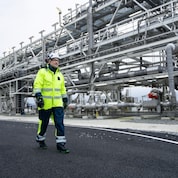
At the remote Energiparken industrial hub in Øygarden on Norway’s rugged west coast, under skies that can stay light for 18 hours a day and where orcas and sea eagles can be spotted, a revolution is underway. In August, Northern Lights, the world’s first cross-border commercial carbon transport and storage service, injected carbon dioxide (CO2) collected from a cement factory 450 kilometres away into an aquifer beneath the North Sea for the first time.
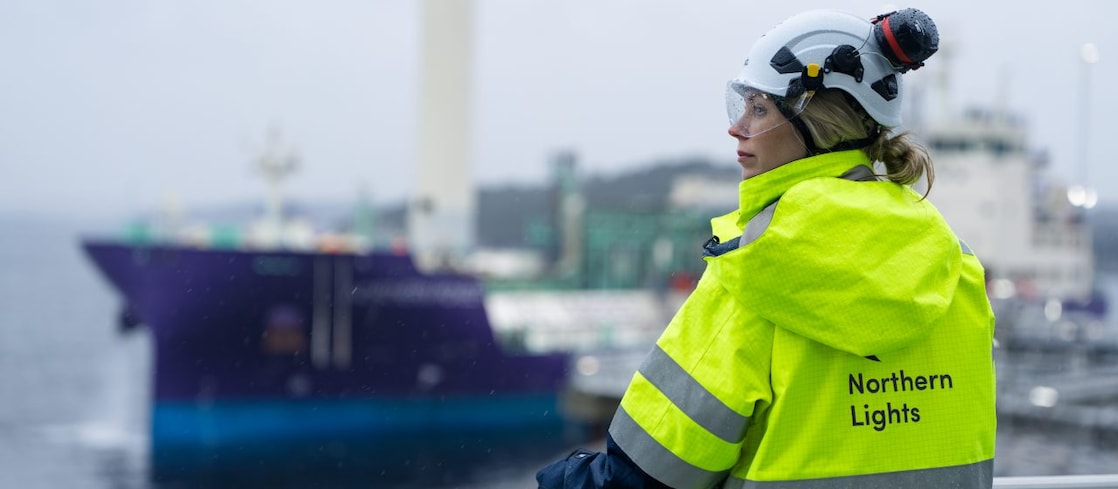
Northern Lights is a key part of Longship, the Norwegian government’s flagship carbon capture and storage (CCS) initiative and Europe’s first end-to-end CCS project. “Northern Lights marks the beginning of a new era in industrial decarbonisation and sets an exciting precedent for open-access carbon storage in Europe,” says Aksel Plener, an Operations Manager seconded from Shell to Northen Lights JV, a company owned by Shell, Equinor, and TotalEnergies.
According to the International Energy Agency, CCS is especially important for cutting emissions from carbon-intensive heavy industries like cement and steel.
So how does this pioneering project work?
Photo gallery
Capturing the CO₂
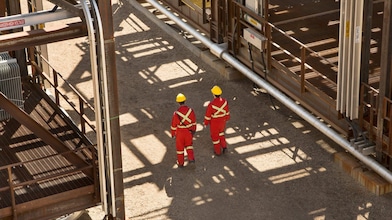
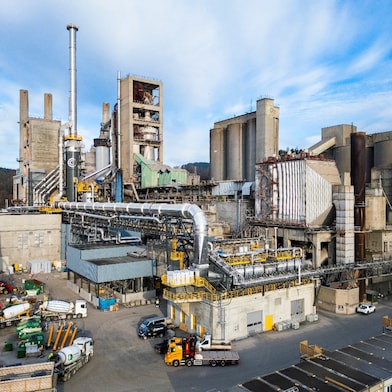
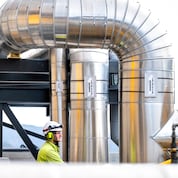
High above the factory floor, limestone is heated in a massive rotating steel kiln which reaches a blistering 1,450°C. This transforms the limestone and leaves behind clinker, which is used to make cement. Inside a 103-metre-tall absorber tower, a chemical called amine, which has a strong affinity for CO2, is injected into the flue gas from the kiln. The CO2 binds with the amine, and is separated as a gas, before being liquefied and pumped into storage tanks on the quayside ready for transport.
Shipping the CO₂
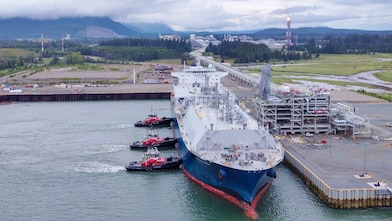
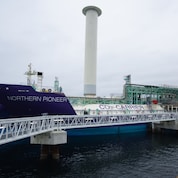
To transport the CO2 to Øygarden, Shell engineers have led the design of two vessels, with more in development. Among the largest liquefied-carbon carriers in the world, they are each capable of transporting 7,500 cubic metres of CO2 in a single voyage, enough to fill three Olympic-sized swimming pools. The 130-metre-long Northern Pathfinder and Northern Pioneer vessels dock at the cement factory to load captured CO2 before making the 36-hour journey to the Northern Lights terminal.
The ships run mainly on liquefied natural gas (LNG) and use wind-assisted rotor sails – motorised spinning cylinders that harness wind power to help propel the ship forward. An air lubrication system makes the ships more efficient by releasing bubbles along the hulls, which reduces friction with the water. These features can reduce the carbon intensity of the vessels by about 34% compared with conventional ships.
The Northern Lights terminal in Norway will receive liquefied carbon dioxide (CO₂) from customers across Europe, including the Heidelburg Materials cement factory (3) and the Hafslund Celsio waste-to-heat plant (4) in Norway, the Stockholm Exergi biomass plant in Sweden (5), Ørsted biomass power plants in Denmark through the Ørsted Kalundborg CO₂ Hub (6), and the Yara ammonia plant in the Netherlands (7). The CO₂ will then be pumped through a 110-kilometre pipeline out into the North Sea and safely stored.
Storing the CO₂
At the Northern Lights terminal, the liquefied CO2 is transferred from the ships into a dozen tanks before being pumped through a 110-kilometre subsea pipeline that winds its way through a fjord and out into the North Sea. It is then safely stored in an aquifer that lies beneath 330 metres of seawater and 2,600 metres of seabed. “This deep geological formation acts as a natural vault, ensuring that the captured CO2 remains locked away, with the stored CO2 monitored in real-time,” says Heidi Fjellvang, Northern Lights’ System Engineering Manager.
As well as from Heidelberg Materials’ cement factory in Brevik, from 2026, the first phase of Northern Lights is expected to collect CO2 from an ammonia plant in the Netherlands belonging to crop nutrition company Yara, and from biomass power plants operated by Danish renewable-energy company Ørsted. From 2029, Northern Lights is also expected to collect CO2 from Hafslund Celsio’s waste-to-heat plant at Klemetsrud in Norway, according to Hafslund Celsio.
Under phase two expansion plans expected to be completed in 2028, Northern Lights will scale up its own transport and storage capacity to at least 5 million tonnes of CO2 annually – equivalent to the annual emissions of over 1 million cars – with Swedish energy provider Stockholm Exergi already signed up for the transportation and storage of up to 900,000 tonnes of CO2 annually from 2028.
With its flexible, ship-based model, Northern Lights is uniquely positioned to serve a growing network of customers across Europe. “Provided there is a jetty and storage tanks,” says Heidi, “we can go anywhere to pick up CO2, and transport and then store it.”
In 2025, 80.85% of Shell’s global investments included oil & gas, 9.58% included low-carbon energy solutions and 9.58% non-energy products.
Cautionary note
Cautionary note
The companies in which Shell plc directly and indirectly owns investments are separate legal entities. In this content “Shell”, “Shell Group” and “Group” are sometimes used for convenience to reference Shell plc and its subsidiaries in general. Likewise, the words “we”, “us” and “our” are also used to refer to Shell plc and its subsidiaries in general or to those who work for them. These terms are also used where no useful purpose is served by identifying the particular entity or entities. ‘‘Subsidiaries’’, “Shell subsidiaries” and “Shell companies” as used in this content refer to entities over which Shell plc either directly or indirectly has control. The terms “joint venture”, “joint operations”, “joint arrangements”, and “associates” may also be used to refer to a commercial arrangement in which Shell has a direct or indirect ownership interest with one or more parties. The term “Shell interest” is used for convenience to indicate the direct and/or indirect ownership interest held by Shell in an entity or unincorporated joint arrangement, after exclusion of all third-party interest.
Forward-Looking statements
This content contains forward-looking statements (within the meaning of the U.S. Private Securities Litigation Reform Act of 1995) concerning the financial condition, results of operations and businesses of Shell. All statements other than statements of historical fact are, or may be deemed to be, forward-looking statements. Forward-looking statements are statements of future expectations that are based on management’s current expectations and assumptions, including (without limitation) those concerning Shell’s strategy and operating plans, macroeconomic conditions, future energy demand, supply and product mix, commodity prices, demand for Shell’s products, production results and reserve estimates, development, execution and management of projects, energy transition and climate change, management of safety and environmental risks, costs, cash capital expenditures, technology advancements, legislative, judicial, fiscal and regulatory developments, regional conflicts and trading conditions, and involve known and unknown risks and uncertainties that could cause actual results, performance or events to differ materially from those expressed or implied in these statements. Forward-looking statements include, among other things, statements concerning the potential exposure of Shell to market risks and statements expressing management’s expectations, beliefs, estimates, forecasts, projections and assumptions. These forward-looking statements are identified by their use of terms and phrases such as “aim”; “ambition”; ‘‘anticipate’’; “aspire”, “aspiration”, ‘‘believe’’; “commit”; “commitment”; ‘‘could’’; “desire”; ‘‘estimate’’; ‘‘expect’’; ‘‘goals’’; ‘‘intend’’; ‘‘may’’; “milestones”; ‘‘objectives’’; ‘‘outlook’’; ‘‘plan’’; ‘‘probably’’; ‘‘project’’; ‘‘risks’’; “schedule”; ‘‘seek’’; ‘‘should’’; ‘‘target’’; “vision”; ‘‘will’’; “would” and similar terms and phrases. There are a number of factors that could affect the future operations of Shell and could cause those results to differ materially from those expressed in the forward-looking statements included in this content, including (without limitation): (a) price fluctuations in crude oil and natural gas; (b) changes in demand for Shell’s products; (c) currency fluctuations; (d) drilling and production results; (e) reserves estimates; (f) loss of market share and industry competition; (g) environmental and physical risks, including climate change; (h) risks associated with the identification of suitable potential acquisition properties and targets, and successful negotiation and completion of such transactions; (i) the risk of doing business in developing countries and countries subject to international sanctions; (j) legislative, judicial, fiscal and regulatory developments including tariffs and regulatory measures addressing climate change; (k) economic and financial market conditions in various countries and regions; (l) political risks, including the risks of expropriation and renegotiation of the terms of contracts with governmental entities, delays or advancements in the approval of projects and delays in the reimbursement for shared costs; (m) risks associated with the impact of pandemics, regional conflicts, such as the Russia-Ukraine war and the conflict in the Middle East, and a significant cyber security, data privacy or IT incident; (n) the pace of the energy transition; and (o) changes in trading conditions. No assurance is provided that future dividend payments will match or exceed previous dividend payments. All forward-looking statements contained in this content are expressly qualified in their entirety by the cautionary statements contained or referred to in this section. Readers should not place undue reliance on forward-looking statements. Additional risk factors that may affect future results are contained in Shell plc’s Form 20-F for the year ended December 31, 2025 (available at www.shell.com/investors/news-and-filings/sec-filings.html and www.sec.gov). These risk factors also expressly qualify all forward-looking statements contained in this content and should be considered by the reader. Each forward-looking statement speaks only as of the date of this content. Neither Shell plc nor any of its subsidiaries undertake any obligation to publicly update or revise any forward-looking statement as a result of new information, future events or other information. In light of these risks, results could differ materially from those stated, implied or inferred from the forward-looking statements contained in this content.
Shell’s net carbon intensity and net-zero emissions target
In this content we may refer to Shell’s “net carbon intensity” (NCI), which includes Shell’s carbon emissions from the production of our energy products, our suppliers’ carbon emissions in supplying energy for that production and our customers’ carbon emissions associated with their use of the energy products we sell. Shell’s NCI also includes the emissions associated with the production and use of energy products produced by others which Shell purchases for resale. Shell only controls its own emissions. The use of the terms Shell’s “net carbon intensity” or NCI is for convenience only and not intended to suggest these emissions are those of Shell plc or its subsidiaries.
Shell’s operating plan and outlook are forecasted for a three-year period and ten-year period, respectively, and are updated every year. They reflect the current economic environment and what we can reasonably expect to see over the next three and ten years. Accordingly, the outlook reflects our combined Scope 1 and 2 target, NCI target and our oil products ambition over the next ten years. However, Shell’s operating plan and outlook cannot reflect our 2050 net-zero emissions target, as this target is outside our planning period. Such future operating plans and outlooks could include changes to our portfolio, efficiency improvements and the use of carbon capture and storage and carbon credits. In the future, as society moves towards net-zero emissions, we expect Shell’s operating plans and outlooks to reflect this movement. However, if society is not net zero in 2050, as of today, there would be significant risk that Shell may not meet this target.
The information provided above regarding Shell’s NCI and net zero emissions target are not intended, nor should they be construed as introducing, suggesting or making any claim, target or representation thereof other than what is included in the content.
Forward-Looking non-GAAP measures
This content may contain certain forward-looking non-GAAP measures such as free cash flow and underlying operating expenses. We are unable to provide a reconciliation of these forward-looking non-GAAP measures to the most comparable GAAP financial measures because certain information needed to reconcile those non-GAAP measures to the most comparable GAAP financial measures is dependent on future events some of which are outside the control of Shell, such as oil and gas prices, interest rates and exchange rates. Moreover, estimating such GAAP measures with the required precision necessary to provide a meaningful reconciliation is extremely difficult and could not be accomplished without unreasonable effort. Non-GAAP measures in respect of future periods which cannot be reconciled to the most comparable GAAP financial measure are calculated in a manner which is consistent with the accounting policies applied in Shell plc’s consolidated financial statements. These forward-looking non-GAAP measures are provided to assist readers in understanding management’s use and expectations of such measures and may not be appropriate for other purposes.
The contents of websites referred to in this content do not form part of this content.
We may have used certain terms, such as resources, in this content that the United States Securities and Exchange Commission (SEC) strictly prohibits us from including in our filings with the SEC. Investors are urged to consider closely the disclosure in our Form 20-F, File No 1-32575, available on the SEC website www.sec.gov.