
Simplified Share Structure
Shareholders have supported the proposal (PDF, 83 kB) to amend Shell’s Articles of Association. This will enable a simplification of its share structure and an increase in the speed and flexibility of capital and portfolio actions.
The Board unanimously believes that the Simplification will strengthen Shell’s competitiveness and accelerate both shareholder distributions and delivery of its strategy to become a net-zero emissions energy business.
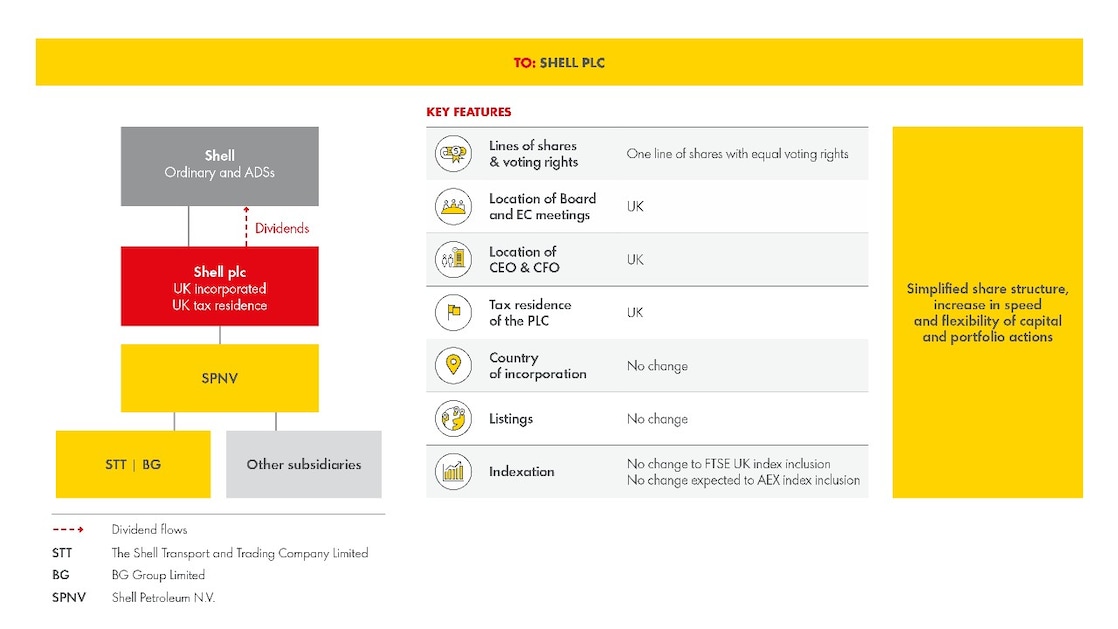
The Simplification, announced on 15 November 2021, entails:
- Establishing a single line of shares to eliminate the complexity of Shell’s A/B Share Structure; and
- Aligning Shell’s tax residence with its country of incorporation in the UK, where it will hold Board and Executive Committee meetings, and locate its chief executive and chief financial officer.
Shell has published a circular which contains further details of the Simplification and the proposed amendments to the Articles of Association.
A General Meeting was held at Rotterdam Ahoy, Ahoyweg 10, 3084 BA Rotterdam, the Netherlands at 10:00 (Dutch time), 09:00 (UK time) on Friday December 10, 2021.
Chair of the Board on simplified share structure
Read the transcript
Read the transcript
ROYAL DUTCH SHELL PLC
SHELL PROPOSES SIMPLIFIED STRUCTURE
ANDREW MACKENZIE, CHAIR OF THE BOARD OF ROYAL DUTCH SHELL PLC
Hello, everyone. I'm Andrew Mackenzie, I'm Chair of the Board of Royal Dutch Shell. Today, the Board announced a proposal to amend Shell's Articles of Association. This will simplify the company's share structure and bring it in line with other companies so as to increase its capital and portfolio flexibility. The simplification will make Shell more competitive, it will allow for an acceleration in shareholder distributions and speed up Shell's transition to a net-zero emissions energy business.
Under the proposal, Shell intends to change its A-B share structure to a single line of shares and to change its tax residence to the UK, which is our country of incorporation. It will hold Board and Executive Committee meetings in the UK and relocate its chief executive and chief financial officers there. As a consequence, the Board also proposes to change the company name from Royal Dutch Shell plc to Shell plc.
But some things will remain unchanged. Post-simplification, shareholders will retain the same legal, ownership, voting and capital distribution rights in Shell as they do today. And the company's shares will continue to be listed in Amsterdam, London and New York, with FTSE UK index inclusion. And we expect that AEX index inclusion will be maintained. Shell's corporate governance structure will also remain unchanged. And the simplification will have no impact on legal proceedings related to the Dutch Court ruling. Shell is rising to meet the court's challenge and has recently announced a new absolute emissions reduction target.
At a time of unprecedented change for the industry, it is even more important that we have an increased ability to accelerate the transition to a lower carbon global energy system. This simpler structure will cause Shell to accelerate the delivery of its Powering Progress strategy, while creating value for shareholders, customers and wider society. The Board believes the proposal is in the best interests of the Company and shareholders as a whole and that the benefits of the simplification will outweigh any potential costs associated with it.
The Board has called for a General Meeting on December 10th, 2021 at which the resolution to amend Shell's Articles of Association will be put to a vote. Your support is extremely important to us. The Board and I strongly recommend that Shell's shareholders vote in favour of the simplification. Thank you.
Royal Dutch Shell plc
November 15, 2021 www.shell.com/investors
DEFINITIONS AND CAUTIONARY NOTE
The companies in which Royal Dutch Shell plc directly and indirectly owns investments are separate legal entities. In this presentation "Shell", "Shell Group" and "Group" are sometimes used for convenience where references are made to Royal Dutch Shell plc and its subsidiaries in general. Likewise, the words "we us" and "our" are also used to refer to Royal Dutch Shell plc and its subsidiaries in general or to those who work for them. These terms are also used where no useful purpose is served by identifying the particular entity or entities. "Subsidiaries "Shell subsidiaries" and "Shell companies" as used in this presentation refer to entities over which Royal Dutch Shell plc either directly or indirectly has control. Entities and unincorporated arrangements over which Shell has joint control are generally referred to as "joint ventures" and "joint operations", respectively. Entities over which Shell has significant influence but neither control nor joint control are referred to as associates". The term "Shell interest" is used for convenience to indicate the direct and/or indirect ownership interest held by Shell in an entity or unincorporated joint arrangement, after exclusion of all third-party interest.
This presentation contains forward-looking statements (within the meaning of the U.S. Private Securities Litigation Reform Act of 1995) concerning the financial condition, results of operations and businesses of Shell. All statements other than statements of historical fact are, or may be deemed to be, forward-looking statements. Forward-looking statements are statements of future expectations that are based on management's current expectations and assumptions and involve known and unknown risks and uncertainties that could cause actual results, performance or events to differ materially from those expressed or implied in these statements. Forward-looking statements include, among other things, statements concerning the potential exposure of Shell to market risks and statements expressing management's expectations, beliefs, estimates, forecasts, projections and assumptions. These forward-looking statements are identified by their use of terms and phrases such as "aim", "ambition anticipate "could" estimate expect" goals" intend", "may", "milestones", "objectives outlook", "plan", "probably", "project", risks" "schedule" should", "target", "will" and similar terms and phrases. There are a number of factors that could affect the future operations of Shell and could cause those results to differ materially from those expressed in the forward-looking statements included in this presentation, including (without limitation): (a) price fluctuations in crude oil and natural gas; (b) changes in demand for Shell's products; (c) currency fluctuations; (d) drilling and production results; (e) reserves estimates; (f) loss of market share and industry competition; (g) environmental and physical risks; (h) risks associated with the identification of suitable potential acquisition properties and targets, and successful negotiation and completion of such transactions; (i) the risk of doing business in developing countries and countries subject to international sanctions; (j) legislative, judicial, fiscal and regulatory developments including regulatory measures addressing climate change; (k) economic and financial market conditions in various countries and regions; (l) political risks, including the risks of expropriation and renegotiation of the terms of contracts with governmental entities, delays or advancements in the approval of projects and delays in the reimbursement for shared costs; (m) risks associated with the impact of pandemics, such as the COVID-19 (coronavirus) outbreak; and (n) changes in trading conditions. No assurance is provided that future dividend payments will match or exceed previous dividend payments. All forward-looking statements contained in this presentation are expressly qualified in their entirety by the cautionary statements contained or referred to in this section. Readers should not place undue reliance on forward-looking statements. Additional risk factors that may affect future results are contained in Royal Dutch Shell plc's Form 20-F for the year ended December 31, 2020 (available at www.shell.com/investors and www.sec.gov). These risk factors also expressly qualify all forward-looking statements contained in this presentation and should be considered by the reader. Each forward-looking statement speaks only as of the date of this presentation, November 15, 2021. Neither Royal Dutch Shell plc nor any of its subsidiaries undertake any obligation to publicly update or revise any forward-looking statement as a result of new information, future events or other information. In light of these risks, results could differ materially from those stated, implied or inferred from the forward-looking statements contained in this presentation. The content of websites referred to in this presentation does not form part of this presentation. We may have used certain terms, such as resources, in this presentation that the United States Securities and Exchange Commission (SEC) strictly prohibits us from including in our filings with the SEC. Investors are urged to consider closely the disclosure in our Form 20-F, File No 1-32575, available on the SEC website www.sec.gov.
Watch this short video where Sir Andrew Mackenzie, Chair of the Board of Shell, explains the reasons for proposing and benefits of a simplified structure.
Simpler. More flexible. Faster.
A conventional single share structure will allow Shell to compete more effectively. It will:
- Allow for an acceleration in distributions by way of share buybacks, as there will be a larger single pool of ordinary shares that can be bought back. Following the start of a $2 billion buyback programme in July, Shell announced in September that it will return an additional $7 billion to shareholders following completion of the sale of its Permian assets in the United States.
- Strengthen Shell’s ability to rise to the challenges posed by the energy transition, by managing its portfolio with greater agility.
- Reduce risk for shareholders by simplifying and normalising Shell’s share structure in line with its competitors and most other global companies. The current complex share structure is subject to constraints and may not be sustainable in the long term.
General Meeting 2021
Read or download the Shareholder circular and Notice of General Meeting
15th November 3pm CET: Shareholder Engagement Session
Hosted by Chair of the Board, Sir Andrew Mackenzie.
30th November 3pm CET: Shareholder Engagement Session
Hosted by Chair of the Board, Sir Andrew Mackenzie.
Frequently asked questions
What changes is Shell intending to make to its corporate structure and what are the benefits of the changes?
What changes is Shell intending to make to its corporate structure and what are the benefits of the changes?
The Board announced a proposal on November 15, 2021 to amend Shell’s Articles of Association (“the Articles”). This will enable a simplification of the company’s share structure (“the Simplification”) and an increase in the speed and flexibility of capital and portfolio actions. The Simplification is designed to strengthen Shell’s competitiveness and accelerate both shareholder distributions and delivery of its strategy to become a net zero emissions energy business.
Shell is currently incorporated in the UK but has Dutch tax residence, and a share structure comprising A and B shares. This structure was established in 2005 when Royal Dutch Shell was formed through the combination of N.V. Koninklijke Nederlandsche Petroleum Maatschappij and The “Shell” Transport and Trading Company, p.l.c. Although the current structure is manageable, it introduces constraints, embeds complexity and slows Shell down compared to our competitors.
The Simplification entails:
- Establishing a single line of shares to eliminate the complexity of Shell’s A / B Share Structure; and
- Aligning Shell’s tax residence with its country of incorporation in the UK by relocating Board and Executive Committee meetings, and the CEO and CFO, to the UK; and consequently changing the Company’s name from Royal Dutch Shell plc to Shell plc.
How is the intended share structure simpler and more efficient than what Shell currently has?
How is the intended share structure simpler and more efficient than what Shell currently has?
A conventional single share structure will enable Shell to compete more effectively. It will:
- Allow for an acceleration in distributions by way of share buybacks, as there will be a larger single pool of ordinary shares that can be bought back.
- Strengthen Shell’s ability to rise to the challenges posed by the energy transition, by managing its portfolio with greater agility.
- Reduce risk for shareholders by simplifying and normalising Shell's share structure in line with its competitors and most other global companies.
Why does Shell want to make this change now?
Why does Shell want to make this change now?
The Simplification will allow Shell to undertake more share buybacks in a particular period from the single pool of shares.
The Board believes now is the right time to make this change. While Shell has operated successfully to date, the scale and speed of change presented by the energy transition are unprecedented.
In February this year Shell published the Powering Progress strategy to transition the business to net-zero emissions. In August, Shell launched a new organisational structure to deliver this clear strategy. The next logical step is to simplify the share structure.
Adopting a simpler share structure brings Shell in line with its competitors and most other large global companies.
Does the Simplification impact shareholders’ ownership rights, the dividend policy, or the size of shareholdings?
Does the Simplification impact shareholders’ ownership rights, the dividend policy, or the size of shareholdings?
Shareholders will continue to hold the same legal, ownership, voting and capital distribution rights in Shell, while shares will continue to be listed in Amsterdam, London and New York (through the American Depository Shares programme), with continued FTSE UK index inclusion. It is fully expected AEX index inclusion will be maintained.
The Simplification will not impact the dividend policy. With the Company’s tax residence in the UK, dividends on the Ordinary Shares will not attract Dutch dividend withholding tax (“DWT”). This means that former holders of A shares among these Shareholders will start to receive their dividends in full, as DWT will no longer be withheld on these dividends. Former holders of B shares among these Shareholders will start to receive their dividends directly from the Company. These dividends will no longer be paid through the Dividend Access Mechanism. The very same applies to holders of A ADSs and B ADSs respectively.
Shareholders will continue to hold the same number of shares as they did before.
What will be the impact on the share price?
What will be the impact on the share price?
The Company’s share price is ultimately set by the market, however, the Board unanimously believes that the Simplification is in the best interests of the Company and Shareholders as a whole.
Adopting a simpler, more flexible structure will help Shell to accelerate the delivery of its Powering Progress strategy to transition to a net-zero emissions energy business, while creating value for our shareholders, customers and wider society.
What is the cost of the Simplification?
What is the cost of the Simplification?
The Simplification may result in Shell incurring certain tax costs. These include a corporate income tax exit tax charge. The Board has been advised that a reasonable estimate of the overall Dutch corporate income tax payable as a result of the move of tax residence is in the range of $0 to $0.4 billion.
In addition, a proposed bill has been submitted to the Dutch Parliament introducing a DWT exit tax. The Board, having considered a range of factors including legal advice, expects that the Company will ultimately not incur any DWT exit tax cost and believes that the benefits of the Simplification outweigh the potential costs, including any DWT exit tax charge, when assessed on a risked basis.
Is Shell changing its Board and/or management team?
Is Shell changing its Board and/or management team?
There are no planned changes to Shell’s Board or management team in relation to the proposed changes announced today.
Why is Royal Dutch Shell changing its name?
Why is Royal Dutch Shell changing its name?
Notwithstanding Shell’s continued and significant presence in the Netherlands, we expect that the Company will no longer meet the conditions for using the honorary Royal designation. Carrying the designation has been a source of immense pride and honour for more than 130 years but, after very careful consideration and subject to Shareholder approval of the Resolution, the Board intends to change the Company’s name from Royal Dutch Shell plc to Shell plc.
What impact will these changes have on the May 2021 District Court ruling?
What impact will these changes have on the May 2021 District Court ruling?
The Simplification will have no impact on legal proceedings relating to the climate ruling issued by the District Court in The Hague in May 2021 or any other legal proceedings currently in progress.
The court ruled that the decision is immediately enforceable against Shell and should not be suspended pending an appeal. This applies regardless of our tax residence location.
We are rising to meet the challenge of the Dutch court’s ruling and have committed to reducing our Scope 1 and 2 emissions by 50% by 2030 on a net basis compared to our 2016 emissions. As we announced as part of our Q3 results, our 2022 business plan will reflect this new target, which we are committed to delivering regardless of whether we win or lose our appeal against the ruling.
What are the next steps and approvals that are required?
What are the next steps and approvals that are required?
Changes in the articles are required to move the CEO, CFO, Board and Executive Committee meetings to the UK, which would result in aligning the tax residence and the Company’s country of incorporation in the UK. This is because the current Articles require the Company’s headquarters and certain meetings, including Board meetings, the AGM and other general meetings, to be located in the Netherlands.
The Resolution requires the approval of at least 75 percent of the votes cast (in person or by proxy) at the General Meeting to be passed.
Following approval of the Resolution by Shareholders and completion of the consultation with the Shell Staff Councils, a final Board decision will be taken as to whether and when to proceed with the Simplification.
The Board intends to proceed with the Simplification as soon as reasonably practicable provided that it remains, in the Board’s view, in the best interests of the Company and Shareholders as a whole. In making its final decision, the Board will take into account all relevant factors.
What action do I need to take?
What action do I need to take?
Shell is seeking approval of the Resolution by Shareholders at the General Meeting. The General Meeting is to be held at Rotterdam Ahoy, Ahoyweg 10, 3084 BA Rotterdam, The Netherlands at 10.00 (Dutch time), 09.00 (UK time) on December 10, 2021 and details of the meeting and Resolution can be found in the Circular which has been sent to shareholders and can be accessed here (PDF, 392 kB)
We urge shareholders to read the Circular to make an informed decision on the proposals. Shareholders are encouraged to submit their proxies in advance of the General Meeting, although voting is enabled during the meeting.
Your board unanimously recommends that you vote in favour of the Resolution.
Will I receive a new share certificate and for those holding shares via the Royal Dutch Shell Corporate Nominee, will there be any change to the terms and conditions?
Will I receive a new share certificate and for those holding shares via the Royal Dutch Shell Corporate Nominee, will there be any change to the terms and conditions?
It is not necessary for new share certificates to be issued to replace those existing. However, following the Simplification, any newly issued share certificates would have the new company name on them.
There will be no change to the existing rights and protections of participants within the Royal Dutch Shell Corporate Nominee as a result of the Simplification. These rights and protections will remain as is. However, references to the name of the Company may change following the approval of the resolution at the General Meeting and when the Simplification is implemented.
FAQ Definitions and cautionary note
FAQ Definitions and cautionary note
The companies in which Royal Dutch Shell plc directly and indirectly owns investments are separate legal entities. In this FAQ “Shell”, “Shell Group” and “Group” are sometimes used for convenience where references are made to Royal Dutch Shell plc and its subsidiaries in general. Likewise, the words “we”, “us” and “our” are also used to refer to Royal Dutch Shell plc and its subsidiaries in general or to those who work for them. These terms are also used where no useful purpose is served by identifying the particular entity or entities. “Subsidiaries”, “Shell subsidiaries” and “Shell companies” as used in this FAQ refer to entities over which Royal Dutch Shell plc either directly or indirectly has control. Entities and unincorporated arrangements over which Shell has joint control are generally referred to as “joint ventures” and “joint operations”, respectively. Entities over which Shell has significant influence but neither control nor joint control are referred to as “associates”. The term “Shell interest” is used for convenience to indicate the direct and/or indirect ownership interest held by Shell in an entity or unincorporated joint arrangement, after exclusion of all third-party interest.
Shell’s operating plan, outlook and budgets are forecasted for a ten-year period and are updated every year. They reflect the current economic environment and what we can reasonably expect to see over the next ten years. Accordingly, Shell’s operating plans, outlooks, budgets and pricing assumptions do not reflect our net-zero emissions target. In the future, as society moves towards net-zero emissions, we expect Shell’s operating plans, outlooks, budgets and pricing assumptions to reflect this movement.
This FAQ contains forward-looking statements (within the meaning of the U.S. Private Securities Litigation Reform Act of 1995) concerning the financial condition, results of operations and businesses of Shell. All statements other than statements of historical fact are, or may be deemed to be, forward-looking statements. Forward-looking statements are statements of future expectations that are based on management’s current expectations and assumptions and involve known and unknown risks and uncertainties that could cause actual results, performance or events to differ materially from those expressed or implied in these statements. Forward-looking statements include, among other things, statements concerning the potential exposure of Shell to market risks and statements expressing management’s expectations, beliefs, estimates, forecasts, projections and assumptions. These forward-looking statements are identified by their use of terms and phrases such as “aim”, “ambition”, “anticipate”, “believe”, “could”, “estimate”, “expect”, “goals”, “intend”, “may”, “milestones”, “objectives”, “outlook”, “plan”, “probably”, “project”, “risks”, “schedule”, “seek”, “should”, “target”, “will” and similar terms and phrases. There are a number of factors that could affect the future operations of Shell and could cause those results to differ materially from those expressed in the forward-looking statements included in this FAQ, including (without limitation): (a) price fluctuations in crude oil and natural gas; (b) changes in demand for Shell’s products; (c) currency fluctuations; (d) drilling and production results; (e) reserves estimates; (f) loss of market share and industry competition; (g) environmental and physical risks; (h) risks associated with the identification of suitable potential acquisition properties and targets, and successful negotiation and completion of such transactions; (i) the risk of doing business in developing countries and countries subject to international sanctions; (j) legislative, judicial, fiscal and regulatory developments including regulatory measures addressing climate change; (k) economic and financial market conditions in various countries and regions; (l) political risks, including the risks of expropriation and renegotiation of the terms of contracts with governmental entities, delays or advancements in the approval of projects and delays in the reimbursement for shared costs; (m) risks associated with the impact of pandemics, such as the COVID-19 (coronavirus) outbreak; and (n) changes in trading conditions. No assurance is provided that future dividend payments will match or exceed previous dividend payments. All forward-looking statements contained in this FAQ are expressly qualified in their entirety by the cautionary statements contained or referred to in this section. Readers should not place undue reliance on forward-looking statements. Additional risk factors that may affect future results are contained in Royal Dutch Shell plc’s Form 20-F for the year ended December 31, 2020 (available at www.shell.com/investors and www.sec.gov). These risk factors also expressly qualify all forward-looking statements contained in this FAQ and should be considered by the reader. Each forward-looking statement speaks only as of the date of this FAQ, November 15, 2021. Neither Royal Dutch Shell plc nor any of its subsidiaries undertake any obligation to publicly update or revise any forward-looking statement as a result of new information, future events or other information. In light of these risks, results could differ materially from those stated, implied or inferred from the forward-looking statements contained in this FAQ. The content of websites referred to in this FAQ does not form part of this FAQ. We may have used certain terms, such as resources, in this FAQ that the United States Securities and Exchange Commission (SEC) strictly prohibits us from including in our filings with the SEC. Investors are urged to consider closely the disclosure in our Form 20-F, File No 1-32575, available on the SEC website www.sec.gov.