Shell Tellus S4 VE for fixed, industrial, and mobile equipment
Shell Tellus S4 VE for mobile equipment
Read the transcript
Read the transcript
Title: {SHELLTELLUSS4VE30SEC9__Construction_}
Duration: {0:33} minutes
Description:
{SHELLTELLUSS4VE30SEC9__Construction_} Transcript
[Background music plays]
{Bright, uplifting music with a driving beat, music fades out towards the end of the video and a short jingle plays, echoing the motif of the music.}
[Animated sequence]
{Yellow screen. Image of factory equipment comes in from right to cover the screen, with left half of the screen becoming white on which text appears.}
[Text displays]
{You and your
equipment
work hard to:}
[Animated sequence]
{Factory image replaced by a yellow background on which is an analogue clock face with three hands, the seconds hand is red and ticking quickly, text begins to appear over the clock face.}
[Text displays]
{meet deadlines;}
[Animated sequence]
{Clock face disappears leaving text in white on a blue screen, in the centre of which a $ symbol appears, getting bigger, more text, in yellow, appears, until the $ symbol is too big for the screen. It is replaced by a darker-blue silhouette text “emissions” behind the main text moving from the top to the bottom of the screen, then a third line of white text appears.}
[Text displays]
{meet deadlines; control costs; and lower emissions.}
[Animated sequence]
{The three lines of text start to leave the screen; white text goes left and yellow text right.}
[Text displays]
{meet deadlines; control costs; and lower emissions.}
[Animated sequence]
{The screen turns yellow, coming in from the right, with the word “Shell” appearing as a lighter-yellow silhouette moving from right to left behind some black text that appears.}
[Text displays]
{Lighten the load with}
[Animated sequence]
{The word “Tellus” appears as a lighter-yellow silhouette moving from right to left behind the same black text and comes in from the right, the “Shell” word moves off screen left, more black text appears from the left- and right-hand sides of the screen to join the original line. When the fourth line appears all silhouette text disappears, leaving the same yellow screen.}
[Text displays]
{Lighten the load with low-density, energy-efficient Shell Tellus S4 VE.}
[Animated sequence]
{A different picture of factory equipment with a summery sky behind it comes in from the right to replace the yellow screen, one line of white text appears in the bottom third of the screen.}
[Text displays]
{Shell Tellus S4 VE}
[Animated sequence]
{The same screen remains, but a white background emerges to cover the screen just below the previous text, which remains on the screen throughout this section, on which black text appears, word by word, with each new line replacing the previous line in the white section.}
[Text displays]
{doubles oil-drain intervals.halves fluid-related emissions.}
[Animated sequence]
{Screen is replaced by a blue screen, with “7%” in lighter blue in silhouette appearing slightly too large to fit the screen, quickly a new “7%” appears in a hollow white circle that forms around it, two arrows appear, one darker blue pointing and moving up overlapping the left-hand side of the circle with white text and the other yellow pointing and moving down overlapping the right-hand side of the circle with one word of black text. Then yellow text appears in a darker blue box at the bottom of the screen.}
[Text displays]
{Up to 7% lower total cost of ownership.}
[Animated sequence]
{Screen turns yellow with the word “Lighter” appearing in the background from the bottom of the screen and moving up as a lighter-yellow silhouette. Black text appears superimposed on the silhouette.}
[Text displays]
{Lighter fluids require
less energy to move.}
[Animated sequence]
{The screen becomes blue with a lighter-blue silhouette “5%” slightly too big for the screen appearing from right and moving left with text appearing over it in white and yellow.}
[Text displays]
{Up to 5% greater
energy efficiency.}
[Animated sequence]
{Screen goes yellow. Then white. Text appears, above and below a yellow horizontal line.}
[Text displays]
{Shell Tellus S4 VE
Low density. Energy efficient.}
[Animated sequence]
{Screen goes white and black text appears.}
[Text displays]
{For more information
Shell.com/Tellus}
[Animated sequence]
{Screen goes white, and the Shell pecten appears, with contoured ripples on the background radiating from it.}
Disclaimer [not in video]
The emissions reduction stated relates to the customer’s activities influenced by lubricant usage only (e.g., lubricant or fuel consumption), which represents a small part of the overall customer’s generated emissions. Emissions reduction has been estimated based on the difference in oil-drain interval by up to 2 × increase between the products compared (between Shell Tellus S2 MX and Shell Tellus S4 VE). It does not represent a guarantee that savings will be achieved. Actual savings may be higher or lower than this calculation. Please note, an average carbon footprint has been generated using carbon footprint profiles for an applicable product family. In general, for product carbon footprints: CO2, CH4, N2O emissions are jointly referred to as “CO2 equivalent” (CO2e) emissions typically associated with the raw-material extraction, production, distribution, use and end of life of the product. Absolute values may not be comparable against carbon footprint calculations for similar products by other manufacturers, recognising the differences in methodology and underlying assumptions. Currently, there are no product category rules for the calculation of lubricants’ carbon footprints, and assumptions around emission factors can differ depending on the databases used. Carbon footprint calculations may only be disclosed to third parties upon written approval from Shell. Shell does not make any representation or warranty, whether express or implied, regarding (1) the accuracy, completeness, reliability or relevance of the emission reduction calculation, and (2) any marketing, reporting or other claims. Partner may make based on the calculation. Shell and its affiliated companies are not liable in any way for any loss, damages or expenses arising out of, or in connection with, the use of the emission-reduction calculations by Partner.
Shell Tellus S4 VE for stationary equipment
Read the transcript
Read the transcript
Title: {SHELLTELLUSS4VE30SEC8._Gen Man.}
Duration: {0:33} minutes
Description:
{SHELLTELLUSS4VE30SEC8._Gen Man.} Transcript
[Background music plays]
{Bright, uplifting music with a driving beat, music fades out towards the end of the video and a short jingle plays, echoing the motif of the music.}
[Animated sequence]
{Yellow screen. Image of factory equipment comes in from right to cover the screen, with left half of the screen becoming white on which text appears.}
[Text displays]
{You and your
equipment
work hard to:}
[Animated sequence]
{Factory image replaced by a yellow background on which is an analogue clock face with three hands, the seconds hand is red and ticking quickly, text begins to appear over the clock face.}
[Text displays]
{meet deadlines;}
[Animated sequence]
{Clock face disappears leaving text in white on a blue screen, in the centre of which a $ symbol appears, getting bigger, more text, in yellow, appears, until the $ symbol is too big for the screen. It is replaced by a darker-blue silhouette text “emissions” behind the main text moving from the top to the bottom of the screen, then a third line of white text appears.}
[Text displays]
{meet deadlines;
control costs;
and lower emissions.}
[Animated sequence]
{The three lines of text start to leave the screen; white text goes left and yellow text right.}
[Text displays]
meet deadlines;
control costs;
and lower emissions.}
[Animated sequence]
{The screen turns yellow, coming in from the right, with the word “Shell” appearing as a lighter-yellow silhouette moving from right to left behind some black text that appears.}
[Text displays]
{Lighten the load with}
[Animated sequence]
{The word “Tellus” appears as a lighter-yellow silhouette moving from right to left behind the same black text and comes in from the right, the “Shell” word moves off screen left, more black text appears from the left- and right-hand sides of the screen to join the original line. When the fourth line appears all silhouette text disappears, leaving the same yellow screen.}
[Text displays]
{Lighten the load with low-density, energy-efficient Shell Tellus S4 VE.}
[Animated sequence]
{A different picture of factory equipment comes in from the right to replace the yellow screen, one line of white text appears in the bottom third of the screen.}
[Text displays]
{Shell Tellus S4 VE}
[Animated sequence]
{The same screen remains, but a white background emerges to cover the screen just below the previous text, which remains on the screen throughout this section, on which black text appears, word by word, with each new line replacing the previous line in the white section.}
[Text displays]
{doubles oil-drain intervals.
halves fluid-related emissions.}
[Animated sequence]
{Screen is replaced by a blue screen, with “7%” in lighter blue in silhouette appearing slightly too large to fit the screen, quickly a new “7%” appears in a hollow white circle that forms around it, two arrows appear, one darker blue pointing and moving up overlapping the left-hand side of the circle with white text and the other yellow pointing and moving down overlapping the right-hand side of the circle with one word of black text. Then yellow text appears in a darker blue box at the bottom of the screen.}
[Text displays]
{Up to 7% lower total cost of ownership.}
[Animated sequence]
{Screen turns yellow with the word “Lighter” appearing in the background from the bottom of the screen and moving up as a lighter-yellow silhouette. Black text appears superimposed on the silhouette.}
[Text displays]
{Lighter fluids require
less energy to move.}
[Animated sequence]
{The screen becomes blue with a lighter-blue silhouette “5%” slightly too big for the screen appearing from right and moving left with text appearing over it in white and yellow.}
[Text displays]
{Up to 5% greater
energy efficiency.}
[Animated sequence]
{Screen goes yellow. Then white. Text appears, above and below a yellow horizontal line.}
[Text displays]
{Shell Tellus S4 VE
Low density. Energy efficient.}
[Animated sequence]
{Screen goes white and black text appears.}
[Text displays]
{For more information
Shell.com/Tellus}
[Animated sequence]
{Screen goes white, and the Shell pecten appears, with contoured ripples on the background radiating from it.}
Disclaimer [not in video]
The emissions reduction stated relates to the customer’s activities influenced by lubricant usage only (e.g., lubricant or fuel consumption), which represents a small part of the overall customer’s generated emissions. Emissions reduction has been estimated based on the difference in oil-drain interval by up to 2 × increase between the products compared (between Shell Tellus S2 MX and Shell Tellus S4 VE). It does not represent a guarantee that savings will be achieved. Actual savings may be higher or lower than this calculation. Please note, an average carbon footprint has been generated using carbon footprint profiles for an applicable product family. In general, for product carbon footprints: CO2, CH4, N2O emissions are jointly referred to as “CO2 equivalent” (CO2e) emissions typically associated with the raw-material extraction, production, distribution, use and end of life of the product. Absolute values may not be comparable against carbon footprint calculations for similar products by other manufacturers, recognising the differences in methodology and underlying assumptions. Currently, there are no product category rules for the calculation of lubricants’ carbon footprints, and assumptions around emission factors can differ depending on the databases used. Carbon footprint calculations may only be disclosed to third parties upon written approval from Shell. Shell does not make any representation or warranty, whether express or implied, regarding (1) the accuracy, completeness, reliability or relevance of the emission reduction calculation, and (2) any marketing, reporting or other claims. Partner may make based on the calculation. Shell and its affiliated companies are not liable in any way for any loss, damages or expenses arising out of, or in connection with, the use of the emission-reduction calculations by Partner.
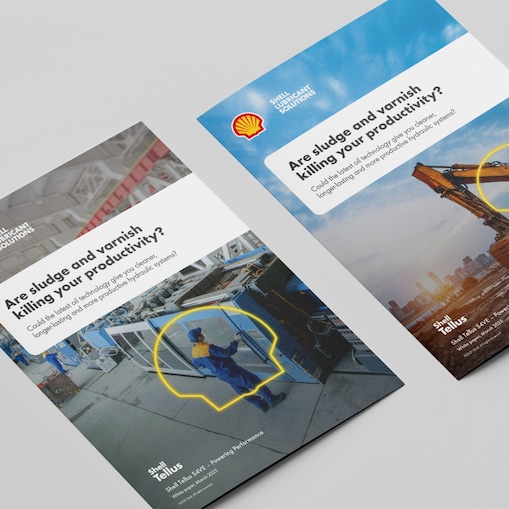
Efficiency without compromise
Gas-to-liquids (GTL) technology enables us to create Shell Tellus S4 VE with lower density (high mechanical efficiency) than conventional fluids. It also releases air rapidly to maintain its volumetric efficiency (ability to transmit power efficiently rather than absorb energy by changing volume by compressing air bubbles). Being lighter makes it easier to pump for up to 5% greater energy efficiency1/lower operating emissions10 for lower fuel/power costs.
However, efficiency is only one key feature. Shell Tellus S4 VE also exceeds the latest industry standards for oil life, wear protection (by up to 5 times4) and system efficiency, and outperforms competitor oils, including forming 15 times less sludge than a zinc-free synthetic fluid.5
Its extreme durability helps to double the oil-drain interval2 for lower oil consumption and planned oil changes, and reduce unplanned downtime by preventing sludge, varnish and wear to improve productivity by up to 6%9.
Together, the potential to reduce fuel/power costs and increase productivity can lower the total cost of owning hydraulic equipment by up to 7%.3
Explore the main features and benefits of Shell Tellus S4 VE
Read the transcript
Read the transcript
Title: Shell Tellus The Conversation Lo Res Master
Duration: 3:50 minutes
Description:
Shell’s Louise Thompson meets a potential new client and introduces the new Shell Tellus S4 VE, a hydraulic GTL based fluid, and all its benefits.
Shell Tellus The Conversation Lo Res Master Transcript
[Background music plays]
Upbeat instrumental music with synthesised effects
[Video footage]
White background with superimposed text as displayed below.
[Text displays]
SHELL TELLUS S4 VE
Shell’s Louise Thompson meets a potential new client
FROM THE PRODUCER
[Video footage]
Footage of a bucket wheel excavator digging into the earth. Change back to white background with superimposed text as displayed below.
[Text displays]
OF
THE
WORLD’S
No. 1
HYDRAULIC OIL
[Video footage]
Wide-angled shot panning around an excavator, low mountains in the background. Change back to white background with superimposed text as displayed below.
[Text displays]
COMES
A BRAND NEW PRODUCT
BRAND
NEW
[Video footage]
Time-lapse footage of a robotic machine in a warehouse picking up large bricks, turning and then depositing them on a conveyer belt. Change back to white background with superimposed text as displayed below.
[Text displays]
WITH REMARKABLE BENEFITS
[Video footage]
Exterior shot of a red brick building with many windows, a tree in the foreground.
Interview with Louise Thompson and Client
[Video footage]
Louise Thompson and an unidentified male client sit at a desk in an office setting and begin their conversation.
Client
We’re not a big business, we have tight budgets and we’re trying to make savings, not just on the lubricant but also on the repair and maintenance costs for the equipment.
Louise Thompson
Okay, it’s interesting you say that actually because I’ve got something that I think really could help you with that.
[Video footage]
Reverse-angled view of Louise and the client as Louise taps the screen of a tablet on the table in front of them. Close-up of the screen, displaying a white background with black text centred reading Tellus S4 VE, followed by animation of a grey container with Tellus S4 VE.
Louise Thompson
We’re just about to launch a new hydraulic fluid, Shell Tellus S4 VE.
[Video footage]
Image of the Tellus S4 VE container fades to white. Change to aerial shot of a bucket wheel excavator digging into the earth.
[On-screen Graphic]
Bottom left, a yellow square appears. Inside it, a grey circle with a graphic of a mining truck and text at the top reading Mining.
[Video footage]
Change to shot of several excavators digging into the earth.
[On-screen Graphic]
Top left, a yellow square appears. Inside it, a grey circle with a graphic of an excavator and text at the top reading Construction.
[Video footage]
Change to shot of a female worker wearing a protective helmet tapping on a display by a machine, then grabbing a door handle and pulling it towards her.
[On-screen Graphic]
Bottom right, a yellow square appears. Inside it, a grey circle with a graphic of a factory and text at the top reading Factory Applications.
[Video footage]
Change to time-lapse footage of a night-time port as containers are being loaded onto a cargo ship.
[On-screen Graphic]
Top right, a yellow square appears. Inside it, a grey circle with a graphic of a weight and text at the top reading High Load.
[Video footage]
Change to still frame of a bearded man smiling, superimposed snow falling.
[On-screen Graphic]
Bottom right, a yellow square appears. Inside it, a grey circle with a graphic of a thermometer with dropping mercury and a snowflake. Text at the top reads Extreme temperatures. The mercury in the thermometer then rises, the snowflake disappears and is replaced by a sun.
[Video footage]
Change to close-up of an excavator bucket filled with earth. Gridded lines are superimposed on the left half of the screen.
[On-screen Graphic]
Bottom right, a yellow square appears. Inside it, a grey circle with a graphic of a clock with three arrows, text in the middle reading 24/7, and text at the bottom reading Long life.
[Video footage]
Louise’s finger comes into view and taps the screen to pause the video. Pause graphic appears centre-screen. Change back to interview footage of Louise and the client.
Louise Thompson
We’ve got some field trials underway at the moment and the results are looking really promising.
Client
What sort of equipment? Is it mobile? Because that’s very relevant for us.
Louise Thompson
Absolutely, the same kit that you’ve got. If you look here, you can see.
[Video footage]
Reverse-angled shot of Louise and the client as Louise taps the screen of the tablet again. Close-up of the screen displaying a white background with centred black text reading Tellus S4 VE Field test results. Change to close-up of the tablet now displaying a split-screen of two excavators at work. On the left, an excavator using mineral oil, on the right an excavator using Tellus S4 VE. Underneath each one a graphic displays the fuel usage. Centred, a timer counting up showing the duration.
Louise Thompson
We’ve got two pieces of kit, identical, running side by side, in the same operating conditions.
[Video footage]
Change to white background with superimposed text as displayed below.
[Text displays]
EXCELLENT ENERGY EFFICIENCY
[Video footage]
Close-up of an excavator bucket digging in the earth. Close-up of the excavator arm turning. Wide-angled view of the excavator at work as it dumps the earth onto a truck, then spins back around. Change to white background with superimposed text as displayed below.
[Text displays]
AN IMPROVEMENT OF UP TO
6%
IN HYDRAULIC SYSTEM PRODUCTIVITY
[Video footage]
Change back to interview footage of Louise and the client.
Client
That’s impressive. So, how do you manage that?
Louise Thompson
Part of it comes from the fact that the product’s formulated using a GTL base oil.
Client
GTL?
Louise Thompson
Gas to liquid. Let me show you.
[Video footage]
Close-up of the client writing notes in a notebook. Change back to interview footage as Louise continues explaining.
Louise Thompson
So it’s a new kind of base oil that’s made out of natural gas. It’s extremely high quality.
[Animated sequence]
Animation of the GTL process. Green hydrocarbons float in a tank, then flow through a pipe into another tank filled with yellow rods. Underneath, water flows through different pipes into the tank.
[Text displays]
GTL Products
[Voiceover]
GTL products are colourless, odourless liquid hydrocarbons.
[Animated sequence]
Animation of green balls representing hydrocarbons.
[Text displays]
COLOURLESS, ODOURLESS LIQUID HYDROCARBONS
[Voiceover]
They have very low levels of impurities.
[Animated sequence]
Animation of a flask filled with a clear liquid.
[Text displays]
VERY LOW LEVELS OF IMPURITIES
[Voiceover]
And give hydraulic oils unique benefits.
[Video footage]
Night-time, time-lapse footage of cargo being loaded into a plane at an airport.
[Text displays]
UNIQUE BENEFITS
[Voiceover]
Extending drain intervals and improving energy efficiency.
[Video footage]
Time-lapse footage of containers being moved around at a port.
[Text displays]
INCLUDING EXTENDED DRAIN INTERVALS
[Video footage]
Aerial time-lapse footage of excavators at work on a site. Change back to interview footage of Louise and the client.
Client
Drain cycles is something we’re looking at. That’s an important issue for us.
Louise Thompson
What sort of oil drain intervals do you get at the moment? Around 4,000 hours, something like that?
Client
Yes, that would be about right.
Louise Thompson
Well, with the new Shell Tellus S4 VE, using the industry testing we’ve done so far, we’ve seen results up to 10,000 hours.
[Video footage]
Change to white background with superimposed text as displayed below.
[Text displays]
UP TO 9996 HOURS
UP TO 9997 HOURS
UP TO 9998 HOURS
UP TO 9999 HOURS
UP TO 10,000 HOURS
[Video footage]
Aerial, night-time, time-lapse footage of construction underway at an urban location. Change to low-angled shot of a drill truck driving down a dirt road. Change to wide-angled shot of an excavator digging up earth beside a truck. Change to close-up of the hydraulics of an excavator. Change to close-up of the rear wheels of a truck in snowy conditions. Change to wide-angled shot of an ice plough clearing snow off of tarmac. Change back to interview footage of Louise and the client.
Louise Thompson
The cold start isn’t a problem, and the viscosity index means that it can still protect even at the higher temperatures.
Client
So, one product for all seasons?
Louise Thompson
Well, unless you’re working in the Arctic, yes.
[Animated sequence]
Animated thermometer with Celsius reading on the left, Fahrenheit on the right. The mercury in the thermometer drops.
[Video footage]
Footage of two mining trucks driving past each other at a site. Change to white background with superimposed text as displayed below.
[Text displays]
ADDITIONAL BENEFITS
PRECISION
[Video footage]
Footage of products on a conveyer belt, a row of robots on either side. Change to different robots assembling products on a conveyer belt. Change to white background with superimposed text as displayed below.
[Text displays]
SMOOTH MOTION
[Video footage]
Panning shot of an excavator digging a trench in the earth, low mountains in the background. Change to white background with superimposed text as displayed below.
[Text displays]
CLEAN RUNNING
[Video footage]
Close-up of a pair of hands pouring lubricant into a beaker in a laboratory setting. Change back to interview footage of Louise and the client.
Louise Thompson
It is a premium product, so I’ll be very upfront, it is going to have a slightly higher purchase cost. But if you think what it will deliver in terms of energy saving, and the oil will last a lot longer, and if you’re not having to take the kit out of service, you’re also increasing productivity.
[Text displays]
ENERGY EFFICIENT
LONGER LASTING
INCREASED PRODUCTIVITY
Louise Thompson
So, add all that together, and a little extra cost on the hydraulic fluid will more than pay for itself.
Client
So, how do we take this forward?
Louise Thompson
I can get one of my technical colleagues to come, have a look at your fleet and your operating conditions to come up with an estimate around what the cost saving could actually be for your company.
Client
So you’d tailor it specifically for our business?
Louise Thompson
Indeed.
Client
That sounds good. We should set something up.
[Video footage]
Change to white background with superimposed text as displayed below.
[Text displays]
LOWER
YOUR TOTAL COST
OF OWNERSHIP
[Video footage]
Close-up of machine hydraulics. Change to wide-angled shot of several hydraulic earth drills at work on a site. Change to close-up of one of the hydraulic drills piercing into the earth. Change to close-up of the hydraulics on the arm of an excavator. Change to panning shot of a parked excavator, its bucket resting on the ground as night sets in. To the left, floodlights. To the right, two oil tanks. Change to white background with superimposed text as displayed below.
[Text displays]
SHELL LUBRICANTS - TOGETHER ANYTHING IS POSSIBLE
[Audio]
Shell jingle
[Graphic]
Shell Pecten logo centred on a white background
[Text displays]
© Shell International 2019
Frequently asked questions
From performance to sustainability, get the answers to your most pressing questions around the Shell Tellus family of hydraulic oils.
Disclaimers
1. Relates to the hydraulic system. Compared with a conventional mineral oil fluid in standard hydraulic applications under controlled conditions. Claims are based on test results in accordance with applicable industry standards, Shell protocols and Shell methodology. Results may vary based on operating conditions and equipment. No guarantees are provided.
2. Compared to conventional GII mineral oil
3. Based on a 5% energy efficiency improvement and 2 times longer oil-drain interval related to moving from a conventional GII mineral oil to Shell Tellus S4 VE 32.
4. Danfoss Vickers 35VQ25 vane pump test (ATS373).
5. High-temperature Indiana stirring oxidation test (ISOT) (JIS K2514). The test promotes the oxidation by blowing dry air at 165.5°C in the presence of copper and iron coils. After 48 and 96 hours, oil samples are forced through a paper filter to examine the sludge buildup. Measured using industry standard, Shell proprietary and internal competitor benchmarking tests. Actual effects and benefits may vary. No guarantees provided. VG 46, based on Shell internal competitor testing.
6. Air release test (ASTM D3427). A fixed quantity of compressed air is blown through the test oil for a fixed time. The time taken for the finely dispersed air to release from the oil such that the final density of the oil is 99.8% of the original density is measured as the air release time. Measured using industry standard, Shell proprietary and internal competitor benchmarking tests. Actual effects and benefits may vary. No guarantees provided. VG 46.
7. Relates to the hydraulic system. Compared with a conventional mineral oil fluid in standard hydraulic applications under controlled conditions. Claims are based on test results in accordance with applicable industry standards, Shell protocols and Shell methodology. Results may vary based on operating conditions and equipment. No guarantees are provided. See later slide.
8. Compared to a competitor mineral oil. ASTM D2877 modified, Stick–slip is a dynamic cyclic process where two mating surfaces oscillate between a stick phase and a slip phase. This test is used to determine the dynamic and static coefficients of friction and is a measure of the resistance of one surface to being dragged across another.
9. Based on tests run at 2,200 rpm with aeration (with all fluids were ISO VG 46) conducted by the Milwaukee School of Engineering Fluid Power Institute. Test methodology presented at the ASME/BATH 2017 Symposium on Fluid Power and Motion Control. The productivity relates to the hydraulic pump volumetric efficiency of a formulation of Shell Tellus S4 VE when compared with a conventional, mineral oil fluid in standard hydraulic bench testing under controlled conditions. The claim is based on test results in accordance with applicable industry standards and Shell protocols and methodologies. Results may vary based on operating conditions and equipment.
10. The emissions reduction stated relate to the customer’s activities influenced by lubricant usage only (e.g., lubricant or fuel consumption), which represents a small part of the overall customer’s generated emissions. Emission reduction have been estimated based on Shell Tellus S4 VE having double the oil-drain interval of Shell Tellus S2 MX. They do not represent a guarantee that savings will be achieved. Actual savings may be higher or lower than this calculation. Please note, an average carbon footprint has been generated using carbon footprint profiles for an applicable product family. In general, for Product Carbon Footprints: CO₂, CH₄, N₂O emissions are jointly referred to as “CO₂ equivalent” (CO₂e) emissions typically associated with the raw material extraction, production, distribution, use and end of life of the product. Absolute values may not be comparable against carbon footprint calculations for similar products by other manufacturers recognising the differences in methodology and underlying assumptions. Currently there are no product category rules for the calculation of lubricant carbon footprints and assumptions around emission factors can differ depending on databases used. Carbon footprint calculations may only be disclosed to third parties upon written approval by Shell.
Shell does not make any representation or warranty, whether expressed or implied, regarding (1) the accuracy, completeness, reliability or relevance of the emission reduction calculation, (2) any marketing, reporting or other claims, Partner may make based on the calculation. Shell and its affiliated companies are not liable in any way for any loss, damages or expenses arising out of or in connection with the use of the emission reduction calculations by Partner.