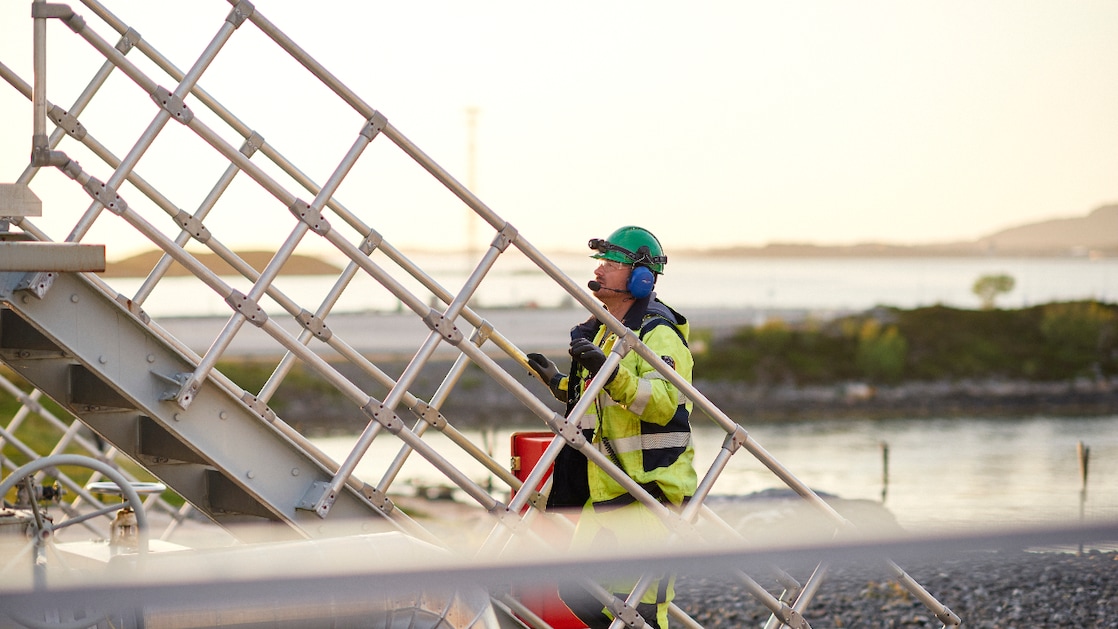
Shell to test carbon capture technology at Technology Centre Mongstad in Norway
Shell Catalysts & Technologies has entered an agreement with Technology Centre Mongstad (TCM) to test a technology for capturing carbon dioxide (CO2). The test will start in January 2023 and will last for five months.
By Shell Catalysts & Technologies on Dec 14, 2022
Shell Catalysts & Technologies offers two leading carbon capture technologies: The CANSOLV CO2 Capture System and ADIP ULTRA. The test at TCM will involve a proprietary amine-based solvent that is part of the CANSOLV CO2 technology. It is expected that this will be then qualified for delivery to carbon capture and storage (CCS) projects around the world.
Shell Catalysts & Technologies has previously carried out two test campaigns at TCM, in 2014–15 and 2016. One of its technologies has been chosen for Hafslund Oslo Celsio’s full-scale capture plant at Klemetsrud, Oslo, Norway. This project is part of the large Norwegian full-chain CCS project named Longship and, following the planned start-up in 2026, 400,000 tons of CO2 emitted by Celsio each year will be captured and permanently stored in the Norwegian shelf.
Nick Flinn, VP Decarbonisation Technologies, Shell Catalysts & Technologies, says, “We are very pleased to continue using TCM’s excellent facilities and expertise. The purpose of the next campaign is to make a final test and verification of this upgraded solvent that will be introduced to the market.”
A contribution to realising carbon neutrality
Nick emphasises that Shell is strengthening its efforts in the energy transition field to help realise a carbon-neutral world on a global scale. He says, “For many years, Shell has strived to minimise CO2 emissions utilising its cutting-edge technologies. Today, we possess reliable and economically feasible carbon-capture technologies, supported by many years of research and development activity, and a robust track record of commercial plants around the world.”
Nick continues, “TCM’s abundant knowledge and experience in environmental impact assessment, and its state-of-the-art testing environment, will further raise the level of our CO2 capture technologies, enabling us to accelerate business expansion, especially in the vital UK and European markets. We expect that the new testing programme will contribute to realising carbon neutrality in the years ahead.”
TCM relevant for many years to come
Muhammad Ismail Shah, Managing Director at TCM, also welcomes the collaboration. He says, “It is very satisfying that a leading capture technology developer such as Shell Catalysts & Technologies has, again, chosen TCM as the arena for its carbon capture tests. Our staff are ready to ensure effective execution of the tests, and to provide expert advice throughout the campaign.”
Muhammad highlights the importance of an experienced capture technology supplier returning to TCM to run a campaign: “This shows that even the mature amine technology is still developing, and that suppliers are continuously making improvements and innovations to have better efficiency and to reduce costs when using the technology in a full-scale plant. Based on this, we believe that TCM will be relevant as an arena for testing both mature and completely new technologies for many years to come.”
“We will now make all necessary preparations for the upcoming campaign for Shell and look forward to welcoming their team,” Muhammad concludes.
For further details, please contact:
Shell Catalysts & Technologies
Justin Swain
Strategic Marketing Manager
Tel.: +44 207 934 4113
Email: justin.swain@shell.com
TCM
Freddy Garcia
Business Development Manager
Tel.: +47 477 13 326
Email: freddy.garcia@tcmda.com
NOTES TO EDITORS
About TCM
TCM is situated on the west coast of Norway. Since its establishment in 2012, a total of 17 test campaigns for CO2 capture have been conducted at the facility. It uses two different live industrial flue-gas sources from Equinor’s refinery at Mongstad that have different CO2 contents.
The test facilities for CO2 capture consist of an amine plant and a chilled ammonia plant, as well as an area for emerging capture technologies. Both the amine and the chilled ammonia plants capture CO2 by means of a liquid chemical, known as a solvent, consisting of a mix of water and either amine- or ammonia-based solutions. The site for emerging technologies, started in 2021, is used for testing technologies such as membranes, adsorbents (solid materials that bind CO2) and hybrid technologies.
The amine plant is a unit with generic capabilities developed to serve as a demonstrator for solvent-based capture technologies. It has so far been used by six technology developers in addition to performing scientific testing using non-proprietary solvents (monoethanolamine and CESAR 1) for helping developments in the global carbon capture community.
During the last ten years, TCM, equipped with the world’s largest-scale CO2-capture testing facilities, has provided users with profound knowledge, online analysis and advanced analytical technologies relating to the trace components of gas emissions. Its data, accumulated through testing, exceed 1,000 categories and contribute significantly to the commercialisation of CO2 capture technologies.
About Shell Catalysts & Technologies
Shell Catalysts & Technologies, part of Shell, is a leading technology licensor and brings owner–operator–innovator capabilities to the market. It has more than 1,200 references for gas processing technologies at gas plants and refineries worldwide.
It supports Shell and non-Shell businesses by working with them to co-create integrated, customised solutions comprising licensed technologies, refining and petrochemical catalysts, and technical services.
It operates across the energy value chain: from upstream, gas processing and liquefied natural gas through to downstream refining and petrochemicals.
For more information, visit www.shell.com/ct.
Shell Catalysts & Technologies is a network of independent technology companies including Shell Global Solutions, all within the Shell Group. In this material, the expressions “Shell Catalysts & Technologies”, “the Shell Group” and “Shell Global Solutions” are sometimes used for convenience where reference is made to these companies in general, or where no useful purpose is served by identifying a particular company.
The information contained in this material is intended to be general in nature and must not be relied on as specific advice in connection with any decisions you may make. The companies within the Shell Group are not liable for any action you may take as a result of you relying on such material or for any loss or damage suffered by you as a result of you taking this action. Furthermore, these materials do not in any way constitute an offer to provide specific services. Some services may not be available in certain countries or political subdivisions thereof.
Copyright © 2022 Shell Global Solutions International BV. All rights reserved. No part of this publication may be reproduced or transmitted in any form or by any means, electronic or mechanical including by photocopy, recording or information storage and retrieval system, without permission in writing from Shell Global Solutions International BV.
Legal Disclaimer
Legal Disclaimer
The companies in which Shell plc directly and indirectly owns investments are separate legal entities. In this content “Shell”, “Shell Group” and “Group” are sometimes used for convenience where references are made to Shell plc and its subsidiaries in general. Likewise, the words “we”, “us” and “our” are also used to refer to Shell plc and its subsidiaries in general or to those who work for them. These terms are also used where no useful purpose is served by identifying the particular entity or entities. ‘‘Subsidiaries’’, “Shell subsidiaries” and “Shell companies” as used in this content refer to entities over which Shell plc either directly or indirectly has control. Entities and unincorporated arrangements over which Shell has joint control are generally referred to as “joint ventures” and “joint operations”, respectively. “Joint ventures” and “joint operations” are collectively referred to as “joint arrangements”. Entities over which Shell has significant influence but neither control nor joint control are referred to as “associates”. The term “Shell interest” is used for convenience to indicate the direct and/or indirect ownership interest held by Shell in an entity or unincorporated joint arrangement, after exclusion of all third-party interest.
This content contains forward-looking statements (within the meaning of the U.S. Private Securities Litigation Reform Act of 1995) concerning the financial condition, results of operations and businesses of Shell. All statements other than statements of historical fact are, or may be deemed to be, forward-looking statements. Forward-looking statements are statements of future expectations that are based on management’s current expectations and assumptions and involve known and unknown risks and uncertainties that could cause actual results, performance or events to differ materially from those expressed or implied in these statements. Forward-looking statements include, among other things, statements concerning the potential exposure of Shell to market risks and statements expressing management’s expectations, beliefs, estimates, forecasts, projections and assumptions. These forward-looking statements are identified by their use of terms and phrases such as “aim”, “ambition”, ‘‘anticipate’’, ‘‘believe’’, ‘‘could’’, ‘‘estimate’’, ‘‘expect’’, ‘‘goals’’, ‘‘intend’’, ‘‘may’’, “milestones”, ‘‘objectives’’, ‘‘outlook’’, ‘‘plan’’, ‘‘probably’’, ‘‘project’’, ‘‘risks’’, “schedule”, ‘‘seek’’, ‘‘should’’, ‘‘target’’, ‘‘will’’ and similar terms and phrases. There are a number of factors that could affect the future operations of Shell and could cause those results to differ materially from those expressed in the forward-looking statements included in this content, including (without limitation): (a) price fluctuations in crude oil and natural gas; (b) changes in demand for Shell’s products; (c) currency fluctuations; (d) drilling and production results; (e) reserves estimates; (f) loss of market share and industry competition; (g) environmental and physical risks; (h) risks associated with the identification of suitable potential acquisition properties and targets, and successful negotiation and completion of such transactions; (i) the risk of doing business in developing countries and countries subject to international sanctions; (j) legislative, judicial, fiscal and regulatory developments including regulatory measures addressing climate change; (k) economic and financial market conditions in various countries and regions; (l) political risks, including the risks of expropriation and renegotiation of the terms of contracts with governmental entities, delays or advancements in the approval of projects and delays in the reimbursement for shared costs; (m) risks associated with the impact of pandemics, such as the COVID-19 (coronavirus) outbreak; and (n) changes in trading conditions. No assurance is provided that future dividend payments will match or exceed previous dividend payments. All forward-looking statements contained in this content are expressly qualified in their entirety by the cautionary statements contained or referred to in this section. Readers should not place undue reliance on forward-looking statements. Additional risk factors that may affect future results are contained in Shell plc’s Form 20-F for the year ended December 31, 2021 (available at
www.shell.com/investor and www.sec.gov). These risk factors also expressly qualify all forward-looking statements contained in this content and should be considered by the reader. Each forward-looking statement speaks only as of the date of this content, 20 May 2022. Neither Shell plc nor any of its subsidiaries undertake any obligation to publicly update or revise any forward-looking statement as a result of new information, future events or other information. In light of these risks, results could differ materially from those stated, implied or inferred from the forward-looking statements contained in this content.
Also, in this content we may refer to Shell’s “Net Carbon Footprint” or “Net Carbon Intensity”, which include Shell’s carbon emissions from the production of our energy products, our suppliers’ carbon emissions in supplying energy for that production and our customers’ carbon emissions associated with their use of the energy products we sell. Shell only controls its own emissions. The use of the term Shell’s “Net Carbon Footprint” or “Net Carbon Intensity” are for convenience only and not intended to suggest these emissions are those of Shell plc or its subsidiaries.
Shell’s operating plan, outlook and budgets are forecasted for a ten-year period and are updated every year. They reflect the current economic environment and what we can reasonably expect to see over the next ten years. Accordingly, they reflect our Scope 1, Scope 2 and Net Carbon Footprint (NCF) targets over the next ten years. However, Shell’s operating plans cannot reflect our 2050 net-zero emissions target and 2035 NCF target, as these targets are currently outside our planning period. In the future, as society moves towards net-zero emissions, we expect Shell’s operating plans to reflect this movement. However, if society is not net zero in 2050, as of today, there would be significant risk that Shell may not meet this target.
This content may contain certain forward-looking non-GAAP measures such as cash capital expenditure and divestments. We are unable to provide a reconciliation of these forward-looking Non-GAAP measures to the most comparable GAAP financial measures because certain information needed to reconcile those Non-GAAP measures to the most comparable GAAP financial measures is dependent on future events some of which are outside the control of Shell, such as oil and gas prices, interest rates and exchange rates. Moreover, estimating such GAAP measures with the required precision necessary to provide a meaningful reconciliation is extremely difficult and could not be accomplished without unreasonable effort. Non-GAAP measures in respect of future periods which cannot be reconciled to the most comparable GAAP financial measure are calculated in a manner which is consistent with the accounting policies applied in Shell plc’s consolidated financial statements.
The contents of websites referred to in this content do not form part of this content.
We may have used certain terms, such as resources, in this content that the United States Securities and Exchange Commission (SEC) strictly prohibits us from including in our filings with the SEC. Investors are urged to consider closely the disclosure in our Form 20-F, File No 1-32575, available on the SEC website

