
Greater Efficiency in Refuelling
When it comes to refuelling, there’s always the threat of delays and inefficiencies negatively impacting on operations, punctuality and profitability. That’s why Shell Aviation has designed a suite of digital refuelling solutions that share a common goal - improved efficiency, leading to time and cost savings.
SkyPad Data Exchange
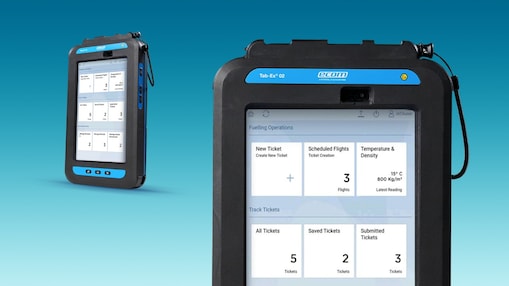
Based on the SkyPad tablet, used by Shell’s apron operators, SkyPad Data Exchange creates a paperless, end-to-end refuelling process. Utilising an API (Application Programme Interface), developed to IATA data fuel standards, SkyPad Data Exchange enables Shell and airline systems to share data. By connecting pilots with operators and back-office functions it allows them to electronically track, update and share information in real-time. From the initial fuel order and fueling activity, to invoicing and reconciliation, this direct exchange of data between SkyPad Data Exchange and an airline’s own system brings the following benefits. You can also hear directly from our airline customers.
Our drive to provide airline customers with greater efficiency is centred around SkyPad Data Exchange, a fully digitised refuelling solution, harnessing technology to maximise efficiency and accuracy across all aspects of the refuelling process.
- Improved data accuracy and reduced admin
Currently, paper-based systems and manual handoffs on the apron mean it’s a matter of when, not if, refuelling errors occur. A single miswritten number can take hours to rectify where minutes cost money. SkyPad virtually eliminates the potential for human error on the apron, while the additional functionality of SkyPad Data Exchange reduces the potential for data errors throughout the entire refuelling process. - Avoid delays with a touchless apron
Refuelling processes based on manual sign off between pilot and refueler can inevitably cause delays. Pilots waste valuable time finding the refueler to update fuel volumes and refuelers then need to find the pilot to manually sign off final fuel amounts. By connecting pilots and refuelers in real-time, SkyPad Data Exchange removes the need for the pilot to leave the cockpit and can save between 8 to 13 minutes in refuelling time1.
Less Downtime, More Uptime with Shell SkyPad Data Exchange
Read the transcript
Read the transcript
Title: Less Downtime, More Uptime with Shell SkyPad Data Exchange
Duration: 1.31 minutes
Description:
Shell’s introduction of a product called SkyPad Data Exchange, which enables touch-less communication between the operator and the pilot in real-time.
Shell SkyPad Data Exchange Video Transcript
[Background music plays]
Bright, uplifting music
[Animated sequence]
The Shell SkyPad Data Exchange with Shell™ pecten logo appears, then fades. Airplanes appear in a blue sky with clouds.
(it is monologue only)
[Voice over]
Less downtime – more uptime.
[Animated sequence]
Everything disappears. Sandglass appears, and is spun upside down with a flick of a finger.
[Text displays]
Time & effort
[Voice over]
How much time and effort could you potentially save by digitalising your refuelling process?
[Animated sequence]
Everything disappears. Hands struggling to use various controllers appear. Multiple people have to get the data manually and input in systems.
(it is monologue only)
[Voice over]
Current manual processes bring inefficiencies in refuelling.
[Animated sequence]
Zoom into one of the controllers. Text appears, controllers slowly move.
[Text displays]
Avoid delays
[Voice over]
Data entry into separate systems increases the workload for airlines.
[Animated sequence]
View slides to another controller
[Text displays]
Idle time
[Voice over]
manual hand-offs result in idle time,
[Animated sequence]
View slides down to the last controller which breaks down.
[Text displays]
Errors
[Voice over]
and paper-based systems create plenty of opportunities for errors
[Animated sequence]
Transition into the next scene.
(it is monologue only)
[Voice over]
Overcoming these inefficiencies could save
[Animated sequence]
Clock icon appears. 8 and 13 minutes ranges get highlighted.
[Text displays]
8 to 13 minutes*
[Voice over]
an average of 8 to 13 minutes of refuelling turnaround time,
[Animated sequence]
Everything disappears. A few people icons appear. One and a half icons get highlighted.
[Text displays]
Free up staff
[Voice over]
Clears up staff to focus on more important tasks.
[Animated sequence]
Everything disappears. Stylised bars appear. Number estimation will stop once “90%” appears.
[Text displays]
90%*
[Voice over]
And improves data accuracy by 90%.
[Animated sequence]
Scene slides into the Shell truck refuelling the plane.
(it is monologue only)
[Voice over]
SkyPad Data Exchange is an end-to-end digital solution with the potential to transform refuelling operations.
[Animated sequence]
A tablet slides in. Pilot icon appears instead of the title and connects to various services icons, e.g. refuelling operator, plane, invoices, stats etc.
(it is monologue only)
[Voice over]
This solution is connecting your pilot to the fuel operative digitally, creating a truly paperless apron.
[Animated sequence]
A few toggle switch icons appear on the tablet screen instead of services icons. Shows pilot and operator icon while chat box icons appear on the side.
(it is monologue only)
[Voice over]
SkyPad Data Exchange adheres to IATA data fuel standards while enabling touch-less real-time communication
[Animated sequence]
Abstract online chat appears on the tablet screen instead of the toggle switches.
(it is monologue only)
[Voice over]
Increasing data accuracy and efficiency for your airline.
[Animated sequence]
Show operator icon and fuelling estimation and abstract icons.
(it is monologue only)
[Voice over]
Fuel figures are automatically tracked, updated and exchanged
[Animated sequence]
Animated transition into the next scene.
(it is monologue only)
[Voice over]
Shell SkyPad Data Exchange brings:
[Animated sequence]
Everything disappears. A few chat message icons and text
[Text displays]
Real-time connection
[Voice over]
An automated end-to-end touchless refuelling process that maximises efficiency
[Animated sequence]
A few chat message icons and text stays with check marks.
[Text displays]
Maximized efficiency.
[Voice over]
that maximises efficiency
[Animated sequence]
Everything disappears. Show invoice and fuel order document icons.
[Text displays]
Improved invoice accuracy
[Voice over]
And improves invoice accuracy
[Animated sequence]
Shell SkyPad Data Exchange title appears on the tablet screen.
[Text displays]
SkyPad Data Exchange
[Voice over]
Shell SkyPad Data Exchange is further evidence of Shell’s commitment to operational excellence
[Animated sequence]
Zoom out. A character holds the tablet and looks towards the parked airplane. Character taps the tablet to show Shelle logo.
(it is monologue only)
[Voice over]
While bringing efficiency to the fuelling zone in the safest way possible. For less downtime and more uptime.
[Animated sequence]
Zoom out to white background with the Shell logo.
[Text displays]
Find out how you can refuel more efficiently today at:
Shell.com/business-customers/aviation/more-time-flying
[Shell mnemonic plays]
[Background music ends]
Availability
SkyPad tablets are robust and intrinsically safe due to their shockproof and waterproof design, with an operating range from +50°C to -50°C. So far SkyPad has been rolled out to 141 sites across 23 countries2. SkyPad Data Exchange is available at all locations where SkyPad is deployed and is currently being trialed by a number of major airlines around the world.
Innovative Solutions
Shell’s pursuit of operational excellence and efficiency has led to a range of other innovative refuelling solutions. On Time Performance Analytics (OTP Analytics) collects and analyses data from airline arrival, refuelling and departure times to further improve apron efficiency. Our innovation team is also currently working on exciting new technology designed to speed up the physical refuelling process and assist in reducing refuelling times. Contact us to learn more.
1 Based on observed and recorded performance by ground operators using Shell SkyPad Data Exchange at Manchester Airport in November 2019
2 Data correct as at September 2020
Disclaimer
Disclaimer
Cautionary Note
The companies in which Shell plc directly and indirectly owns investments are separate legal entities. In this content “Shell”, “Shell Group” and “Group” are sometimes used for convenience to reference Shell plc and its subsidiaries in general. Likewise, the words “we”, “us” and “our” are also used to refer to Shell plc and its subsidiaries in general or to those who work for them. These terms are also used where no useful purpose is served by identifying the particular entity or entities. ‘‘Subsidiaries’’, “Shell subsidiaries” and “Shell companies” as used in this content refer to entities over which Shell plc either directly or indirectly has control. The terms “joint venture”, “joint operations”, “joint arrangements”, and “associates” may also be used to refer to a commercial arrangement in which Shell has a direct or indirect ownership interest with one or more parties. The term “Shell interest” is used for convenience to indicate the direct and/or indirect ownership interest held by Shell in an entity or unincorporated joint arrangement, after exclusion of all third-party interest.
Forward-Looking statements
This content contains forward-looking statements (within the meaning of the U.S. Private Securities Litigation Reform Act of 1995) concerning the financial condition, results of operations and businesses of Shell. All statements other than statements of historical fact are, or may be deemed to be, forward-looking statements. Forward-looking statements are statements of future expectations that are based on management’s current expectations and assumptions, including (without limitation) those concerning Shell’s strategy and operating plans, macroeconomic conditions, future energy demand, supply and product mix, commodity prices, demand for Shell’s products, production results and reserve estimates, development, execution and management of projects, energy transition and climate change, management of safety and environmental risks, costs, cash capital expenditures, technology advancements, legislative, judicial, fiscal and regulatory developments, regional conflicts and trading conditions, and involve known and unknown risks and uncertainties that could cause actual results, performance or events to differ materially from those expressed or implied in these statements. Forward-looking statements include, among other things, statements concerning the potential exposure of Shell to market risks and statements expressing management’s expectations, beliefs, estimates, forecasts, projections and assumptions. These forward-looking statements are identified by their use of terms and phrases such as “aim”; “ambition”; ‘‘anticipate’’; “aspire”, “aspiration”, ‘‘believe’’; “commit”; “commitment”; ‘‘could’’; “desire”; ‘‘estimate’’; ‘‘expect’’; ‘‘goals’’; ‘‘intend’’; ‘‘may’’; “milestones”; ‘‘objectives’’; ‘‘outlook’’; ‘‘plan’’; ‘‘probably’’; ‘‘project’’; ‘‘risks’’; “schedule”; ‘‘seek’’; ‘‘should’’; ‘‘target’’; “vision”; ‘‘will’’; “would” and similar terms and phrases. There are a number of factors that could affect the future operations of Shell and could cause those results to differ materially from those expressed in the forward-looking statements included in this content, including (without limitation): (a) price fluctuations in crude oil and natural gas; (b) changes in demand for Shell’s products; (c) currency fluctuations; (d) drilling and production results; (e) reserves estimates; (f) loss of market share and industry competition; (g) environmental and physical risks, including climate change; (h) risks associated with the identification of suitable potential acquisition properties and targets, and successful negotiation and completion of such transactions; (i) the risk of doing business in developing countries and countries subject to international sanctions; (j) legislative, judicial, fiscal and regulatory developments including tariffs and regulatory measures addressing climate change; (k) economic and financial market conditions in various countries and regions; (l) political risks, including the risks of expropriation and renegotiation of the terms of contracts with governmental entities, delays or advancements in the approval of projects and delays in the reimbursement for shared costs; (m) risks associated with the impact of pandemics, regional conflicts, such as the Russia-Ukraine war and the conflict in the Middle East, and a significant cyber security, data privacy or IT incident; (n) the pace of the energy transition; and (o) changes in trading conditions. No assurance is provided that future dividend payments will match or exceed previous dividend payments. All forward-looking statements contained in this content are expressly qualified in their entirety by the cautionary statements contained or referred to in this section. Readers should not place undue reliance on forward-looking statements. Additional risk factors that may affect future results are contained in Shell plc’s Form 20-F for the year ended December 31, 2025 (available at www.shell.com/investors/news-and-filings/sec-filings.html and www.sec.gov). These risk factors also expressly qualify all forward-looking statements contained in this content and should be considered by the reader. Each forward-looking statement speaks only as of the date of the publication mentioned in this website. Neither Shell plc nor any of its subsidiaries undertake any obligation to publicly update or revise any forward-looking statement as a result of new information, future events or other information. In light of these risks, results could differ materially from those stated, implied or inferred from the forward-looking statements contained in this content.
Shell’s net carbon intensity and net-zero emissions target
In this content we may refer to Shell’s “net carbon intensity” (NCI), which includes Shell’s carbon emissions from the production of our energy products, our suppliers’ carbon emissions in supplying energy for that production and our customers’ carbon emissions associated with their use of the energy products we sell. Shell’s NCI also includes the emissions associated with the production and use of energy products produced by others which Shell purchases for resale. Shell only controls its own emissions. The use of the terms Shell’s “net carbon intensity” or NCI is for convenience only and not intended to suggest these emissions are those of Shell plc or its subsidiaries.
Shell’s operating plan and outlook are forecasted for a three-year period and ten-year period, respectively, and are updated every year. They reflect the current economic environment and what we can reasonably expect to see over the next three and ten years. Accordingly, the outlook reflects our combined Scope 1 and 2 target, NCI target and our oil products ambition over the next ten years. However, Shell’s operating plan and outlook cannot reflect our 2050 net-zero emissions target, as this target is outside our planning period. Such future operating plans and outlooks could include changes to our portfolio, efficiency improvements and the use of carbon capture and storage and carbon credits. In the future, as society moves towards net-zero emissions, we expect Shell’s operating plans and outlooks to reflect this movement. However, if society is not net zero in 2050, as of today, there would be significant risk that Shell may not meet this target.
The information provided above regarding Shell’s NCI and net zero emissions target are not intended, nor should they be construed as introducing, suggesting or making any claim, target or representation thereof other than what is included in the content.
Forward-Looking non-GAAP measures
This content may contain certain forward-looking non-GAAP measures such as free cash flow and underlying operating expenses. We are unable to provide a reconciliation of these forward-looking non-GAAP measures to the most comparable GAAP financial measures because certain information needed to reconcile those non-GAAP measures to the most comparable GAAP financial measures is dependent on future events some of which are outside the control of Shell, such as oil and gas prices, interest rates and exchange rates. Moreover, estimating such GAAP measures with the required precision necessary to provide a meaningful reconciliation is extremely difficult and could not be accomplished without unreasonable effort. Non-GAAP measures in respect of future periods which cannot be reconciled to the most comparable GAAP financial measure are calculated in a manner which is consistent with the accounting policies applied in Shell plc’s consolidated financial statements. These forward-looking non-GAAP measures are provided to assist readers in understanding management’s use and expectations of such measures and may not be appropriate for other purposes.
The contents of websites referred to in this content do not form part of this content.
We may have used certain terms, such as resources, in this content that the United States Securities and Exchange Commission (SEC) strictly prohibits us from including in our filings with the SEC. Investors are urged to consider closely the disclosure in our Form 20-F, File No 1-32575, available on the SEC website www.sec.gov.


Contact Us
Complete the form below to find out more about efficient refuelling solutions from Shell Aviation.